
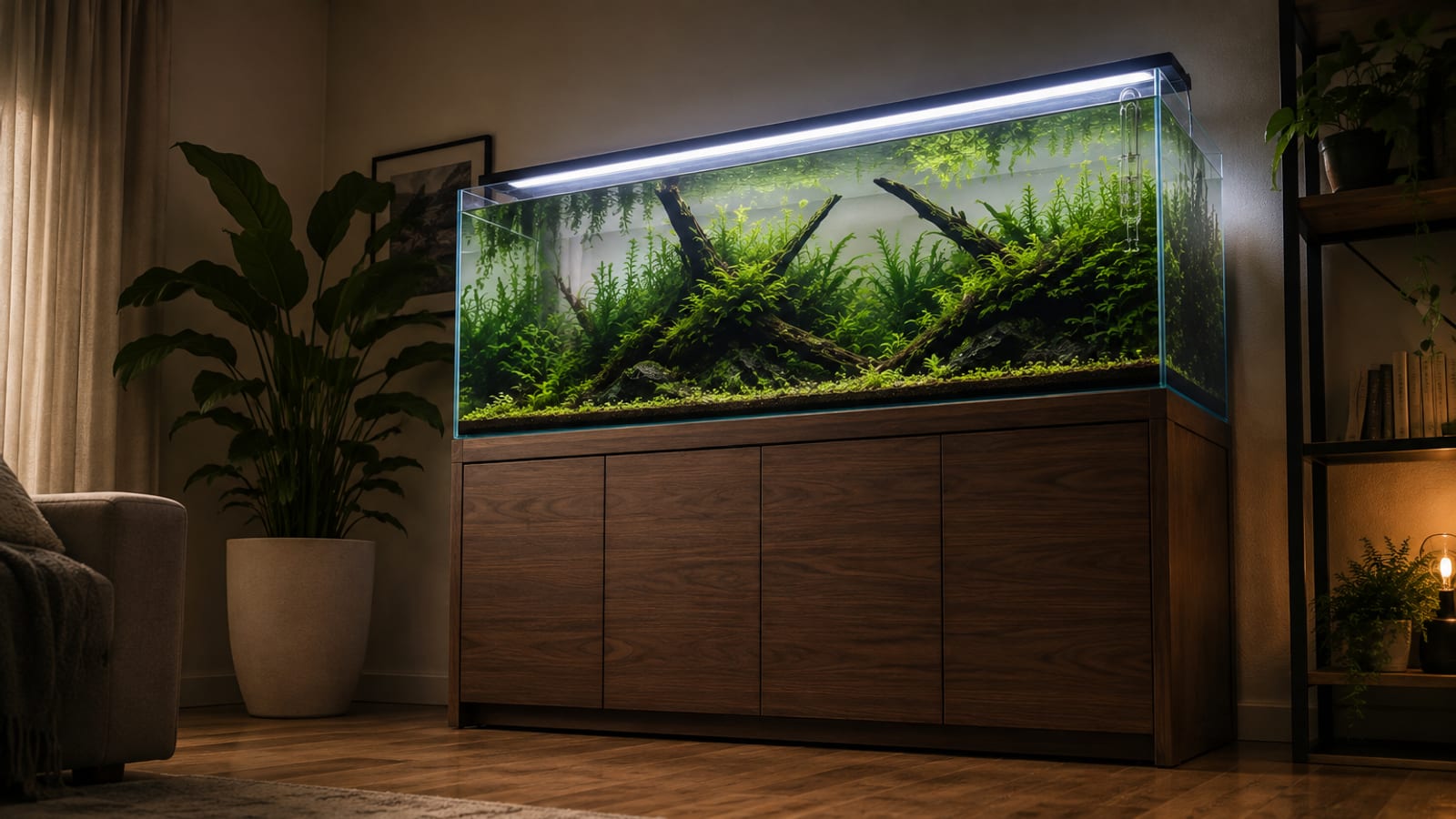
Quick Verdict
A filled 55 gallon fish tank weighs roughly 625 lb — about 460 lb of water, 78 lb of glass and 55 lb of substrate. That is concentrated on roughly four square feet, which is why the floor matters as much as the stand.
Water weighs 8.34 lb per US gallon, and that single number is most of the answer. Everything else — the glass, the substrate, the rocks — is a rounding error next to it.
A filled 55 gallon fish tank comes out around 625 lb, sitting on roughly four square feet of floor. That is more concentrated load than an upright piano.
The table above has every common size — empty weights vary by a few pounds with glass thickness and manufacturer, and it lines up closely with the size and weight chart Petco publishes. What follows is the part the table cannot tell you.
Why a fish tank weighs more than it looks
The weight itself is not unusual. Six hundred pounds is a few people standing together, and any floor holds that.
What makes an aquarium different is the footprint. A 55 gallon tank is 48 by 13 inches — about 4.3 square feet — and it never moves. Six hundred pounds spread across a room is nothing. Six hundred pounds parked permanently on four square feet is a point load, and point loads are what floors care about.
Fill it where it lives
Position the tank, level it, and only then add water. A filled tank cannot be moved, slid, or nudged straight — and trying puts twisting force on the glass seams. This is the most common way a tank that was fine for a year suddenly is not.
What your floor can take
US residential floors are designed to a 40 lb per square foot live load. Run the numbers from the table and a filled 55 gallon is around 145 lb per square foot, which looks alarming.
In practice it is usually fine, for two reasons. The rated figure is a design minimum with safety factors on top, and it assumes the load is spread over an entire room rather than concentrated — a room loaded to 40 lb/sq ft everywhere is a far heavier total than one tank.
Position is what turns "usually fine" into "fine":
- Set the tank so its long side runs perpendicular across the floor joists, spreading the load over several rather than concentrating it on one.
- Put it against or near a load-bearing wall, not in the middle of a floor span.
- Avoid the centre of a room on an upper floor — that is the point of maximum deflection.
- On a ground floor over a concrete slab, none of this matters. Put it where you like.
- If the floor already bounces noticeably when you walk across it, get someone to look before you fill anything large.
Below about 40 gallons this is not a conversation worth having. Above 75 gallons on an upper floor, it is.
The stand matters more than the floor
This surprises people: the failure you should actually worry about is not the floor giving way, it is the tank being unevenly supported.
A glass aquarium is designed to sit on a perfectly flat plane. Where the base is unsupported — a slight dip in a tabletop, a stand that has twisted, a shim under one corner — the load transfers into the silicone seams, which are strong in shear and weak in tension. Seams do not sag as a warning. They let go.
That is the reason for a purpose-built stand above 20 gallons. Not the total load. The flatness.
The floor almost never fails. The seam does, because one corner was 2 mm high.
Real volume is less than the label
One thing worth knowing when you buy salt, medication or dechlorinator by tank size: your tank does not hold its stated volume.
Substrate displaces a few gallons, the water line sits an inch or two below the rim, and rock and decor take up more. Actual water volume typically runs 10 to 15 percent under the nominal figure — a "20 gallon" tank usually holds about 17.
Weight calculations are unaffected in any way that matters, since substrate weighs roughly what the water it displaced did. Dosing calculations are not. Dose to real volume.
Detailed Comparison
| Tank | Empty | Water | Substrate | Filled total | Load per sq ft |
|---|---|---|---|---|---|
| 10 gallon | 11 lb | 83 lb | 10 lb | ~111 lb | ~65 lb |
| 20 gallon high | 25 lb | 167 lb | 20 lb | ~225 lb | ~100 lb |
| 29 gallon | 40 lb | 242 lb | 29 lb | ~330 lb | ~145 lb |
| 40 gallon breeder | 58 lb | 334 lb | 40 lb | ~458 lb | ~135 lb |
| 55 gallon | 78 lb | 459 lb | 55 lb | ~625 lb | ~145 lb |
| 75 gallon | 140 lb | 626 lb | 75 lb | ~850 lb | ~170 lb |
Frequently Asked Questions
🔗 Related Resources
Explore More:
More Reviews:
Related Articles
20 Gallon Fish Tank Setup Cost: Every Item, Priced
What a 20 gallon fish tank setup costs in 2026, item by item: about $230 on a tight budget, $400–$500 done properly with a stand, and $10 a month to run.
How to Acclimate Fish to a New Tank (Freshwater)
How to acclimate fish to a new tank: float the bag 15 minutes, add tank water every 5 minutes for 20, then net them in. Never pour the bag water in.
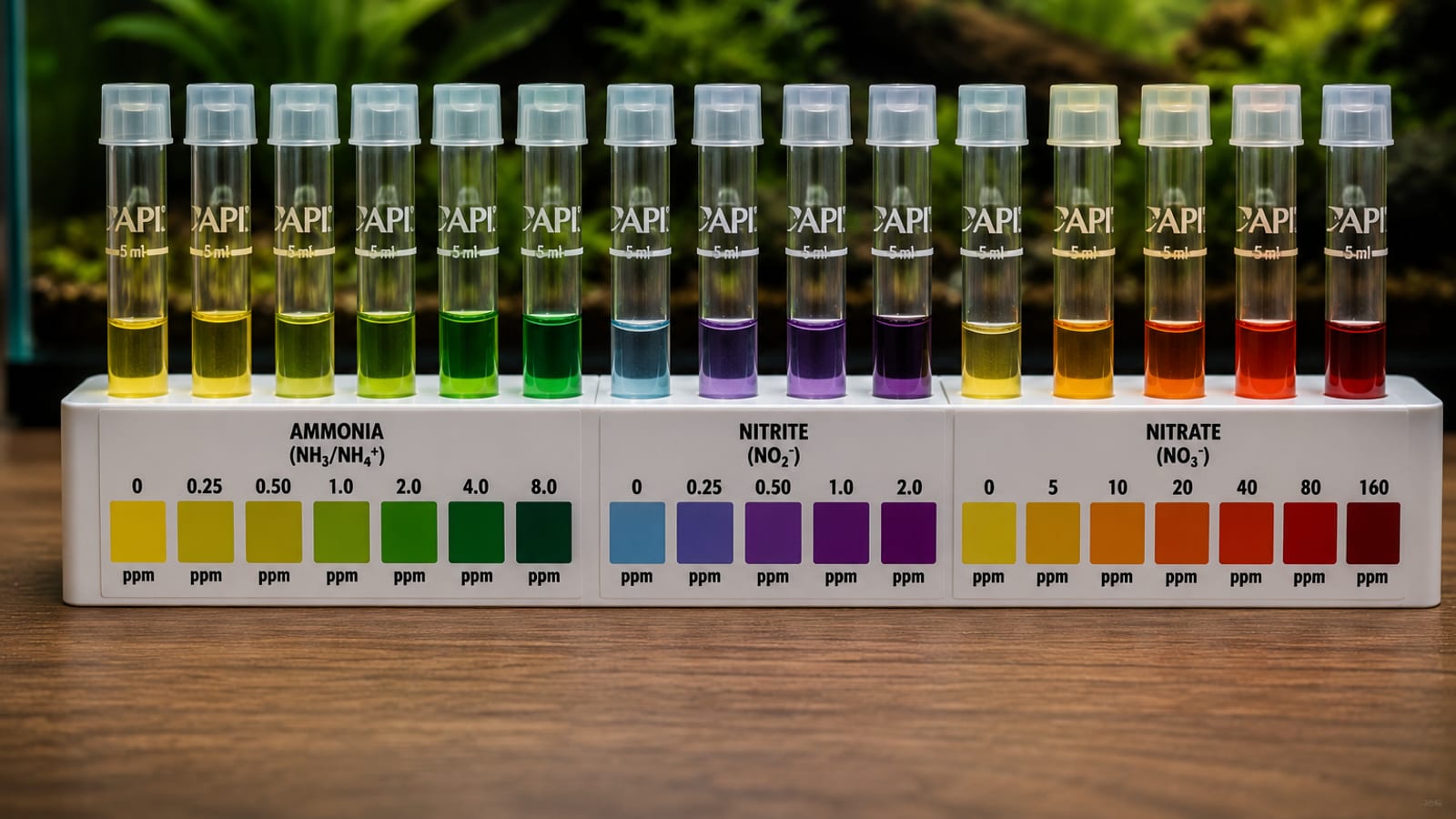
Nitrogen Cycle for Beginners: Why You Wait Weeks for Fish
Ammonia, nitrite and nitrate in plain English — how to run a fishless cycle step by step, and the one test that tells you the tank is ready for fish.