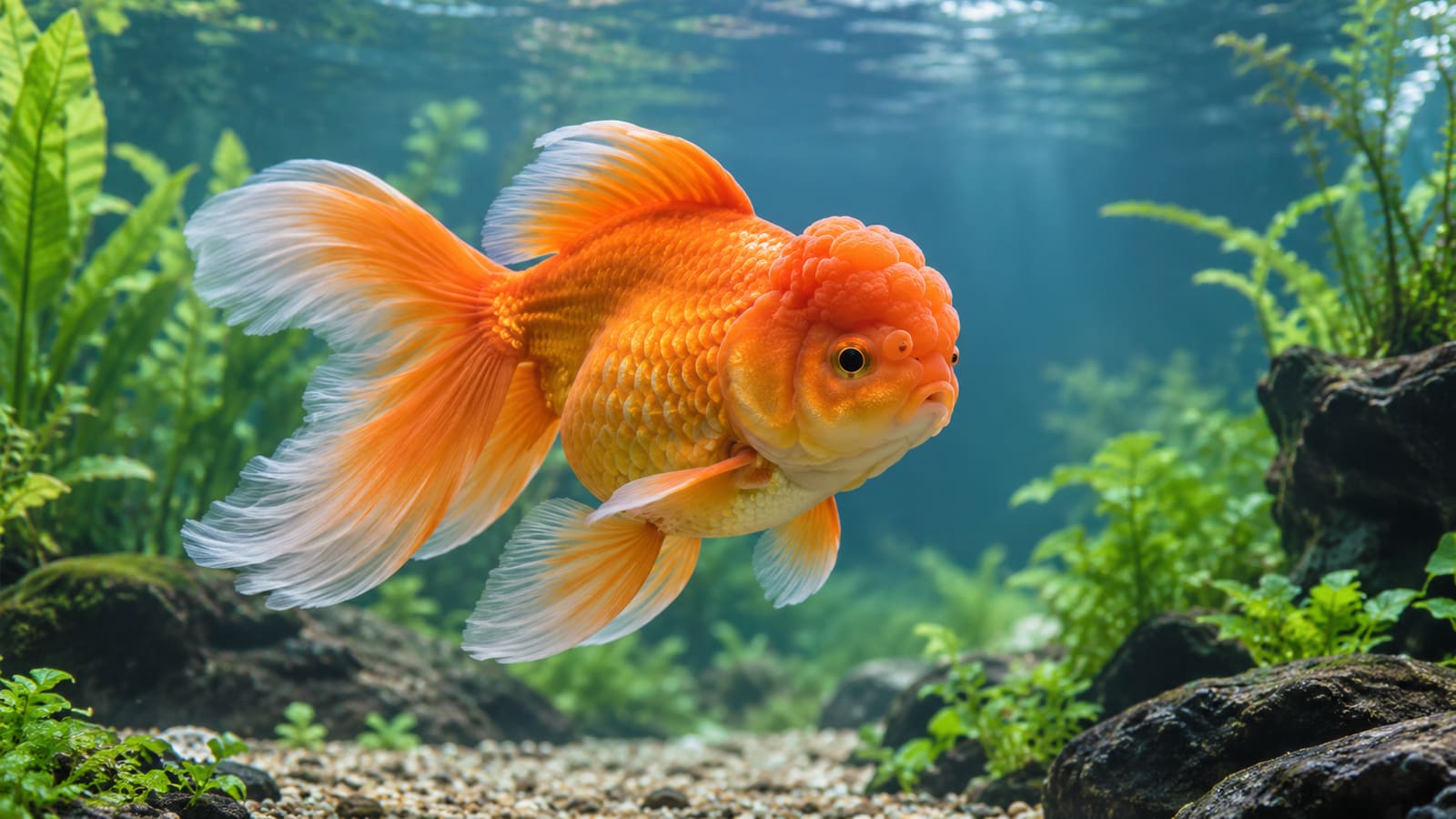
Common and comet goldfish, the slim kind sold as feeders, usually reach 8 to 12 inches in a big tank or pond, and well-fed pond fish can pass 14. They grow fastest in their first two or three years, keep growing slowly after that, and commonly live 10 to 15 years. A small, crowded tank can keep a goldfish small, but that is stunting, not the fish adapting.
Some links go to retailers. As an Amazon Associate, Aquarium for Beginners earns from qualifying purchases, at no extra cost to you.
The numbers
| Type | Body shape | Typical adult size | Minimum home |
|---|---|---|---|
| Common, comet, shubunkin | Slim, single tail, fast swimmer | 8–12 inches in a big tank or pond; 14 or more in the wild | A pond, or a very large tank |
| Fantail, ryukin, oranda, black moor, telescope | Round body, double tail | 6–8 inches; some ryukins reach 10 | 20 gallons for one young fish, 30–40 as an adult |
| Ranchu, pearlscale, bubble eye | Very round, often no back fin | Usually at the small end of the fancy range | 20 gallons for one young fish, 30–40 as an adult |
How big do goldfish get? Most fancy goldfish grow to 6 to 8 inches, and common goldfish usually reach 8 to 12 inches, more in a pond. The small goldfish sold at shops are babies, often only a few months old. They grow fastest in their first two or three years, keep growing slowly after that, and with good care commonly live 10 to 15 years.
That adult size is why goldfish need far more space than people expect. PetMD's vet-written care sheet puts even a single young goldfish in a 20-gallon tank or larger. Common goldfish belong in a pond or a very large tank.
Which goldfish do you have?
Goldfish come in two broad shapes, and the shape tells you roughly how big yours will get. The table above lists the common types.
Slim-bodied goldfish have a long, streamlined body and a single tail. Common goldfish, comets and shubunkins are in this group. They are fast, strong swimmers that usually reach 8 to 12 inches in a big tank or pond, and well-fed fish go past a foot. The cheap goldfish sold as feeders or given away at fairs are almost always this type.
Fancy goldfish have a short, round body and usually a double tail. Fantails, ryukins, orandas, black moors and ranchus are in this group. Dr Jessie Sanders, a fish vet, puts it plainly: "most fancy goldfish do not get larger than 6-8″ long," a figure that may or may not include their long fins. Some grow bigger: her practice has seen a ryukin 10 inches long. The very round types such as ranchus and pearlscales usually stay at the small end.
There is no scientific data that splits adult size by variety. The sizes for individual types come from vets' and keepers' reports, and they vary with care.
How big goldfish get, year by year
Almost no one has measured goldfish growth in home tanks. The best data come from feral goldfish, which show how fast the species can grow when it has warmth, food and space. In the Vasse River in Western Australia, researchers aged and measured a wild goldfish population and fitted a growth curve to it (Morgan and Beatty, 2007):
| Age | Length, including tail | Share of full size |
|---|---|---|
| 1 year | 7.0 inches (177 mm) | 47% |
| 2 years | 10.7 inches (271 mm) | 72% |
| 3 years | 12.6 inches (321 mm) | 86% |
| 4 years | 13.6 inches (346 mm) | 92% |
| 5 years | 14.0 inches (356 mm) | 95% |
| 6 years | 14.4 inches (367 mm) | 98% |
The curve levels off at about 14.7 inches. The researchers called it "a relatively high growth rate," so treat it as the upper end. These were common-type goldfish in a warm river, and fish in home tanks usually grow more slowly. The shape is what carries over: fast growth for two or three years, then a long, slow taper. PetMD notes that goldfish keep growing throughout their lives.
How to measure yours
Measure from the tip of the snout to the end of the tail fin, and check whether a source includes the tail before comparing. Scientific sources often use standard length, which stops at the base of the tail. The USGS, for example, gives a typical size of 120 to 220 mm standard length, about 4.7 to 8.7 inches of body without the tail. That is one reason goldfish size figures seem to disagree.
Do goldfish grow to the size of their tank?
Partly, but not in the way the myth means.
A small, crowded tank can keep a goldfish small. Fish farms do it on purpose: a study of feeder goldfish production notes that producers "normally must stunt fish growth through a combination of high stocking and low feeding rates," and found that only feeding at 1% of body weight a day kept the fish small enough to sell (Stone, McNulty and Park, 2003). Research from the 1970s also described a "crowding factor," a substance goldfish and carp release under crowded conditions that holds back growth, though it has had little follow-up since.
So the tank does not set the size. Food, crowding and water quality do. A goldfish kept small that way has not adapted to fit. In the same farm study, restricted feeding on its own did not necessarily make the fish poorer in condition, but crowding combined with low feeding did, and survival dropped at the highest density. Crowding and dirty water are what shorten a goldfish's life.
There is little research on whether a stunted goldfish catches up once it moves to a bigger tank. The safest plan is to give it room early, while it is still growing fast.
What makes a goldfish grow
Food. More food does make a young goldfish grow faster, up to a point. That is the lever fish farms use. It also makes more waste, so feed small meals and keep the water clean. See how often to feed goldfish for amounts in grams.
Warmth. FishBase notes that young goldfish need warm water to grow, and the Southern Regional Aquaculture Center says temperatures outside the comfortable range reduce feeding and growth.
Space and clean water. The same farm study found growth and survival suffered when fish were crowded. Regular water changes keep a growing goldfish's water clean.
What size tank a goldfish needs
Fancy goldfish: PetMD recommends at least 20 gallons for a single young goldfish, and about 5 gallons for every inch of body length as it grows. For a 6- to 8-inch adult, that is 30 to 40 gallons. The common hobby rule of 20 gallons for the first fish and 10 more for each extra one is a minimum for young fish, not a target. Goldfish produce more waste than other fish of their size, so they also need a strong filter and weekly water changes.
Common and comet goldfish: a pond, or a very large tank. They grow too big and swim too fast for an ordinary home aquarium.
This is also why goldfish do not belong in the small tanks they are often sold with. How many fish fit in a 10 gallon tank explains why a 10 gallon is no place for a goldfish, and what a 20 gallon setup costs prices the smallest tank one young fancy goldfish needs.
| Item | Why |
|---|---|
| AquaClear 70 filter | Rated for 40–70 gallons. A growing goldfish needs more filtration than its tank size suggests |
| API Freshwater Master Test Kit | Shows when the tank is no longer keeping up with the fish's waste |
Goldfish rarely need a heater
Goldfish are comfortable at about 65–75°F and usually need no heater. Their size and waste, more than the temperature, keep them out of most tropical community tanks, and they are the main reasons a betta cannot live with a goldfish. What fish can live with goldfish covers the few that fit. See what temperature a fish tank should be.
How big goldfish get in the wild
Goldfish released into lakes and rivers often grow much bigger than pet goldfish, because they have space, warm summers and plenty of food.
- Typical wild size: 5 to 8 inches, according to the Minnesota Department of Natural Resources.
- The Vasse River, Australia: the largest fish caught was 411 mm (16.2 inches) and about 2.2 kg (4.9 pounds), in its eighth year.
- Keller Lake, Minnesota, 2021: some of the goldfish pulled from the lake were 18 inches long and weighed about 4 pounds, according to the Associated Press.
Released goldfish stir up the bottom, cloud the water and compete with native fish for food and space, according to the Minnesota DNR. Minnesota lists them as a regulated invasive species that may not be released into the wild, and many other places have similar rules. If you cannot keep a goldfish, rehome it rather than releasing it.
Goldfish size and age records
- Longest goldfish: 47.4 cm (18.7 inches), owned by Joris Gijsbers of Hapert, the Netherlands, measured in 2003, according to Guinness World Records.
- Oldest goldfish: Tish, who lived to 43, according to Guinness World Records.
- Biggest by weight: sources disagree. The USGS cites fish of up to 59 cm and 3 kg, and the Southern Regional Aquaculture Center nearly 23 inches and 6 pounds.
- Not a goldfish: "Carrot," the 67-pound orange fish caught in France in 2022, was reported by CNN to be a hybrid of a leather carp and a koi carp.
A typical 6- to 8-inch adult goldfish weighs about 100 to 300 grams (3.5 to 10.5 ounces), according to the USGS. Many goldfish also change colour as they grow and age; that is usually harmless, as why a goldfish turns white explains.
The one thing worth taking from this
A goldfish is not a small fish that stays small. Plan for the adult: 6 to 8 inches and 30 to 40 gallons for a fancy goldfish, or a pond for a common one. Given that, it can live for 10 to 15 years or more.
Sources
- Witherell. Goldfish Care Sheet. PetMD, 2024.
- Sanders. How big do goldfish get? From 1″ to 14″! Aquatic Veterinary Services, 2021.
- Morgan and Beatty. Feral Goldfish (Carassius auratus) in Western Australia: a case study from the Vasse River. Journal of the Royal Society of Western Australia 90: 151–156, 2007.
- Stone, McNulty and Park. The Effect of Stocking and Feeding Rates on Growth and Production of Feeder Goldfish in Pools. North American Journal of Aquaculture 65(2): 82–90, 2003.
- Pfuderer, Williams and Francis. Partial purification of the crowding factor from Carassius auratus and Cyprinus carpio. Journal of Experimental Zoology 187: 375–382, 1974.
- USGS Nonindigenous Aquatic Species. Goldfish (Carassius auratus) Species Profile.
- FishBase. Carassius auratus species summary.
- Watson, Hill and Pouder. Species Profile: Koi and Goldfish. Southern Regional Aquaculture Center, Publication 7201, 2004.
- Masser. Water Gardens. Southern Regional Aquaculture Center, Publication 435, 1999 (length-to-weight table).
- Minnesota Department of Natural Resources. Goldfish and Koi Best Management Practices, 2022.
- Associated Press. Unwanted pets: Giant goldfish turn up in Minnesota waterways, 2021.
- Guinness World Records. Longest goldfish and Oldest goldfish ever.
- CNN, via East Idaho News. Fisherman catches 67-pound goldfish, 2022.
Questions people ask
Mentioned in this guide
Related guides
How Long Can Goldfish Go Without Food? Up to Two Weeks
A healthy adult goldfish can go a week without food easily and survives about two. How to prepare for a trip, why feeder blocks backfire, and ponds in winter.
How Often to Feed Goldfish: Schedule by Age and Water Temp
How often to feed goldfish: once or twice a day, what they eat in 1-2 minutes. See how much in grams and a pond feeding chart by water temperature.
What Fish Can Live With Goldfish? A Short, Honest List
What fish can live with goldfish? Another goldfish first, then a few cool-water fish and snails, with temperatures, sizes and the ones to avoid.