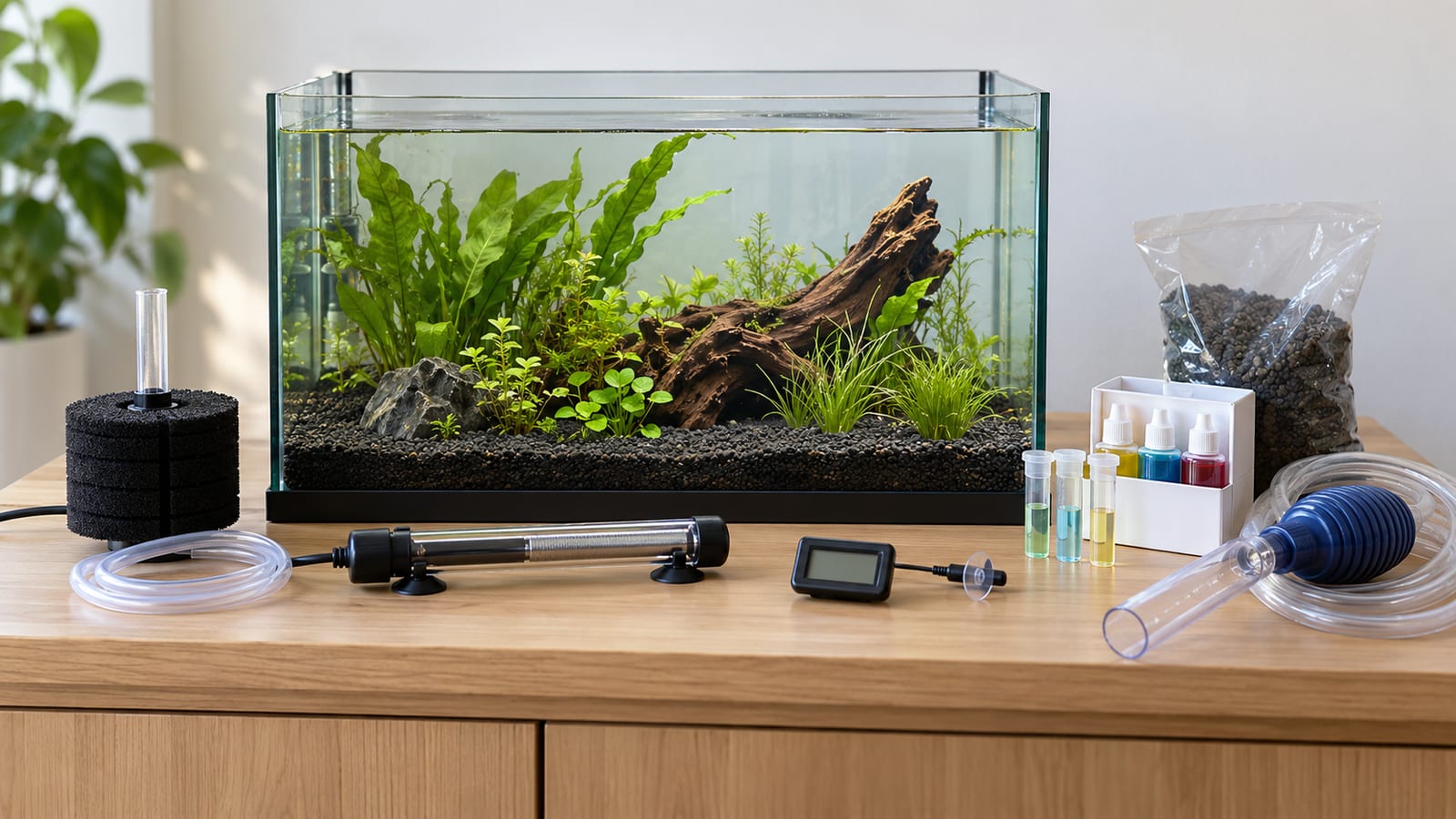
A starter kit on sale can bring it down to about $115. Prices were checked on 25 October 2026. A 20 gallon costs only about $45 more on a tight budget and is far more forgiving, so consider it first. If you go with a 10, buy a gentle filter, a 50 W heater and a liquid test kit, use 10 to 25 lb of gravel, and cycle the tank before any fish go in.
Some links go to retailers. As an Amazon Associate, Aquarium for Beginners earns from qualifying purchases, at no extra cost to you.
The numbers
| Item | Tight budget | Done properly | Can you skip it? |
|---|---|---|---|
| Tank, 10 gallon glass | $18 (Petco, on a 50% sale) | $36 (regular price) | No, but wait for a sale |
| Lid and light | $39 (Top Fin LED hood) | $55 (Aqueon LED Deluxe hood) | No. Fish jump, and water evaporates |
| Filter | $24 (sponge filter and air pump, plus airline tubing) | $42 (AquaClear AC20) | No |
| Heater, 50 W | $21 (Aqueon preset) | $32 (Eheim Jäger adjustable) | Only for coldwater fish |
| Thermometer | $10 | $10 | No |
| Gravel | $15 (10 lb, about ¾ inch) | $29 (20 lb, about 1.5 inches) | Technically, but almost nobody should |
| Liquid test kit | $36 | $36 | No. This is the one people are most tempted to cut |
| Water conditioner | $10 | $10 | No. Tap water chlorine and chloramine kill fish and filter bacteria |
| Gravel vacuum | $10 | $10 | No |
| Stand | $0 (sturdy furniture you own) | $70 (metal 10 gallon stand) | Only on furniture that is flat, level and solid. Aqueon calls a proper stand essential |
| Total before fish and decor | About $185 | About $260, or $330 with the stand |
A 10 gallon fish tank setup costs about $185 in parts on a tight budget and about $260 done properly, before fish and decor. A stand adds about $70, and a starter kit bought on sale brings the whole thing down to about $115. Prices were checked on 25 October 2026 against live listings at Petco, PetSmart and Amazon.
As with any tank, the glass is the cheap part. A bare 10 gallon was $18 in a Petco sale and $36 at regular price. The filter, heater, light, test kit and the rest are where the money goes.
Should it be a 10 gallon?
Be honest with yourself about this before you buy, because tank size is the hardest decision to change later.
A 10 gallon is the classic starter size, and it is also the source of a lot of beginner frustration. Small volumes swing fast: the same overfeeding or missed water change that a 20 gallon absorbs can crash a 10. On a tight budget, the 20 gallon setup costs only about $45 more, because the test kit, conditioner, thermometer and vacuum cost the same at every size. What size tank a beginner should get makes the full case.
A 10 gallon is the right call when space or budget really is fixed, or when you want a small, specific tank: one betta with a few shrimp or snails, a school of six to eight nano fish, or a shrimp colony. PetMD's vet-written betta care sheet calls 10 gallons or larger ideal for a betta. How many fish fit in a 10 gallon tank covers the stocking.
The itemised list
The table above has every line. Three notes on reading it.
The two columns are different decisions, not different quality. The tight-budget column uses a sponge filter, a preset heater, one bag of gravel and furniture you already own. Each item is rated for a 10 gallon and does the job. The second column buys adjustability and capacity: a hang-on-back filter with adjustable flow and room for your own media, a heater with a dial, a deeper gravel bed and a stand built for the job. How aquarium heaters fail, and which to buy covers what to look for in the heater.
The fixed costs do not shrink with the tank. The test kit, conditioner, thermometer and gravel vacuum come to about $66 whichever column you pick, about a third of a tight budget. That is why a 10 gallon is not much cheaper than a 20.
Weight is not a problem, flatness is. A filled 10 gallon weighs about 105 to 120 lb: about 11 lb of glass, 83 lb of water and the gravel. Most sturdy furniture holds that. What it cannot take is an uneven surface, which puts the load onto the glass seams. See how much a fish tank weighs.
The item people cut, and should not
The liquid test kit is $36 and looks like the obvious saving. It is the only way to know when the tank is safe for fish, and the only way to find out later why fish are dying.
What to buy for each line
These parts are the same wherever you buy them, so they are linked below. Each one is sized for a 10 gallon tank. We chose them from manufacturers' ratings and the needs of a small tank, not from hands-on testing.
| Line | Tight budget | Done properly |
|---|---|---|
| Filter | AQUANEAT sponge filter, small (up to 10 gallons) and a Tetra Whisper air pump for up to 10 gallons, plus a length of airline tubing, which neither includes | Fluval AquaClear AC20, rated up to 20 gallons, 100 GPH at most on Fluval's comparison chart, adjustable flow |
| Heater | Aqueon 50 W preset heater (PetSmart) | Eheim Jäger 50 W adjustable heater, or the Fluval M50 |
| Lid and light | Top Fin LED hood, 10 gallon (PetSmart) | Aqueon LED Deluxe Full Hood, 20 inch, which fits a standard 10 gallon |
| Thermometer | Digital aquarium thermometer | Same |
| Gravel | Fine gravel, 10 lb bag | Two bags |
| Liquid test kit | API Freshwater Master Test Kit | Same |
| Water conditioner | Seachem Prime | Same |
| Gravel vacuum | Tetra gravel siphon | Same |
Buy the tank in person. Chain-store sales on bare tanks are hard to beat, and a 10 gallon is light enough to carry home. If a hood is not part of a kit, check it matches your tank's exact length; a standard 10 gallon is 20 by 10 inches.
On the filter choice. Bettas, shrimp and fry need gentle water. University of Florida researchers note that bettas prefer calm water and that heavy filtration "may actually be harmful" to them, and PetMD lists air-driven sponge filters among the ideal choices. A sponge filter has no intake to trap shrimp or fins, which is why it is the budget pick here as well as the gentle one. The AC20 suits a community 10 gallon better: more capacity, an intake sponge included, and a flow control to turn the current down. The best filter for a 10 gallon tank compares five options, from a sponge filter to an internal filter, on their published specs.
Kit or separate parts
Kits are where a 10 gallon gets cheap. When we checked, PetSmart had its Top Fin Essentials 10 gallon starter kit at $44.99, half its regular $89.99, in a sale running to 1 November. It includes the tank with an LED hood, a filter with a cartridge, a 50 W heater, a thermometer, a net and a test vial. Add the test kit, conditioner, gravel vacuum and a bag of gravel, and the whole setup comes to about $115 on sale, or about $160 at regular price. Aqueon's 10 gallon starter kit, with a preset 50 W heater and its SmartClean internal filter, was $129.99 on Amazon.
The catch is the filter cartridge. Kit filters are usually built around a cartridge you are told to replace every few weeks. The bacteria that make the tank safe live on the filter media: a 2025 study that followed three new home aquariums found nitrifying bacteria on the filter sponge and beads within weeks. Throw the whole cartridge out and you throw much of that colony out with it.
So a kit is a good buy if you treat its filter differently from the instructions. Rinse the cartridge in a bucket of old tank water when it clogs instead of replacing it on a schedule, and when it finally falls apart, keep the old one in the filter alongside the new one for a few weeks if there is room, or swap in a sponge.
How much gravel for a 10 gallon tank
About 13 lb for each inch of depth: about 13 lb for a 1-inch layer and 25 lb for 2 inches, slightly less in practice.
The working is simple. Aqueon's dimensions chart puts its 10 gallon at 20¼ by 10½ inches outside, so each inch of gravel is a little over 200 cubic inches. Engineering reference tables put dry gravel at about 105 lb per cubic foot and dry sand at about 97, which comes to about 13 lb of gravel or 12 lb of sand per inch.
A thin layer of ¾ to 1 inch is enough for a fish-only tank. Two inches holds rooted plants better. The common rule of 1 lb per gallon gives only about ¾ inch in a 10 gallon, which is why a single 10 lb bag gives a thin layer.
The same sum for other standard tanks, from Aqueon's outside dimensions (so the real amount is slightly less, since the glass takes up some of the footprint):
| Tank | Footprint | Gravel, 1 inch | Gravel, 2 inches | Sand, 1 inch | Sand, 2 inches |
|---|---|---|---|---|---|
| 5.5 gallon | 16³⁄₁₆ × 8⅜ in | 8 lb | 16 lb | 8 lb | 15 lb |
| 10 gallon | 20¼ × 10½ in | 13 lb | 26 lb | 12 lb | 24 lb |
| 20 high | 24¼ × 12½ in | 18 lb | 37 lb | 17 lb | 34 lb |
| 20 long, 29 gallon | 30¼ × 12½ in | 23 lb | 46 lb | 21 lb | 42 lb |
| 40 breeder | 36³⁄₁₆ × 18¼ in | 40 lb | 80 lb | 37 lb | 74 lb |
| 55 gallon | 48¼ × 12¾ in | 37 lb | 75 lb | 35 lb | 69 lb |
| 75 gallon | 48½ × 18½ in | 55 lb | 109 lb | 50 lb | 101 lb |
In a 55 or a 75 the 1 lb per gallon rule gives about 1.4 to 1.5 inches. In small tanks, and in wide ones like a 40 breeder, it gives an inch or less.
How to set up a 10 gallon fish tank
- Place the tank on a flat, level surface, out of direct sun and near an outlet. A filled 10 gallon cannot be moved, so put it where it will live.
- Rinse the gravel in a bucket until the water runs clear, then spread it in the tank, sloping slightly higher at the back.
- Fill the tank with tap water treated with conditioner. Pour onto a plate or your hand so the gravel does not churn.
- Fit the filter and the heater, and wait 20 to 30 minutes before plugging them in, so the heater's glass matches the water temperature. If the heater is adjustable, set 76–78°F, or 78–80°F for a betta; the budget preset is fixed at 78°F. Check it with the thermometer after 24 hours.
- Add plants and decor. Fish need cover and broken lines of sight more than ornaments.
- Start the nitrogen cycle, and test the water every few days. The tank is ready when a dose of ammonia to 2 ppm reads zero ammonia and zero nitrite 24 hours later.
- Only then add fish, a few at a time.
The cycle takes weeks, and it is the step that decides whether the tank works. The nitrogen cycle guide walks through it, and how to acclimate fish covers the day the fish go in.
What it costs to run
A few dollars a month. The figures below use the US average residential electricity price for August 2026, 18.16 cents per kWh, a preliminary figure from the US Energy Information Administration.
| Running cost | Per month |
|---|---|
| Heater, 50 W | At most $6.60, if it ran every minute. In a warm room it runs a fraction of that |
| Air pump for the sponge filter, a few watts | 20 to 35 cents |
| Light and a hang-on-back filter | The AquaClear AC20 draws 7 W, about 93 cents a month running all day. An LED hood on for eight hours uses well under a dollar |
| Water conditioner | Pennies. Seachem doses Prime at 5 mL per 50 gallons, so a 250 mL bottle treats 2,500 gallons |
| Food | A small tub lasts months |
The heater is almost all of the electricity bill, and how much it runs depends on the room. A tank in a room that stays near 70°F needs far less heating than one by a cold window. See what temperature a fish tank should be for the target and where to put the tank.
The cost that arrives later: fish
Do not spend it yet. The tank has to run without fish while the nitrogen cycle establishes, which is the most useful fact here for anyone on a budget: the equipment spend and the livestock spend fall weeks apart.
When the time comes, keep it small. A betta with a few shrimp or snails, or a single school of six to eight nano fish, is what a 10 gallon supports. Goldfish are never right for one; see how big goldfish get.
The one thing worth taking from this
Price the whole list before you buy the tank. The glass is one of the cheapest lines, the fixed costs are the same at any size, and for about $45 more on a tight budget a 20 gallon gives you twice the water to absorb mistakes. If you stay with a 10, buy a gentle filter, a 50 W heater and the test kit, and let the tank cycle before you buy a single fish.
Sources
- Petco. 10 gallon aquarium search results, including the Imagitarium 10 gallon open-glass tank and the Imagitarium Brooklyn metal tank stand, seen 25 October 2026.
- PetSmart. Marineland Open Glass Aquarium, 10–75 gallon, Top Fin Essentials Aquarium Starter Kit, Aqueon Preset 50W Submersible Aquarium Heater and Top Fin LED Aquarium Hood, seen 25 October 2026.
- Fluval. AC20 Power Filter, 5–20 US Gal / 18–76 L, and the AC series comparison chart on its Amazon listing.
- Aqueon. Aquarium Starter Kit with SmartClean Filtration and LED Lighting, 10 gallon, Amazon listing, seen 25 October 2026.
- Aquarium Co-Op. Heater wattage guide.
- Zayas. Betta Fish Care Sheet. PetMD, 2026.
- Watson, DiMaggio, Hill, Tuckett and Yanong. Evolution, Culture, and Care for Betta splendens. University of Florida IFAS Extension, FA212.
- Aqueon. Aquarium dimensions chart.
- The Engineering ToolBox. Dirt and Mud - Densities.
- US Energy Information Administration. Electric Power Monthly, Table 5.6.A: Average Price of Electricity to Ultimate Customers by End-Use Sector, August 2026.
- Seachem. Prime.
- McKnight et al. Microbial community succession of home aquarium biofilters associated with early establishment of comammox Nitrospira. ISME Communications 5(1), 2025.
Questions people ask
Mentioned in this guide
Related guides
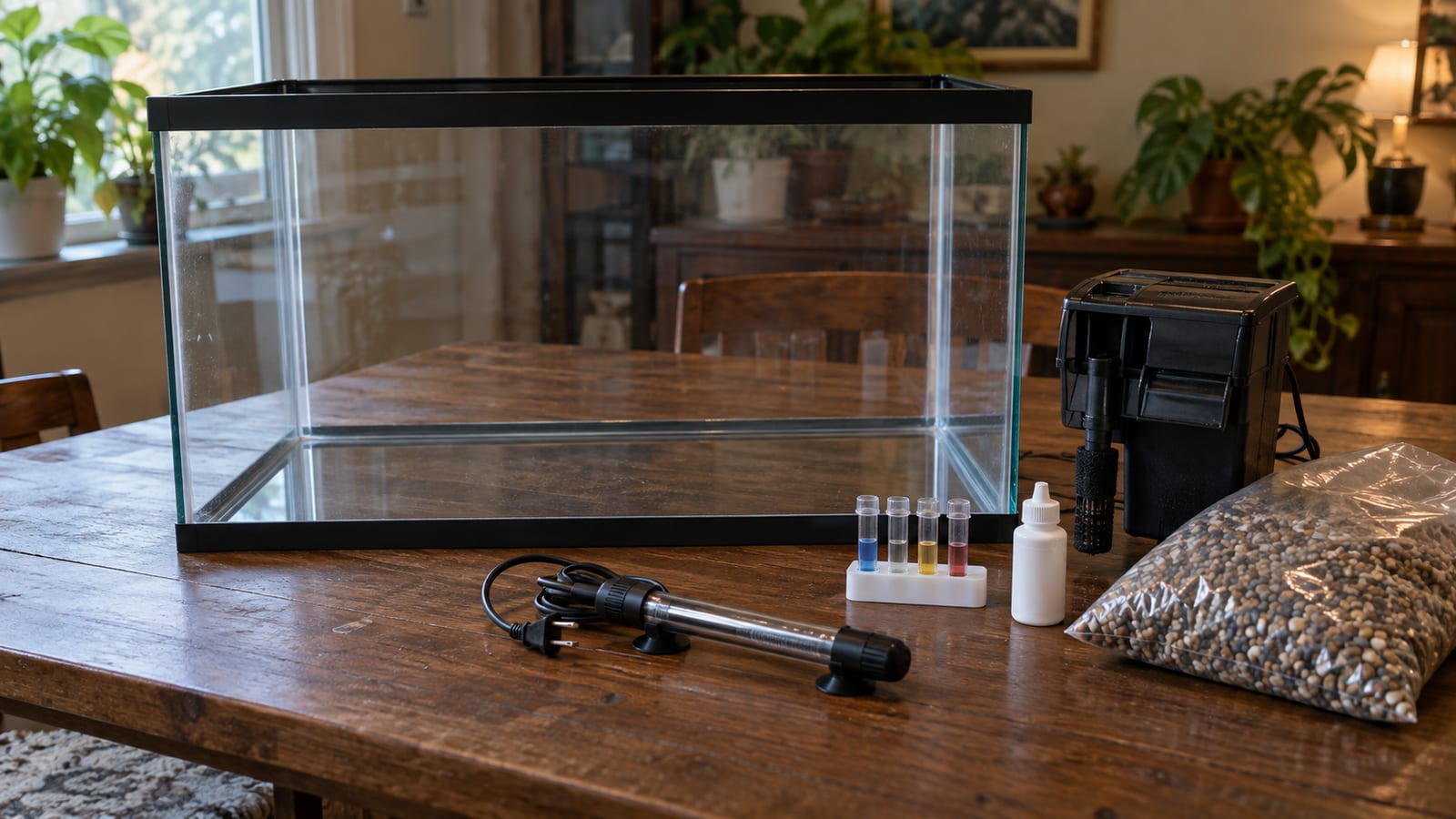
20 Gallon Fish Tank Setup Cost: Every Item, Priced
What a 20 gallon fish tank setup costs in 2026, item by item: about $230 on a tight budget, $400–$500 done properly with a stand, and $10 a month to run.
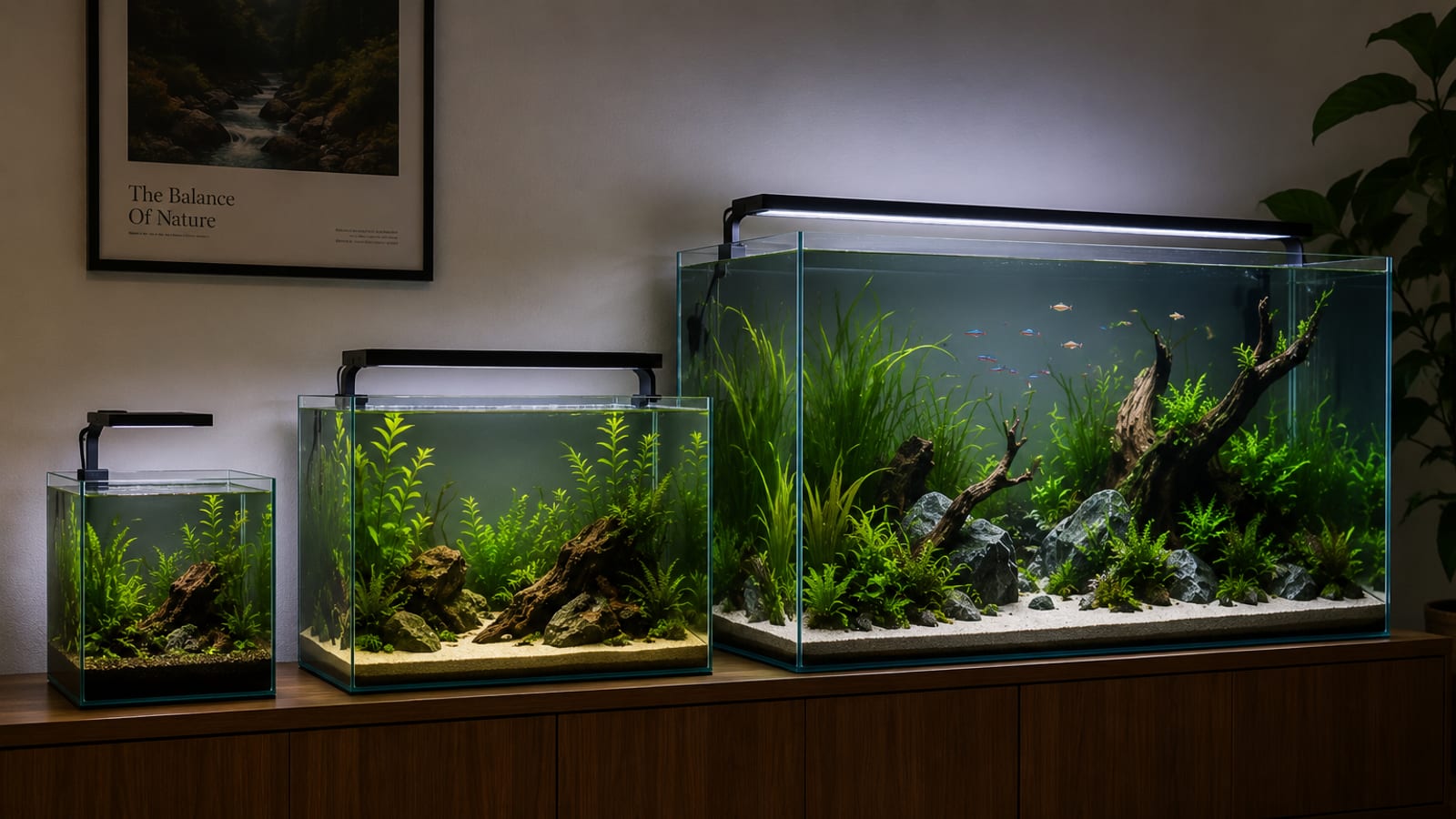
What Size Aquarium Should a Beginner Get? (Bigger Is Easier)
Small tanks are sold as beginner tanks but are the hardest to keep stable. How 5, 10, 20 and 29-gallon tanks compare on stocking, cost and forgiveness.
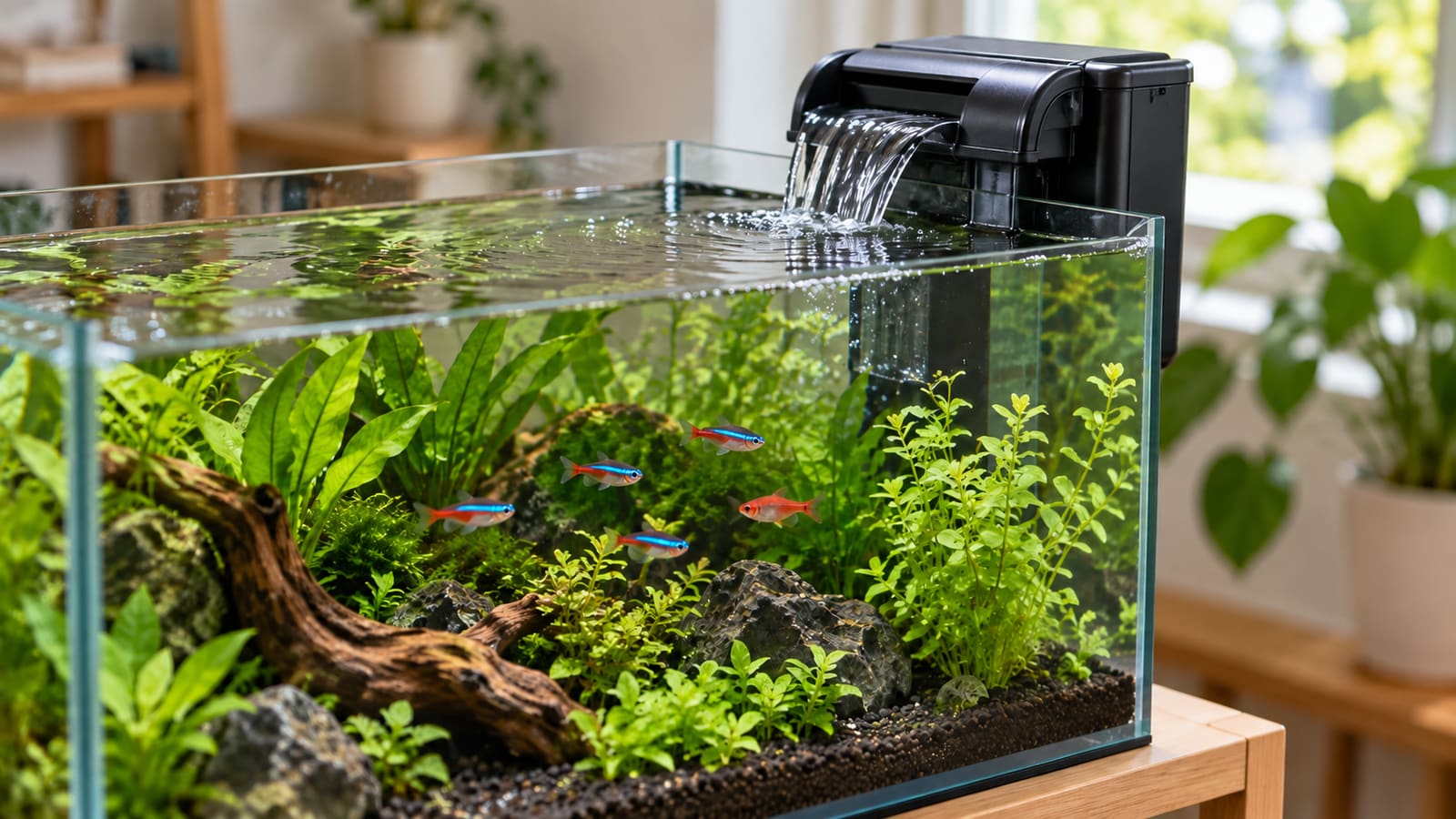
Best Filter for a 10 Gallon Tank: Picks by Setup, With Specs
The best filter for a 10 gallon tank depends on what lives in it. Picks for community, betta, shrimp and budget tanks, compared on maker specs.