Quick Verdict
Harmless. Thin white worms wriggling in the substrate of a fish tank are detritus worms, not parasites — they eat waste. A sudden bloom means overfeeding, so cut food and vacuum the substrate. Do not medicate.
They are harmless. Thin white threads wriggling in the gravel, or drifting up into the water when you disturb it, are detritus worms — small aquatic relatives of the earthworm that eat waste. They do not bite, do not infect fish, and do not parasitise anything.
Before you relax entirely, though, spend thirty seconds confirming that is what you have. There is a second white worm that looks similar at a glance, is also harmless to fish, and is a genuine problem in a shrimp tank.
Which worm do you have
The table above has the full comparison. Two things separate them and you can check both with your eyes:
The head. Planaria have a distinct flat, triangular, arrow-shaped head with two small eyespots. Detritus worms are the same thickness end to end, with nothing you would call a head.
The movement. Planaria glide — a smooth, continuous slide across a surface, like a slug. Detritus worms thrash, wriggling in quick erratic bursts.
The fastest check
Look at your glass. Detritus worms live in and just above the substrate; they do not crawl around on the front pane. If you are watching a white worm glide smoothly across the glass, you are looking at planaria.
For a fish-only tank the distinction is academic — neither will hurt your fish. For a shrimp tank it is the whole question, because planaria prey on shrimplets, eggs, and adults during the hours after a moult when they are soft.
Why detritus worms appear in a fish tank
As Aquarium Science notes in its writeup on them, detritus worms are in nearly every established aquarium already. They arrive on live plants, on second-hand decor, in substrate, or with fish, and in normal numbers you never see them.
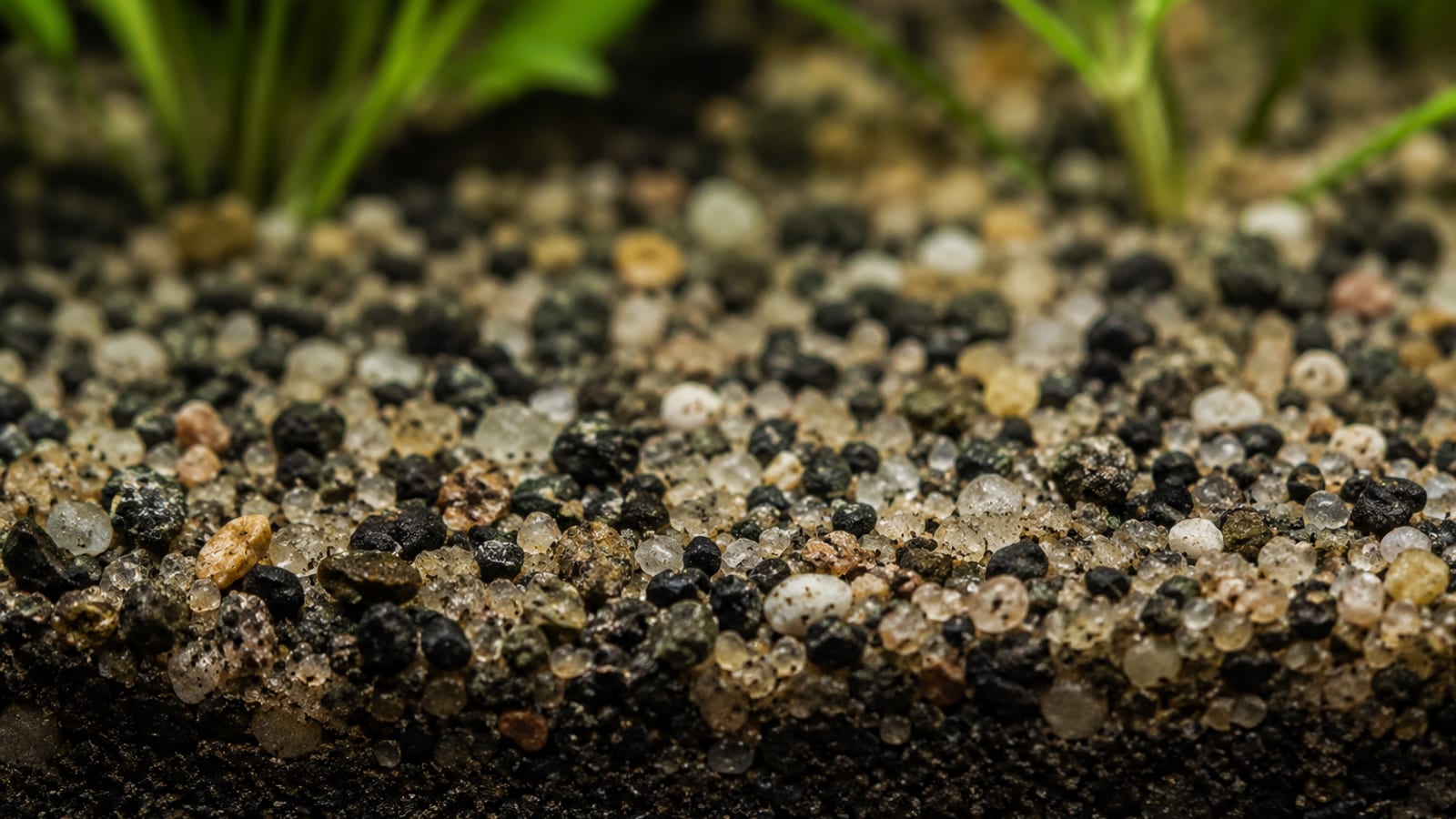
What you are seeing is not an infestation. It is a population boom, and a population booms because its food supply did. Their food is waste — uneaten food, fish waste, decaying plant matter, and whatever is trapped in the substrate.
So a sudden bloom of detritus worms is a reading, not a disease. It is telling you one of these:
- You are feeding more than the tank consumes
- Something died out of sight — a fish behind the filter, a snail under a rock
- The substrate has not been vacuumed in long enough for a layer of mulm to build up
- The tank is overstocked for its filtration
A detritus worm bloom is not something that happened to your tank. It is your tank telling you what it is being fed.
What to do
- Confirm they are not planaria — head shape and movement, as above.
- Cut feeding. Most beginner tanks are fed roughly twice what they need. Fish should finish everything within a couple of minutes.
- Check for something dead. Behind the filter, under decorations, in the plants. A decomposing snail is a common hidden cause.
- Vacuum the substrate properly during your next water change, working across a third of the tank each week rather than all of it at once.
- Wait. The population falls back as the food supply does, over a few weeks.
- Do not medicate, and do not tear the tank down.
What not to do
Do not use dewormers. Medications sold for aquarium worms will kill your snails and shrimp, disrupt the filter, and treat a problem you did not have. This is the most common overreaction to this question.
Do not strip and rebuild the tank. Removing and washing the substrate destroys a large part of your bacterial colony and starts your nitrogen cycle over. You would be trading a cosmetic issue for a genuine one.
Do not panic about a few. Seeing a handful when you disturb the gravel is the normal state of a healthy established aquarium, not a warning.
The one thing worth taking from this
Detritus worms are a symptom that is easy to read: there is more waste in the tank than there should be. Fix that and they recede on their own, along with several other problems you have probably not noticed yet.
Detailed Comparison
| Detritus worms | Planaria | |
|---|---|---|
| Shape | Thin, round, hair-like | Flat, ribbon-like |
| Head | No distinct head | Triangular or arrow-shaped, with two eyespots |
| Movement | Quick, erratic wriggling | Smooth gliding, like a slug |
| Where you see them | In and just above the substrate | Gliding on the glass and hardscape |
| Harmful to fish? | No | No |
| Harmful to shrimp? | No | Yes — preys on shrimplets, eggs and moulting shrimp |
| What to do | Feed less, vacuum substrate | Treat, especially in a shrimp tank |
Frequently Asked Questions
🔗 Related Resources
More Reviews:
Related Articles
Scuds in an Aquarium: Harmless With Fish, a Problem With Shrimp
Scuds in an aquarium are tiny curled crustaceans that swim on their side. With fish they are free live food. With only shrimp they are a rival.
Snail Eggs in a Fish Tank: Which Snail, and Will They Hatch?
Snail eggs in a fish tank look different for every species. Identify yours in one table — clear jelly, pink clutch or hard white dots — and if they will hatch.
Why Does My Fish Tank Smell? Match the Smell to the Cause
Why does my fish tank smell? A healthy tank smells like damp soil. Rotten eggs, rotting fish and musty swamp each point to one cause — matched in one table.