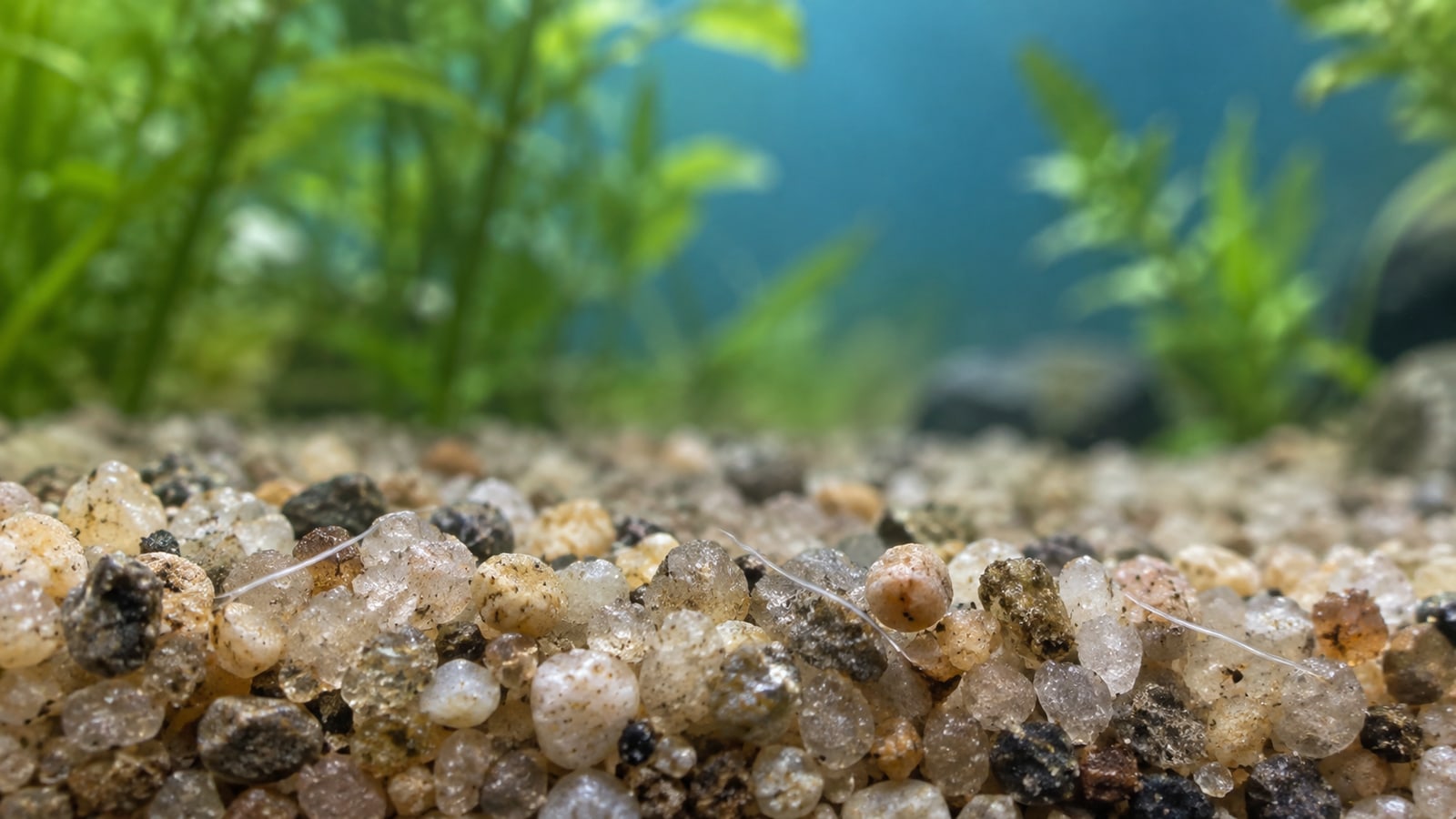
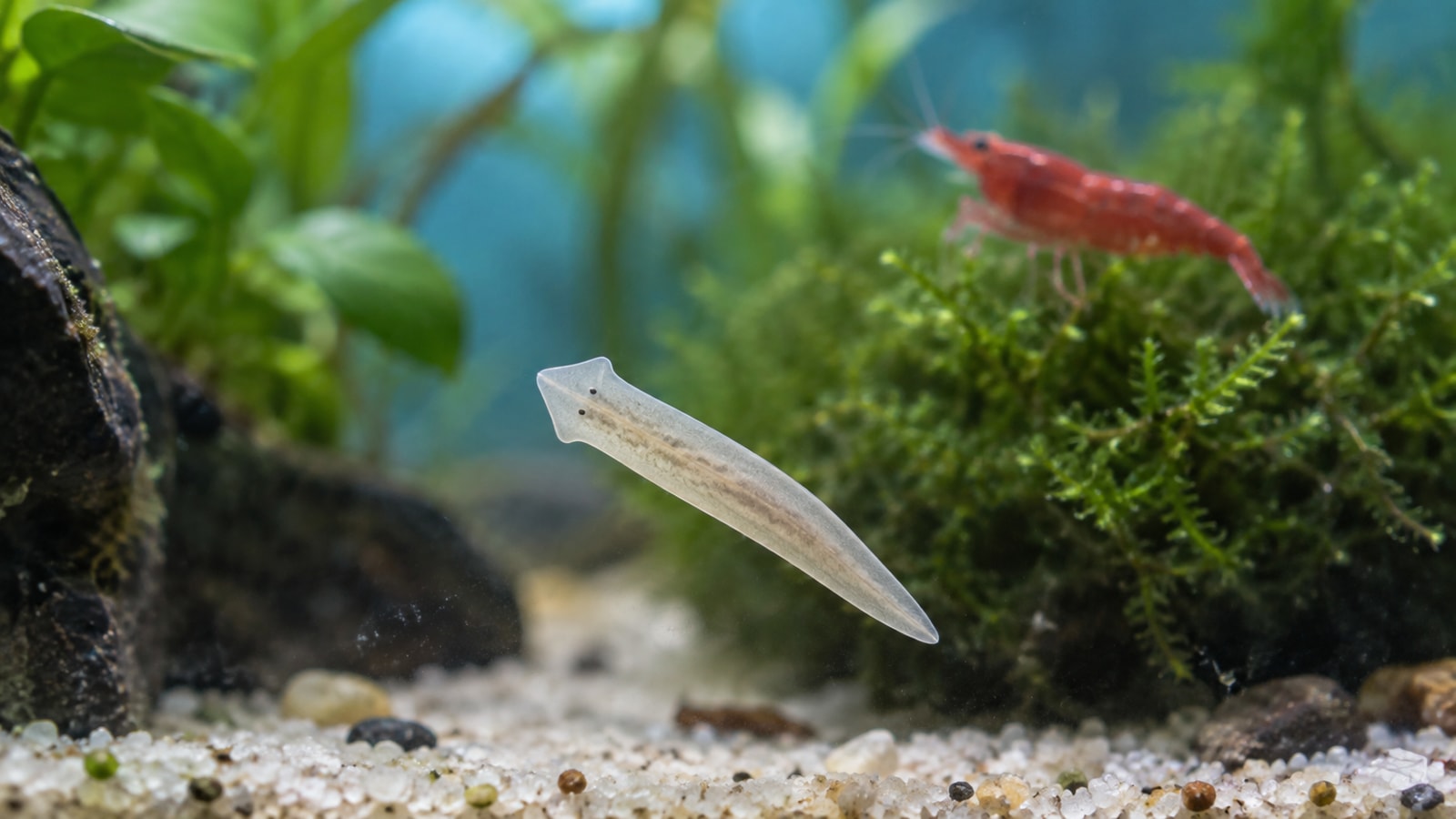
A flat worm gliding on the glass with a triangular head is planaria, which only matters if you keep shrimp. Red threads hanging from a fish's vent are camallanus, the one worm that is a fish disease, and the whole tank needs treatment.
The numbers
| Detritus worm | Nematode | Planaria | Hydra | Camallanus | |
|---|---|---|---|---|---|
| What you see | Thin white or pinkish thread, 1–3 cm, round head | Tiny clear or white hair, under 1 cm | Flat, white to brown, triangular head with two eye spots | Stalk with 4–6 thin tentacles, like a tiny palm tree | Red threads sticking out of a fish's vent |
| Where | Substrate, and wriggling in open water | On the glass near the surface, flicking in the water | Gliding on the glass, often after lights-out | Stuck to the glass, plants or decor, not moving | Inside the fish |
| How it moves | Thrashes and whips | Fast S-shaped flicking | Smooth glide, like a slug | Stays put. Tentacles sway | Retracts into the fish when disturbed |
| Is it a problem? | No. A sign of overfeeding | No. A sign of overfeeding | For shrimp and eggs, yes. For fish, no | For fry and baby shrimp, yes | Yes. Treat the whole tank |
Most worms in a fish tank are harmless, and the rest are easy to recognise. Thin white worms wriggling in the gravel or the water are detritus worms or nematodes. They eat waste, and a bloom of them means the tank is being fed more than the fish eat.
Two need action. A flat worm gliding on the glass is planaria, which matters in a shrimp tank. Red threads hanging from a fish's vent are camallanus, a parasite, and that one needs medicine.
The table above covers all five. Here is how to use it.
Start with how it moves
Shape is hard to see on something 1 cm long. Movement is easy. Watch it for ten seconds.
It thrashes, whips or wriggles in open water. A detritus worm, if it is 1–3 cm and white to pink. A nematode, if it is tiny and hair-thin and flicks in an S-shape on the glass near the surface. Both are harmless.
It glides smoothly along the glass like a slug. Planaria. Get close with a flashlight: a triangular, arrow-shaped head with two dark eye spots confirms it. You need both. A worm with a pointed head but no eye spots, or one that thrashes, is not planaria.
It does not move at all, and has tentacles. Hydra. It is not a worm, but it gets called one. It looks like a tiny stalk with four to six thin arms, stuck to the glass or a leaf.
It is coming out of a fish. Red or red-brown threads from the fish's vent, which pull back inside when the fish is startled, are camallanus worms.
Detritus worms and nematodes: harmless
These two are the answer for most people who search this. They live in every aquarium, mostly in the substrate, and eat leftover food and waste. You notice them only when there is enough food for a population boom, or when something drives them out of the gravel, such as a tank that has gone too long between water changes.
The fix is the same for both: feed only what the fish finish in two minutes, vacuum the substrate at the next water change, and keep changing water weekly. The numbers fall within a few weeks. There is a full guide to detritus worms, including why a sudden mass of them in open water is a reason to test your water.
Do not medicate for these
Detritus worms and nematodes are not parasites. A dewormer does nothing useful, and killing thousands at once leaves them to rot in the gravel.
Planaria: a shrimp problem
Planaria are flatworms. They eat the same leftovers as the harmless worms, but they also go after shrimp eggs, baby shrimp and snail eggs, and they can attack a moulting shrimp. In a tank of fish only, most fish eat them and they are not worth treating.
In a shrimp tank they are worth dealing with. Start by feeding less, since planaria boom on uneaten food just as detritus worms do. A planaria trap baited with a small piece of meat overnight pulls many out. If that is not enough, a betel-nut-based treatment sold for the purpose (No Planaria is the common one) kills planaria and hydra and is the usual choice in shrimp tanks. It is sold as snail-safe, but keepers regularly report losing snails to it, so move any you want to keep before you dose. The full walk-through is in planaria in an aquarium.
Hydra: a fry problem
Hydra are relatives of jellyfish. They sit still and catch whatever drifts into their tentacles, which means baby shrimp and newly hatched fry. Adult fish are too big for them.
They bloom when there is plenty of tiny food in the water, most often in tanks where fry are fed baby brine shrimp or powdered food. Cut back the feeding and most of them shrink away. In a breeding tank, the same betel-nut treatment used for planaria kills them too, with the same warning about snails. More in hydra in an aquarium.
Camallanus: the one that is a disease
Camallanus worms live in a fish's gut. What you see is the tail end of the adult: red threads, a few millimetres long, sticking out of the vent. Guppies, livebearers and anything from a crowded shop tank are the usual carriers. An infected fish can look healthy for weeks, then lose weight and its appetite.
Treat the whole tank, not one fish
Camallanus larvae pass from fish to fish through the water, so by the time you see worms in one fish, others are infected. Treat every fish in the tank with an anthelmintic dewormer made for fish — levamisole, fenbendazole or flubendazole — following the product's dosing exactly, and repeat the course as the label directs to kill worms that hatched in between.
Two things to know before you dose. Fenbendazole and flubendazole also kill snails and can harm shrimp, so move them out first. And vacuum the substrate well between doses, because that is where the larvae wait for a new host.
If it is none of these
A small curled animal that swims on its side is a scud, a crustacean rather than a worm. A slow-moving black or brown worm that stretches and contracts and clings with a sucker at each end is a leech, which is rare in home tanks and usually arrives on pond plants.
The one thing worth taking from this
Watch how it moves before you do anything. The thrashing white worms need nothing but less food. Only the worm coming out of a fish needs medicine, and for that one, the whole tank gets treated.
Questions people ask
Mentioned in this guide
Related guides
Detritus Worms in a Fish Tank: Harmless, But Check First
Detritus worms in a fish tank are harmless waste eaters. A sudden bloom means overfeeding — and here is how to tell them apart from planaria, which are not.
Planaria in an Aquarium: Harmless to Fish, Bad for Shrimp
Planaria in an aquarium are flatworms that glide on the glass. With fish they are harmless. In a shrimp tank, here is how to trap them and treat safely.
How to Get Rid of Duckweed in an Aquarium Without Hurting Fish
How to get rid of duckweed in an aquarium without hurting fish: net it, wipe the glass, pick it out of moss, then check for six weeks so it stays gone.