Quick Verdict
Yes — pothos in an aquarium is safe, and one of the best nitrate exporters for a beginner tank. Roots in the water, leaves in the air. Submerging the leaves kills the plant, and an unquarantined shop plant can kill shrimp.
Pothos is the cheapest useful upgrade you can make to a beginner tank. A $5 cutting from a garden centre, roots trailing in the water and leaves hanging over the rim, will measurably slow how fast nitrate climbs — once it has grown the root mass to do it with.
It is also the plant most likely to kill a shrimp colony, for a reason that has nothing to do with the plant.
Why pothos works so well in a fish tank
Most aquarium plants are fighting for carbon. Underwater, dissolved CO₂ is scarce, which is why serious planted tanks inject it and why a beginner's Amazon sword sits there doing very little.
Pothos does not have that problem. Its leaves are in the air, where CO₂ is unlimited, while its roots sit in water that is essentially a nitrate solution. Nothing limits it except light and nutrients — and nitrate is the nutrient. So it grows fast, and growing fast is the entire mechanism: the nitrogen leaves your tank inside the plant.
What to expect, and when
Be patient with it. A cutting has to replace its soil roots with water roots before it exports anything, so expect a month or two of very little, then a steadily growing effect as the root mass fills out. In a moderately stocked 10–20 gallon tank a mature pothos noticeably slows how fast nitrate climbs between water changes. It will not hold nitrate at zero, and anything promising that is overselling it.
Setting it up
- Take a cutting with at least three leaves and, more importantly, two or three nodes — the small brown bumps on the stem where roots emerge.
- Strip the leaves off the lowest node or two. Submerged leaves rot; bare nodes root.
- Quarantine it first if you keep shrimp or snails. See below — this is the step people skip.
- Sit the cut end in a glass of water for a few hours before it goes in the tank. A freshly cut stem weeps sap, and this costs you nothing.
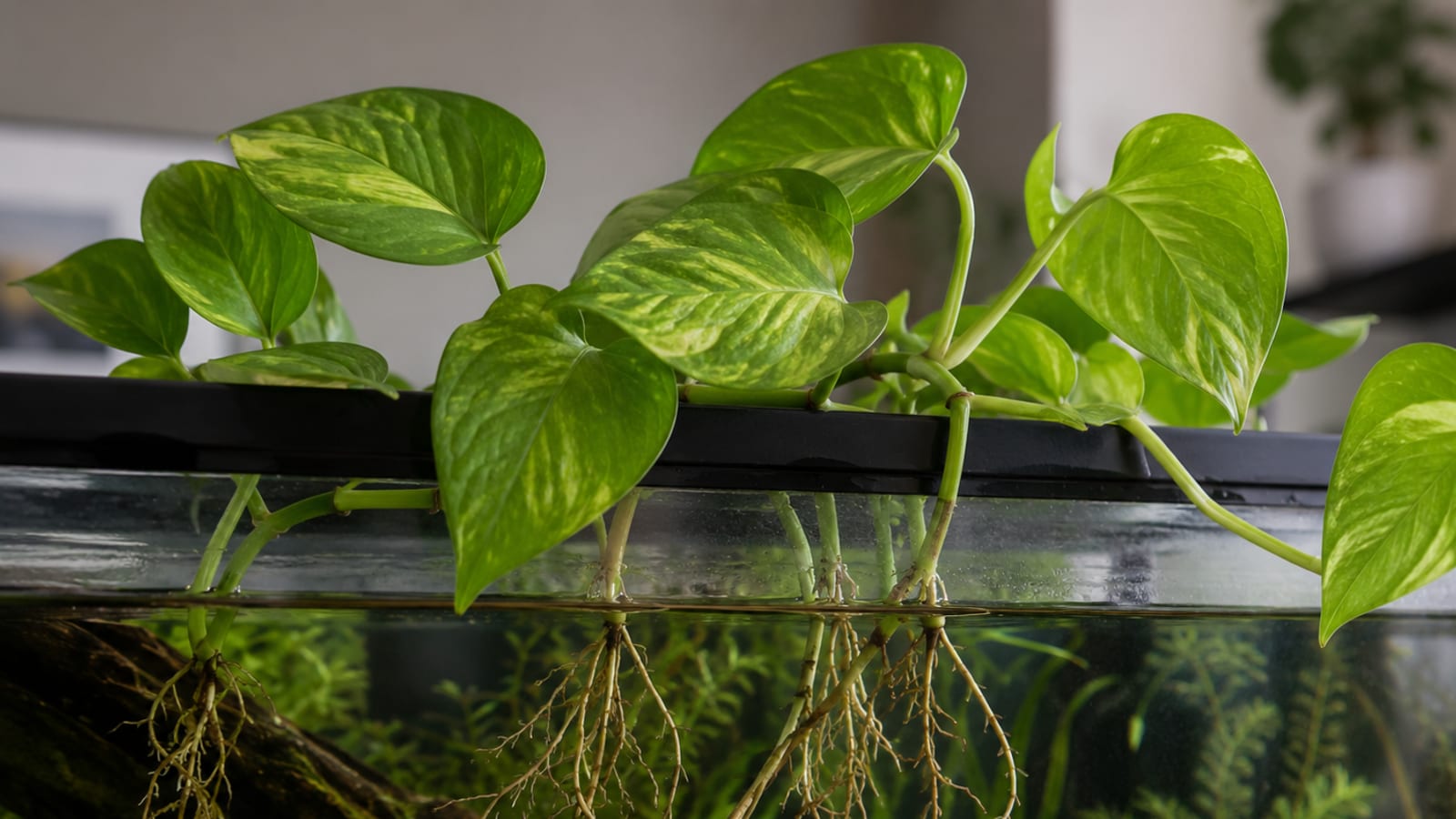
- Drape the vine over the tank rim, or drop the cutting into a hang-on-back filter box, so at least one node is under water and every leaf is above it.
- Wait. Roots appear in 7–14 days and the plant does very little before then.
- Trim the root mass when it starts crowding the tank or blocking your filter outflow. Trimming does not hurt it.
The pesticide problem
This is the part page one of Google does not tell you, and it is the only genuinely dangerous thing about putting pothos in a tank.
Pothos is sold as a houseplant, not as an aquarium plant. Houseplants are routinely treated with systemic insecticides — most commonly imidacloprid, a neonicotinoid that the plant takes up into its tissue and releases slowly. It is acutely toxic to aquatic invertebrates at very low concentrations, and it has a half-life measured in weeks, not hours.
Fish mostly shrug it off. Shrimp, snails and other invertebrates do not. The classic version of this story is a shrimp keeper who adds a new plant and finds the colony dead within days, having changed nothing else — a pattern Practical Fishkeeping traced back to pesticide residue on supplied plants.
If you keep shrimp or snails, quarantine the plant
Remove any rock wool or sponge from the roots — it soaks up residue and holds it. Then stand the plant in a bucket of dechlorinated water for at least five days, changing the water completely every day, before it goes near the tank. A fish-only tank is far lower risk, but the bucket costs you five days and nothing else.
Rinsing under the tap is not enough. A systemic insecticide is inside the plant, which is the whole point of it — you cannot wash it off the surface.
Is pothos toxic to fish?
Not in the water, and the confusion here is worth clearing up because it stops people using a good plant.
Pothos is genuinely listed as toxic to cats, dogs and children. The mechanism is insoluble calcium oxalate — microscopic needle-shaped crystals in the leaves and stems that cause burning and swelling when chewed. Two words are doing the work there. Insoluble means the crystals do not dissolve into your water. Chewed means the danger requires eating the plant.
Your fish do not eat pothos leaves, because the leaves are in the air. What they encounter is the root system, which is the safest part of the plant and the part fish and shrimp actively enjoy.
Toxic to a cat that eats it is not the same as toxic to a fish swimming past its roots. Keep the leaves out of the water and the question disappears.
What it will not do
It is not a filter. Pothos takes up nitrate and some ammonium, but slowly, and its uptake rate has nothing to do with your tank's acute ammonia load. The bacterial colony in your filter processes ammonia in hours and is what actually keeps fish alive. A tank that is not cycled does not become safe because there is a plant in it.
It does not end water changes. Nitrate is one of several reasons to change water. Dissolved organic compounds accumulate and minerals deplete regardless of how much nitrate the pothos eats.
It does not fix overstocking. A tank with too many fish in it is still a tank with too many fish in it.
Where to put pothos in your aquarium
The table above covers the four options. In practice, two work:
Draped over the rim is the normal approach and looks like a houseplant that happens to live on an aquarium. Dropped into a hang-on-back filter box is the more effective one, because water is being pushed past the roots continuously instead of drifting past them — the same reason your filter media works better than gravel does.
Whichever you choose, the rule that decides whether this succeeds or fails is one line: roots under the water, leaves above it.
Detailed Comparison
| Where you put it | How | Nitrate export | The catch |
|---|---|---|---|
| Roots in the tank, leaves out | Drape the vine over the rim, one or two nodes under water | High | Roots eventually fill the corner. Trim them |
| In a hang-on-back filter | Sit the cutting in the filter box, roots in the flow | Highest — constant flow past the roots | Roots can block the outflow if left unchecked |
| Rooted in the substrate | Do not. Pothos is not an aquatic plant | None | The stem rots and fouls the water |
| Fully submerged | Do not | None | Leaves melt within two weeks and decay in the tank |
Frequently Asked Questions
🔗 Related Resources
More Reviews:
Related Articles
How to Change Fish Tank Water, and How Often to Do It
How to change fish tank water: replace 25% once a week, with new water dechlorinated and matched to within 2°F. The steps, and how to set your own schedule.
Detritus Worms in a Fish Tank: Harmless, But Check First
Detritus worms in a fish tank are harmless waste eaters. A sudden bloom means overfeeding — and here is how to tell them apart from planaria, which are not.
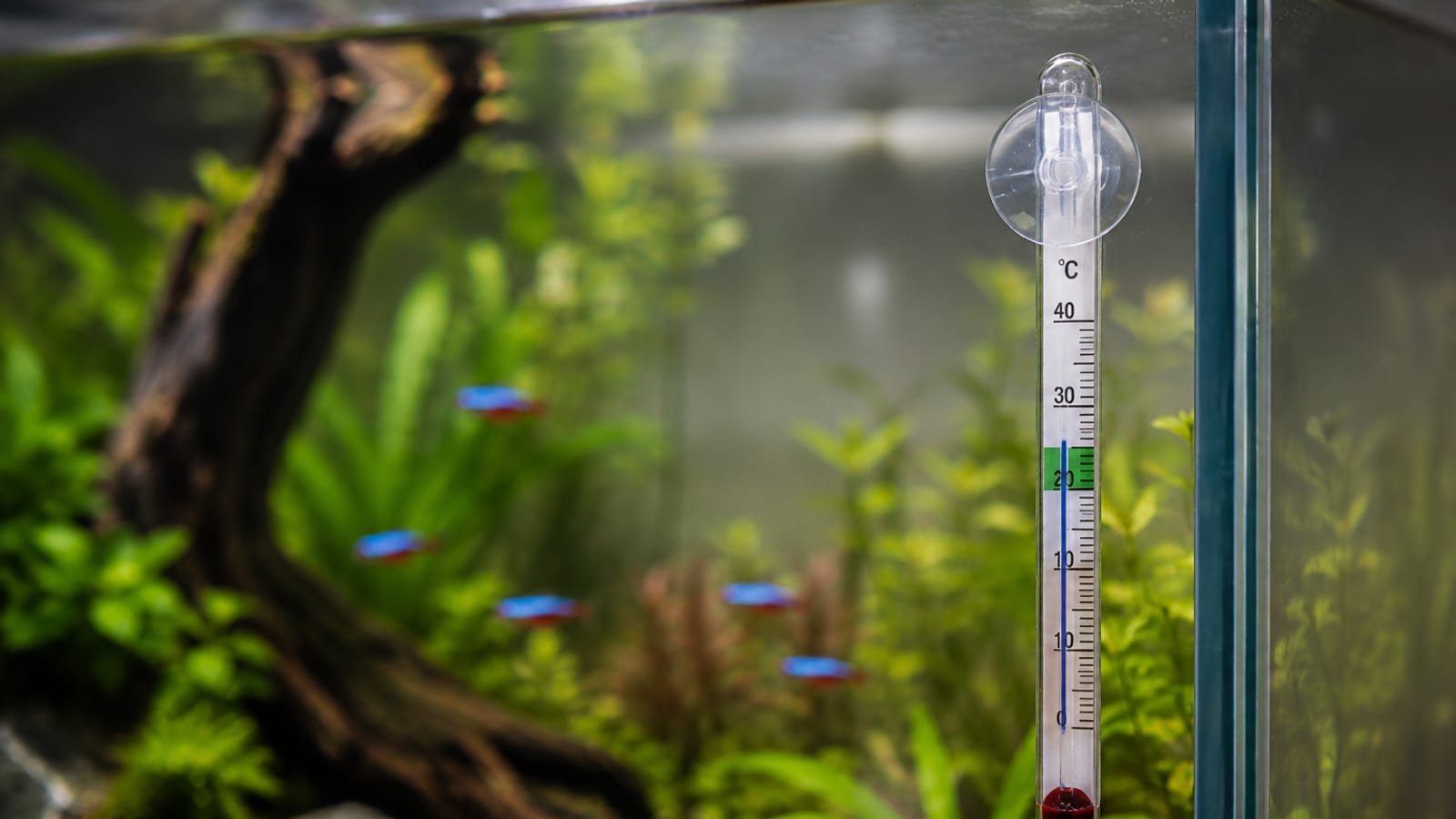
What Temperature Should a Fish Tank Be? By Species
What temperature should a fish tank be? 76-78°F suits almost every community tank. Bettas want warmer and goldfish cooler — which is why they cannot share.