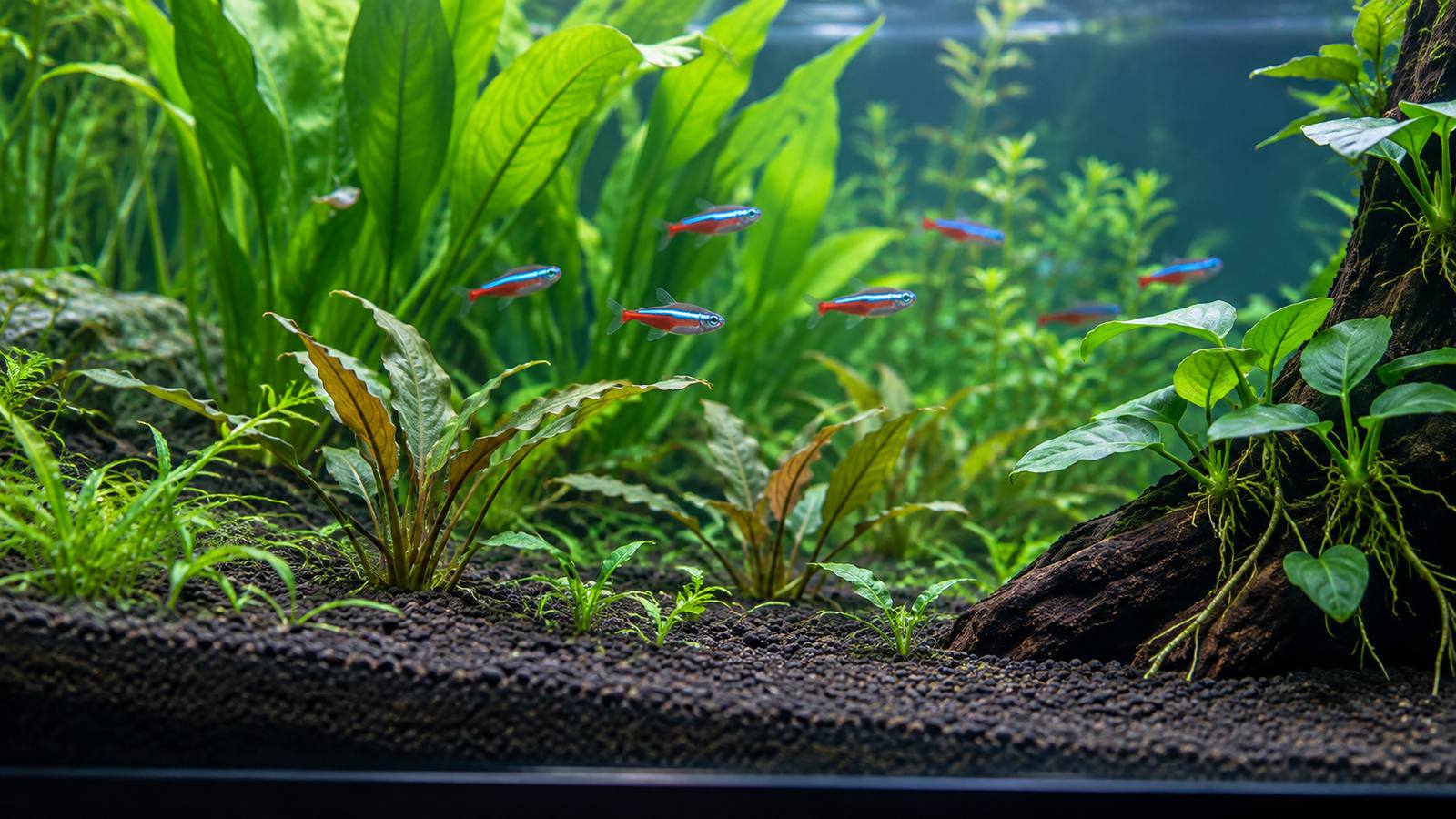
Add root tabs under swords and crypts. For a tank built around root feeders, a clay gravel: Seachem Flourite or CaribSea Eco-Planted. For shrimp, soft-water fish or a carpet, Fluval Stratum. We picked these from makers' specifications and planting guides, not from hands-on testing.
Full specs
| Substrate | Best for | Kind | Grain (maker) | Changes pH? | Lasts | Bag |
|---|---|---|---|---|---|---|
| Plain gravel and Seachem Flourish TabsPrice on Amazon | Low-tech tanks of anubias, java fern, stems and a few swords | Inert, plus root tabs | Your gravel | No, though Seachem says slightly acidic in very soft water | Gravel: the life of the tank. Tabs: renew every 3–4 months | 10 tabs |
| CaribSea Eco-Planted BlackPrice on Amazon | A tank built around root feeders | Volcanic (basalt) gravel | 0.25–7.0 mm | Maker doesn't say | Not stated by maker | 20 lb |
| Seachem FlouritePrice on Amazon | Root feeders, never replace it | Porous clay gravel | Not published | No | "Life of the aquarium" | 7 kg (15.4 lb) |
| Seachem Flourite Black SandPrice on Amazon | Corydoras, a fine foreground | Clay, sand grade | Not published | No | "Life of the aquarium" | 7 kg |
| Fluval Plant and Shrimp StratumPrice on Amazon | Shrimp, soft-water fish, carpets | Aquasoil (active) | Not published | Yes, toward neutral to slightly acidic | Aquasoils run down in one to a few years | 17.6 lb (8 kg) |
The best substrate for a planted aquarium depends on where your plants feed. If you keep anubias, java fern and stem plants, the gravel you already have is fine: they take nutrients from the water, and anubias and java fern rot if buried. Add root tabs only under swords and crypts. For a tank built around root feeders, use a clay gravel such as Seachem Flourite or CaribSea Eco-Planted. For shrimp, soft-water fish or a carpet, use an aquasoil such as Fluval Stratum, and plan for extra water changes in the first month.
How we chose. We have not grown plants in these substrates ourselves. The picks rest on makers' specifications and planting guides, how each kind of plant feeds, and bag counts worked out from each maker's own density figure or calculator. Specs and prices were checked on 28 October 2026. Prices are the item price shown on the retailer's page that day, before shipping and tax. Shipping depends on where you live and prices change often, so check the current price before you buy.
First, check whether your plants grow in the substrate at all
Plants feed two ways. Rhizome plants, floating plants and most stem plants take most of their food from the water, while swords, vallisneria, crypts and certain carpet plants feed mainly through their roots. That split, which Aquarium Co-Op sets out and Tropica's own care pages agree with, decides whether you need an aquarium substrate for plants at all.
| Plant | Feeds mostly from | Plant it in the substrate? | Needs a plant substrate? |
|---|---|---|---|
| Anubias | Water | No. Tie it to wood or rock; a buried rhizome rots | No |
| Java fern | Water | No. Same rule as anubias | No |
| Floating plants | Water | No | No |
| Stem plants | Both | Yes | No, gravel works |
| Amazon sword (Echinodorus) | Roots | Yes | Helps, or use root tabs |
| Cryptocoryne | Roots | Yes | Helps, or use root tabs |
| Vallisneria | Roots | Yes | Helps, or use root tabs |
| Carpet plants | Mostly roots | Yes | Often aquasoil, and some need CO2 too |
The rhizome rule is the one that costs beginners plants. The rhizome is the thick horizontal stem that anubias and java fern grow their leaves from, and Tropica's planting guide is blunt about it: do not cover the rhizome, or the plant rots. Tie the plant to driftwood or wedge it between stones instead.
Stem plants sit in the middle. Aquarium Co-Op says most of them feed from the water, while Tropica lists stem plants among the plants its root capsules are for. They take from both, and they grow in plain gravel.
That roots really do feed is not just a hobby belief. In a field study of nine common lake plants, published in Science, the plants took all their phosphorus from the sediment in two lake bays, and even in very nutrient-rich water the sediment supplied an average of 72% of it. Those were lake plants rather than aquarium species, so take it as evidence that rooted plants feed from the bottom, not as a figure for your tank.
If everything on your list is a rhizome, floating or stem plant, you can stop here: keep the gravel and skip to the first pick.
The three kinds of planted tank substrate
Every planted tank substrate falls into one of three groups. Two are inert, meaning they do not change your water chemistry. The third is active: it changes the water on purpose.
Plain gravel or sand, plus root tabs (inert). It does nothing to the water. A root tab is a fertilizer tablet you push into the gravel next to a root-feeding plant, and it feeds the roots where you put it. Tropica recommends gravel with a grain of 0.8 to 4 mm so water keeps moving around the roots. Avoid very fine sand: Aquarium Co-Op, which sells root tabs, says it compacts and is hard on plants, while coarse sand works much better. This is the best gravel for a planted aquarium in practice, because it is the gravel you already have.
Clay or volcanic gravel (inert). Seachem Flourite and CaribSea Eco-Planted are gravels made from clay or volcanic rock. Aquarium Co-Op says they do not tend to break down, and Seachem says Flourite will not change pH. Their advantage over plain gravel, per Aquarium Co-Op, is a usually higher cation exchange capacity, or CEC: they hold on to nutrients better. Soil scientists explain why: clay particles carry a negative charge, so they hold positively charged nutrients in the root zone instead of letting them wash out. No maker of these products publishes a CEC figure, so treat it as the reason clay helps rather than a number to compare.
Aquasoil (active). Aquasoil is soil formed into small, nutrient-rich granules. It tends to lower pH and soften the water: Fluval says Stratum "helps support neutral to slightly acidic pH", and Tropica says its soil "lowers pH and slightly affects water chemistry." It can release some ammonia when new, and it runs down over time. Tropica says its soil can typically last "a few years", and Aquarium Co-Op says aquasoils are exhausted of nutrients after one to two years. Expect somewhere in that range, and expect it to vary.
None of this contradicts the site's 20 gallon cost guide, which says plain gravel is enough for a first tank. That is true for a first tank of hardy plants. A dedicated aquarium plant substrate is for a tank you plan around root feeders, shrimp or a carpet, which is often a second tank.
The best substrate for a planted aquarium, by setup
Keep your gravel and add Seachem Flourish Tabs: best for a low-tech beginner tank
For a low tech planted tank of anubias, java fern, stems and one or two swords or crypts, the cheapest correct answer is to keep the gravel you have and add root tabs under the root feeders only.
Seachem Flourish Tabs were $12.96 for a pack of 10. Seachem says to insert one tab for every 4 to 6 inch radius, that a standard 10 gallon takes six, and to add new tabs every three to four months. Per Seachem they contain no phosphate or nitrate, though the label does list 0.4% total nitrogen. They will not alter pH, though Seachem adds that in very soft or unbuffered water they are slightly acidic, like peat. You do not need to tab the whole bed: since one tab covers a 4 to 6 inch radius, a tab beside each sword or crypt covers it.
The alternative is Aquarium Co-Op Easy Root Tabs, $13.99 for 20. Aquarium Co-Op sells them under its own name, and says to insert one every 4 to 6 inches in a grid, at least an inch deep, and to replace them every month or as needed.
The limitation is that tabs are a recurring cost, which matters more in year two than in week one. The cost section below puts a number on it.
Seachem Flourish Tabs
Low-tech tanks of anubias, java fern, stems and a few swords
CaribSea Eco-Planted (formerly Eco-Complete): best for a tank built around root feeders
If you are setting up a new community tank around swords, crypts and vallisneria, with no CO2, normal tap water and fish that like neutral water, a clay or volcanic gravel feeds the roots without changing the water.
Eco-Planted is the product many people still search for as Eco-Complete. CaribSea renamed it and says it is the same product. The black version is a basalt volcanic base containing iron, calcium, magnesium, potassium and sulfur, with no dyes, paints or coatings. CaribSea gives the grain as 0.25 to 7.0 mm and the density as about 54 lb per cubic foot, in a 20 lb bag. The red version is laterite based, at 3.0 to 6.0 mm.
It was $33.38 for 20 lb at Chewy, black or red. Its Amazon listing did not show a price we could confirm when we checked.
What we could not confirm: CaribSea does not say whether Eco-Planted affects pH, and retailer listings disagree with each other, so we make no claim either way. Retailer copy says it needs no rinsing, and CaribSea says it contains live bacteria; both are marketing claims we have not seen tested.
CaribSea Eco-Planted
A tank built around root feeders
Seachem Flourite: best if you never want to replace it
Flourite suits the same root-feeder tank, for a buyer who wants to fill it once. Seachem describes it as a porous clay gravel that is not chemically coated, will not alter pH and is "good for the life of the aquarium and need not be replaced." It works best on its own as the whole bed, though it can be mixed with other gravel, and Seachem says gravel modifiers such as laterite are not necessary. Root tabs are "useful and helpful, but are not necessities."
Rinse it before use. Seachem says it can become dusty in transit.
Flourite comes in 3.5 kg and 7 kg bags and several colors. The 7 kg prices seen on Amazon were original $31.99, Red $31.08, Dark $35.18 and Black $35.79. Seachem does not publish a grain size, and the figures on retailer listings conflict, so we leave it out.
Seachem Flourite, 7 kg
Root feeders, never replace it
Seachem Flourite Black Sand: best with corydoras
Flourite Black Sand is the same porous clay at sand grade. Seachem's claims for it match the original's: it will not alter pH and is good for the life of the aquarium. As with Flourite, no grain size is published.
It is the pick for a planted tank with corydoras or other fish that sift the bottom, because many keepers choose sand for those fish. It also suits a foreground of fine-rooted plants. It was $34.14 for 7 kg, or $14.97 for 3.5 kg.
Seachem Flourite Black Sand, 7 kg
Corydoras, a fine foreground
Fluval Plant and Shrimp Stratum: best for shrimp, soft-water fish or a carpet
Stratum is the only active pick here, and the only one that changes your water. Fluval collects it from the foothills of Mount Aso, a volcano in Japan, and sells it for planted tanks and shrimp tanks. It says Stratum helps support neutral to slightly acidic pH, that its porous grains are colonized quickly by nitrifying bacteria, and that it gives newborn shrimp a refuge from predators. That makes it the best substrate for a planted aquarium with shrimp, and a common choice for carpet plants, which feed by the root. Some carpets also need added CO2: Tropica rates Glossostigma, a popular one, high for both light and CO2.
Fluval is straightforward about the start-up: "Stratum is a natural soil product, and like any other organic matter, adding it to an aquarium has the potential to slightly increase ammonia levels. If the aquarium is established, this should not present a problem." It recommends an ammonia test kit to make sure the tank is safe for fish, and it also says to rinse it gently in a colander without agitating it.
It was $32.91 for the 17.6 lb (8 kg) bag at Chewy, a sale price against a $71 list price, so check it before you rely on the costs below. The 4.4 lb bag was out of stock there, and we did not find it in an Amazon search.
The limitation follows from what it does. Because it softens the water and lowers pH, it is the wrong choice for fish that need hard water.
Fluval Plant and Shrimp Stratum
Shrimp, soft-water fish, carpets
How much substrate do you need for a 10 or 20 gallon?
For a 10 gallon with about a 2 inch bed, one bag of any pick here is enough. For a 20 long at about 2.5 inches, buy two bags of Eco-Planted or Stratum, or three of Flourite by Seachem's calculator.
The footprints are approximate interiors: about 20 × 10 inches for a 10 gallon and 30 × 12 inches for a 20 long.
| Tank and depth | Volume | Eco-Planted | Flourite | Stratum |
|---|---|---|---|---|
| 10 gallon, 2 in | 400 in³, about 6.6 L | 12.5 lb: one 20 lb bag, $33 | One 7 kg bag, $32 | About 6.6 kg: one 8 kg bag, $33 |
| 20 long, 2.5 in | 900 in³, about 14.7 L | 28 lb: two 20 lb bags, $67 | Three 7 kg bags, about $96 | About 14.7 kg: two 8 kg bags, $66 |
Here is the working, so you can redo it for your own tank:
- Eco-Planted: length × width × depth in inches, divided by 1,728, times 54 lb. A whole 20 lb bag in a 10 gallon gives about a 3.2 inch bed.
- Stratum: Fluval's formula is length × width × depth in centimeters, divided by 1,000, which gives kilograms.
- Flourite: Seachem's online calculator. It rounds up, so at a 2 inch bed a 20 long may need only two bags.
Comparing bags by the pound can mislead you. Plain gravel is much denser than these substrates, at about 13 lb per inch of depth in a 10 gallon. A 20 lb bag of Eco-Planted, at 54 lb per cubic foot, covers far more of the bottom than a 20 lb bag of plain gravel. If you are keeping plain gravel, the 10 gallon setup guide covers how much plain gravel a 10 gallon takes.
What each option costs in year two
The bag is a one-off. Root tabs are not.
| Option | Up front (10 gallon) | Ongoing |
|---|---|---|
| Your gravel and Flourish Tabs | One pack of tabs, $12.96, if the gravel is already in | 6 tabs every 3–4 months is 18–24 a year: 2–3 packs, about $26–$39 a year if you tab the whole bed |
| Flourite or Eco-Planted | About $32–$33 | Nothing required. Tabs optional under heavy root feeders |
| Stratum | About $33 | Nutrients run down over one to a few years, then tabs or replacement |
The plain conclusion: in a 10 gallon, a year of root tabs across the whole bed costs about as much as one bag of plant substrate. Tabs win when only two or three plants feed by the root, because you only tab under those. A plant substrate pays off in a tank full of root feeders.
A 20 long has a bigger footprint, 360 square inches against 200, so tabbing the whole bed costs more, though not necessarily double. Seachem's own figures point both ways: one tab per 4 to 6 inch radius suggests a little under double, while it also says a 10-pack treats a 12 × 30 inch bed, a 20 long's footprint, twice. Treat anything between the 10 gallon cost and about double it as the estimate.
How deep should substrate be in a planted tank?
Slope it, from at least 1.25 to 1.5 inches (3–4 cm) at the front to about 2.5 to 3 inches (6–8 cm) at the back. That is Tropica's recommendation, and it puts the deepest bed where the largest root feeders, such as swords, belong.
For grain size, Tropica recommends 0.8 to 4 mm for gravel. The aquascaping site Aquascaping Love suggests finer grains of 1 to 2 mm for carpets and 2 to 5 mm for large rooted plants, broadly in line with Tropica's range.
Deeper is not always better with fine sand. A deep, fine bed that nothing stirs can lose its oxygen and form pockets that smell of rotten eggs. Why a fish tank smells explains how to spot one and what to do about it.
Do you need substrate layers?
Not with these picks. Planted aquarium substrate layers come up a lot, but every product here is meant to be the whole bed. Tropica calls its Aquarium Soil "a complete substrate that can be used without any other type of bottom layer", and Seachem says Flourite is most effective "used alone as an integral substrate bed", though it can be mixed with other gravel.
Layering takes two forms. One is a thin nutrient base under ordinary gravel: Tropica suggests a layer of ½ to 1 cm under the gravel. The other is a "dirted" tank, where ordinary soil is capped with sand or gravel, a method hobbyists recommend often on forums. Both work for experienced keepers, but they are beyond this beginner buying guide.
Setting up aquasoil without an ammonia spike
Aquasoil can release some ammonia at first. Fluval says that in an established tank "this should not present a problem" and recommends an ammonia test kit. Tropica recommends changing 25 to 50% of the water at least twice a week during the first four weeks after setting up with its soil. How much ammonia appears varies between brands and tanks, so test rather than guess.
- Rinse Stratum gently in a colander without stirring it, as Fluval directs.
- Fill the tank slowly. Pour onto a saucer resting on the bed so the stream does not dig a crater.
- Cycle the tank before adding fish. New aquasoil and fish going in on the same day is exactly the combination to avoid.
- Test for ammonia during the first weeks, and before fish go in.
- Do the extra water changes in month one: 25 to 50%, twice a week, per Tropica.
A brown dust on new substrate and glass in the first months is normal. It is diatoms, and it fades as the tank matures.
Flourite and Eco-Planted are not aquasoils, so none of this applies to them, beyond rinsing Flourite.
Shrimp, corydoras and hard-water fish
Shrimp. Stratum. Fluval sells it for shrimp, its porous grains give baby shrimp somewhere to hide, and Fluval says it helps support a neutral to slightly acidic pH, which suits soft-water shrimp.
Corydoras. Flourite Black Sand. Many keepers choose sand for corydoras, and this is the planted-tank version of it.
Hard-water fish. Avoid aquasoil for African cichlids, or livebearers you keep in hard water. As Aquarium Co-Op puts it, "the last thing you want to do is lower the pH and soften the water." Choose a clay gravel, or plain gravel with tabs. If your tap water is already soft, with little buffering, see soft, low-KH water before choosing an aquasoil, because it will soften it further.
Left out, and why
ADA Aqua Soil Amazonia. It is a popular choice for CO2 tanks, but retailer and forum sources describe a heavy ammonia release at the start, which makes it the wrong first buy for anyone adding fish soon. ADA's English product page returned an error when we checked.
Tropica Aquarium Soil. Well documented, and we use Tropica's guidance throughout, but Chewy did not list it when we searched, and in the US it is sold mainly through specialist planted-tank shops.
UNS Controsoil and dirted tanks. Beyond a beginner buying guide.
The short version
Check your plants first. If they are water feeders, keep your gravel. If a few are root feeders, add tabs under them. If the tank is built around root feeders, buy a clay gravel: Flourite or Eco-Planted. For shrimp, soft-water fish or a carpet, buy an aquasoil such as Stratum and cycle the tank before fish go in. Whichever is the best substrate for your planted aquarium, buy one bag for a 10 gallon and two for a 20 long, or three of Flourite by Seachem's calculator.
Sources
- Aquarium Co-Op. How to Pick the Best Substrate for a Planted Aquarium.
- Tropica. Anubias barteri var. nana.
- Tropica. Planting.
- Tropica. Nutrition Capsules.
- Carignan and Kalff. Phosphorus sources for aquatic weeds: water or sediments? Science 207(4434):987–989, 1980.
- Tropica. Hardscape and substrate.
- Seachem. Flourite.
- Sonon, Kissel and Saha. Cation Exchange Capacity and Base Saturation. University of Georgia Extension, Circular 1040.
- Fluval. Plant and Shrimp Stratum.
- Tropica. Aquarium Soil.
- Tropica. FAQ.
- Seachem. Flourish Tabs.
- Retailer listings, seen 28 October 2026: Amazon (Flourish Tabs, Flourite, Flourite Black Sand) and Chewy (CaribSea Eco-Complete Planted, Fluval Plant and Shrimp Stratum).
- Aquarium Co-Op. Easy Root Tabs.
- CaribSea. Freshwater substrates: Eco-Planted.
- Seachem. Flourite Black Sand.
- Tropica. Glossostigma elatinoides.
- Aquascaping Love. Planted Aquarium Substrate.
Questions people ask
Mentioned in this guide
Related guides
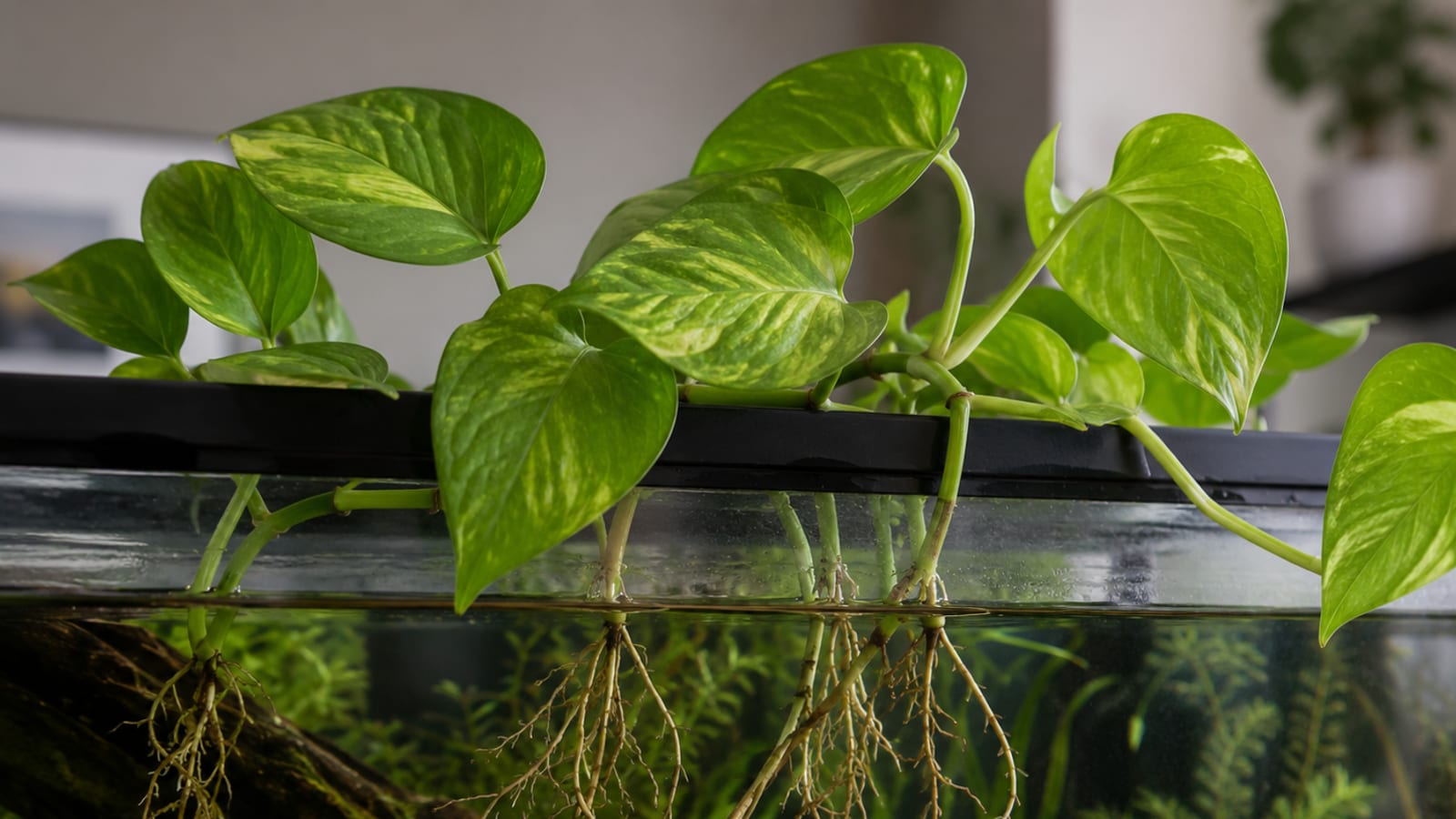
Pothos in an Aquarium: Safe for Fish, Risky for Shrimp
Pothos in an aquarium is safe for fish and a strong nitrate exporter — roots in the water, leaves in the air. The real risk is the pesticide on the plant.
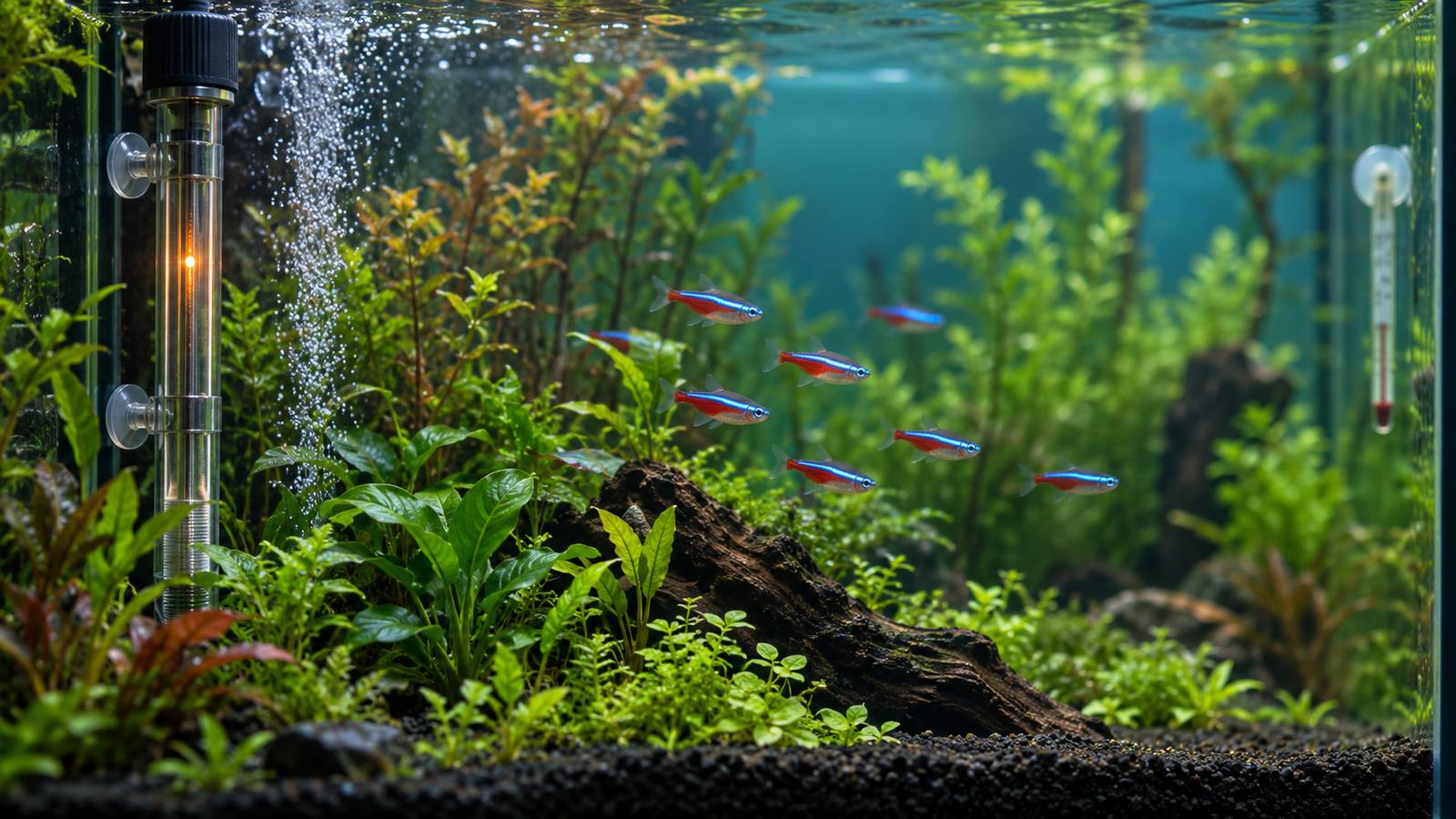
Best Aquarium Heater: How Heaters Fail and Which to Buy
The best aquarium heater is right-sized, cuts out when dry and runs on a controller. See how heaters fail and which to buy for 5 to 75 gallon tanks.
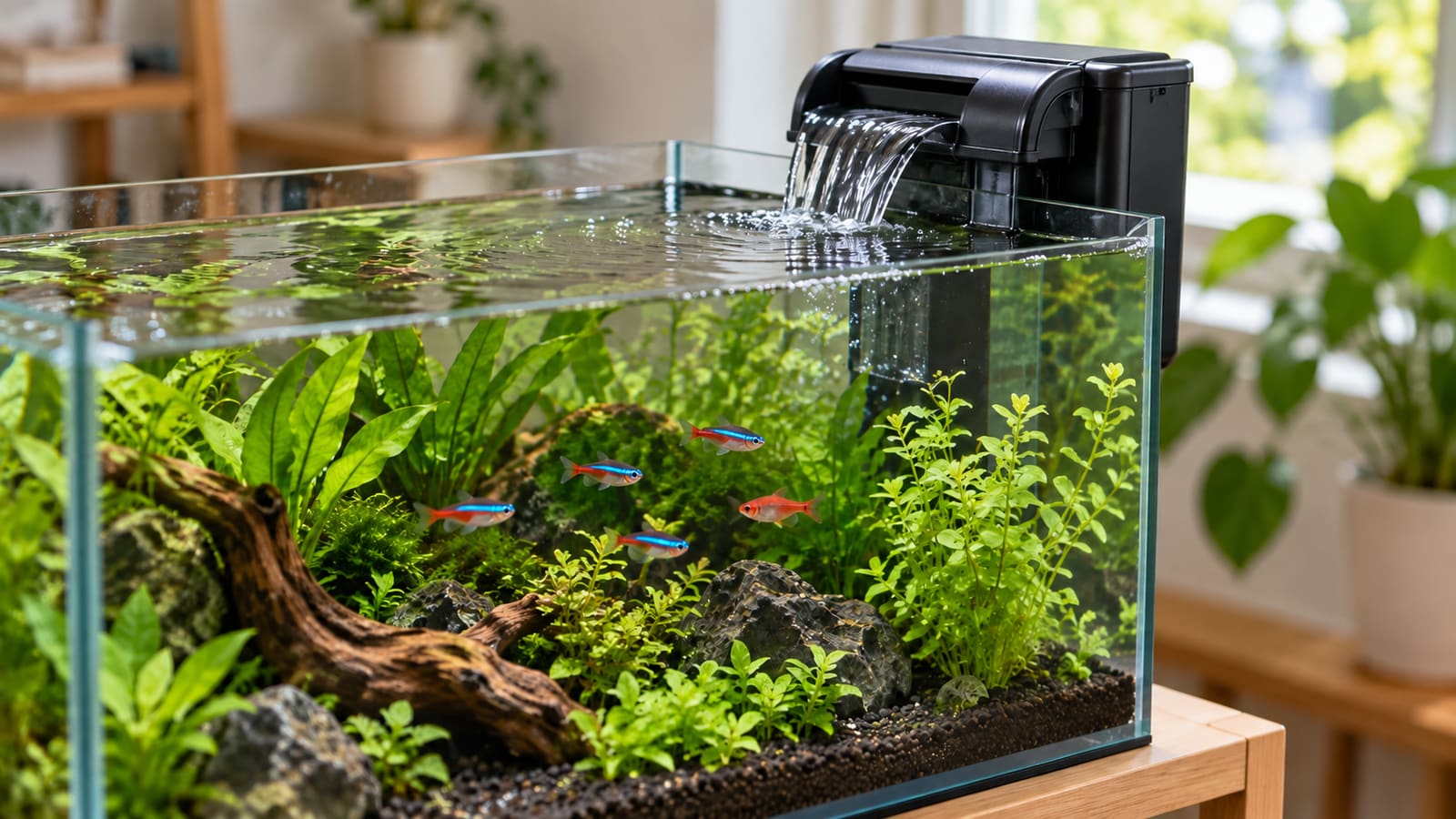
Best Filter for a 10 Gallon Tank: Picks by Setup, With Specs
The best filter for a 10 gallon tank depends on what lives in it. Picks for community, betta, shrimp and budget tanks, compared on maker specs.