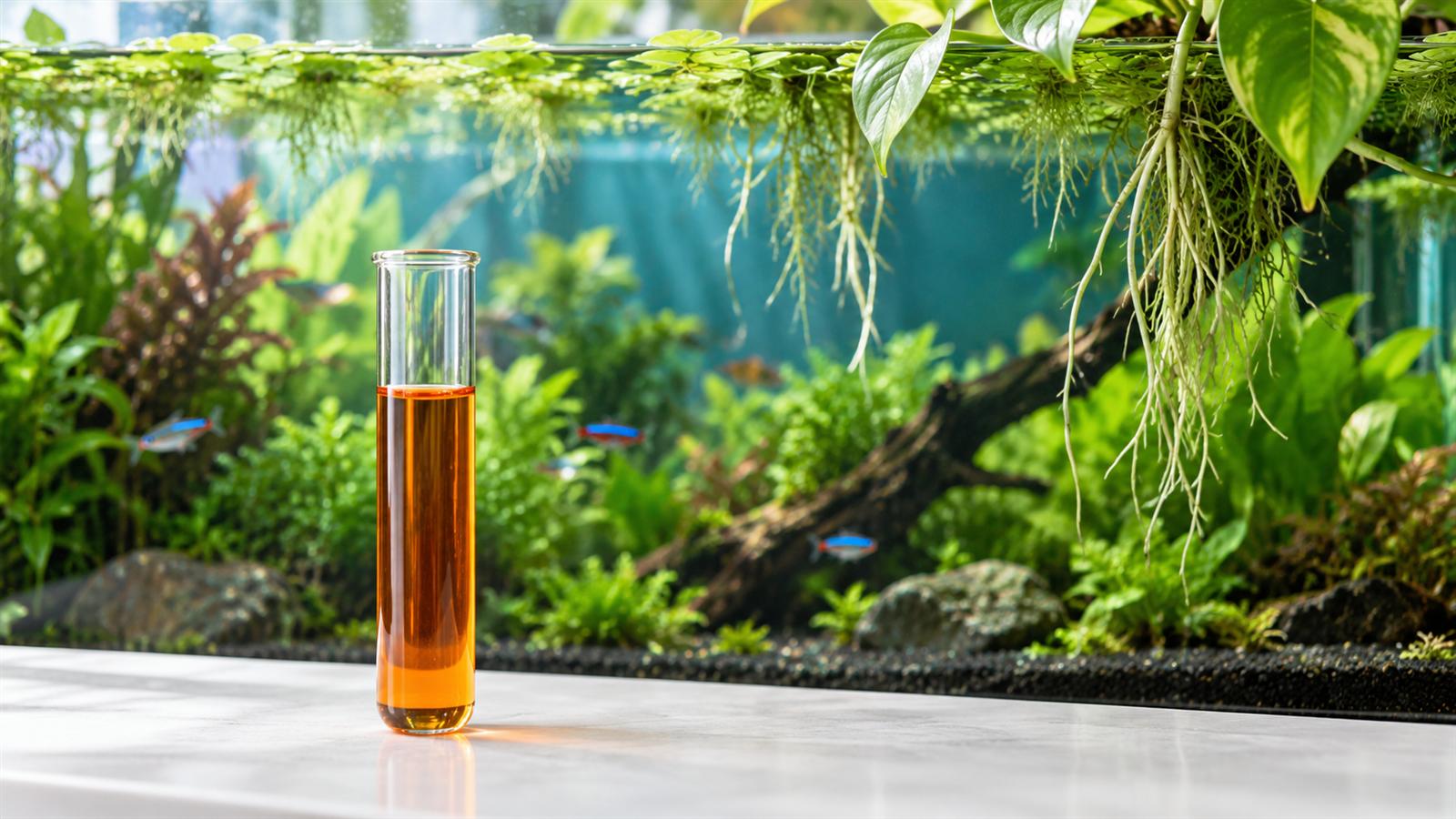
Then measure how much it rises in a week and size your weekly change to match. If water changes barely move it, test your tap water: no water change can take nitrate below the level in the water you refill with. In a tank left for months without a change, use 20% changes instead, so the pH does not swing.
Some links go to retailers. As an Amazon Associate, Aquarium for Beginners earns from qualifying purchases, at no extra cost to you.
The numbers
| Nitrate (API kit) | What it means | What to do |
|---|---|---|
| Under 20 ppm | Healthy. The target for most tanks | Keep your current schedule |
| 20–40 ppm | Acceptable, but your schedule is not quite keeping up | Change a bigger share each week, or feed less |
| 40–80 ppm | Too high to leave. Sensitive fish suffer over time | Change 50% now, then every 2–3 days until under 20 |
| 80–160 ppm | Very high. Usually a tank that has gone months without changes | Compare the tank's pH with the tap's first. If it is lower, change 20% every 2–3 days |
| Tap water reads 10 ppm or more | Every water change refills the tank to at least this level | Blend in RO water, add plants. See the tap water section |
To lower nitrates in a fish tank, take them out with water: a 50% water change halves the reading, every time. Repeat it every two to three days until nitrate tests under 20 ppm, then size your weekly change so it stays there.
When water changes seem not to work, there are two usual reasons. Either the tap water already contains nitrate, so every change refills the tank with it, or the tank makes nitrate faster than your schedule removes it. You can measure both with the test kit you already have, and this guide shows how.
Step 1: test the tank and the tap
Use the same kit for both. A liquid kit gives you a number. Strips give you a colour band that is too broad to plan with.
- Shake Nitrate Test Solution #2 hard for at least 30 seconds before you use it. API calls this step "extremely important" for accuracy.
- After adding the drops, cap the tube, shake it for a full minute, then wait 5 minutes before reading.
- Test a glass of tap water the same way. Whatever it reads is the lowest a water change can ever take your tank.
- If the tank reads 160 ppm, the darkest colour on the chart, the real level may be higher. Test again using half tank water and half distilled water, then double the result.
Step 2: bring it down without shocking the fish
A drop in nitrate does not harm fish. The risk comes from everything else that changes when you swap a lot of water at once.
If the tank gets regular water changes, change 50% now and repeat every two to three days until nitrate reads under 20 ppm. Starting at 80 ppm with nitrate-free tap water, that is 40 after the first change and about 20 after the second, plus whatever the fish add in between.
If the tank has gone months without a change, test the pH of the tank and the tap first. A neglected tank slowly turns more acidic and softer than the tap water. One big change swings it back within an hour, which is a shock in itself, and any ammonia in the water becomes more toxic as the pH rises. Change 20% every two to three days instead. With nitrate-free tap water, about six of those take 80 ppm down to the low 20s, plus whatever the fish add in between. Why fish keep dying covers this old-tank problem in more detail.
Either way, dose conditioner for the whole tank volume and match the temperature to within 2°F. The water change guide has the full routine.
Step 3: work out how fast your tank makes nitrate
This is the step most guides skip, and it decides whether nitrate stays down.
Test straight after a water change, then again a week later, just before the next one. The difference is your tank's weekly rise.
On a steady routine, the reading just before each change settles at:
your tap water's nitrate + (weekly rise ÷ share of water changed)
So a tank that adds 10 ppm a week, on 25% weekly changes, settles at 40 ppm before each change and 30 after it. Switch to 50% changes and it settles at 20 and 10.
| Weekly rise | 10% weekly change | 25% weekly change | 50% weekly change |
|---|---|---|---|
| 5 ppm | 50 ppm | 20 ppm | 10 ppm |
| 10 ppm | 100 ppm | 40 ppm | 20 ppm |
| 20 ppm | 200 ppm | 80 ppm | 40 ppm |
The table shows where nitrate settles just before each change. Add your tap water reading to every number.
Two things follow from it:
- A small weekly change cannot hold a busy tank. At 10% a week, even a modest rise of 10 ppm settles at 100 ppm. That is how a tank that gets "regular water changes" ends up at the top of the chart.
- A new schedule takes weeks to settle. Each week closes a share of the gap equal to the share of water you change. On 25% changes it takes about eight weeks to get within 10% of the new level. On 50% changes it takes three to four. If nitrate is still drifting after you change the schedule, give it time before you decide it is not working.
What the formula assumes
It assumes the tank makes nitrate at a steady rate, you change water once a week, and nothing else removes nitrate. Real tanks wobble, and plants pull the numbers down. Treat it as a planning tool, not a promise. It is close enough to pick a schedule.
The tap water trap
In the US, drinking water can legally contain up to 10 mg/L of nitrate measured as nitrogen (US EPA). Aquarium kits measure the whole nitrate ion, which weighs 4.43 times as much, so that legal limit reads about 44 ppm on an API kit. Tap water can be perfectly safe to drink and still read higher than a healthy aquarium should.
To check yours:
- Test it. Five minutes with the kit you already own.
- Read your water report. Every US community water system has to publish a Consumer Confidence Report by July 1 each year (US EPA). You can search for yours at sdwis.epa.gov/fylccr, or ask your water supplier. Reports usually give nitrate "as N", so multiply by 4.43 before comparing it with your test.
- Private wells get no report, so test the water yourself.
If your tap water reads above about 10 ppm:
- Blend in RO water. A reverse osmosis filter removes most of the nitrate. A University of Nebraska guide works through an example at 85% removal (Dvorak and Skipton, 2014). Mixing RO water 50/50 with tap water halves the nitrate. Do not use pure RO water on its own, because it has none of the minerals fish need. Distilled water in a fish tank explains why. Household units also send 70–80% of the water they take in to the drain.
- Grow plants that feed on nitrate. See below.
- Do not boil it. Boiling removes water, not nitrate, so it concentrates the nitrate.
Top-ups count too. Water evaporates from a tank but nitrate does not, so the level creeps up between changes, and topping up with tap water adds more.
Cut the source: food, fish and dirt
All the nitrate in a tank started as food. Fish-farm engineers estimate that about half the nitrogen in fish feed goes unused by the fish and ends up in the water (Losordo and DeLong, 2015). As a rough guide, every gram of flake or pellets fed per day in a 20 gallon tank adds about 13 ppm of nitrate a week, if nothing else removes it.
That figure comes from simple arithmetic. A gram of 40%-protein food holds about 0.064 g of nitrogen. Half of it, spread through 75 litres for a week and converted to the units your kit reads, comes to about 13 ppm.
So:
- Feed less. Give only what the fish finish in about two minutes, once or twice a day. Halving the food roughly halves the weekly rise, which can do more than doubling the water change.
- Check the stocking. More fish means more waste. How many fish fit in a 10 gallon explains why small tanks get overstocked so easily.
- Clean out the waste. Uneaten food, waste in the gravel and sludge in the filter keep breaking down into nitrate. Vacuum the gravel at each change, take out dead leaves, and rinse the filter sponge in old tank water about once a month.
- Read the fertiliser label. Some plant fertilisers add nitrogen on purpose. Seachem Flourish Nitrogen, for example, is made from potassium nitrate and urea (Seachem). A planted tank needs some nitrate, but in a tank that is already high, stop dosing nitrogen.
Plants: how much they actually help
Plants use nitrate as food, and fast growers use the most. In a 2024 study of tanks raising ornamental fish, tanks with Najas grass held nitrate at about 9 to 12 mg/L over four weeks, while matching tanks without plants rose to about 34 to 35 mg/L (Csontos et al., 2024).
The best choices for a beginner:
- Floating plants. They sit in unlimited light and air at the surface, so they grow fast.
- Fast stem plants such as hornwort and water sprite.
- Pothos, with its roots in the water and its leaves in the air. A houseplant cutting hung on the rim is one of the cheapest ways to pull nitrate out of a tank.
Plants slow the rise. They will not take a tank from 80 ppm to 20 this week. And the nitrogen only leaves the tank when you take the growth out, so trim and remove plants regularly.
Do nitrate removers work?
| Product | What it does | Verdict |
|---|---|---|
| Water changes | Dilution. Takes out the same share of nitrate as the share of water you replace | Always works, down to your tap water's level |
| Seachem Purigen | A synthetic adsorbent that removes organic waste before it breaks down into nitrate. Seachem says it does not directly remove nitrate | Prevention, not a cure |
| API Nitra-Zorb | A pouch of ion-exchange resins, according to API's product listing. Recharged by soaking in salt water, replaced after two months | A workable stopgap. Size 6 fits most canister filters, API says |
| Seachem de*nitrate | Removes nitrate only where water flows through it slowly, under 50 gallons an hour | In a normal filter it acts as ordinary filter media |
| Seachem Prime | Seachem says it binds nitrate for up to 48 hours. It does not remove it | Not a nitrate fix |
| Bottled bacteria | Dr Tim's says its One & Only does not remove nitrate | No |
| RO water | Removes most of the nitrate from tap water before it goes in | Worth it only if your tap water is the problem |
The sources for this table are the makers' own pages: Purigen, Nitra-Zorb, de*nitrate, Prime and One & Only. Where a product works, it is because it does one of three things: dilutes nitrate, stops it forming, or locks it away somewhere you then remove.
What level is actually safe?
Nitrate is far less toxic than ammonia or nitrite. Fish survive levels that sound alarming. Rainbow trout kept for three months at 80–100 mg/L of nitrate-nitrogen, about 350 to 440 ppm on an API kit, developed health problems (Davidson et al., 2014). In a 30-day test on Nile tilapia, growth and health suffered at the highest level tested, 1,000 mg/L of nitrate-nitrogen, and the authors advise staying under 500 mg/L (Monsees et al., 2017).
The concern is the long term. A review of nitrate toxicity concluded that 10 mg/L of nitrate-nitrogen, about 44 ppm on an API kit, can harm sensitive freshwater fish, invertebrates and amphibians over long exposures. It suggested 2 mg/L, about 9 ppm, to protect the most sensitive species (Camargo et al., 2005). That review covered species such as trout and salmon, not aquarium fish, but it is the best guide available.
API recommends 40 ppm or less (API). Put together, that gives a simple rule: aim under 20 ppm, act at 40. Shrimp are invertebrates, one of the most sensitive groups in the review, so keep a shrimp tank nearer 10 ppm. We found no study of aquarium shrimp specifically.
Check which units you are reading
API kits report nitrate as the nitrate ion, NO₃⁻. Water reports and most research give nitrate-nitrogen (NO₃-N). To compare a nitrate-nitrogen figure with an API reading, multiply it by 4.43. A water report showing 5 mg/L as N means about 22 ppm on your kit.
What you need
| Item | Why |
|---|---|
| API Freshwater Master Test Kit | Liquid nitrate test, plus ammonia, nitrite and pH. Or the cheaper API nitrate kit on its own |
| Python No Spill Clean and Fill, 25 ft | Drains and refills from the tap, so 50% changes in a 20 gallon or larger tank take minutes, with no buckets |
| Gravel siphon | The budget option for tanks up to about 20 gallons. Vacuums the gravel as it drains |
| Seachem Prime | Conditioner. When you refill straight from the tap, dose it for the whole tank volume before the water goes in |
| Seachem Purigen | Optional. Slows how fast nitrate builds up by removing waste first. It will not lower a high reading |
| API Nitra-Zorb, size 6 | Optional, for canister filters. Pulls nitrate out between changes. Recharge it in salt water |
| Aquatic Life RO Buddie | Only if your tap water reads high. Does not remove chloramine, so keep using conditioner |
The one thing worth taking from this
Water changes always remove nitrate, but only in proportion to how much water you change, and only down to the level in your tap. Measure both your tap water and your tank's weekly rise, and the right schedule becomes simple arithmetic.
Sources
- US EPA. National Primary Drinking Water Regulations.
- US EPA. Consumer Confidence Report information for consumers.
- API. Nitrate Test Kit instructions.
- Camargo, Alonso and Salamanca (2005). Nitrate toxicity to aquatic animals: a review with new data for freshwater invertebrates. Chemosphere 58: 1255–1267.
- Davidson, Good, Welsh and Summerfelt (2014). Comparing the effects of high vs. low nitrate on the health, performance, and welfare of juvenile rainbow trout Oncorhynchus mykiss within water recirculating aquaculture systems. Aquacultural Engineering 59: 30–40.
- Monsees, Klatt, Kloas and Wuertz (2017). Chronic exposure to nitrate significantly reduces growth and affects the health status of juvenile Nile tilapia (Oreochromis niloticus L.) in recirculating aquaculture systems. Aquaculture Research 48: 3482–3492.
- Csontos, Bartal and Bakacsy (2024). Removal of nitrate and phosphate by aquatic plants during aquarium-based ornamental fish production. North American Journal of Aquaculture 86: 413–423.
- Losordo and DeLong (2015). Flow rate estimation for RAS. Global Seafood Alliance.
- Dvorak and Skipton (2014). Drinking Water Treatment: Reverse Osmosis. University of Nebraska–Lincoln Extension, G1490.
- Seachem. Purigen, de*nitrate, Prime and Flourish Nitrogen.
- API. Nitra-Zorb.
- DrTim's Aquatics. One & Only.
Questions people ask
Mentioned in this guide
Related guides
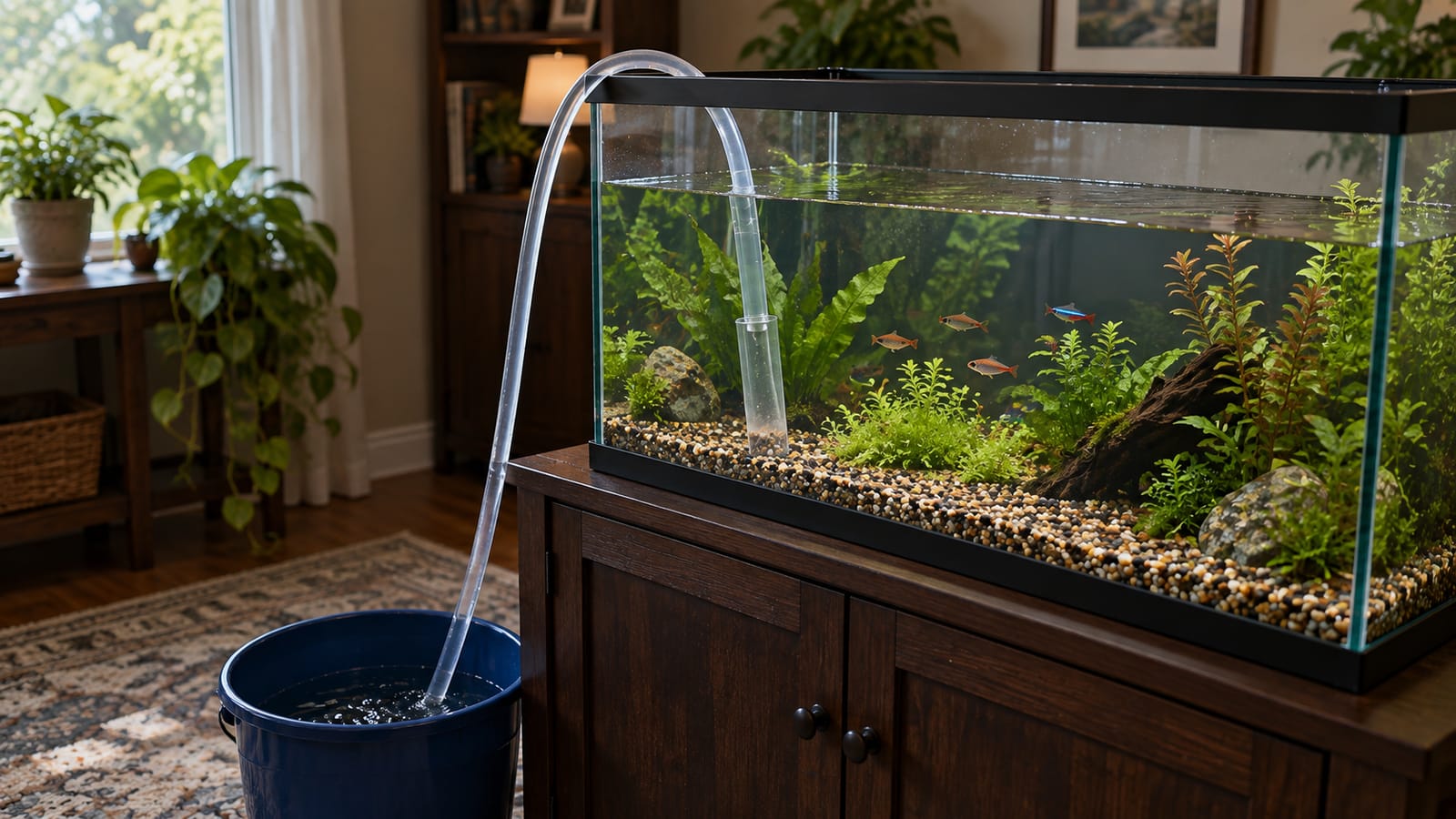
How to Change Fish Tank Water, and How Often to Do It
How to change fish tank water: replace 25% once a week, with new water dechlorinated and matched to within 2°F. The steps, and how to set your own schedule.
How to Lower Nitrites in a Fish Tank: What to Do Today
To lower nitrites in a fish tank, change 50% of the water today and add a little aquarium salt to block it. Then fix the cause. Exact doses, sourced.
Why Do My Fish Keep Dying? Work Out When, Then Why
When fish keep dying one after another, the timing names the cause: a new tank, a water change, new fish or a neglected tank. How to find yours and stop it.