Quick Verdict
A fish tank temperature of 76-78°F (24-26°C) suits almost every beginner community tank. Bettas want 78-80°F and goldfish want 65-72°F, and the two cannot share a heater setting — which is the real reason they cannot share a tank.
76 to 78°F, or 24 to 26°C. That is the answer for almost every beginner community tank, and if you set your heater there and never touch it again you will be fine.
The table above has the species that want something different, and it agrees with the ranges Aquarium Science publishes in its temperature reference. Two of them matter more than the rest, because they pull in opposite directions.
Why stability beats the exact number
Fish are ectothermic: their body temperature is whatever the water's is. Every metabolic process they run — digestion, immune response, oxygen uptake — is set by the number on your thermometer, and they have no way to buffer a change.
That has a consequence people miss. A tank held steady at 75°F is healthier than one that averages 78 but swings between 74 and 82. The destination matters less than the stability of getting there.
What a heater is really for
Not to make the water warm — to stop it moving. A room that sits at 74°F in the afternoon and 66°F at 3am is putting your fish through an 8-degree cycle every day. The heater's job is flattening that curve.
The goldfish and betta problem
These two are the most commonly bought beginner fish and they are at opposite ends of the range.
A betta wants 78-80°F. Bettas come from shallow warm water in Southeast Asia, and they are sold in unheated cups at room temperature, which is where the idea that they do not need a heater comes from. Kept at 70°F a betta becomes lethargic, stops eating, sits on the substrate and gets sick. It is the most frequent cause of the sad-betta question.
A goldfish wants 65-72°F. Goldfish are coldwater fish — genuinely, not as a marketing term — and at tropical temperatures their metabolism runs permanently fast, which shortens their life.
So there is no heater setting that serves both. This is worth stating plainly because "goldfish and a betta in one tank" is a common first plan, and every other objection to it (waste output, adult size, fin nipping) is on top of a temperature conflict that cannot be resolved.
There is no thermostat setting where a goldfish and a betta are both correct. That is the end of the argument before it starts.
Setting your fish tank temperature
- Size the heater at roughly 3-5 watts per gallon. A 10 gallon wants around 50W; a 55 gallon wants 200W or two smaller units.
- Put the heater near the filter outflow, so moving water distributes the heat instead of leaving a warm pocket.
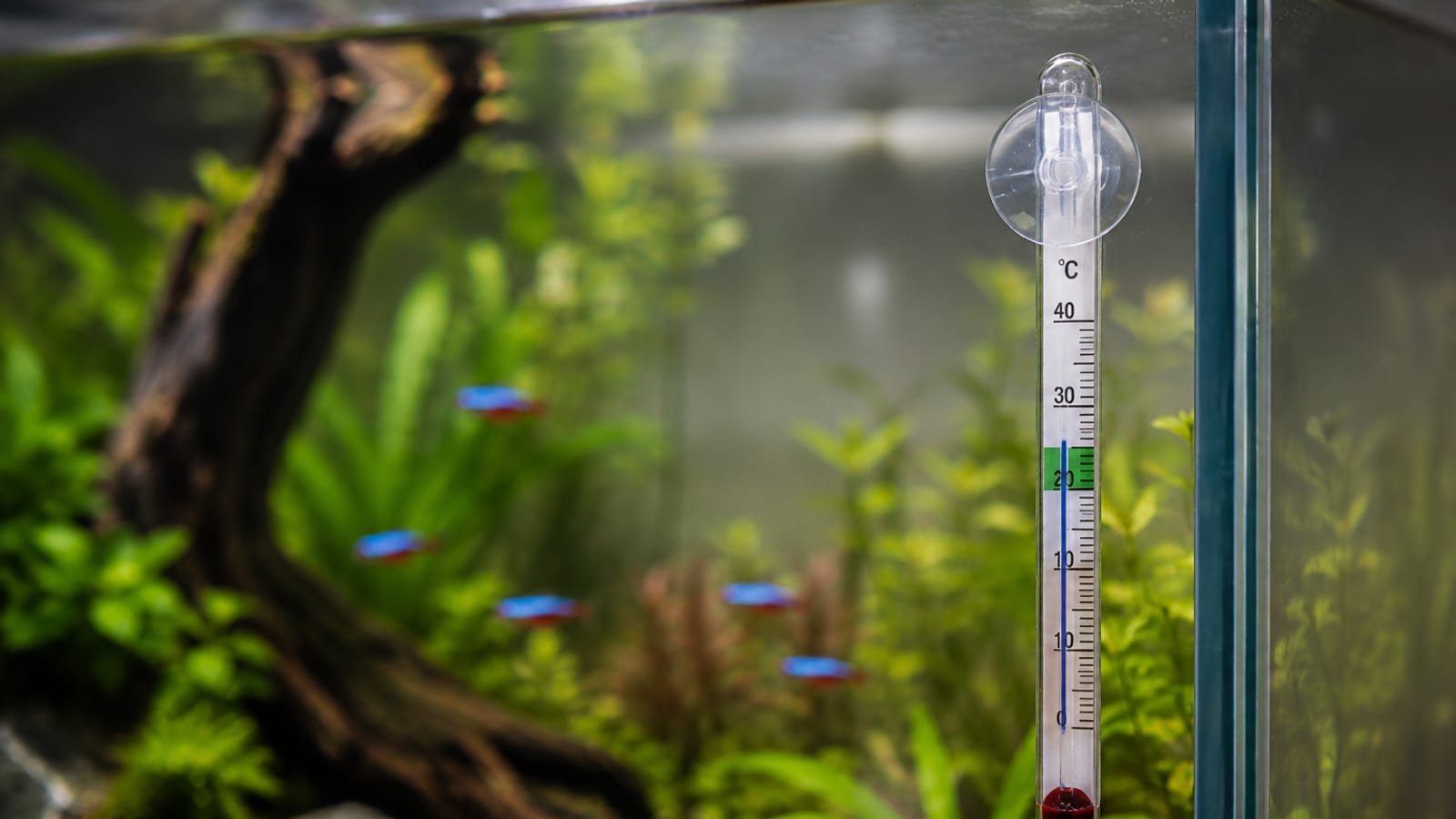
- Put the thermometer at the far end of the tank. Next to the heater it tells you what you want to hear.
- Set it and leave it for 24 hours before adjusting. Heaters respond slowly and chasing the dial overshoots.
- Do not trust the dial's printed numbers — check against your thermometer and adjust to what the water actually reads.
- Keep the tank off windowsills, away from exterior walls, radiators and draughts. Placement does more than wattage.
Two smaller heaters instead of one large one is worth considering in bigger tanks. If one fails off you lose half your heating rather than all of it, and if one fails on — the more dangerous failure — it lacks the power to cook the tank.
When to change it
Rarely, and slowly. 1 to 2°F per day is the ceiling for any deliberate change.
The usual reason to raise it is treating ich, where the standard approach is to bring the tank up to around 80-82°F over two or three days to accelerate the parasite's life cycle. Even then the ramp matters as much as the target, and warm water holds less dissolved oxygen — so add aeration when you raise the temperature.
If you are not treating something, leave it alone. A thermostat that has held 77°F for a year is doing its job, and adjusting it because you read a species chart is a change your fish did not need.
Detailed Comparison
| Fish | °F | °C | Notes |
|---|---|---|---|
| General community tank | 76-78 | 24-26 | The default. Suits tetras, rasboras, corys, livebearers together |
| Betta | 78-80 | 25.5-27 | Sluggish and prone to illness below 76 |
| Neon tetra | 72-78 | 22-26 | Tolerates the low end better than most tropicals |
| Guppy, platy, molly | 74-82 | 23-28 | Wide range. Breed faster at the top of it |
| Corydoras | 72-78 | 22-26 | Most species dislike sustained temperatures above 80 |
| Goldfish | 65-72 | 18-22 | Coldwater. Usually needs no heater at all |
| White cloud minnow | 64-72 | 18-22 | The genuinely unheated tropical-looking option |
| Cherry shrimp | 68-78 | 20-26 | Breed well around 72-75. Shorter lifespan when kept hot |
| Discus | 82-86 | 28-30 | Not a beginner fish, and incompatible with most of this list |