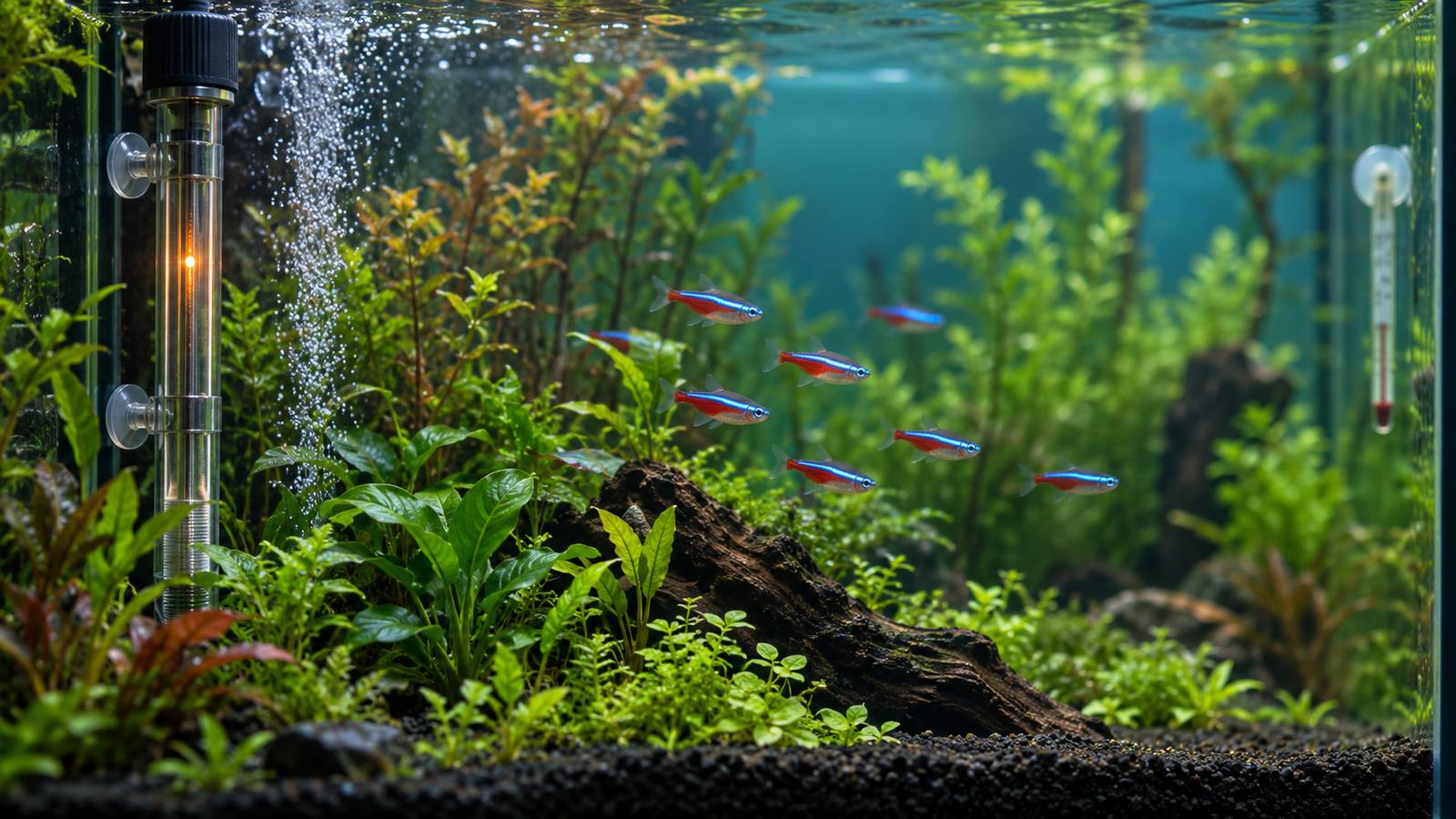
It shuts off when out of the water. Any heater can stick on, so above 40 gallons use two smaller heaters on a controller such as the Inkbird ITC-306T. We picked these from manufacturers' specifications, manuals and recall records, not from hands-on testing.
Full specs
| Heater | Best for | Maker's rating | Temp range | Accuracy (maker) | Housing | Built-in cut-out |
|---|---|---|---|---|---|---|
| Eheim Jäger 50 WPrice on Amazon | Most 10 gallons | 7–16 gal | 65–93°F | Calibration to ±2°F | Glass | Yes, shuts off when not submerged |
| Eheim Jäger 75 WPrice on Amazon | A 20 gallon | 16–26 gal | 65–93°F | Calibration to ±2°F | Glass | Yes, shuts off when not submerged |
| Cobalt Neo-Therm 25 WPrice on Amazon | A 5 gallon betta tank | Up to 6 gal | 66–96°F | ±0.5°F | Shatterproof casing | Yes, thermal protection |
| Aqueon Pro 100 WPrice on Amazon | When breakage is the risk | Up to 30 gal (listing) | 68–88°F | ±1° | Shatterproof thermal plastic | Yes, on overheating and on tilting |
| Aqueon preset 100 WPrice on Amazon | Tight budget | Up to 30–40 gal (listings vary) | Fixed at 78°F | Not stated | Shatter-resistant quartz glass (listing) | Auto shut-off (listing) |
| Inkbird ITC-306T (controller)Price on Amazon | 40 to 75 gallons, with two heaters | 10 A, about 1,200 W at 120 V | Set by you | ±1°F | Plug-in controller with a probe | Cuts power at the set point; high-temperature alarm only |
The best aquarium heater for most 10 to 20 gallon tanks is an Eheim Jäger sized at roughly 3 to 5 watts per gallon: the 50 W for a 10 gallon, the 75 W for a 20. It is adjustable, and it shuts itself off when it is out of the water. But any heater can stick on, so the safest setup is a right-sized heater on a temperature controller such as the Inkbird ITC-306T, and two smaller heaters instead of one big one on tanks over about 40 gallons.
How we chose. We have not run these heaters ourselves. The picks are based on manufacturers' specifications and manuals, U.S. Consumer Product Safety Commission recall records, and the arithmetic of how fast a stuck heater warms a tank. Specs and prices were checked on 28 October 2026. Prices are the item price shown on the retailer's page that day, before shipping and tax. Shipping depends on where you live and prices change often, so check the current price before you buy.
How aquarium heaters fail, and what each failure does
A fish tank heater is a heating element and a thermostat in a sealed tube. Almost everything that goes wrong is one of five things, and each one has a different defence:
| Failure | What you see | Usual cause | What protects you |
|---|---|---|---|
| Stuck on | The temperature climbs past the set point; fish hang at the surface | The relay or thermostat contact fails closed. In heaters with a mechanical thermostat, the usual explanation is a bimetallic contact that welds shut | The right wattage, and a controller |
| Stuck off | The tank drifts down to room temperature; the light may still be on | The relay or switch fails open | A second heater, and a thermometer you check daily |
| Cracked glass | A visible crack, or the GFCI outlet trips | Thermal shock when it is pulled out hot or hit by cold water, a fish striking it, rocks pressing on the tube | Unplug and wait 30 minutes before removing it; a guard or a plastic housing; decor kept off the tube |
| Dry-firing | The heater is exposed by a water change or evaporation | Water below the minimum line | A cut-out that shuts it off out of water; topping up |
| Electrical fault or water inside | A shock, a tripped breaker, at worst a fire | Wiring or seal failure | A GFCI outlet and a drip loop in the cord |
Bulk Reef Supply, a reef retailer, says the most common failure is "a broken relay or switch", which leaves the heater stuck on or stuck off, and that electrical faults are "the least common cause of failure, but also the most dangerous." Keepers report a similar pattern. In one 2007 forum poll of 83 keepers, the most common answer for how a glass heater died was that it "would never turn off" (35 votes), ahead of thermal shock during a water change (27), breakage by a fish or while handling it without a guard (19) and "would never turn on" (17). That is a self-selected group, not a failure rate, but it points the same way.
Stuck on is the failure to plan for. A heater that dies cold gives you hours to notice. One that sticks on keeps adding heat, and the USGS notes that cold water holds more dissolved oxygen than warm water, so an overheating tank loses oxygen at the same time as the fish are heat-stressed. That is how a heater can cook a fish tank overnight. If your aquarium heater is not working at all, the fix is simpler: see the section on telling whether it works, below.
The recalls that show this isn't hypothetical
Aquarium heaters have been recalled, through the U.S. Consumer Product Safety Commission, for exactly these failures.
In June 2015, PetSmart recalled about 112,200 Top Fin plastic heaters, models HT50 to HT250, on top of 33,000 recalled in August 2014, because "an electrical problem with the aquarium heaters, poses a risk of fire or electrical shock." The recall listed 13 incidents, including four minor shocks, seven tanks overheating and one fire with property damage.
In April 2011, about 1.2 million Marineland Stealth and Stealth Pro heaters were recalled because "a wiring problem can cause the aquarium heaters to overheat or break during normal use." There were 38 reports of fires with property damage, 45 of broken aquarium glass, and one eye injury when a heater broke while the owner was holding it.
Both recalls are more than ten years old. The point is that these failure modes are documented, not that these brands are unsafe today. If you own a heater and want to check it, search the model name at cpsc.gov/recalls.
Why the right wattage is a safety feature
What size heater do you need? Roughly 3 to 5 watts per gallon. Aquarium Co-Op's rule of about 5 W per gallon covers heating a lidded tank up to about 10°F above room temperature, which matches Fluval's T-Series manual: its heaters are designed to hold the set temperature when the gap between the room and the set point is under 10°F. A cold room or an open top needs more.
The reason to stay inside that range is what happens when the heater sticks on. Water needs 4,184 joules to warm one kilogram by 1°C, according to the USGS, and a gallon is about 3.785 kg. From that, the fastest a stuck heater can warm a tank, ignoring any heat lost to the room:
| Heater | Tank | Rise per hour if stuck on, no heat loss (upper bound) |
|---|---|---|
| 50 W | 10 gallon | about 2.0°F |
| 100 W | 10 gallon | about 4.1°F |
| 200 W | 10 gallon | about 8.2°F |
| 75 W | 20 gallon | about 1.5°F |
| 300 W | 20 gallon | about 6.1°F |
| 150 W | 55 gallon | about 1.1°F |
Real tanks hold a little less water than their nominal size once the gravel and decor are in, so the real rate is somewhat faster. Heat lost to the room slows it, and eventually caps it.
That cap is the safety argument. As a rough estimate: a heater sized to hold about 10°F over the room is close to flat out already, so if it sticks on in a 70 to 72°F room, it levels off somewhere in the low to mid 80s°F. That is too warm, but survivable while you notice. Triple the wattage and the ceiling is far higher, and you get there in hours rather than overnight. A 300 W heater is a sensible size for a 75 gallon; in a 20 gallon it is the setup most likely to cook the tank.
A short sizing chart, kept inside 3 to 5 W per gallon:
| Tank | Suggested wattage | On this page |
|---|---|---|
| 5 gallon | 25 W | Cobalt Neo-Therm 25 W |
| 10 gallon | 50 W | Eheim Jäger 50 W |
| 20 gallon | 75 to 100 W | Eheim Jäger 75 W, or Aqueon preset 100 W |
| 29 to 40 gallon | 100 to 150 W, or 2 × 75 W | Eheim Jäger 100 W, or a pair of 75 W |
| 55 gallon | 2 × 100 W, plus a controller | Two heaters and an Inkbird ITC-306T |
| 75 gallon | 2 × 150 W, plus a controller | Two heaters and an Inkbird ITC-306T |
Treat the gallon range on the box as a ceiling, not a target. Eheim's own table rates the Jäger 100 W for tanks up to 40 gallons and the 300 W for up to 264 gallons, far more generous than any watts-per-gallon rule. More water also buys time when a heater fails either way, which is one of the reasons a bigger first tank is more forgiving. For the number to set it to, see what temperature a fish tank should be.
What is the most reliable aquarium heater?
No published data shows any current brand failing less often than another. Every claim about the most reliable aquarium heater online, ours included, comes from specs, warranties and anecdote. So rather than a brand promise, buy the features that limit the damage when a heater does fail:
- An electronic thermostat with a stated accuracy, such as the Neo-Therm's ±0.5°F or the Aqueon Pro's ±1°.
- A cut-out, which shuts the heater off when it is out of the water or overheating. The Eheim Jäger, Fluval T-Series, Neo-Therm and Aqueon Pro all list one.
- A warranty you can claim. Fluval gives two years on the T-Series and Aqueon a limited lifetime warranty on the Pro. Keep the receipt.
- An external controller on bigger tanks, covered below.
That is also the honest answer to the best aquarium heater brand question. Keepers' threads on Reddit, Reef2Reef and other forums keep landing on the same advice: no heater is reliable, so run a controller. A reliable aquarium heater setup is one where a single failure cannot take the tank with it.
The best aquarium heaters, by setup
Eheim Jäger 50 W: best for most 10 gallon tanks
The Eheim Jäger 50 W is rated by Eheim for 7 to 16 gallons, is 9 inches long and adjusts from 65 to 93°F. Eheim lists "easy calibration to ±2°F" through a ring on the dial, so you can match the dial to what your thermometer actually reads.
The feature that matters in a 10 gallon is its run-dry protection: Eheim says the heater shuts off when it is not submerged. In a small tank, a water change can drop the level below the heater faster than you expect, and this covers that mistake. It is made from what Eheim calls "shatter-proof laboratory glass", but it is still glass, so keep rocks off it and unplug it before it comes out of the water.
It was $31.99 on Amazon on 28 October 2026. It is the same heater the 10 gallon setup guide uses. The Fluval M50, rated for up to 15 gallons, is the alternative, a glass heater with a mirror finish; it was $32.94.
Eheim Jäger 50 W
Most 10 gallon tanks
Eheim Jäger 75 W: best for a 20 gallon
The Eheim Jäger 75 W is the same heater in the size Eheim rates for 16 to 26 gallons, 10.2 inches long. At 75 W in a 20 gallon, it sits at the low end of 3 to 5 watts per gallon, which is where you want it: from the table above, it can add at most about 1.5°F an hour if it sticks on. In a cold room, the 100 W is the step up.
It was $31.99 on Amazon on 28 October 2026, and it is the "done properly" heater in what a 20 gallon setup costs.
Eheim Jäger 75 W
A 20 gallon tank
Cobalt Neo-Therm 25 W: best for a 5 gallon betta tank
Bettas are tropical fish and need a heater, and a cold betta is one of the first things to rule out when a betta lies on the bottom of the tank. The problem in a 5 gallon is fitting one in.
The Cobalt Neo-Therm 25 W is rated for tanks up to 6 gallons and is 6½ inches long, short enough for a shallow nano tank. It sets from 66 to 96°F, is listed as accurate to ±0.5°F, and has an LED display showing both the set and the actual tank temperature. Its outer casing is listed as shatterproof, and its specifications say its thermal protection circuitry shuts it down before it can overheat. Mount it vertically, element down, and keep the water above the top of the bezel, which is its minimum water line.
The display is a useful second opinion, not a replacement for a separate thermometer. We could not find the 25 W in stock at a clear price on 28 October 2026, so check the current price. The Eheim Jäger 25 W, rated for 5 to 7 gallons, is the alternative, though at 9 inches long it needs a deeper tank.
Cobalt Neo-Therm 25 W
A 5 gallon betta tank
Aqueon Pro: best when breakage is the risk
If the tank holds big or boisterous fish, if children put their hands in it, or if you are in and out of it often, glass is the weak point. The Aqueon Pro removes it: its housing is what Aqueon calls "durable thermal plastic shatterproof", so a fish strike or a knock during maintenance will not crack it.
Aqueon lists an electronic thermostat accurate to ±1°, a range of 68 to 88°F, and two shut-offs: one when the heater overheats, which resets once it cools, and one "when the top of the heater tilts below the bottom of the heater", which covers a heater knocked off its suction cups. It comes in 50, 100, 150, 200 and 300 W, and its warranty is a limited lifetime one. For the safest aquarium heater on its own, without a controller, this is the strongest candidate on the list.
The 100 W was listed at $62.48 on Amazon on 28 October 2026, which looks like an inflated third-party price. Check the current price at Petco or Chewy before you buy.
Aqueon Pro adjustable heater
When breakage is the risk
Aqueon preset 100 W: best on a tight budget
The Aqueon preset 100 W was $22.09 on Amazon on 28 October 2026, the cheapest named-brand heater we found at that size. Its listing gives a fixed temperature of 78°F, an automatic shut-off and a shatter-resistant quartz glass tube, and rates it for tanks up to 40 gallons, though other retailers list the same heater for up to 30. We could not check those specs against an Aqueon page, so treat them as the listing's.
The advantage of a preset is that there is no dial to knock or turn by mistake. The limitation is the same: you cannot change the temperature, so it suits a community tank kept at 78°F and nothing else. It is also the budget heater in the 20 gallon cost guide linked above. Use it in a 20 to 30 gallon, not a 40, to stay inside 3 to 5 watts per gallon.
Aqueon preset 100 W
A tight budget
Two heaters and an Inkbird ITC-306T: best for 40 to 75 gallons
On a bigger tank, split the heat. Two Eheim Jäger 100 W heaters for a 40 to 55 gallon, or two 150 W heaters for a 75, on an Inkbird ITC-306T controller. Fluval's T-Series is an alternative if the tank is freshwater; Fluval says to use it with fresh water only, gives it a two-year warranty, and rates the T150 for up to 45 gallons.
Two heaters change both failures. If one sticks off, you lose half the heat rather than all of it. If one sticks on, it heats the tank half as fast: in a 55 gallon, a single 200 W heater stuck on can add about 1.5°F an hour, while one 100 W heater of a pair adds about 0.7°F, by the same arithmetic as the table above. And the controller's own probe cuts power to both when the tank reaches your set point, whatever the heaters' thermostats are doing.
Inkbird rates the ITC-306T's heating relay at 10 A, about 1,200 W at 120 V, so two 150 W heaters are well inside it. It is accurate to ±1°F and alarms on over-temperature and sensor faults. It was $32.99 on Amazon on 28 October 2026. The ITC-308, at $34.19, adds a cooling outlet you do not need here, but Inkbird's comparison table also gives it a low-temperature alarm as well as a high one. That low alarm is the one that would flag a heater stuck off. Eheim's 100 W was not priced when we checked, so check the current price.
Inkbird ITC-306T controller
40 to 75 gallons, with two heaters
Do you need an aquarium heater controller?
The safest aquarium heater is any right-sized heater on an external controller, because the controller's probe cuts power when the heater's own thermostat fails. A controller is a box between the outlet and the heater, with a temperature probe that goes in the tank. It switches the heater's power on and off by what the probe reads.
The usual way to set one up is to set the heater's own dial a degree or two above your target, so the controller does the switching. The heater's thermostat then becomes the backup: if the controller fails on, the heater still stops itself a degree or two higher.
What a controller like the ITC-306T does and does not cover:
- It catches a heater stuck on. The probe reads the tank, the controller cuts power and sounds its over-temperature alarm.
- It catches a faulty probe, with its sensor-fault alarm.
- It does not warn you about a heater stuck off. Inkbird's own comparison table lists the ITC-306T's temperature alarm as "Only High", so a dead heater and a cooling tank go unannounced. The same table lists high and low alarms for the ITC-308. Either way, you still need to read the thermometer.
- It is one more device that can fail. That is why two heaters plus a controller is the belt-and-braces setup, or as Bulk Reef Supply puts it, "two heating elements and two methods of control."
Who needs one: any tank over about 40 gallons, any tank with expensive or sensitive fish, and any heater with no thermostat of its own, which includes the titanium heaters below. A 5 gallon betta tank with a right-sized 25 W heater is the honest "probably optional" case, because, from the table above, a stuck 25 W heater can warm 5 gallons by only about 2°F an hour at most.
Glass, plastic or titanium?
The housing decides how a submersible aquarium heater breaks.
| Housing | How it fails | Thermostat | Good for |
|---|---|---|---|
| Glass (Eheim Jäger, Fluval M and T) | Can crack from thermal shock or impact | Built in | Most community tanks |
| Shatterproof casing (Aqueon Pro's "thermal plastic", Neo-Therm) | Listed as shatterproof | Built in | Big fish, children, nano tanks |
| Titanium (Finnex) | Listed as "virtually unbreakable" | None on Finnex's TH tubes: needs an external controller | Big tanks with rough fish, owners already running a controller |
A titanium aquarium heater solves the cracking problem completely. The catch is the thermostat: the Finnex titanium heaters we looked at are sold to be run on a separate controller, not on a thermostat of their own; Bulk Reef Supply's listing says they "do not come with any type of temperature control." Without that controller, a titanium heater has nothing to stop it heating. So the best titanium aquarium heater for a beginner is no titanium heater, unless it comes with a controller and you set that up first. It swaps one failure for a worse one.
Preset, dial or digital?
- Preset heaters, like the Aqueon preset, are fixed at one temperature, usually 78°F. They are cheap and there is nothing to bump, but you cannot adjust them.
- Dial heaters, like the Eheim Jäger, are the usual adjustable aquarium heater. The Jäger's calibration ring lets you correct the dial to match your thermometer.
- Digital heaters, like the Neo-Therm, show the set temperature and the actual one. If you want the best digital aquarium heater for a small tank, that display is the reason, because it gives you a second reading.
Whichever you pick, a heater's dial or display is not a thermometer. Keep a separate one at the other end of the tank.
Install it so a failure can't go badly
These steps come from Fluval's T-Series manual. Other makers' manuals give similar advice, with slightly different waiting times.
- Before it goes in, check the glass tube for cracks.
- Put it in the water and wait 30 minutes before plugging it in, so it adjusts to the water temperature.
- Plug it into a GFCI-protected outlet (the manual assumes one and says what to do if it trips), and arrange a drip loop: let the cord hang below the socket before it rises to it, so water running down the cord drips off instead of reaching the outlet. If the plug or outlet ever gets wet, do not unplug it; switch off the fuse or breaker first.
- Keep rocks, decor and gravel off the tube. Fluval says they create uneven heat in the glass and weaken it.
- Keep the water above the minimum line marked on the heater, and top up for evaporation.
- Before a water change, or any time the heater comes out, unplug it and let it cool for at least 30 minutes. Never run it out of water. The water change guide has the full routine.
- Set it by what a separate, accurate thermometer reads, not by the dial. Tropical fish need water near 77°F, according to the Merck Veterinary Manual, and Fluval says a heater can take up to 12 hours to reach its set temperature, so give it a day before adjusting.
If a GFCI outlet ever trips, Fluval's instruction is to unplug the heater and take it out of the water. Placement matters too; where to put the heater is covered with the temperature guide.
How to tell if your heater is working, or stuck
The thermometer is the safety system, and the habit is what makes it work: read it every day, at the same time.
- The light cycles on and off, and the tank holds its temperature. Normal. The light shows when the element is heating, and once the tank is warm it heats only now and then.
- The light is on but the tank is cold. The element has likely failed. Replace the heater.
- The light is off, the tank is cold, and the plug, outlet and setting are fine. The thermostat or relay has likely failed off. Replace it.
- The temperature is above your set point. The heater is stuck on. Unplug it now.
If it was stuck on, unplug it first, then bring the temperature down gradually with ordinary partial water changes, using dechlorinated water only a couple of degrees cooler than the tank, not cold water. Add surface movement while it cools, with the filter outflow or an air stone, because warm water holds less oxygen. A big, sudden drop is its own stress; see temperature swings for why.
How long do heaters last? No maker publishes a figure. Some keepers replace heaters every year or two as a precaution; that is a habit some follow, not a rule. The useful version is to look the heater over at every water change, for cracks, water inside the tube or a cord that has been chewed or kinked, and to know how long your warranty runs.
Left out, and why
Finnex titanium heaters. They need an external controller to run safely, and we could not check their specs against a Finnex page.
The no-name digital heaters that fill Amazon's results. Several look well specified, but we could not verify the specs on a maker's site.
IM Helio and BRS titanium heaters. Both are aimed at reef tanks and priced for them.
The one thing worth taking from this
The brand matters less than the setup. A heater sized at 3 to 5 watts per gallon, with a cut-out for when it runs dry, a thermometer you actually read, and a controller once the tank is big or the fish are precious, makes any single failure survivable. For most 10 to 20 gallon tanks, the best aquarium heater is an Eheim Jäger 50 W or 75 W, plugged into a GFCI outlet with a drip loop in the cord.
Sources
- U.S. Consumer Product Safety Commission. PetSmart Recalls Top Fin Plastic Aquarium Heaters, 19 June 2015.
- U.S. Consumer Product Safety Commission. Aquarium Heaters Recalled by United Pet Group Due to Fire and Laceration Hazards, 21 April 2011.
- Bulk Reef Supply. Aquarium heater failure.
- MonsterFishKeepers forum. Modes of failure: glass submersible heaters, poll, December 2007.
- U.S. Geological Survey. Dissolved Oxygen and Water. Water Science School.
- Aquarium Co-Op. How to Choose the Right Aquarium Heater.
- Fluval. T-Series Heater Instruction Manual.
- U.S. Geological Survey. Specific Heat Capacity and Water. Water Science School.
- Eheim. Jäger TruTemp aquarium heater, maker's size table and specifications as reproduced by Bulk Reef Supply.
- Cobalt Aquatics. Neo-Therm submersible heater, specifications as listed by Bulk Reef Supply.
- Aqueon. Pro Adjustable Aquarium Heater.
- Amazon listings for the Eheim Jäger 50 W and 75 W, Fluval M50, Aqueon Pro 100 W, Aqueon preset 100 W, and Inkbird ITC-306T and ITC-308, seen 28 October 2026.
- Fluval. M50 Submersible Heater.
- Inkbird. ITC-306T temperature controller, including its model comparison table.
- Finnex. TH Deluxe titanium heating element with plastic guard, as listed by Bulk Reef Supply.
- Merck Veterinary Manual. Special Considerations for Fish.
Questions people ask
Related guides
Best Filter for a 10 Gallon Tank: Picks by Setup, With Specs
The best filter for a 10 gallon tank depends on what lives in it. Picks for community, betta, shrimp and budget tanks, compared on maker specs.
What Temperature Should a Fish Tank Be? By Species
What temperature should a fish tank be? 76-78°F suits most tropical community tanks. Bettas want it warmer, goldfish cooler. Species chart inside.
Best Substrate for a Planted Aquarium: Pick by Your Plants
The best substrate for planted aquarium setups depends on which plants feed by the root. Picks for 10 and 20 gallon tanks, with bag counts and costs.