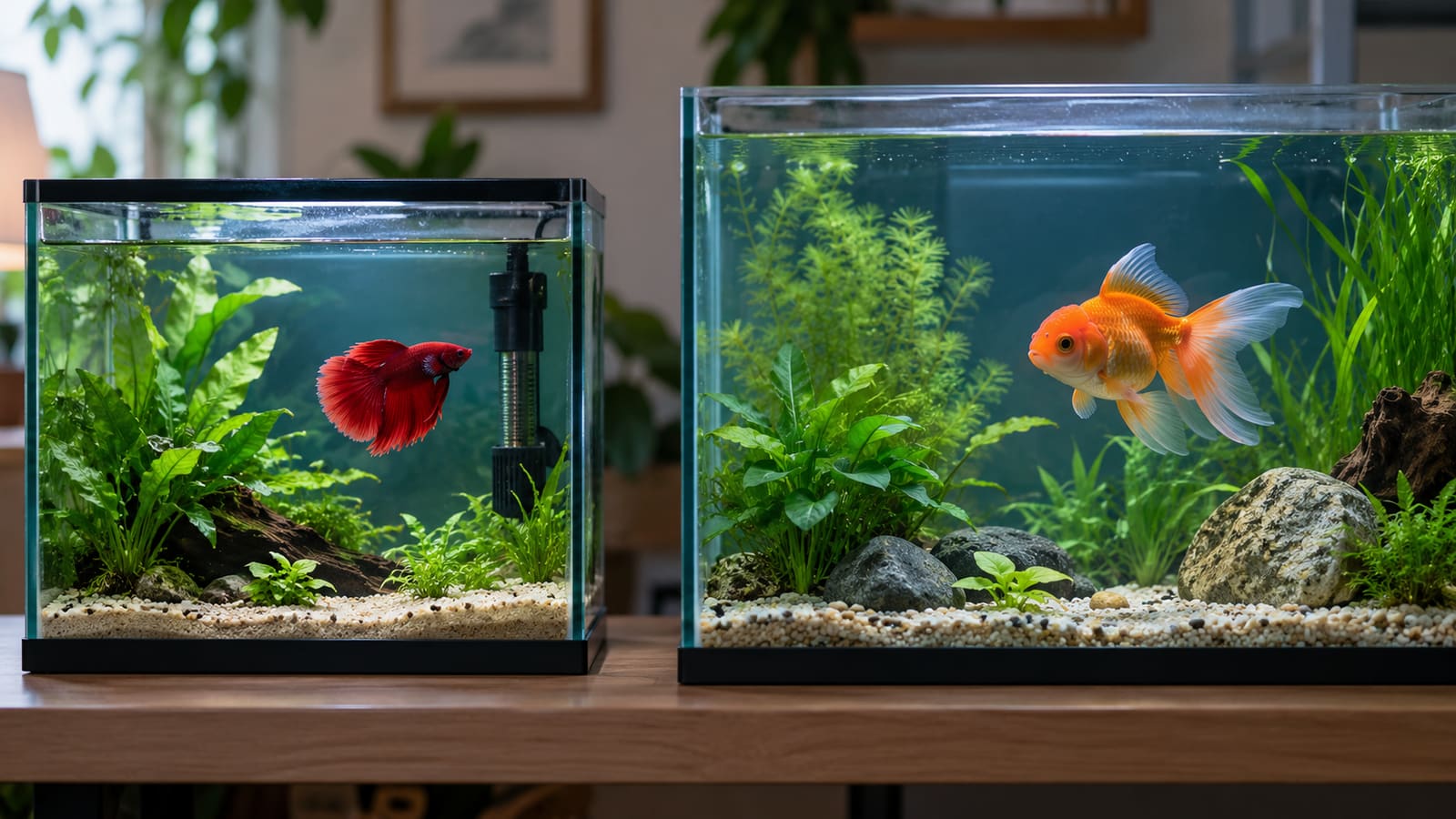
Their temperature ranges only meet at the edges: about 65–75°F for goldfish and 76–81°F for bettas. Either fish can damage the other's fins. Keep them in separate tanks. A betta does well with snails and a few small, peaceful fish, and goldfish do best with other goldfish.
Some links go to retailers. As an Amazon Associate, Aquarium for Beginners earns from qualifying purchases, at no extra cost to you.
The numbers
| Betta | Goldfish | |
|---|---|---|
| Tank size | 5 gallons or more | About 20 gallons for one, more for each extra |
| Adult size | 2.5–3 inches | 6 inches or more; common goldfish can pass a foot |
| Waste | Light | Heavy, more than other fish of the same size |
| Water flow | Gentle. Strong currents stress it | Strong filtration, turning the tank over at least 4 times an hour |
| Temperature | 76–81°F, needs a heater | 65–75°F, heater only if the room runs cold |
| Diet | Carnivore: pellets, frozen foods | Omnivore: eats almost anything, including plants |
No, a betta should not live with a goldfish. The biggest problem is the goldfish itself. It grows to 6 inches or more, needs about 20 gallons to itself, and produces so much waste that its tank needs strong filtration. A betta has long, heavy fins and needs gentle water, and strong currents stress it.
Temperature makes it worse. Vet care guides put goldfish at about 65–75°F and bettas at 76–81°F, so the only shared setting, around 75–76°F, is at the edge of both ranges. Add the risk of torn fins in both directions, and the answer is two tanks.
The main problem: size, waste and flow
Goldfish get big. The small goldfish sold at shops are juveniles (see how big goldfish get). PetMD's vet-written care sheet puts most goldfish at 1 to 14 inches, and common goldfish can pass a foot. A betta is fully grown at 2.5 to 3 inches and does well in 5 gallons. According to PetMD, a single young goldfish needs a 20-gallon tank or larger, and the guide works on about 20 gallons of water per fish.
Goldfish produce a lot of waste. PetMD notes that goldfish need "strong filtration because they produce more waste than similarly sized fish," with the filter turning the tank's water over at least four times an hour. That is exactly what a betta cannot live with. PetMD's betta care sheet warns that "strong currents can stress bettas," the University of Illinois vet school calls a low-flow filter vital, and University of Florida researchers note that heavy filtration "may actually be harmful" to them.
So a tank that suits the goldfish blows the betta around, and a tank that suits the betta drowns in goldfish waste. No setting fixes that.
Temperature: a mismatch, not a wall
Bettas are tropical fish from shallow ponds, rice paddies and even puddles in Southeast Asia. University of Florida researchers cite a wild habitat in Thailand that averaged about 86°F, and vets put the aquarium range at 76–81°F. Bettas "do not do well in cold water," as the University of Florida puts it, so a betta tank needs a heater.
Goldfish are usually called coldwater fish, but that means they do not need a heater, not that warmth harms them. Vet and extension guides put their best range at about 65–75°F, and they survive far beyond it. In laboratory temperature tests, goldfish given a choice settled at around 75–86°F (Coutant, 1977).
The two ranges meet at about 75–76°F. A tank held there is at the bottom of the betta's range and the top of the goldfish's. Warmth also changes the goldfish: a vet-reviewed PetMD guide notes that a goldfish kept warmer than its range becomes "very hungry" and fouls its water quickly. That makes the waste problem worse, in exactly the small, gently filtered tank a betta needs. The full range for each common fish is in what temperature a fish tank should be.
Fins and food
Fins get damaged. Bettas are territorial, and PetMD advises against keeping them with long-finned fish they may spar with, which describes most fancy goldfish. It works the other way too: PetMD notes that many goldfish "may attack other fish," and a betta's long fins are an easy target. Torn fins can become infected, which is how fin rot often starts.
They eat differently. Bettas are carnivores that eat insects and larvae in the wild, and need protein-rich pellets and frozen foods. Goldfish are omnivores that eat almost anything, plants included. A fast, hungry goldfish can easily take the betta's food first.
Already have them together?
Separate them as soon as you can. Take one back to the shop, or set up a second tank this week: for the betta, a 5-gallon tank with a small adjustable heater is enough. Until then, test the water daily, since the goldfish's waste builds up fast, and watch both fish's fins for damage.
What a betta can live with
A betta alone in a 5-gallon tank is a complete, happy setup. With 10 gallons or more, some peaceful tank mates can work. It depends on the individual betta: some ignore other fish, some attack them. Have a backup plan before adding anything, and keep the tank at 76–78°F so it suits both the betta and its companions.
- Snails: mystery and nerite snails are the usual choice, and vets list mystery snails among good companions. See identifying snail eggs before buying, since some species breed fast.
- Shrimp: the University of Illinois vet school lists ghost shrimp. Small shrimp, and the babies of any shrimp, can end up as food.
- Pygmy corydoras: a tiny catfish that swims in midwater as much as on the bottom. Keep at least six, and ideally ten or more.
- Ember tetras: in a group of eight to ten. Seriously Fish suggests a tank at least 18 by 12 inches across the base.
- Bigger tanks only: harlequin rasboras, in a group of eight to ten, and kuhli loaches need a base of at least 24 by 12 inches, which means a 20-gallon long or larger.
Avoid fin-nippers such as tiger barbs, and long-finned fish such as male guppies, which a betta may take for a rival.
What a goldfish can live with
Goldfish do best with other goldfish of a similar type. Fancy goldfish, with round bodies and slow swimming, should live with other fancy goldfish. Common and comet goldfish are fast and grow large, and they belong with each other in a large tank or a pond.
Most tropical fish want warmer water than a goldfish tank is usually kept at, and anything small enough to fit in a goldfish's mouth will eventually be eaten. The full list, with temperatures and adult sizes, is in what fish can live with goldfish.
The one thing worth taking from this
A goldfish needs a big tank with a strong filter, and a betta needs a small, calm, heated one. Their temperatures overlap only at the edges, and their fins are at risk either way. Each one does well in its own tank, and that is the only answer that works.
Sources
- Witherell. Goldfish Care Sheet. PetMD, 2024.
- Perry, reviewed by Sanders. How To Take Care of Goldfish. PetMD, 2024.
- Zayas. Betta Fish Care Sheet. PetMD, 2026.
- Mueller, quoting Keller. Bettas Need More Than Bowls. University of Illinois College of Veterinary Medicine, 2019.
- Watson, DiMaggio, Hill, Tuckett and Yanong. Evolution, Culture, and Care for Betta splendens. University of Florida IFAS Extension, FA212.
- Watson, Hill and Pouder. Species Profile: Koi and Goldfish. Southern Regional Aquaculture Center, Publication 7201, 2004.
- Coutant. Compilation of Temperature Preference Data. Journal of the Fisheries Research Board of Canada 34: 739–745, 1977.
- FishBase. Betta splendens and Carassius auratus species summaries.
- Seriously Fish. Species profiles for Betta splendens, Corydoras pygmaeus, Hyphessobrycon amandae, Trigonostigma heteromorpha and Pangio kuhlii.
Questions people ask
Mentioned in this guide
Related guides
What Fish Can Live With Goldfish? A Short, Honest List
What fish can live with goldfish? Another goldfish first, then a few cool-water fish and snails, with temperatures, sizes and the ones to avoid.
Best Food for Betta Fish: Picks by Size, With Label Data
The best food for betta fish is a betta pellet sized to its mouth. Six picks compared on label protein and pellet size, plus how many to feed a day.
Betta Lying on the Bottom of the Tank: Resting, Cold or Sick?
Bettas rest on the bottom more than most fish, and often it means nothing. How to tell a resting betta from a cold or sick one, and what to check first.