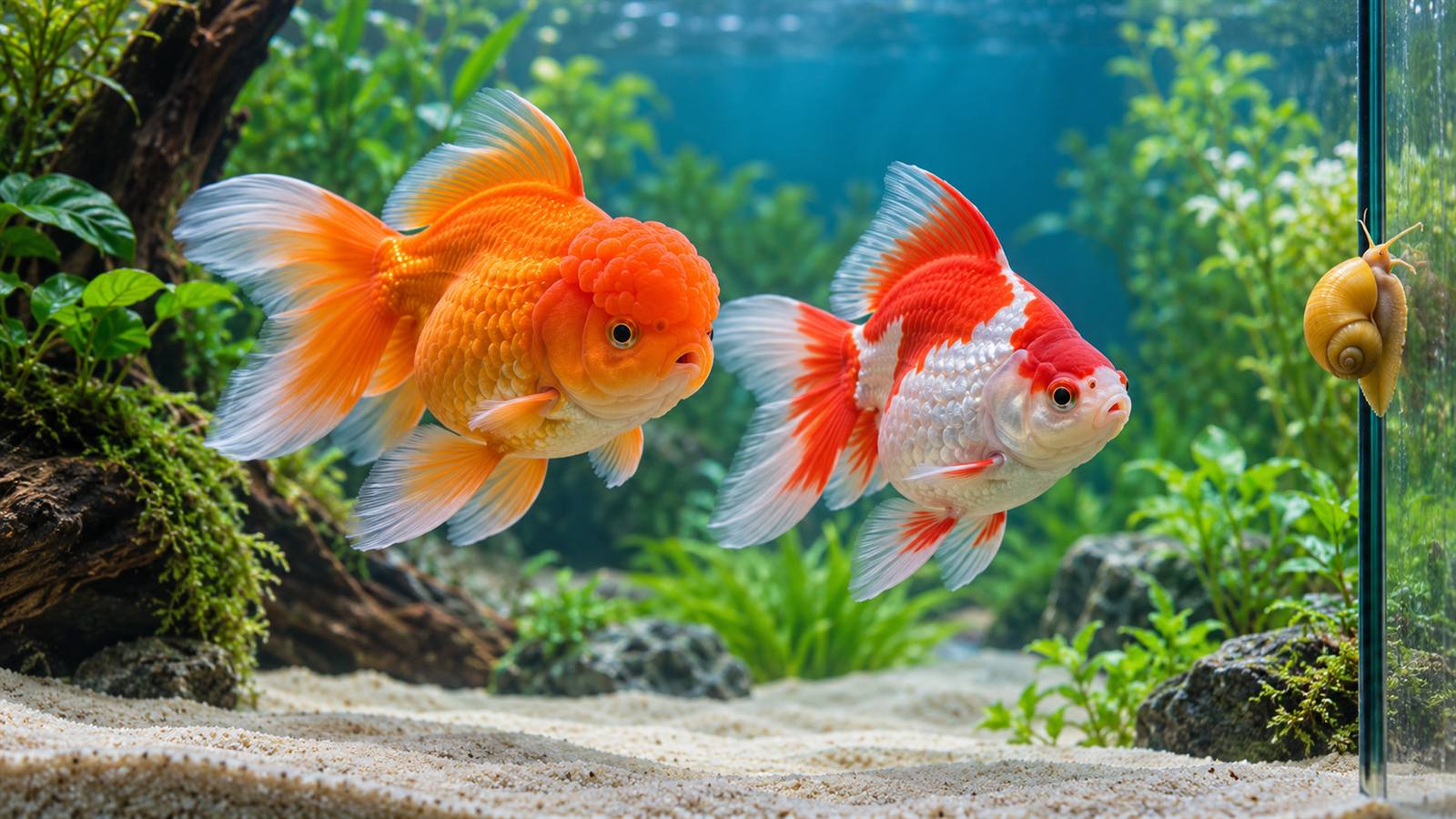
Beyond that, the list is short, because most fish either need a heated tropical tank or are small enough to be eaten. Rosy barbs, zebra danios and peppered corydoras can work in a big enough tank, and mystery and Japanese trapdoor snails are usually safe. Plecos, guppies, shrimp and bettas are not.
Some links go to retailers. As an Amazon Associate, Aquarium for Beginners earns from qualifying purchases, at no extra cost to you.
The numbers
| Tank mate | Temperature range | Fits a 65–72°F goldfish tank? | Adult size | Verdict |
|---|---|---|---|---|
| Another goldfish, same type | Kept at 65–72°F | Yes | Fancy 6–8 in, common 8–12 in | The best choice |
| Rosy barb | 64–72°F | Yes | Up to about 5.5 in | Good with common goldfish, kept in a group |
| Zebra danio | 64–75°F | Yes | About 2 in | Possible with common goldfish. Large adults may catch some |
| Peppered corydoras | 64–73°F | Yes | About 3 in | Possible in a large tank with sand, in a group. Seriously Fish puts it warmer (72–79°F) |
| White Cloud Mountain minnow | 64–72°F | Yes | About 1.5 in | Risky. Fits the water, but adult goldfish can eat them |
| Dojo (weather) loach | 41–77°F | Yes | 4–8 in, sometimes more | Fits, but illegal in several states. Check yours |
| Hillstream loach (Sewellia) | 68–75°F | Only 68–72°F | About 2.5 in | Only with common goldfish, in strong flow |
| Mystery snail | Survives above 50°F | Yes | 1.5–2.5 in | Usually safe. Banned in a few states |
| Japanese trapdoor snail | Hardy in cool water | Yes | Up to about 2.5 in | Usually safe. Banned in a few states |
| Bristlenose pleco | 70–79°F | Only 70–72°F | About 5 in | No. A warm-water fish at the edge of its range |
| Common pleco | 73–82°F | No | 20 in or more | No |
| Bloodfin tetra | 64–82°F | Yes | About 2 in | No with fancy goldfish. May nip long, slow fins |
| Guppy | 64–82°F | Yes | About 2 in | No. Gets eaten, and so do its fry |
| Cherry or Amano shrimp | Cool-tolerant | Yes | 1–2 in | No. Food |
| Betta | 76–81°F | No | About 2.5 in | No |
What fish can live with goldfish? Above all, another goldfish of the same type: fancy with fancy, common with common. After that the list is short. Most fish sold as "goldfish tank mates" either need a heated tropical tank or are small enough for an adult goldfish to eat. A few cool-water fish and two kinds of snail do work, in a tank big enough for everyone.
Fish vet Dr Jessie Sanders puts the first point plainly: "The #1 tank mate for a goldfish is… another goldfish!" (California Fish Vet). The table above checks every common candidate against the temperature a goldfish tank runs at, the size it reaches, and how it gets on with goldfish.
Why most "goldfish tank mates" lists get it wrong
Search for goldfish tank mates and you will find bristlenose plecos, platies, tetras and rasboras recommended alongside cool-water fish, often with no temperature given. Some retailer charts even list large plecos as compatible. Check each one against four things and most of the list falls away.
1. The water a goldfish tank runs at
Most goldfish are kept without a heater, at room temperature, around 65–72°F. Goldfish themselves tolerate a far wider range, and in laboratory preference tests they have chosen water of around 75–86°F (Coutant, 1977). But a tank mate has to suit the tank as it is actually run, and cooler water also holds more oxygen (USGS), which a heavy-breathing, heavy-eating fish like a goldfish uses.
The fish temperature ranges in the table come from FishBase and Seriously Fish, two standard species databases; where they differ, the table uses FishBase. A fish whose range only touches 70–72°F would spend its whole life at the cold edge of what it tolerates.
2. The size of a goldfish's mouth
Goldfish are omnivores. In the wild their diet includes small crustaceans, insect larvae, fish eggs and fry (USGS). A fancy goldfish grows to 6–8 inches and a common goldfish to 8–12 (how big goldfish get). Anything that fits in that mouth is food in the end: shrimp, fry, small snails, and fish of 1 to 1.5 inches.
That is why the White Cloud Mountain minnow is the classic trap. It loves the same cool water, which is why it appears on almost every list, but it is about 1.5 inches long. Seriously Fish states that it does not make a suitable companion for goldfish (Seriously Fish). It can work with young goldfish, and then disappear one at a time as they grow.
3. Speed and fins
Fancy goldfish are slow, round-bodied swimmers with long, delicate fins. They lose out at feeding time to anything fast, and they are a target for fin-nippers. Bloodfin tetras, for example, may nip at long-finned or slow-moving tankmates (Seriously Fish). Fast fish such as zebra danios and rosy barbs are a better match for common goldfish, which are fast themselves.
4. Waste and space
Goldfish produce a lot of waste for their size. The usual minimum for fancy goldfish is about 20 gallons for the first and 10 more for each extra one, and adults do better with more: PetMD's guideline of 5 gallons per inch of fish puts a grown fancy goldfish at 30–40 gallons (how big goldfish get). A tank mate needs its space on top of that, so:
- One goldfish in 20 gallons has no room for tank mates.
- Two fancy goldfish need about 30 gallons on their own, so a 40-gallon tank is the realistic starting point for adding a small group of anything.
- Common goldfish belong in a pond or a tank of 75 gallons or more, where a group of rosy barbs or zebra danios has room to move.
More fish means more nitrate. If the tank already struggles, how to lower nitrates shows how to size the weekly water change.
The tank mates that work
Another goldfish. Match the body type. Fancies with fancies, commons and comets with commons. A ryukin with an oranda is usually fine; a comet with a bubble-eye is not.
Rosy barbs (64–72°F, up to about 5.5 inches) are among the few genuinely cool-water community fish, and Seriously Fish describes them as generally peaceful. They are fast and active, so they suit common goldfish better than fancies. Keep them in a group.
Zebra danios (64–75°F, about 2 inches) are fast enough to stay out of reach most of the time and fit the temperature well. They suit common goldfish in a large tank. Keepers report that adult goldfish sometimes learn to catch them.
Peppered corydoras (64–73°F on FishBase, about 3 inches) are one of the few corydoras with a cool-water range, though Seriously Fish gives a warmer 72–79°F. They do best in a group and need a soft sand bottom, and they are only safe with goldfish too small to swallow them.
Mystery snails and Japanese trapdoor snails are usually the safest additions. Grown snails are too big to eat, they clean up leftover food, and both cope with goldfish temperatures. The University of Florida notes that the mystery snail is not known to survive below about 50°F (UF/IFAS), which is well below a goldfish tank. Snail eggs in a fish tank covers what to expect if they breed.
The ones to avoid
Plecos. The common pleco grows to 20 inches or more and needs 73–82°F. The bristlenose stays around 5 inches but its range, 70–79°F, only overlaps the goldfish range at the very top. There are many keeper reports of plecos latching onto slow fish at night. Those reports are anecdotal, but slow, round fancy goldfish are exactly the fish they describe.
Tropical community fish. Guppies, mollies, platies, neon tetras and most rasboras are small, tropical, or both. Dr Sanders' advice on guppies is simply "Don't mix goldfish and guppies."
Shrimp. Cherry and Amano shrimp cope with cool water, but goldfish eat small invertebrates as a normal part of their diet.
Bettas. A betta needs 76–81°F and gentle water flow, has long fins a goldfish may damage, and is small enough to be harassed. Can a betta live with a goldfish covers it in full.
Fin-nippers. Tiger barbs and serpae tetras have a reputation for nipping fins, and bloodfin tetras may nip long-finned, slow fish: all poor company for a fancy goldfish.
Check your state before you buy
Two of the cool-water options on most lists are restricted in parts of the US, and few tank-mate guides mention it.
- Dojo (weather) loach. The US Fish and Wildlife Service lists it as regulated in Maryland, Michigan, Minnesota, New Jersey, New York, North Carolina and Oregon (USFWS, 2026). It is prohibited outright in Oregon, Minnesota and New York.
- Snails. Nevada prohibits, and Arizona lists as restricted live wildlife, every species of Pomacea, the apple-snail genus that mystery snails belong to. Oregon and New York prohibit Japanese and Chinese mystery snails.
Rules change, so check your state wildlife agency before buying. And never release a goldfish or any tank mate outdoors: goldfish have been established or reported in the wild in every US state except Alaska, and where they take hold they crowd out native fish and uproot plants (USGS).
Quarantine every new fish
Goldfish are prone to several diseases that spread between fish. Koi herpesvirus is the best-known example: goldfish can carry it without showing any signs and pass it to koi (UF/IFAS). New tank mates of any kind should spend at least 30 days in a separate tank first, the minimum the University of Florida gives (UF/IFAS); the Merck Veterinary Manual advises 30 to 60 days for valuable fish (Merck). How to acclimate fish covers moving them in safely afterwards.
What you need
| Item | Why |
|---|---|
| AquaClear 70 filter | Rated for 40–70 gallons. Goldfish and tank mates together need strong filtration |
| API Freshwater Master Test Kit | Tells you whether the tank is coping with the extra fish |
| Digital thermometer | Confirms the room keeps the tank in the 65–72°F range |
| Slow-sinking goldfish granules | Food the goldfish can eat without gulping air at the surface |
| Hikari Sinking Wafers | For corydoras and loaches, which feed on the bottom while the goldfish eat above |
Buy the tank itself in a local store if you can. Large glass aquariums ship badly.
The one thing worth taking from this
Start with another goldfish of the same type, and give them the room they need as adults. If there is space after that, choose from the few fish that are comfortable in cool water and too big or too fast to be eaten, check your state's rules, and quarantine first.
Sources
- Sanders, J. (2021). What fish can live with goldfish? California Fish Vet.
- FishBase. Species pages for goldfish, White Cloud Mountain minnow, zebra danio, rosy barb, peppered corydoras, dojo loach, common pleco, bloodfin tetra and guppy.
- Seriously Fish. Species pages for White Cloud Mountain minnow, bloodfin tetra, Sewellia lineolata and bristlenose plecos.
- Coutant (1977). Compilation of temperature preference data. Journal of the Fisheries Research Board of Canada 34: 739–745.
- US Geological Survey. Dissolved oxygen and water.
- US Geological Survey, Nonindigenous Aquatic Species. Carassius auratus fact sheet.
- US Fish and Wildlife Service (2026). Pond loach (Misgurnus anguillicaudatus) ecological risk screening summary.
- University of Florida IFAS Extension. Applesnails of Florida, Pomacea spp. and Koi herpesvirus disease.
- Merck Veterinary Manual. Routine Health Care of Fish.
- State rules: Oregon OAR 635-056-0050, Minnesota 6216.0250, New York 6 NYCRR 575.3, Arizona R12-4-406, Nevada.
Questions people ask
Mentioned in this guide
Related guides
Can a Betta Live With a Goldfish? No, and Here's Why
Can a betta live with a goldfish? No. Goldfish need 20 gallons and strong filtration, bettas need calm water, and their temperatures barely overlap.
How Big Do Goldfish Get? Size by Type, Age and Tank
How big do goldfish get? Fancy goldfish reach 6–8 inches, commons 8–12 or more. Size by type and age, wild records, and what really stunts growth.
How Many Guppies in a 10 Gallon Tank? Five, All Male
How many guppies in a 10 gallon tank? Five, all male. Add females and two can drop 40 to 80 fry a month. See the breeding math and what to do instead.