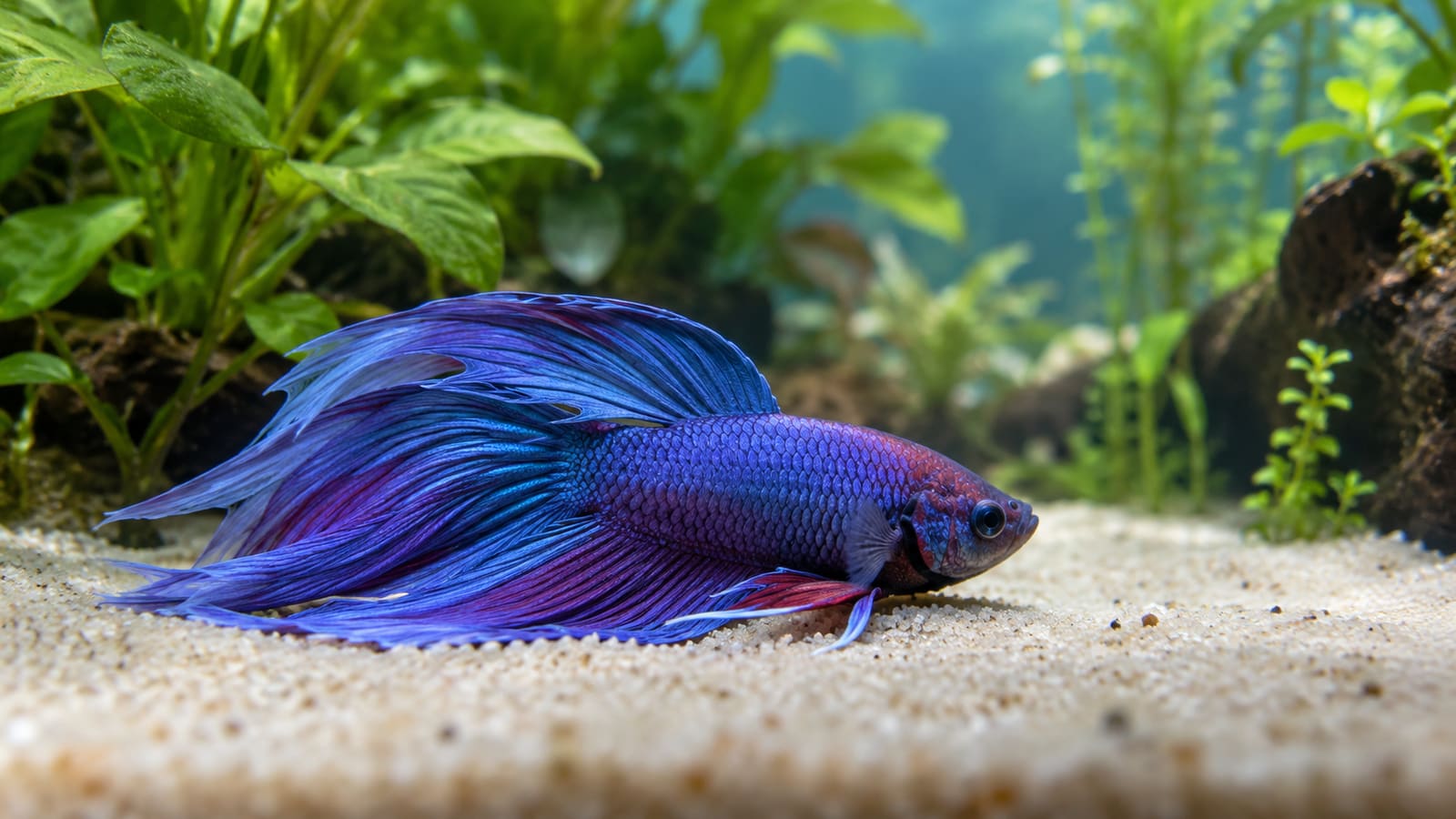
Long-finned bettas rest a lot. If it stays down, stops eating or looks pale, check the thermometer first: a betta below about 76°F slows down and sits on the bottom. Then test the water. Cold and ammonia cause most cases, and both are fixable today.
Some links go to retailers. As an Amazon Associate, Aquarium for Beginners earns from qualifying purchases, at no extra cost to you.
The numbers
| Resting | Cold | Water quality | Sick or old | |
|---|---|---|---|---|
| Breathing | Normal, slow | Slow | Fast, gills working hard | Varies |
| Colour | Normal | Dull | Pale or darkened | Faded, or other signs |
| At feeding time | Swims up and eats | Slow, may refuse food | Refuses food | Refuses, or eats little |
| What to do | Nothing. Add resting spots near the top | Fix the heater, 78–80°F | Test, then change 30–50% of the water | Identify the illness before treating |
A betta lying on the bottom of the tank is often just resting. Bettas rest more than most aquarium fish, on the bottom, on leaves and among plants, and long-finned bettas rest the most. If it breathes normally, keeps its colour and swims up to eat, nothing is wrong.
If it stays down all day, stops eating or looks pale, check the thermometer first. A betta in water below about 76°F slows down and sits on the bottom. Then test the water. Cold and poor water cause most cases, and both can be fixed today.
Resting, or something wrong?
The table above compares the common causes. Watch your betta for a few minutes and check four things.
- Breathing. Slow, steady gill movement is normal. Fast, heavy breathing means the fish is struggling.
- Colour. A resting betta keeps its colour. A pale, washed-out or very dark betta is stressed.
- Feeding. A resting betta swims up when food arrives. One that ignores food is telling you something.
- Fins. Fins held open are normal. Fins pressed against the body, called clamped fins, are a sign of stress.
A betta that passes all four is resting. Bettas also sleep at night, often on the bottom, and can look pale while they do. A betta that wakes and swims when the light comes on is fine.
Why bettas rest more than other fish
Their fins are heavy. Wild bettas have short fins. Pet bettas have been bred for long, flowing ones, which are beautiful but tiring to swim with. Long-finned bettas spend a lot of the day resting, and that is normal for them.
They come from still water. Bettas live in shallow, slow water in the wild, where they rest near the surface or among plants. A strong filter current tires them, and they may hide on the bottom to get out of it.
Giving a betta resting places near the surface often moves it off the bottom. A leaf hammock, broad-leaved plants that reach the top, or a floating log all work.
Check 1: the temperature
This is the most common cause, and the quickest to check.
Bettas are tropical fish and need 78–80°F. Bettas are sold in unheated cups, and many people assume they do not need a heater. At 70°F a betta becomes sluggish, stops eating and sits on the bottom, and over weeks the cold weakens it against disease. See what temperature a fish tank should be.
- Look at the thermometer. Below 76°F is too cold for a betta.
- If there is no heater, get one. A small adjustable heater suits a 5 to 10 gallon tank.
- If there is a heater, check it is plugged in and its light comes on.
- Raise the temperature slowly, by no more than 2–3°F an hour.
Check 2: the water
Bettas are often kept in small tanks, and small tanks foul quickly. Ammonia and nitrite build up within days in a bowl or an unfiltered tank.
Test ammonia and nitrite. Both should read zero. If either is above zero, change 30–50% of the water today with dechlorinated water at the same temperature, and repeat daily until both read zero. See how to change the water safely. In a new tank, this is part of the nitrogen cycle, and it will settle once the filter bacteria grow.
The general version of this problem, for any fish, is in fish lying on the bottom of the tank.
Check 3: illness
If the temperature and the water are both fine, look at the fish closely.
- Swollen belly, floating or sinking awkwardly, struggling to swim up: swim bladder trouble, usually from overfeeding. See swim bladder disease in bettas.
- Swollen body with scales sticking out like a pine cone: dropsy, which needs treatment today.
- Fins with ragged, dark or white edges that get shorter: fin rot, a bacterial infection that follows poor water.
- Small white spots like grains of salt: ich, a common parasite.
A betta that is not eating can safely go several days without food, so focus on the cause first, not on getting it to eat.
Check 4: age
Bettas usually live three to five years, and most are already several months old when sold. An old betta rests more, swims less, and its fins and colour fade. If the water is fine and it still eats, it is ageing, not sick.
Make life easier for it: keep the water warm and clean, lower the water level a little, turn the filter flow down, and add resting places near the surface.
What you need
| Item | Why |
|---|---|
| Small adjustable heater | Cold is the most common reason a betta sits on the bottom. Suits a 5–10 gallon tank |
| Digital thermometer | Check 1 takes ten seconds with one |
| Betta leaf hammock | Gives a resting betta somewhere near the surface instead of the bottom |
| Liquid test kit | Check 2: ammonia and nitrite, more accurate than strips |
The one thing worth taking from this
A betta on the bottom is usually resting, and its fins are the reason. When it is not, the thermometer is the first thing to check, then the test kit. Most bottom-sitting bettas are cold, and a heater fixes them.
Questions people ask
Mentioned in this guide
Related guides
How Long Can a Betta Go Without Food? A Week Is Fine, Two Is Not
A healthy adult betta can go about a week without food, and survives up to two. How to plan a trip, which feeders to avoid, and why a betta stops eating.
Fish Lying on the Bottom of the Tank: Test the Water First
A fish lying on the bottom of the tank is usually reacting to the water: ammonia, nitrite, temperature or oxygen. What to check first and what to do today.
Betta Fin Rot: Signs, Treatment, and When to Medicate
Betta fin rot usually starts with dirty or cold water. How to tell it from tail biting, the clean-water fix, when to medicate, and how fins grow back.