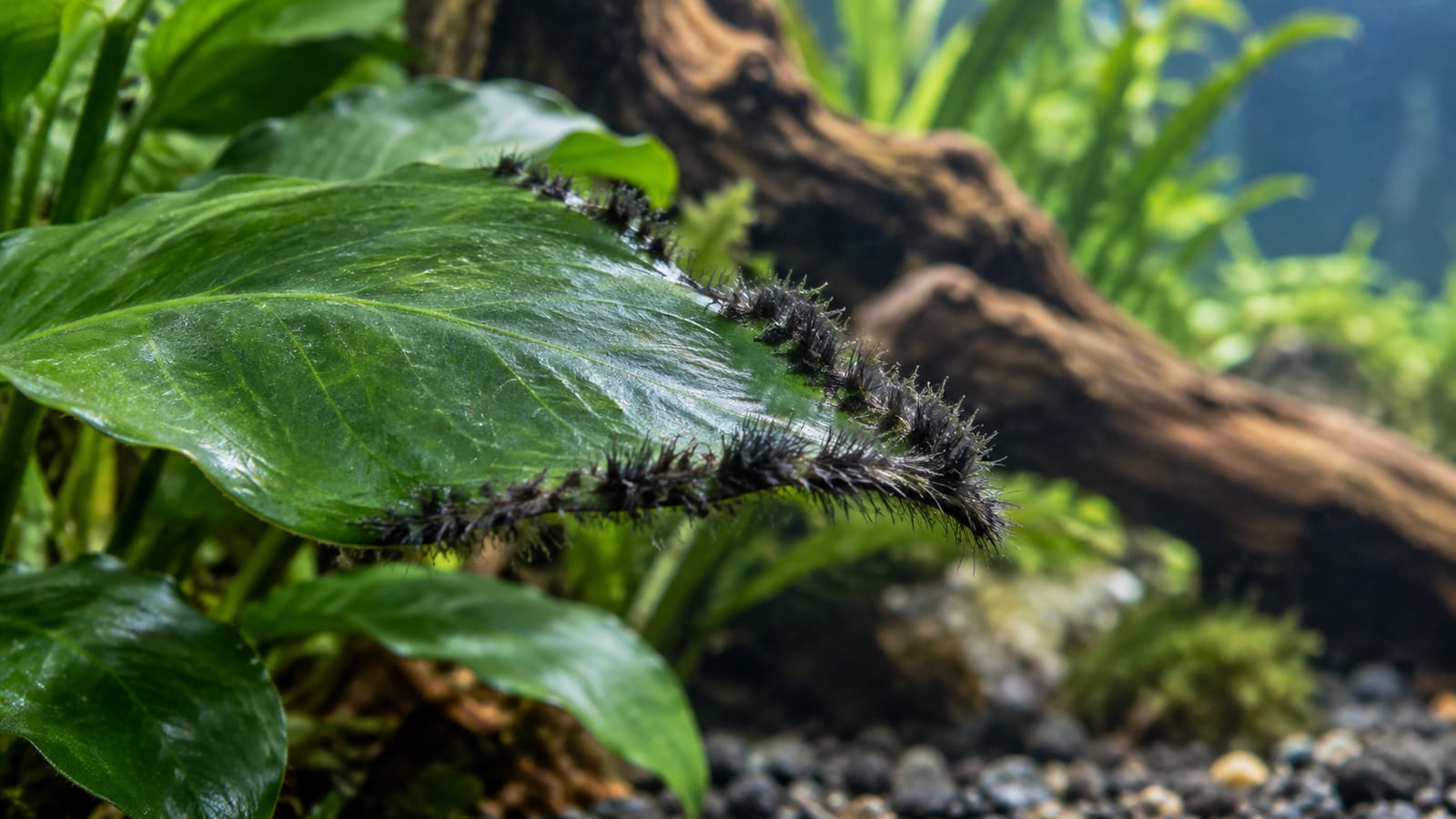
It is harmless to fish but slow to remove. Cut off the worst leaves, scrub or remove the decorations it grows on, and spot-treat what is left with a liquid carbon product. Then fix the cause, which in a tank without CO2 is usually built-up waste and a long lighting period.
Some links go to retailers. As an Amazon Associate, Aquarium for Beginners earns from qualifying purchases, at no extra cost to you.
The numbers
| Black beard algae | Staghorn algae | Cyanobacteria | Hair algae | |
|---|---|---|---|---|
| What you see | Dense tufts, dark grey to black, a few millimetres long | Grey-green strands that branch like antlers | A dark slimy sheet lying over surfaces | Long, soft bright green strands |
| Where it grows | Leaf edges of slow plants, wood, rock, filter outlet | Leaf edges and decorations | Substrate and leaves, in still water | Plants and decorations, in bright light |
| The finger test | Will not come off. Feels coarse | Hard to pull off | Peels off in a sheet | Pulls off in tufts |
| Main eaters | Siamese algae eater, when young | Few | Almost none | Amano shrimp |
Black algae in a fish tank is almost always black beard algae, often shortened to BBA. It grows in short, dense tufts, dark grey to black, on the edges of slow-growing leaves, on driftwood and rock, and on the filter outlet. It does not wipe off, which is the quickest way to tell it from anything else.
It does not harm fish. It is slow to remove, though, and it takes over slow plants if it is left. Cut off the worst leaves, scrub the decorations, spot-treat what is left, and fix the cause so it does not return.
Is it black beard algae?
The table above compares it with the algae it is most often confused with. The short version:
- Dense dark tufts that will not come off: black beard algae. This page is for you.
- Grey-green strands that branch like antlers: staghorn algae. It is a close relative and the same fixes work on it.
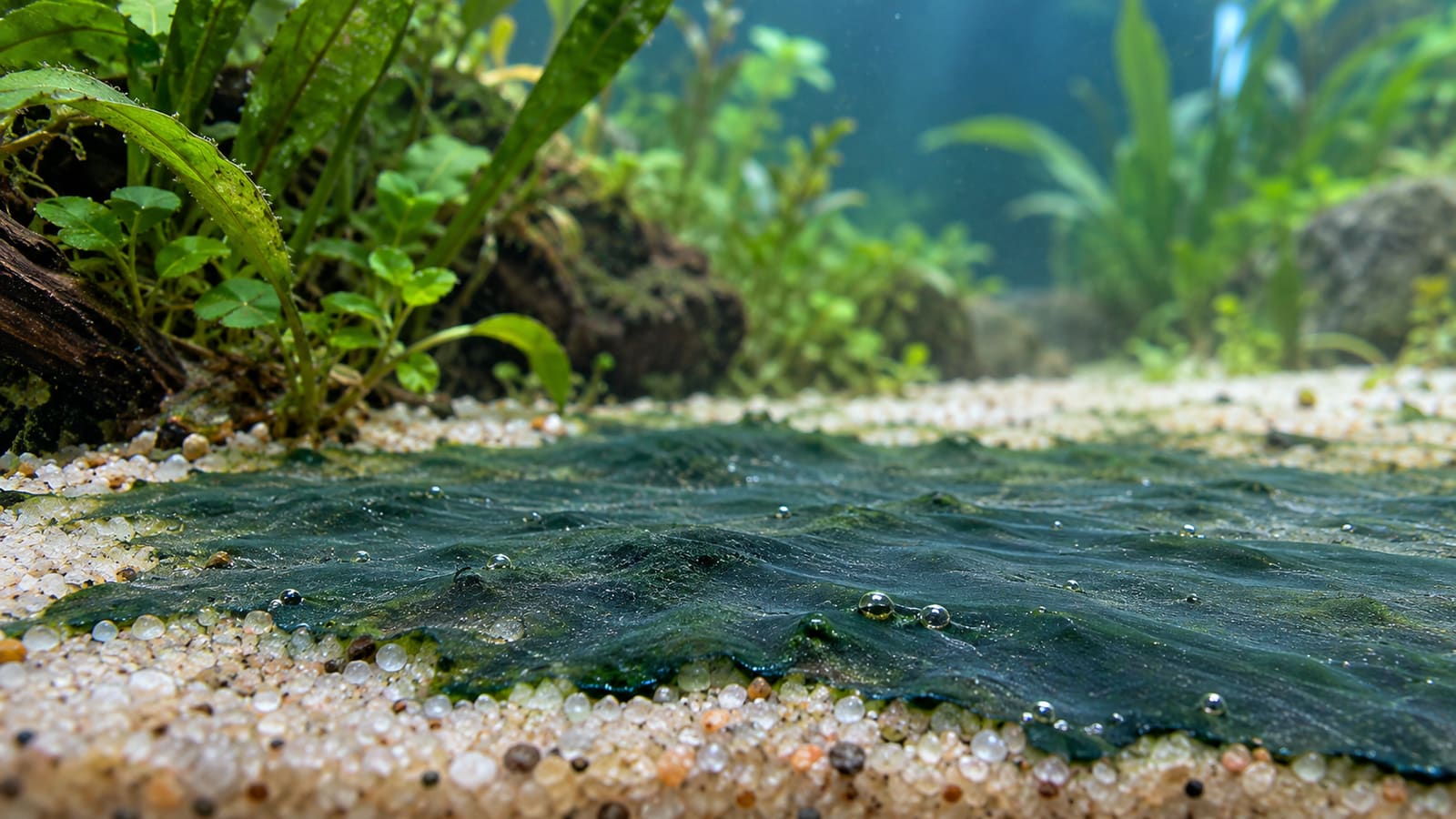
- A dark slimy sheet that peels off: that is cyanobacteria, which is a bacterium rather than an alga, and needs a different approach.
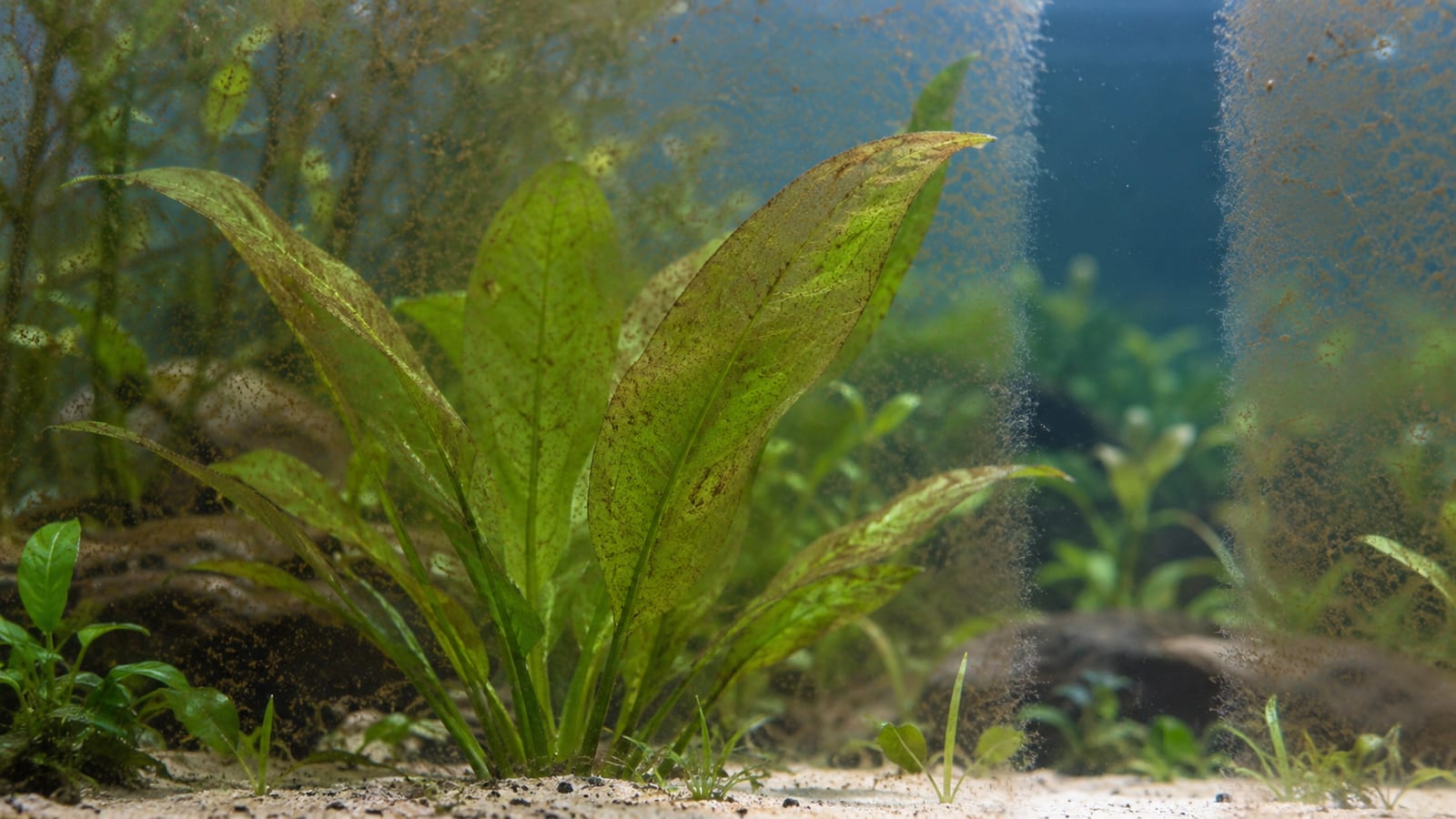
- A soft brown dust that wipes off: diatoms, the brown algae every new tank goes through.
Black beard algae is a red alga, even though it looks black. When it dies it turns pink or red, then white. If you treat a patch and it goes pink a day or two later, that confirms what it was.
Why it grows
BBA grows on surfaces that stay still and stay the same for a long time, in water that carries more organic waste than the plants can use. That is why it favours:
- Slow plants. Anubias and java fern grow a new leaf every few weeks, so their leaf edges sit unchanged for months. Fast stem plants grow away from it.
- Hard surfaces in the flow. Wood, rock and the filter outlet, where water brings it a steady supply of nutrients.
- Older tanks. It usually shows up after the first six months, once waste has had time to build up in the substrate and the filter.
- Long lighting. Ten hours or more a day gives it more time to grow.
In tanks that inject CO2, it is often linked to CO2 levels that swing through the day. Most beginner tanks have no CO2, and for them the cause is the list above.
How to get rid of black beard algae
Removing it takes several steps, because it holds on firmly and grows back from what is left.
- Cut off the plant leaves that are badly covered. A leaf under a thick layer of BBA is not getting enough light to recover, and the plant grows new ones.
- Take out wood and rock that have it. Scrub them with a stiff brush and hot water. Boiling driftwood for 10 to 15 minutes kills what the brush misses.
- Clean the filter intake and outlet, and replace the sponge cover on the intake if it has grown into it.
- Do a 30% water change with a gravel vacuum, and then keep to weekly changes. See how to change fish tank water.
- Cut the lighting to six or seven hours a day on a timer.
- Feed less, and do not leave food to settle into the substrate.
Spot-treating what is left
For tufts you cannot scrub or cut off, a liquid carbon product works well. These products are sold as a plant supplement, and their active ingredient, glutaraldehyde, kills BBA on contact.
- Turn off the filter so the water is still.
- Draw the product into a syringe and squirt it slowly onto the patch, close to it.
- Leave the filter off for 10 to 15 minutes, then turn it back on.
- Repeat every day or two. Within a few days the tufts turn pink or red, and the fish or snails start eating them.
Stay within the bottle's daily dose
Count everything you spot-treat towards the total dose for the tank. Glutaraldehyde in high doses harms shrimp and snails, and some plants, such as vallisneria and elodea, melt even at normal doses. Read the label before using it in a tank with any of these.
What about algae eaters?
The Siamese algae eater is the one fish known to eat black beard algae, but mostly while it is young. It grows to about six inches, lives in groups and needs a tank of at least 30 gallons, so it does not suit most beginner tanks. Be careful when buying, since several similar-looking fish are sold under the same name and do not eat BBA.
Amano shrimp and nerite snails may graze young tufts, but neither clears an established patch.
The one thing worth taking from this
Black beard algae is slow, harmless to fish and stubborn, and it shows a tank where waste has had time to build up. Removing it by hand and spot-treating clears what you see. A weekly water change and a shorter lighting period are what stop it coming back.
Questions people ask
Mentioned in this guide
Related guides
Blue-Green Algae in an Aquarium: It's Bacteria, and How to Clear It
Blue-green algae is cyanobacteria: a slimy sheet that peels off and smells like a swamp. Why it grows, how to remove it, and how to keep it from coming back.
White Algae in a Fish Tank: What the White Stuff Actually Is
White fuzz, film or crust in a fish tank is rarely algae. Most often it is harmless growth on new driftwood or mineral deposits. How to tell which one you have.
Brown Algae in Fish Tank: Why It Happens and When It Ends
Brown algae in fish tank? It is almost always diatoms. How to confirm it, how long a new-tank bloom lasts, and what actually clears it.