
Quick Verdict
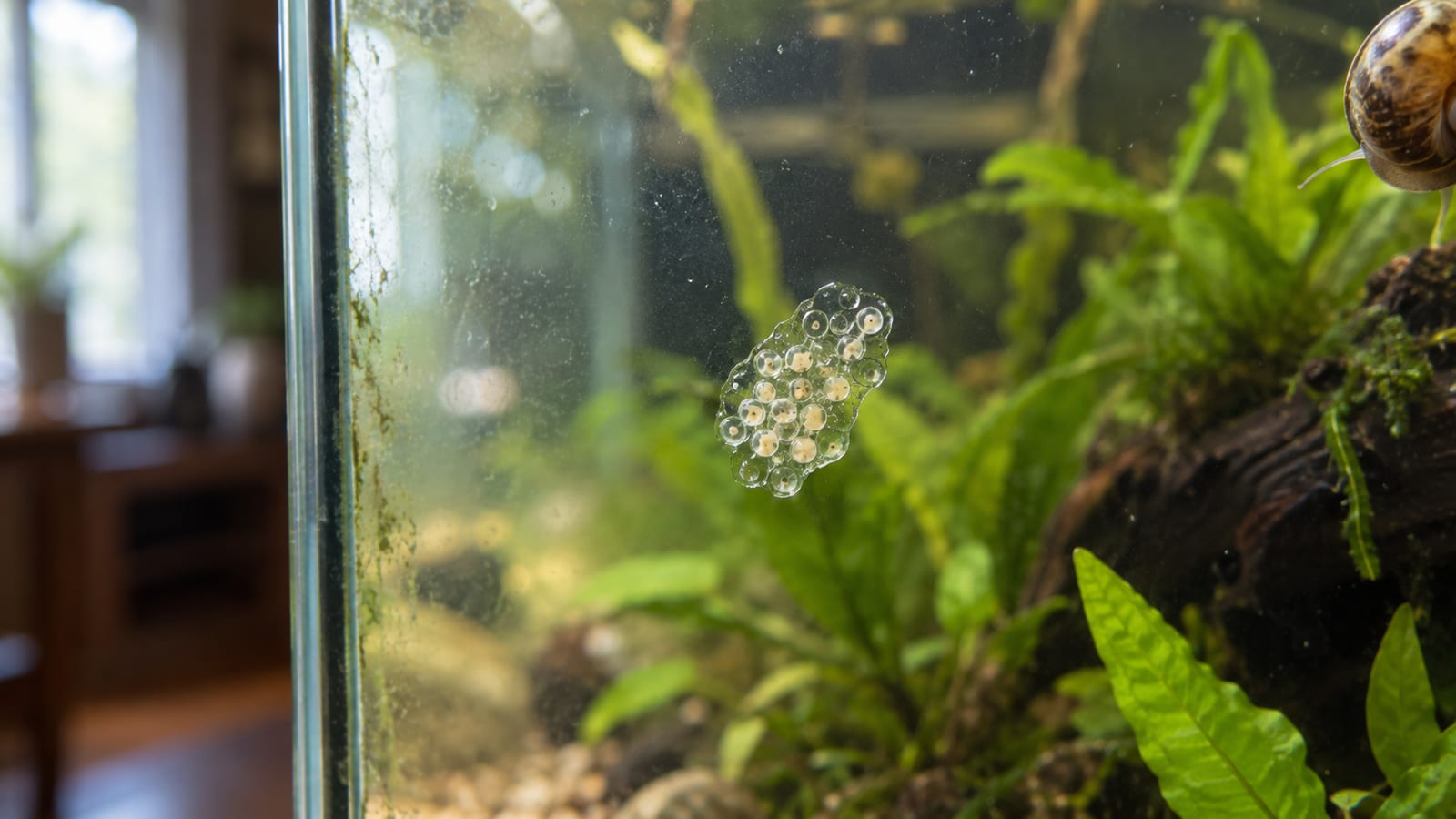
Clear jelly blobs on the glass or plants are pest snail eggs and will hatch in one to three weeks. A pink honeycomb above the waterline is a mystery snail clutch. Hard white dots like sesame seeds are nerite eggs, and those never hatch in freshwater.
Three looks cover almost every case. A clear jelly blob on the glass or a leaf is a pest snail's eggs, and it will hatch. A pale pink honeycomb stuck above the waterline is a mystery snail clutch. Hard white dots like sesame seeds on the driftwood are nerite eggs, and those will never hatch in a freshwater tank.
None of them is dangerous to fish. What you do next depends on which one you have, and whether you want more snails.
Which eggs do you have
The table above has the full comparison. In practice two questions settle it.
Is it above or below the water? Only mystery snails climb out to lay. A clutch on the rim, the underside of the lid or the hood is theirs, without exception. It starts soft and pink and hardens to a chalky off-white over a day or two.
Is it soft or hard? Below the waterline, press gently with a fingernail. Pest snail eggs sit in a soft, clear jelly that smears. Nerite eggs are hard capsules that do not give at all, and you will feel them as grit on the wood.
The one that needs no decision
White sesame-seed dots that will not rub off are nerite eggs. The larvae need brackish water, so in freshwater they never develop. You can stop reading here if that is what you have — the only question left is whether the look bothers you.
Two snails lay nothing you will find. Malaysian trumpet snails give birth to live young, so their numbers rise with no eggs ever appearing. Assassin snails lay single, squarish, translucent capsules one at a time, slowly enough that a population is never a surprise.
How snail eggs get into a fish tank
If you never bought a snail, the eggs came in on a live plant. A jelly cluster on the underside of a leaf is nearly invisible, and bladder and ramshorn snails are hermaphrodites, so a single hatchling is enough to start a population.
This is not a sign that anything was done wrong, and it is close to universal. The plant tanks at most shops carry them. If you want to be sure of keeping them out, buy tissue-culture plants — the ones sold in sealed cups of gel — which are grown sterile and carry no eggs.
If you do not want them to hatch
- Pest snail jelly: wipe it off the glass with a paper towel or an algae pad, and pinch off any leaf that carries a cluster. Check again weekly, because you will not find them all.
- Mystery snail clutch: slide a card under it within the first few days so it comes off whole, then bag it and freeze it before it goes in the bin.
- Nerite eggs: do nothing, or take them off the glass with a razor blade held at a low angle. Leave the ones on wood alone.
- Feed less. This is the step that actually controls numbers, and it is covered below.
- Do not reach for a snail-killing treatment. Most are copper-based, and copper kills shrimp and the snails you wanted to keep, and lingers in the silicone and substrate afterwards.
Never release or flush a live clutch
Mystery snails are apple snails, a family that is invasive in parts of the United States and damages wetlands and crops. Freeze a clutch before you dispose of it, and never put eggs or snails into a drain, a pond or a garden.
If you want them to hatch
Pest snail eggs need nothing from you. Leave the jelly where it is and hatchlings the size of a grain of sand appear in one to three weeks.
A mystery snail clutch is the only one that needs care, and the rule is simple: humid, but never wet. The eggs breathe air, and a clutch that falls into the water or is submerged drowns. Left where it was laid, under a tight lid, it usually has enough humidity. After two to four weeks the clutch darkens, looks mouldy for a day or two, and the babies chew out and drop into the water.
Before you let it happen, count. One clutch holds from 50 to 200 eggs. A shop may take a dozen juveniles. It will not take a hundred and fifty, and each adult mystery snail is a meaningful share of the waste load in a small tank — the same arithmetic as in how many fish fit in a 10 gallon tank.
Why there are suddenly so many
Pest snails do not overrun a tank on their own. Their population follows their food supply, exactly as detritus worms do, and their food is what your fish leave behind: uneaten flakes, dying leaves, algae and the film on the glass.
You do not have a snail problem. You have a leftover food problem that happens to be shaped like snails.
So a tank crawling with snails is a reading, and the reading says you are feeding more than the fish eat. Cut feeding to what disappears within two minutes, vacuum the substrate at the next water change, and the population falls back over a month or two without you removing a single snail by hand.
A small standing population is worth keeping. Bladder and ramshorn snails eat the decaying matter that would otherwise break down into ammonia, they do not touch healthy plants, and they cost nothing.
The one thing worth taking from this
Identify before you act. Nerite eggs need no action at all, pest snail eggs are a feeding gauge rather than an infestation, and the mystery snail clutch is the only one with a deadline — a few days to decide whether you want a hundred snails.
Detailed Comparison
| Pest snails (bladder, pond, ramshorn) | Mystery snail | Nerite | |
|---|---|---|---|
| What you see | Clear jelly blob or flat disc with specks inside | Pale pink honeycomb clutch the size of a thumb | Hard white dots like sesame seeds |
| Where | Underwater: glass, plant leaves, filter intake | Above the waterline: rim, lid, hood | Underwater: driftwood, rock, heater |
| Will it hatch? | Yes, in 1–3 weeks | Yes, in 2–4 weeks, if kept humid and out of the water | No. The larvae need brackish water |
| What to do | Wipe off if unwanted, and feed less | Decide within a few days: keep, or remove and freeze | Ignore, or scrape off glass with a blade |
Frequently Asked Questions
🔗 Related Resources
More Reviews:
Related Articles
Scuds in an Aquarium: Harmless With Fish, a Problem With Shrimp
Scuds in an aquarium are tiny curled crustaceans that swim on their side. With fish they are free live food. With only shrimp they are a rival.
Why Does My Fish Tank Smell? Match the Smell to the Cause
Why does my fish tank smell? A healthy tank smells like damp soil. Rotten eggs, rotting fish and musty swamp each point to one cause — matched in one table.
Detritus Worms in a Fish Tank: Harmless, But Check First
Detritus worms in a fish tank are harmless waste eaters. A sudden bloom means overfeeding — and here is how to tell them apart from planaria, which are not.