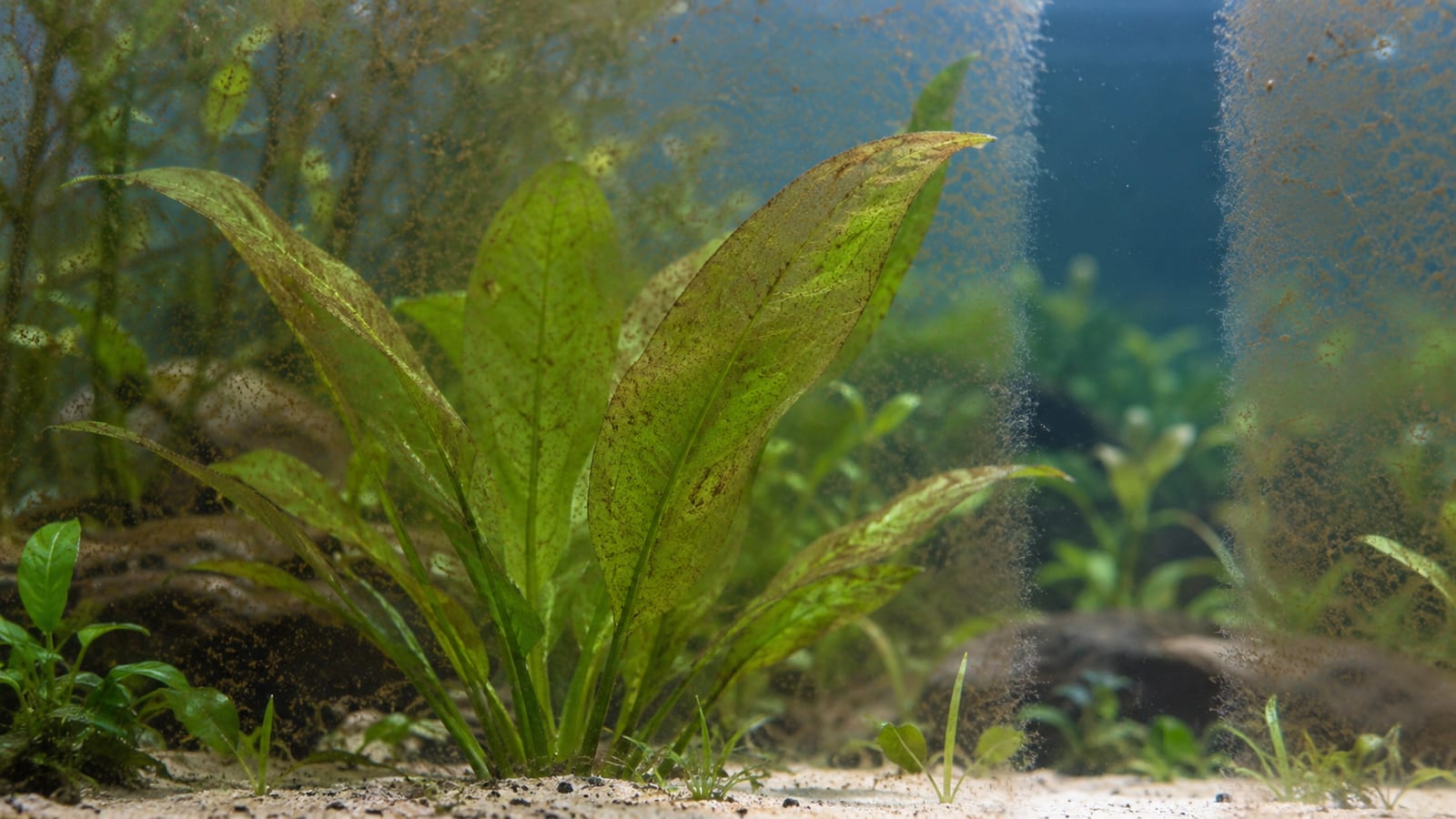
In a tank under about three months old it is a normal stage: diatoms are among the first things to colonise new glass, rock and leaves, and plants, green algae and grazers take over as the tank matures. Wipe it off, keep up weekly water changes and wait. Silica is not what runs out, since tap water refills it with every water change. Diatoms are harmless to fish, so do not use an algaecide.
Some links go to retailers. As an Amazon Associate, Aquarium for Beginners earns from qualifying purchases, at no extra cost to you.
The numbers
| Diatoms (brown algae) | Blue-green algae | Black beard algae | Tannins | |
|---|---|---|---|---|
| What you see | Soft brown or rust-coloured dust on glass, gravel and leaves | Slimy sheet, dark green to brown, spreading over the substrate | Short dark tufts on leaf edges, wood and equipment | Tea-coloured water. Nothing on the surfaces |
| The finger test | Wipes off easily in a cloud | Peels off in a sheet | Clings on and does not wipe off | Nothing to wipe |
| Smell | None | Earthy or musty | None | None |
| Harmful to fish? | No known risk | Can be, in a large bloom | No, but it smothers plants | No |
Brown algae in a fish tank is almost always diatoms, and in a new tank it goes away by itself. Diatoms are single-celled algae with a cell wall made of silica, coloured golden-brown by a pigment called fucoxanthin. New glass, rock and leaves are bare surfaces, and diatoms are among the first things to colonise them. As the tank matures, plants, green algae and grazers take over.
Wipe it off, keep doing weekly water changes, and wait. Nothing about it harms your fish.
Despite the name, it is not true brown algae. The true brown algae are the kelps and seaweeds, and almost all of them are marine. Diatoms are a separate group.
Is it diatoms, or something else?
Put a finger on it. That test sorts out nearly every case, and the table above has the details.
- Wipes off in a brown cloud: diatoms. This page is for you.
- Peels off in a slimy sheet and smells earthy or musty: blue-green algae, which is a bacterium rather than an alga and a different problem. The smell comes from compounds called geosmin and MIB, the same ones behind earthy-tasting tap water.
- Short dark tufts that cling on: black beard algae, a red alga that grows on the edges of slow leaves and on wood.
- Brown slime somewhere dark, such as inside the filter or under decor: not diatoms, which need light. That is bacterial film, and inside the filter it is the bacteria you want. See biofilm in an aquarium.
- White fuzz on new driftwood: a different growth altogether, covered in what the white stuff in a tank is.
- The water itself is tea-coloured: tannins from driftwood or leaves. That is not algae, and it is harmless.
Why diatoms show up in a new tank
A new tank is a set of clean surfaces, and every clean surface underwater gets colonised in roughly the same order. A study of how new surfaces are colonised in fresh water describes bacteria arriving first, "followed by low profile diatoms," then taller diatoms and filamentous green algae. In an aquarium you see the diatom stage as a brown film over everything, usually one to three weeks after setup.
That is around the same time the tank is working through the nitrogen cycle. In a 2025 study that followed new home aquariums, ammonia and nitrite reached zero by week 3 in two tanks and by week 8 in the third. The brown phase and the cycle run side by side, and neither means anything was set up wrong.
As the weeks pass, plants grow in, green algae and grazers spread, and the diatoms lose their space. They fade.
Silica does not run out
A common explanation is that diatoms fade because the tank "uses up" its silicate. The numbers do not support it. The silica content of natural waters, which is what comes out of most taps, is commonly 5 to 25 mg/L, and over 100 mg/L in some areas. In laboratory work on a freshwater diatom, growth reached 90% of its maximum at only about 0.4 to 0.8 mg/L. Tap water carries many times that, and every water change tops it up. That diatom was a lake species rather than one of the films on aquarium glass, but the point holds: silica is rarely what limits diatoms in a tank.
How long brown algae lasts
There is no controlled study of this, so treat any timeline as experience rather than measurement. Hobby guides put the onset at one to three weeks after setup. Estimates for how long it lasts run from a few weeks to four to eight weeks, and one reference says it can take four to six months to fade.
A useful check-in point: if the bloom is still heavy at about three months, or keeps coming back strongly, stop waiting and look for a cause. That is covered below in brown algae in an older tank.
How to get rid of brown algae
- Wipe the glass with an algae pad or a magnetic cleaner. Diatoms come off with almost no pressure.
- Stir the top of the gravel or sand with the gravel vac during water changes. The brown film on the substrate lifts straight into the bucket.
- Rub broad plant leaves gently between two fingers underwater. A film on the leaves shades them: in one study of a nutrient-rich lake, the growth on plant leaves caused 86% of the light loss they suffered.
- Keep a steady weekly water change of about 25%. You do not need to do more than that for diatoms.
- Keep the light on a timer at six to eight hours a day. That is standard practice for new tanks, and consistency matters more than the exact number.
- Once the tank is cycled, add a nerite snail or two. They graze diatoms off the glass, and their larvae need seawater to develop, so they do not fill a freshwater tank with babies. You may still see their hard white eggs on wood and rock: see snail eggs in a fish tank.
Otocinclus catfish are the famous diatom eaters, but they are the wrong answer for most new tanks. Seriously Fish recommends a group of at least six, in a mature, planted tank at least 18 by 12 inches across the base. Diatoms are their food, and that is the catch: once the bloom fades, a group of otos in a young tank can starve. Add them later, if at all.
What not to do
Do not dose an algaecide. Diatoms do not justify it. University of Florida guidance on copper, the active ingredient in many algaecides, is that it is toxic to snails and other invertebrates, and algae killed off all at once use up oxygen as they decompose.
Do not do a lights-out blackout. Diatoms cope with dim light better than green algae, which need brighter light. A blackout is unlikely to fix them, and it sets your plants back.
Do not scrub the filter in tap water. The brown sludge inside a filter is bacterial film, not diatoms, and it is the bacteria your tank is still building. Chlorinated tap water can kill them. If the filter needs a rinse, swish the media in a bucket of old tank water.
Brown algae in an older tank
If a tank that has been running for six months or more suddenly goes brown, something has changed. Check these, in this order:
- Light. An old bulb, a timer that has stopped, or a tank that has started getting sunlight all change the balance on the glass.
- Plant health. Plants that are dying back leave nutrients and space for algae of every kind.
- Nutrient load. A tank that has gone a while without water changes has more of everything, and diatoms take the opening. The fix is the water-change schedule, and how to lower nitrates shows how to size it.
- Silicate. Only after the first three. An aquarium silicate test kit tells you whether your tap water is unusually high compared with the typical 5 to 25 mg/L. Silica is not on the EPA's drinking-water standards lists, so your utility's annual report may not mention it.
Two things are often blamed and rarely the cause. New sand is mostly quartz, and quartz dissolves extremely slowly at room temperature: in a classic USGS study its solubility at 77°F was about 6 parts per million, and some samples took around a year to approach that. It is a minor source next to tap water. Silicate-removing filter pads do work, but Aquasabi's algae guide warns that they also strip phosphate, which plants need, so they are a last resort in a planted tank. Mixing in RO water lowers silica too.
The one thing worth taking from this
Brown dust in a new tank is not a problem to solve. It is the first stage of every new surface underwater, and it ends as the tank matures. The only real mistake is fighting it with chemicals and setting back the tank that was about to outgrow it.
Sources
- Kelly and Haworth. Phylum Bacillariophyta (Diatoms). In The Freshwater Algal Flora of the British Isles, Cambridge University Press, 2021.
- University of California Museum of Paleontology. Introduction to the Phaeophyta.
- ASTM International. D859-16, Standard Test Method for Silica in Water.
- Kilham. Kinetics of Silicon-Limited Growth in the Freshwater Diatom Asterionella formosa. Journal of Phycology 11(4): 396–399, 1975.
- Hoagland, Roemer and Rosowski. Colonization and Community Structure of Two Periphyton Assemblages, with Emphasis on the Diatoms (Bacillariophyceae). American Journal of Botany 69(2), 1982.
- McKnight et al. Microbial community succession of home aquarium biofilters associated with early establishment of comammox Nitrospira. ISME Communications 5(1), 2025.
- Morey, Fournier and Rowe. The solubility of quartz in water in the temperature interval from 25° to 300° C. Geochimica et Cosmochimica Acta 26(10), 1962.
- Sand-Jensen and Søndergaard. Phytoplankton and Epiphyte Development and Their Shading Effect on Submerged Macrophytes in Lakes of Different Nutrient Status. Internationale Revue der gesamten Hydrobiologie, 1981.
- Watson and Yanong. Use of Copper in Freshwater Aquaculture and Farm Ponds. University of Florida IFAS Extension, FA008.
- Bändel and Riedel. Ecological zonation of gastropods in the Matutinao River (Cebu, Philippines), with focus on their life cycles. Annales de Limnologie 34(2): 171–191, 1998.
- Seriously Fish. Otocinclus macrospilus and Otocinclus cocama species profiles.
- USGS. Cyanobacteria: Harmful Algae Blooms and Cyanobacterial (Blue-Green Algal) Blooms: Tastes, Odors, and Toxins.
- NOAA National Ocean Service. West Coast Harmful Algal Bloom.
- McCoy. Briefing paper on Periphyton. USGS Quality of Water Technical Memorandum 78.10, 1978.
- Aquasabi. Brown algae. Aquascaping wiki.
Questions people ask
Mentioned in this guide
Related guides
How to Lower Nitrites in a Fish Tank: What to Do Today
To lower nitrites in a fish tank, change 50% of the water today and add a little aquarium salt to block it. Then fix the cause. Exact doses, sourced.
Why Do My Fish Keep Dying? Work Out When, Then Why
When fish keep dying one after another, the timing names the cause: a new tank, a water change, new fish or a neglected tank. How to find yours and stop it.
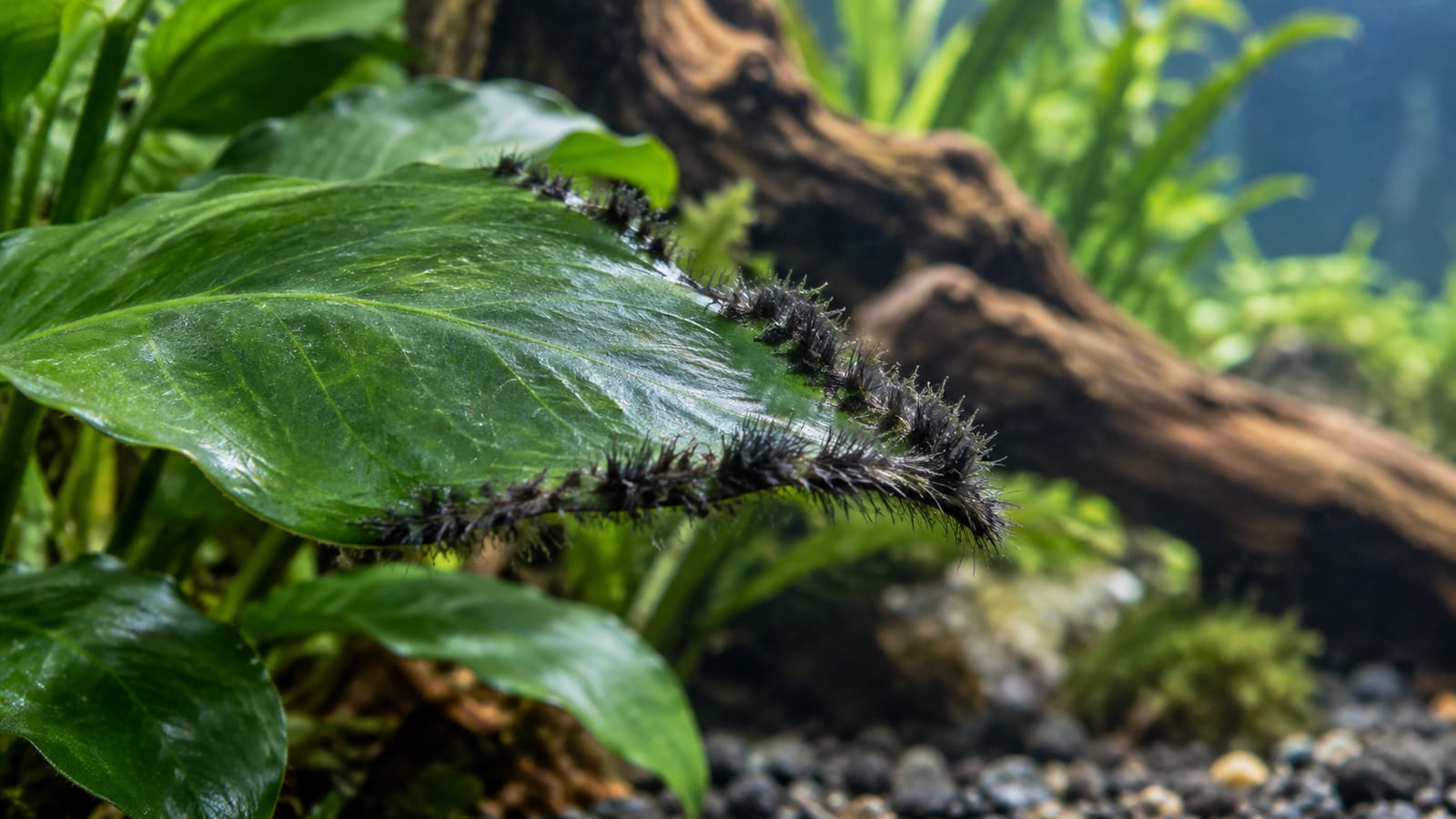
Black Algae in a Fish Tank: Black Beard Algae and How to Remove It
Black algae in a fish tank is almost always black beard algae: dark tufts on leaf edges and wood that will not wipe off. Why it grows and how to get rid of it.