Quick Verdict
Clean aquarium decorations by scrubbing them in hot water with a toothbrush kept only for the tank. Never soap. For algae that will not come off, soak 10 minutes in 1 part bleach to 9 parts water, rinse, then dechlorinate before it goes back.
Most of the time this is a five-minute job with hot water and an old toothbrush. The reason it gets complicated is that two of the obvious solutions — soap and the dishwasher — will kill your fish, and the one that works properly needs a number attached to it.
Here is the number: one part bleach to nine parts water, ten minutes, then rinse and dechlorinate.
The one rule with no exceptions
Never use soap, washing-up liquid, or anything from a dishwasher. Surfactants cling to porous surfaces, rinse out far more slowly than they appear to, and strip the mucus coat that protects a fish's gills. There is no safe dilution.
The fastest way to clean aquarium decorations
For ordinary algae film and debris, you do not need chemicals at all.
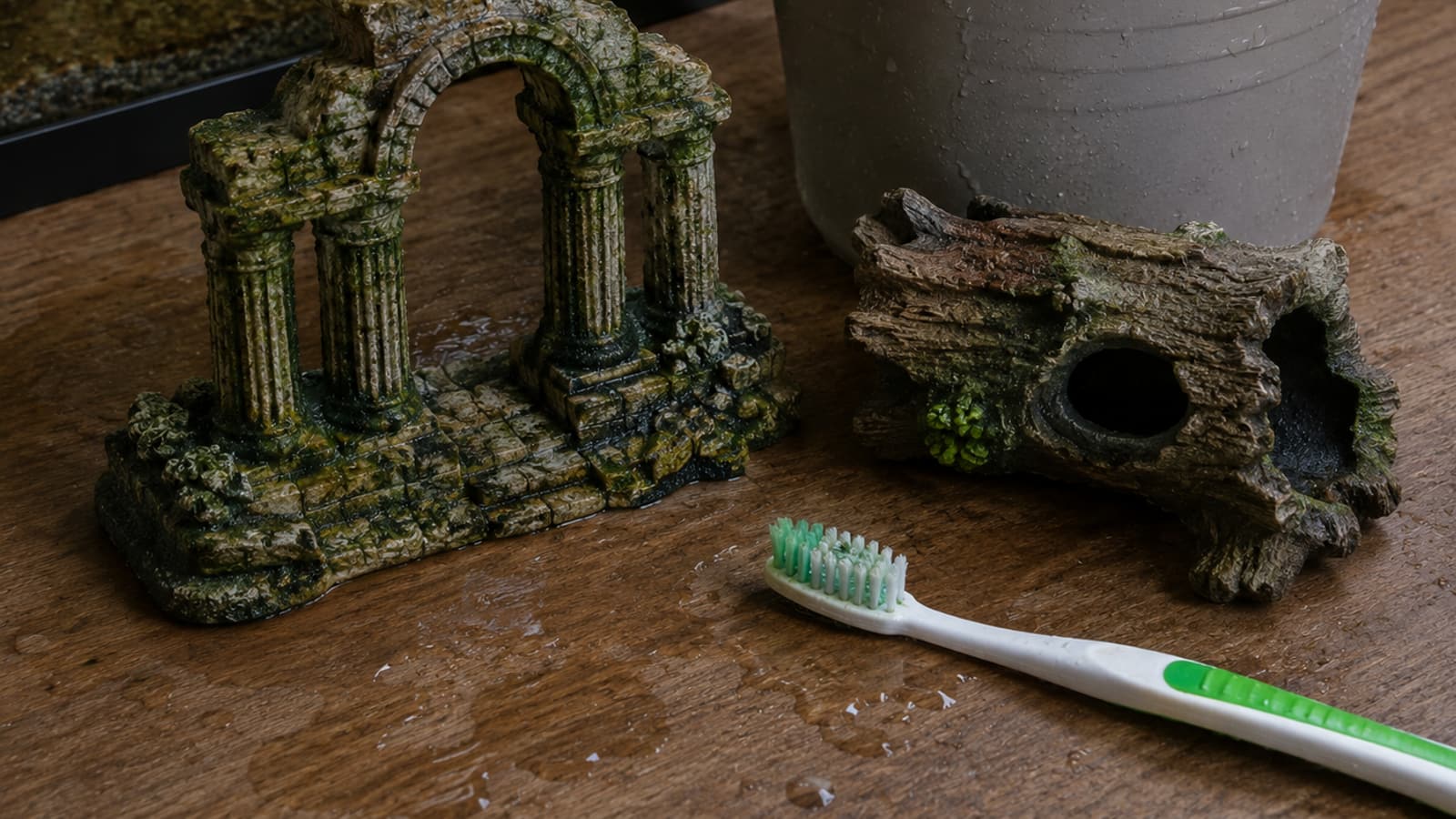
Take the decoration out of the tank, hold it under hot running water, and scrub it with a toothbrush you keep for this and nothing else. That handles the great majority of cases. Old tank water in a bucket works just as well if you are already doing a water change.
If that shifts it, stop there. You are done, and the ornament goes straight back in.
When you need bleach
Algae that has properly bonded to a surface — the hard green or black kind that laughs at a toothbrush — needs bleach. Done correctly this is completely safe. Done impatiently it is not.
- Mix 1 part plain household bleach to 9 parts water in a bucket. Plain means unscented, no additives, nothing marked "splashless".
- Submerge the decoration for 10 to 15 minutes. Longer does not clean better; it just drives bleach deeper into porous material.
- Scrub off the loosened algae — after the soak it comes away easily.
- Rinse under running water for a full minute, turning the item over. Be thorough about crevices and hollow ornaments.
- Soak in clean water with a double dose of dechlorinator for 30 minutes. This neutralises whatever the rinse missed, and there is no downside to overdoing this step.
- Leave it to air-dry until you cannot smell bleach on it at all. If you can smell it, repeat the dechlorinator soak.
The dechlorinator step is the one people skip, and it is the one that makes this reliably safe. Your water conditioner neutralises chlorine — that is its entire job — and bleach is chlorine.
What must not be bleached
Silk plants. The colour strips and the fabric frays. Hot water and a soft brush only.
Driftwood and porous rock. These absorb bleach into their structure and release it back for weeks. If wood has algae on it, scrub it, boil it, or leave it — snails and shrimp will graze it clean given time.
Anything you cannot rinse the inside of. Hollow ornaments with a small opening trap bleach in a pocket you cannot flush. If you cannot get water flowing through it freely, do not put bleach in it.
A light film of algae on an ornament is not dirt. It is grazing for snails and shrimp, and it means the tank is working.
Hard water scale is a different problem
The chalky white crust above the waterline and on ornaments in hard-water areas is mineral deposit, not algae, and bleach does nothing to it. That one needs acid: undiluted white vinegar, 10 to 20 minutes, then scrub and rinse.
If something has both — mineral crust with algae growing on it — do vinegar first, rinse completely, then bleach. Never put the two in the same container. Bleach mixed with an acid releases chlorine gas, and that is a genuine hazard to you, not just the fish.
Second-hand and non-aquarium items
Anything that came out of somebody else's tank gets the full bleach treatment before it goes near yours, without exception. Used decorations are the most common way disease and pest snails move between tanks.
Rocks and wood collected outdoors are a longer conversation and mostly come down to what they are made of — limestone and other carbonate rocks will steadily raise your pH and hardness, whatever you do to clean them.
How often
Less often than you think. Chasing every trace of algae off every surface every week is a habit that makes tanks look sterile and gives you a job you did not need. Clean a decoration when it genuinely looks bad, and leave the rest to the snails.
Detailed Comparison
| Method | What it removes | Contact time | Safe for | Not safe for |
|---|---|---|---|---|
| Hot water + dedicated toothbrush | Most algae, debris, film | As long as you like | Everything | — |
| Bleach, 1 part to 9 parts water | Stubborn algae, anything organic | 10-15 minutes, no longer | Plastic, ceramic, resin, glass | Silk plants, driftwood, porous rock |
| White vinegar, undiluted | Hard water scale and mineral crust | 10-20 minutes | Plastic, ceramic, glass | Anything with calcium you want to keep |
| Boiling | Bacteria, hitchhiking pests | 10 minutes | Ceramic, most rock | Plastic, resin, silk — they warp and melt |
| Soap or detergent | Your fish | — | Nothing | Everything |