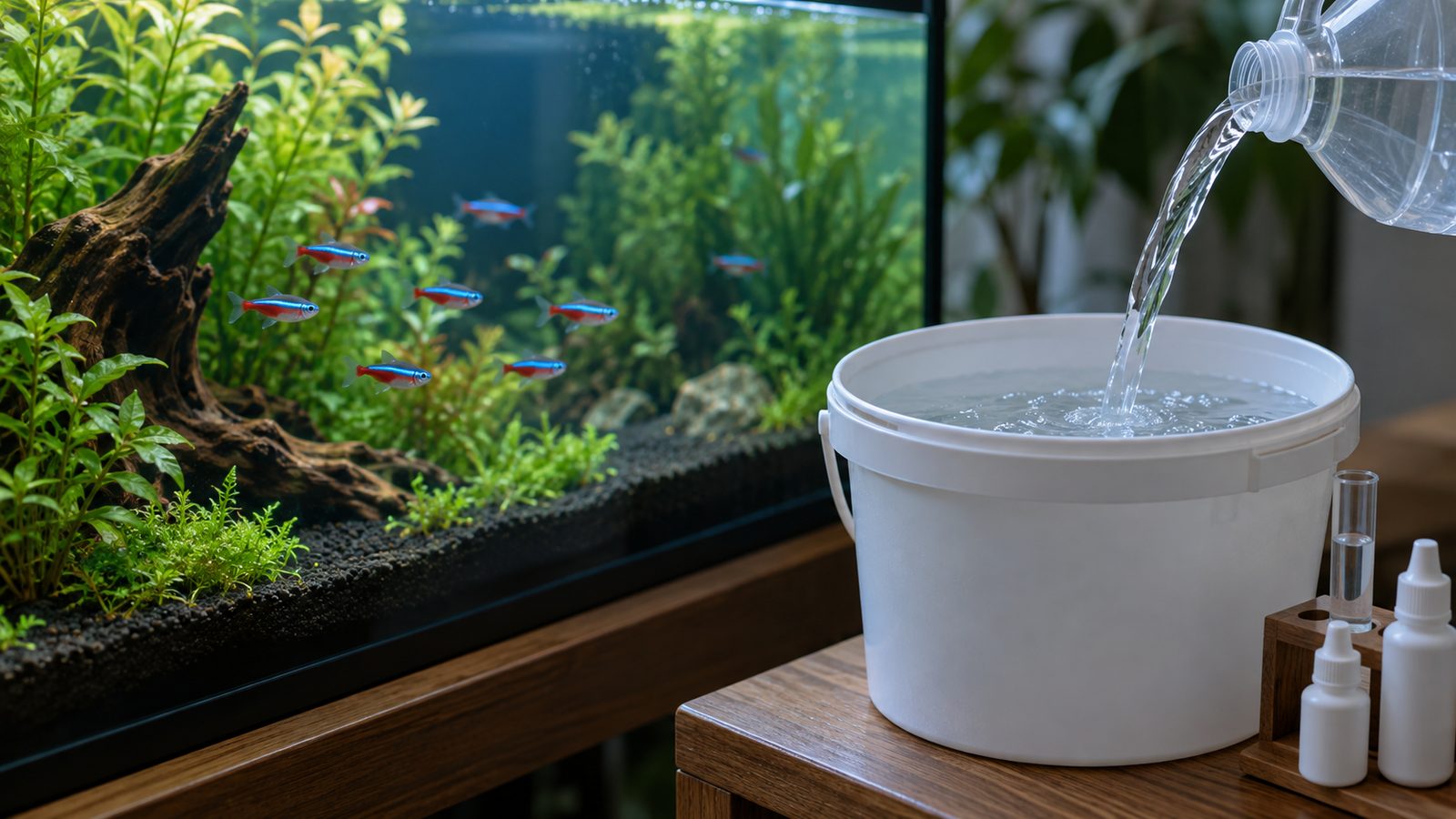
Keep KH at 3 dKH or above so the pH holds, and step down over several water changes at the same ratio. Almond leaves and driftwood mostly lower pH, not GH, and a house water softener swaps the calcium for sodium. Most captive-bred beginner fish do not need soft water at all.
The numbers
| Method | Lowers GH? | Lowers KH and pH? | The catch |
|---|---|---|---|
| RO or distilled water, mixed with tap | Yes, in proportion to the mix | Yes, KH in the same proportion | Watch KH. Never use it on its own |
| Rainwater | Yes, used the same way as RO | Yes | Roof and gutter runoff can carry metals and debris. Test it first |
| Peat | A little, until it is used up | Yes | No published figure for how much it removes. Stains the water and needs replacing |
| Indian almond leaves | No measured effect | pH, mainly in water that is already soft | Tints the water brown |
| Driftwood | No measured effect | Slightly, in low-KH water | Tints the water brown |
| House water softener | Yes, to near zero | No | Swaps the calcium and magnesium for sodium |
| Baking soda | No | No. It raises KH | A myth. It is a buffer, not a softener |
Dilute it. To soften aquarium water you have to lower its GH, the calcium and magnesium dissolved in it, and the one method that does that reliably is mixing your tap water with reverse osmosis (RO) or distilled water at a measured ratio. Almond leaves and driftwood mostly lower pH, not hardness. A house water softener does take the hardness out, but it swaps the calcium for sodium and leaves the carbonate that keeps the pH high.
Before you start, check whether you need to. Most captive-bred fish sold to beginners do fine in hard tap water. The ones that need soft water are discus, wild-caught or breeding soft-water species, and some shrimp. Water that stays the same every week matters more than a perfect number.
Soft water means low GH, not low pH
Two numbers get called "hardness", and most softening advice mixes them up.
General hardness (GH) is the dissolved calcium and magnesium in the water (USGS). It is what "hard" and "soft" describe. Fish use these minerals to balance the salts in their bodies, snails and shrimp build shell from them, and plants need them.
Carbonate hardness (KH) is alkalinity: the carbonate and bicarbonate that buffer the pH. Hardness counts the positive metal ions, calcium and magnesium. Alkalinity counts negative ions such as carbonate and bicarbonate, which absorb acid (WSAVA, 2018). They are separate measurements, and different things lower them.
| GH (general hardness) | KH (carbonate hardness) | |
|---|---|---|
| What it measures | Calcium and magnesium | Carbonate and bicarbonate |
| What it does in the tank | Minerals for fish, shells and plants | Holds the pH steady |
| How you test it | GH drop test | KH drop test |
| What lowers it | Only dilution or ion exchange | Dilution, and acids such as peat and tannins |
The last row explains most of the confusion. Anything that only adds acid uses up some KH and lowers the pH, but the calcium and magnesium stay where they were. To lower GH you have to take those minerals out, or dilute them.
If you want to lower the carbonate in a fish tank, dilution does that too, by the same proportion as GH. That is also the trap covered further down.
The units, in one place
- 1 dGH (or 1 dKH) = 17.9 ppm, written as mg/L of calcium carbonate (American Killifish Association). This page uses degrees, with ppm in brackets.
- Liquid drop kits usually count one drop per degree. Follow the leaflet that comes with yours.
- 1 grain per gallon (gpg) is about 17 mg/L (NDSU Extension, 2022), a little under 1 dGH. US water utilities and softener sellers often quote grains.
- The USGS classes water as soft up to 60 mg/L (about 3.4 dGH), hard from 121 to 180 mg/L, and very hard above 180 (USGS). That is a general water-quality scale, not a fish one, but it is the kind your utility may use.
Do you need to soften your aquarium water?
Often not. These are the hardness ranges Seriously Fish lists for some common species:
| Fish | GH range | Soften for it? |
|---|---|---|
| Neon tetra | 1–12 dGH, 1–5 for spawning | Only to breed them |
| Cardinal tetra | 1–12 dGH, toward the low end for wild fish or breeding | For wild-caught fish or breeding |
| Betta | 1–15 dGH | No |
| Discus | 0–5 dGH | Yes |
| Guppy | 8–30 dGH | No. They want hard water |
Hard water is common across the east-central and western United States (USGS). A typical hard tap reading of 8 to 12 dGH (about 140 to 215 ppm) already sits inside the listed range for captive-bred neons, cardinals and bettas. Seriously Fish notes that commercially produced neons "are more adaptable than wild specimens".
So soften for discus, for breeding or wild-caught soft-water fish, and for soft-water shrimp such as Caridina, whose keepers usually build their water from RO. Do not soften for guppies, mollies, platies or other livebearers (Seriously Fish lists mollies at 15–30 dGH and platies at 10–30), or for goldfish (what fish can live with goldfish covers their tank mates). Many common aquarium plants grow in hard water as well.
Where a fish does need soft water, soft means a GH of about 3 to 6 degrees, not zero. Merck's veterinary reference ranges put total hardness for fish above 20 mg/L, a little over 1 dGH (Merck Veterinary Manual). Hardness that keeps changing does more harm than a high number held steady.
Find your numbers before you change anything
Test your tap and your tank
Test GH and KH on a glass of tap water and on the tank water, the same day, and write both down. If the tank reads noticeably harder than the tap, something in the tank is adding minerals, and no mixing will hold until that is fixed.
Read your water utility's report
Community water systems in the US must send their customers a Consumer Confidence Report each year by July 1 (US EPA), and the EPA's CCR page links a lookup to find yours. Some reports list hardness and some do not. If yours gives it in grains per gallon, multiply by 17 for ppm: a 10 gpg report is about 170 ppm, or 9.5 dGH. Treat it as a starting point and test anyway: the report covers the whole system, and the water at your tap can differ. On a private well there is no report, so your kit is the only number you get.
What causes high GH in an aquarium
If the tank is harder than the tap, look for one of these:
- Limestone and other carbonate rock. They keep raising pH and hardness however well you clean them (how to clean aquarium decorations).
- Crushed coral or aragonite substrate. Both are calcium carbonate, and both are sold to harden water on purpose.
- Topping off evaporation with tap water. Only water evaporates. The minerals stay behind, so every top-off with tap water adds more.
Take the source out first, or you are diluting against something that keeps putting the minerals back.
How to lower GH: mix RO or distilled water with tap
RO and distilled water have a GH and KH close to zero, so mixing them with tap water lowers hardness in direct proportion. Half and half gives half the GH and half the KH. It is the only home method that softens fish tank water by an amount you can predict before you pour.
The mixing formula
The formula
Tap fraction = target GH ÷ tap GH. The rest of the bucket is RO or distilled water.
Three worked examples. The KH figures are only illustrations, so use your own test results:
| Your tap water | Target GH | Mix | GH of the mix | KH of the mix |
|---|---|---|---|---|
| 12 dGH, 6 dKH | 6 dGH | ½ tap, ½ RO | 6 dGH | 3 dKH |
| 15 dGH, 9 dKH | 5 dGH | ⅓ tap, ⅔ RO | 5 dGH | 3 dKH |
| 10 dGH, 5 dKH | 4 dGH | 40% tap, 60% RO | 4 dGH | 2 dKH: too low |
In gallons: a 25% change on a 20-gallon tank is 5 gallons. At one-third tap, that is about 1.7 gallons of tap water and 3.3 gallons of RO or distilled.
Keep KH at 3 dKH or above
The third row is the catch. Diluting GH dilutes KH by the same amount, and KH is the tank's buffer against acid. The bacteria in the filter use up carbonate as they work, so alkalinity falls between water changes, and as it falls the water "may experience sudden, and deadly, pH shifts" (WSAVA, 2018). The bacteria that run the nitrogen cycle use up KH, and a pH crash hurts them too.
So the honest answer to "how do I lower GH without lowering pH" is that with dilution, you cannot entirely. You choose a ratio that leaves KH at 3 dKH (about 54 ppm) or more. In the 10 dGH example above, that means 60% tap instead of 40%, which gives a mix of 6 dGH and 3 dKH rather than 4 and 2. Test the mix in the bucket, not just the tap.
Treat 3 dKH as a floor, not a target. Merck's general reference range for fish asks for more than 100 mg/L of alkalinity, about 5.6 dKH (Merck Veterinary Manual). Keep as much KH as your fish allow.
Change it slowly, over several water changes
To lower hardness in a fish tank, do not swap the whole tank in one go. Mix each change in a bucket to the target, add conditioner for the tap portion only, match the temperature, and use the same ratio at each regular water change. The tank moves a step closer every time. With 25% weekly changes and a mix at 6 dGH, a tank that starts at 12 dGH goes like this:
| After change | 1 | 2 | 3 | 4 | 8 |
|---|---|---|---|---|---|
| Tank GH | 10.5 dGH | 9.4 dGH | 8.5 dGH | 7.9 dGH | 6.6 dGH |
That is about two months to get most of the way, and a slow, steady fall is what you want. Top off evaporation with RO or distilled, not tap, or the top-offs push the number back up. And once your water differs from the store's, acclimate new fish slowly.
RO unit or store-bought distilled?
Can you use reverse osmosis water in a fish tank? Yes, mixed with tap water or remineralized, and never on its own. For softening, distilled and RO water do the same job, and the distilled water guide explains why pure distilled or RO water can't be used on its own. The choice between them comes down to volume.
Jugs of distilled water are simplest for a small tank. Once you are buying many gallons a month, a home RO unit starts to make sense. Four things to know first (Alberta Agriculture, 2012):
- RO removes 85 to 98% of dissolved solids, so the output is close to zero, not exactly zero. Test it.
- Small units send 3 to 20 gallons to the drain for every gallon they make.
- On a home water supply, expect about half the output the sales literature states.
- Chlorine damages the common thin-film membranes, so the unit needs a carbon pre-filter, and hard water can scale the membrane.
Why a house water softener is wrong for a fish tank
This is the question keepers on hard well water ask most. A softener is an ion exchanger. As water passes through it, "the calcium and magnesium ions trade places with sodium ions" (NDSU Extension, 2022), and it can remove nearly all of them (Skipton and Dvorak, 2014). GH reads near zero, so it looks like exactly what you wanted. It is not, for three reasons:
- It adds sodium. About 8 mg/L of sodium goes in for every grain of hardness taken out, according to both NDSU and the University of Nebraska. Fully softening 15 gpg water (about 256 ppm, very hard) adds about 120 mg/L of sodium.
- It leaves the carbonate. A softener swaps positive ions only. The bicarbonate that makes up KH passes straight through, so KH stays where it was and the pH barely moves. Ohio State's watershed network notes that alkalinity higher than total hardness "may indicate that the water passed through a water softener" (Ohio State University). Taking alkalinity out needs a different unit, a dealkalizer, which is usually installed after a softener (Wikipedia). Softened water is not the soft, slightly acidic water that soft-water fish come from.
- It strips the minerals. A GH near zero means almost no calcium or magnesium left for fish, snail shells, shrimp or plants.
We found no reliable figure for how much sodium is too much for aquarium fish, so this is not a claim that softened water kills fish. The point is that it gives a soft-water fish nothing it needs. A softener regenerated with potassium chloride instead of salt swaps in potassium, with the same two other problems.
| House softener | RO or distilled mix | |
|---|---|---|
| GH afterwards | Near zero | Whatever ratio you choose |
| KH afterwards | Unchanged | Lowered in the same proportion |
| pH | Stays where the tap had it | Held by the KH you leave |
| What it adds | Sodium | Nothing |
| For a fish tank? | No | Yes, with KH at 3 dKH or more |
The fix is to fill from a tap plumbed before the softener. Outdoor spigots and the cold kitchen line are often left unsoftened, but not always, so test GH from the tap you plan to use. If that water is harder than your fish need, mix it with RO.
What about water softener pillows?
These are pouches of resin that sit in the filter and work on the same principle as a house softener: hardness comes out because something else goes in. API's own page for its pillow says it lowers calcium and magnesium, stays active for 48 hours, and is recharged by soaking it in a solution of aquarium salt, up to four times (API). A salt recharge means sodium is what it swaps in. API gives no figure for how much hardness one pillow removes, so test GH before and after, and treat it as a top-up to dilution, not a way to soften a whole tank.
Peat, almond leaves and driftwood: what they really change
The table at the top of this page sums up every method. Here is the detail on the natural ones.
Peat
Sphagnum peat is the one natural material with a real mechanism for lowering GH. It is a cation exchanger: it binds calcium and magnesium and releases hydrogen ions in their place, which is also how it lowers pH. In a study of Sphagnum moss, its pH effect in pure water with no minerals in it was negligible. It needs the calcium to work on (Gagnon and Glime, 1992).
The catch is capacity. Peat can only take up so much before it is spent, and we found no published figure for how much GH a given amount removes in an aquarium, so there is no reliable dose. Even the replacement interval varies: Aquasabi's listing for Fluval's peat granules suggests renewing them every 6 months, or using a pH test to tell when they are spent (Aquasabi). It stains the water brown, and in very hard, high-KH tap water its effect is small. If you use it, put it in a filter bag alongside dilution, and test GH before and after.
Indian almond leaves and driftwood
Catappa leaves and driftwood release tannins, mild acids that tint the water tea-brown. In a study on bettas kept in water treated with an ethanol extract of catappa leaves, doses from 125 to 500 ppm left the pH close to the untreated tanks' 6.14. Only the highest dose, 625 ppm, brought it down noticeably, to 5.05. The researchers measured temperature, oxygen and pH. They did not measure hardness (Nugroho et al., 2016). We found no study that measured a GH drop from leaves or driftwood.
In hard tap water with plenty of KH, the carbonate absorbs most of that acid before the pH moves much. Almond leaves are fine for the look, and for fish that like tannin-stained water, but if you add them and retest GH, expect the same number.
Rainwater
Rainwater is naturally low in minerals, so it can dilute tap water the way RO does. But roof and gutter runoff picks up whatever is on the roof: a study of harvested roof water found that uncoated galvanized metal and treated wood roofs were more likely to leach heavy metals (Nicholson et al., 2010). Test it first, and do not make it your only source.
Baking soda does not soften anything
Some pages suggest baking soda, with or without vinegar. Baking soda is sodium bicarbonate: it raises KH and pH and does nothing to lower GH. It is the opposite of what you want.
Common mistakes when softening tank water
- Filling from a house softener. KH and pH stay high, and the minerals become sodium.
- Expecting almond leaves to lower a GH reading. They change pH, mostly in soft water.
- Filling with 100% RO or distilled water. With no buffer, the pH can crash.
- Dropping the hardness in one big change. Step it down over several.
- Diluting KH below 3 dKH. Test the mix, not just the tap.
- Leaving limestone or crushed coral in. The tank keeps hardening itself.
- Topping off with hard tap water. Use RO or distilled for top-offs.
- Softening for fish that want hard water. Leave livebearers and goldfish on tap water.
How to soften aquarium water: the short version
Test your tap and your tank. Take out whatever is hardening the tank. Mix RO or distilled water with tap using tap fraction = target GH ÷ tap GH, keep KH at 3 dKH or more, and step down over several water changes at the same ratio. If your fish are captive-bred and your tap reads 8 to 12 dGH, you probably do not need to do any of it.
Sources
- US Geological Survey. Hardness of Water. USGS Water Science School.
- World Small Animal Veterinary Association (2018). Water Quality Assessment in Aquatic Vet Medicine. WSAVA Congress proceedings, via VIN.
- American Killifish Association. General Water Hardness: A Comparison of the dH, GH, fH and US Scales of Hardness.
- NDSU Extension (2022). Water Softening (Ion Exchange). North Dakota State University, WQ1031, revised May 2022.
- Seriously Fish. Species profiles: Paracheirodon innesi, Paracheirodon axelrodi, Betta splendens, Symphysodon aequifasciatus, Poecilia reticulata, Poecilia sphenops, Xiphophorus maculatus.
- Merck Veterinary Manual. "Normal" Reference Ranges for Routine Water Quality Analysis.
- US EPA. CCR Information for Consumers and Consumer Confidence Reports.
- Alberta Agriculture (2012). Reverse Osmosis Water Treatment. Agdex 716 (D36), revised September 2012.
- Skipton and Dvorak (2014). Drinking Water Treatment: Water Softening (Ion Exchange). University of Nebraska–Lincoln Extension, NebGuide G1491.
- Ohio State University, Ohio Watershed Network. Alkalinity.
- Wikipedia. Dealkalization of water.
- API Fishcare. Water Softener Pillow. Manufacturer product page, read 2026-10-28.
- Gagnon and Glime (1992). The pH-lowering ability of Sphagnum magellanicum. Journal of Bryology 17(1): 47–57.
- Aquasabi. Fluval Aquatic Peat Peat Granules. Retailer product listing.
- Nugroho et al. (2016). The effects of Terminalia catappa L. leaves extract on the water quality properties, survival and blood profile of ornamental fish (Betta sp) cultured. Biosaintifika 8(2): 240–247.
- Nicholson et al. (2010). Rainwater harvesting from roofs for non-potable reuse. Low Impact Development 2010 conference proceedings, 21–30.
Questions people ask
Mentioned in this guide
Related guides
Can You Use Distilled Water in a Fish Tank? Not on Its Own
Can you use distilled water in a fish tank? Not by itself — it has no minerals and cannot hold a stable pH. Use it for top-offs and to soften hard tap water.
How to Lower Nitrates in a Fish Tank (and Keep Them Down)
To lower nitrates in a fish tank, change 50% of the water, then size your weekly change to fit. The tap water trap, the maths and which removers work.
How to Lower Nitrites in a Fish Tank: What to Do Today
To lower nitrites in a fish tank, change 50% of the water today and add a little aquarium salt to block it. Then fix the cause. Exact doses, sourced.