That clears most tanks in four to six weeks. Add assassin snails only if there are no snails you want to keep. Do not use snail-killing chemicals.
The numbers
| Does it work? | How fast | What it risks | |
|---|---|---|---|
| Feed less | Yes. Nothing else lasts without it | 4–8 weeks | Nothing |
| Vegetable trap overnight | Yes, for bladder, pond and ramshorn snails | Dozens per night | Nothing, if you remove the bait by morning |
| Picking by hand | Only on a small population | Slow | Nothing |
| Assassin snails | Yes, steadily | 4–8 weeks for a moderate problem | Any snail you wanted: mystery, nerite, rabbit |
| Snail-eating fish (loaches, puffers) | Yes | Days | Most need 30+ gallons or a tank of their own |
| Snail-killer medication | Yes, too well | Days | Shrimp, wanted snails, and an ammonia spike from the dead |
To get rid of snails in an aquarium: feed less, trap them overnight, and vacuum. That combination clears pest snails from most tanks in four to six weeks, and it is the only approach that stays cleared. Add assassin snails if you want it faster and there are no snails in the tank you want to keep. Leave the snail-killing chemicals on the shelf.
The table above compares every method people try. The rest of this page is the order to use them in.
First: are these the snails you think they are?
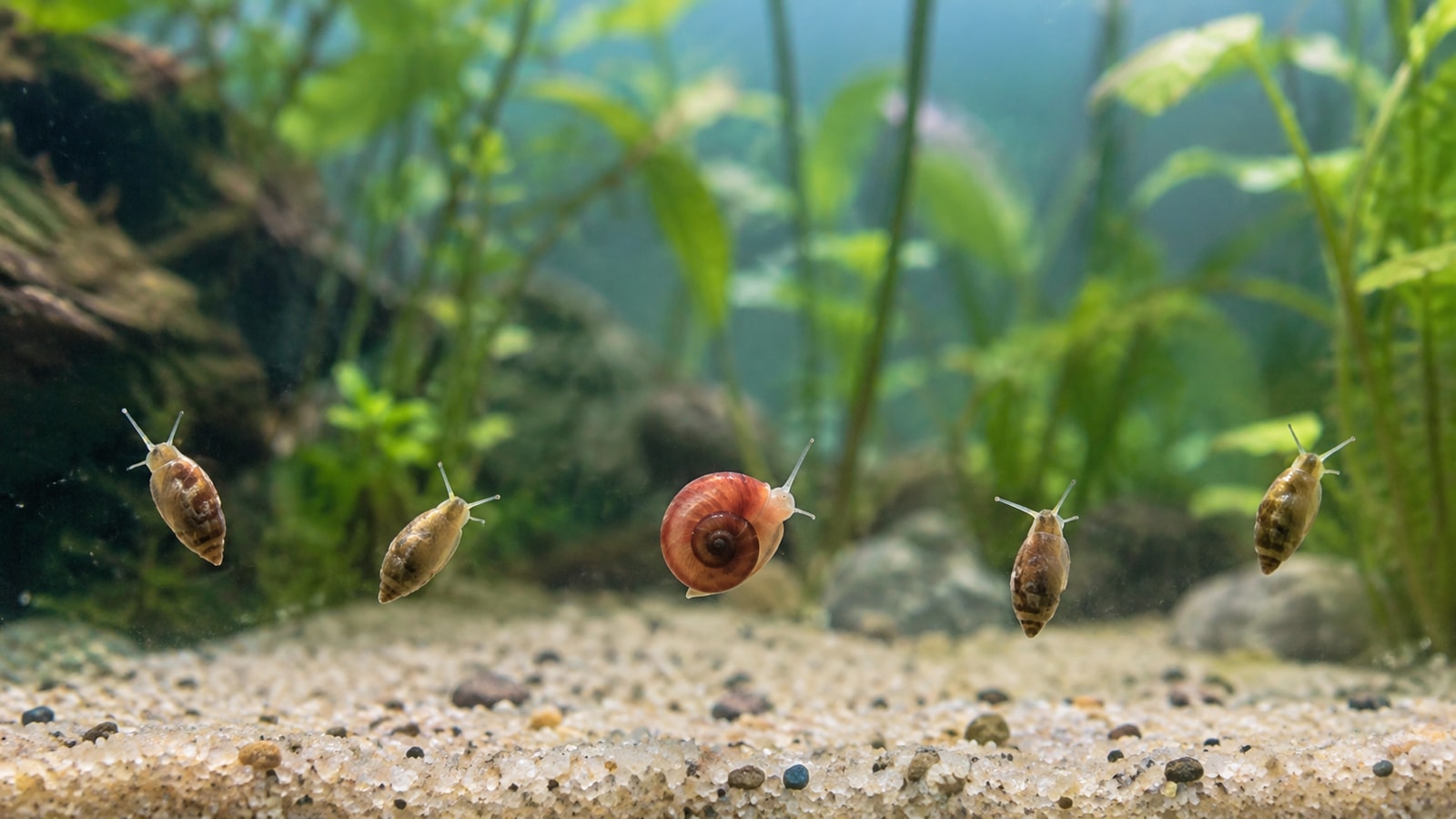
Nearly every snail that appears uninvited is one of three kinds, and all three are harmless to fish:
- Bladder or pond snails. Small, teardrop-shaped, with a shell that coils to the left and a pointed tip. Fast for a snail, and often seen hanging from the surface.
- Ramshorn snails. A flat spiral shell like a coiled rope, brown, red or pink.
- Malaysian trumpet snails. A long cone like a tiny unicorn horn. They spend the day buried in the substrate and come out at night, so the first sign is often dozens on the glass after lights-out.
If you are still finding eggs rather than snails, identify the eggs first. The white sesame-seed dots from a nerite never hatch in freshwater and need no action at all.
Step 1: cut the food
A snail population is the size its food supply allows. The food is what your fish leave: flakes that sink past them, pellets that roll under the rocks, dying plant leaves and the film on the glass. Take that away and the population shrinks by itself.
- Feed only what the fish finish in about two minutes, once a day. If food reaches the substrate, it was too much.
- Skip one day a week. Healthy adult fish lose nothing by it.
- Vacuum the substrate at every water change, working the gravel vac into the areas under decor where food collects.
- Trim dying and melting plant leaves as soon as you see them.
- If you feed sinking wafers for a catfish or pleco, feed them after lights-out and take out whatever is left in the morning.
You can remove every snail you see, and if the food stays the same, the tank grows them back.
Step 2: trap them overnight
Blanch a slice of zucchini or cucumber, or a leaf of lettuce, for a minute in boiling water so it sinks and softens. Weigh it down on the substrate before lights-out. By morning it is covered in snails. Lift it out in a cup, snails and all, and throw them away (see below for how).
Do this every night for a week, then twice a week. Bladder, pond and ramshorn snails come to it readily. Trumpet snails come less, so for them the gravel vac and the reduced feeding do more.
Two rules. Take the bait out the next morning, every time: a slice left in for days rots and feeds the snails you are trying to starve. And do not use a trap with a one-way entrance in a shrimp tank, because shrimp go in too.
Step 3, if needed: assassin snails
Assassin snails (Clea helena) hunt other snails. They are yellow with dark brown bands, and they are the one biological control that works in a normal community tank.
Two or three in a 10 to 20 gallon tank is enough. Expect a visible drop within a month and most of the pest snails gone in two, faster if you also keep feeding light. An assassin with a steady supply of fish food ignores the snails, so Step 1 matters here too.
Assassins do not choose
Assassin snails eat any snail they can overpower. Baby mystery snails, nerites and rabbit snails are on the menu. If you keep snails you like, stay with Steps 1 and 2.
Snail-eating fish work as well, but few fit a beginner tank. Clown loaches reach 12 inches. Yoyo and zebra loaches need a group and at least 30 gallons. Pea puffers eat snails very efficiently but are aggressive enough that they need a tank of their own. Buying a fish to solve a snail problem is usually trading a small problem for a bigger one.
What not to do
Snail-killing medications. Most are copper-based. Copper kills shrimp and every snail in the tank, including the ones you paid for, and it binds to the silicone and substrate so it can keep leaching for months. That tank may never be safe for shrimp again.
Killing a large population all at once, by any method. A hundred dead snails in the gravel are a hundred small pieces of rotting protein, and the ammonia that follows can do more harm to your fish than the snails ever would. One large snail matters too: how to tell if a mystery snail is dead covers the checks.
Flushing, or releasing them outdoors. Some aquarium snails are invasive in US waterways. Put the ones you remove in a sealed bag in the freezer before they go in the bin.
Keeping them out of the next tank
Every unwanted snail arrives the same way: as eggs on a live plant. Tissue-culture plants, sold in sealed cups of gel, are grown sterile and bring nothing with them. For ordinary potted plants, inspect every leaf, rinse them well and quarantine them in a bucket for a couple of weeks before they go in the tank. Any hitchhiker that hatches does it in the bucket.
The one thing worth taking from this
A few snails are worth keeping. They eat what your fish miss, and a steady population of five or ten tells you the feeding is right. It is the boom that means something, and the fix for a boom is on the food side, not the snail side.
Questions people ask
Mentioned in this guide
Related guides
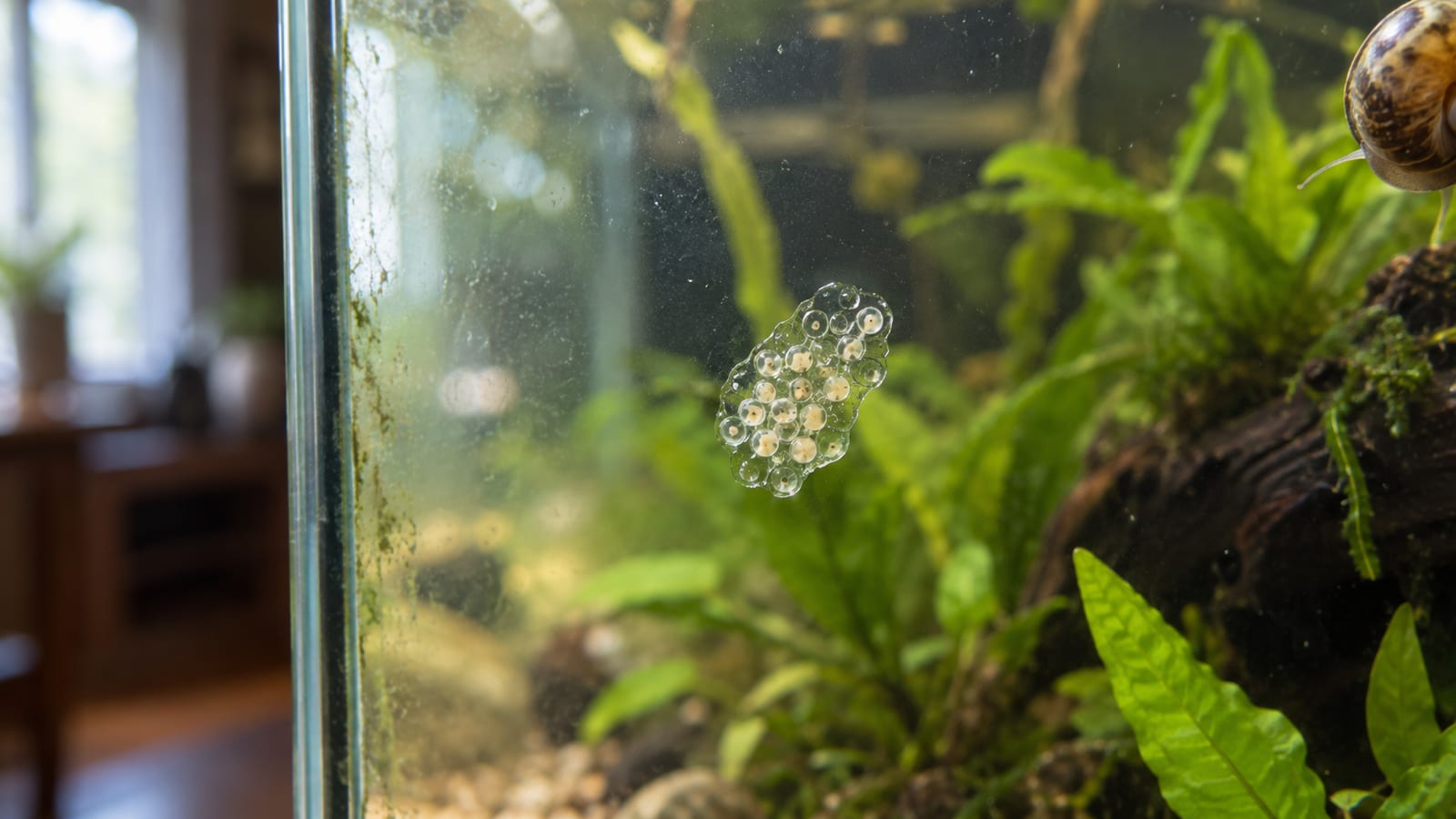
Snail Eggs in a Fish Tank: Which Snail, and Will They Hatch?
Snail eggs in a fish tank look different for every species. Identify yours in one table — clear jelly, pink clutch or hard white dots — and if they will hatch.
How to Get Rid of Duckweed in an Aquarium Without Hurting Fish
How to get rid of duckweed in an aquarium without hurting fish: net it, wipe the glass, pick it out of moss, then check for six weeks so it stays gone.
How to Tell If a Mystery Snail Is Dead: A 3-Step Check
How to tell if a mystery snail is dead: check its grip, its trapdoor, then the smell. Floating is not a sign. Then head off the ammonia spike.