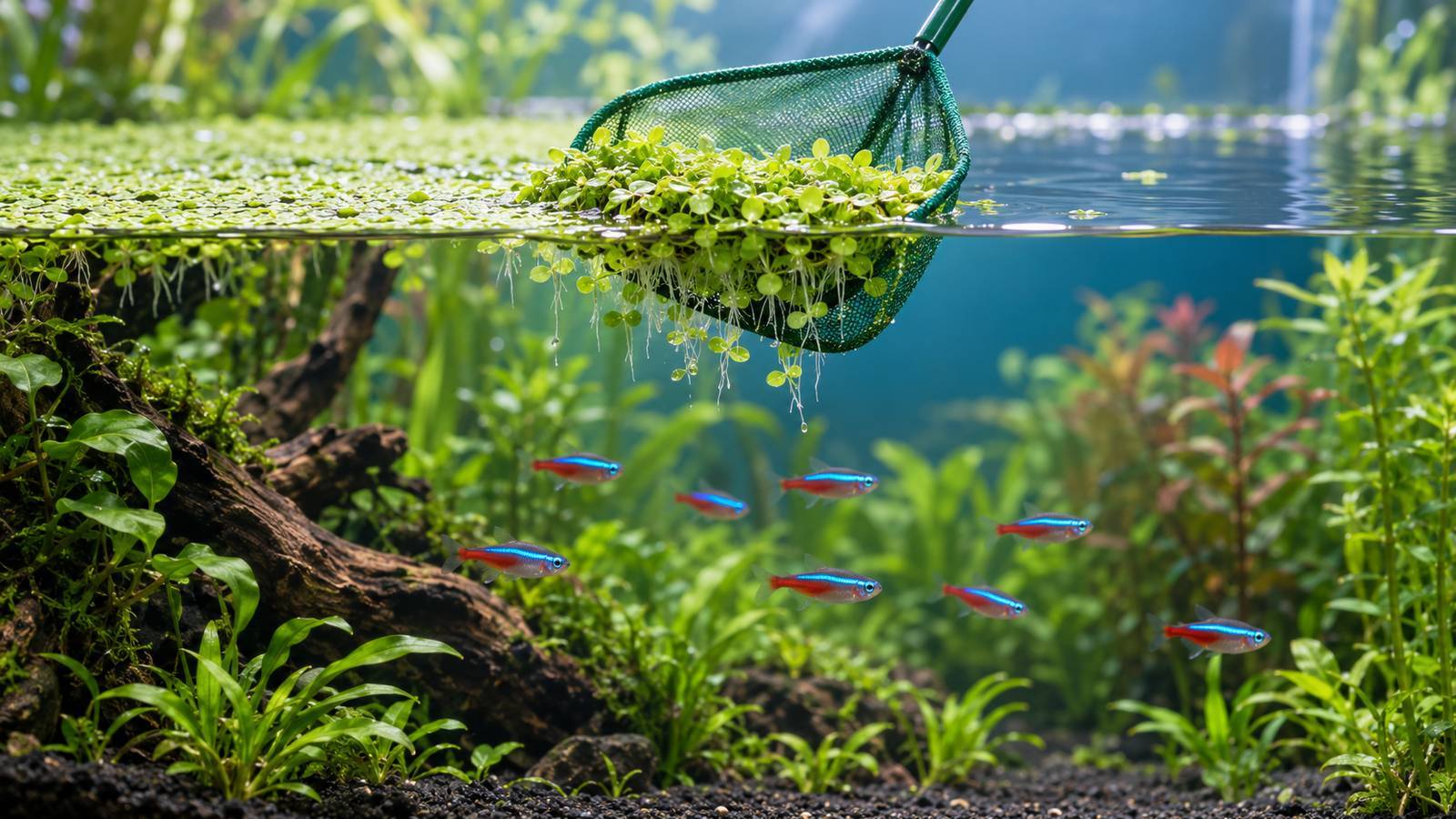
Turn the filter off, net the mat, lower the water and wipe the stragglers off the glass, and clear it out of moss, other plants and the filter. Then check daily for a week and every two or three days until week six, since one missed frond can rebuild a patch within a month. More surface ripple and less food and fertilizer keep it from coming back.
The numbers
| Does it work? | How fast | What it risks | |
|---|---|---|---|
| Net, wipe the glass, then follow up | Yes. The only complete fix | One session, then six weeks of checks | Shrimplets caught in the netted mat, unless you float it first |
| More surface ripple | Slows it a lot, and can finish off stragglers | Weeks | Too much current for bettas and other calm-water fish |
| Feed and fertilize less | Slows regrowth. Does not remove what is there | Weeks | Nothing |
| Fish that eat it | Not reliably in a tropical tank | Unpredictable | A fish that outgrows the tank |
| Pond herbicide | Never in a fish tank | — | Your plants, and an oxygen crash as the dead mat rots |
| Vinegar, peroxide or salt | Never in a fish tank | — | Everything else in the water gets the same dose |
| Tear the tank down | Yes, as a last resort | A day | Disturbing the filter bacteria. Rarely needed |
To get rid of duckweed in an aquarium, take it out by hand: nothing that kills duckweed is safe in the same water as your fish. Turn the filter off, net the mat, drop the water level and wipe the stragglers off the glass, and pick it out of moss and other plants. Then check every day for a week and every two or three days until week six, because a single frond left behind can rebuild a visible patch within a month.
The rest of this page covers each step, the places the last fronds hide, why the follow-up takes six weeks, and how to make your tank a poor place for duckweed to come back.
First, make sure it is duckweed
Several floating plants look alike from above, and the smallest one needs a finer net.
| Size | Roots | How to tell | |
|---|---|---|---|
| Duckweed | 1/8–1/4 in across | One root hanging from each frond | Round or oval fronds, often one to three joined together. About the size of a pencil eraser |
| Watermeal | Under 1/16 in | None | Looks like green seeds. A handful feels gritty, "like rubbing cornmeal between your fingers" |
| Frogbit, salvinia and other larger floaters | Much larger | Varies | Leaves big enough to pick up one at a time |
The sizes, roots and the cornmeal comparison come from Purdue's extension guide (Lembi, Purdue), the "one to three" count from Mississippi State (MSU) and the pencil eraser from Clemson (Clemson HGIC). Mississippi State gives a smaller size for common duckweed, 1/16 to 1/8 in long, so small fronds are normal.
If you have watermeal, everything below still applies, but use the finest net you can find and expect more passes. It is the smallest flowering plant there is.
Do you need every last frond gone?
Not always. Duckweed is not harmful in itself: fish and water birds eat it, and it is used as livestock feed (UF/IFAS Extension). A thin patch is harmless. What causes trouble is a full mat. It shades the plants below, and it blocks the surface, which is where a tank swaps gases with the air. Duckweed also gives off its oxygen to the air, not the water (Clemson HGIC). In ponds, extension services warn that mats can drive oxygen low enough to kill fish (Lembi, Purdue). A tank with a running filter is at much less risk than a still pond, but your carpet and stem plants will notice the shade.
There is a trade-off. Floating plants pull nitrogen out of the water, which is why they are often suggested to lower the nitrate it is feeding on. Duckweed just does the job too well. If the mat was thick, test nitrate for a week or two after you remove it.
So decide. If you like it, scoop out half every week and leave it. If you want it gone, the job only works if you finish it. The rest of this page is for that.
How to get rid of duckweed in an aquarium, step by step
Removing duckweed from an aquarium is one long session followed by short checks. Have a fine net, a clean bucket or tub, a jug, paper towels and tweezers ready.
- Turn the filter and air pump off for a few minutes. With no current, the fronds drift together into a mat that is easier to net. This is a common keeper method, not a lab finding. Remember to turn everything back on.
- Herd the mat and net it. Push the duckweed into a corner with the net rim or a piece of card, then lift it out. The finest net you have catches the most small fronds.
- Float what you net in a tub of tank water. Shrimp and fry get caught in the mat, and this gives them a chance to swim out before you throw it away. See the next section if you keep shrimp.
- Lower the water and wipe the glass. On water-change day, drain the tank down a few inches. The fronds strand on the glass as the level drops, and a paper towel wipes them off (Aquasabi). Doing it during your weekly water change saves a separate job.
- Dip the plants you are keeping. Lift out other floating plants, and any stem plants with leaves at the surface, and swish them in a jug of tank water. The water loosens fronds stuck to the leaves and roots (Shrimp Science).
- Pick it out of moss with tweezers. Moss holds duckweed like a net, and only tweezers get it out (Aquasabi).
- Clean whatever breaks the surface. Filter intakes, tubing, the heater top and any wood or rock that sticks out of the water all collect fronds.
- Rinse the net, tub and jug. Duckweed stuck to a net is how it gets into the next tank.
How long does it take? One shrimp keeper reports about an hour for a 10-gallon tank (Shrimp Science). Bigger tanks and mossy scapes take longer.
If you keep shrimp or fry
Shrimp spend a lot of time under floating plants, and shrimplets are small enough to disappear into a netted mat. To get rid of duckweed without killing fish fry or shrimp:
- Feed about 20 minutes before you start, so the shrimp are down on the food and off the surface.
- Gently push the floating plants before you net them, to shoo off the shrimp hanging underneath (Shrimp Science).
- Float the netted duckweed in a tub of tank water so any shrimp or fry caught in it can swim free. Check the tub before you throw anything away, and pour any shrimp back. One keeper combing duckweed out of a fry tank rinsed the comb in a container of clean water after each pass and freed two fry that way (Aquarium Co-Op forum).
Where the last fronds hide
These are the spots a first session always misses:
- In moss, and in the crowns of rosette plants
- Tangled in the roots of other floating plants
- On the filter intake sponge or strainer
- Inside a hang-on-back filter box
- On the rim, the lid and the underside of the cover glass
- In the corners where the water meets the glass
- Behind and under wood, where shrimp drag fronds down (Shrimp Science)
- On the net, buckets and anything else you used in another tank
Go through the list once on the day you net it, and again on your first few checks.
Check for six weeks, and why it takes that long
Duckweed grows faster than almost any other flowering plant. Under standardised lab conditions, 39 duckweed clones covering 13 species doubled every 1.34 to 4.54 days (Ziegler et al., 2015). In a 2022 study of 40 clones, doubling times ran from 1.12 to 9 days, and common duckweed (Lemna minor) clones averaged 4.38 days (Taghipour et al., 2022). Extension guides say that in some cases it can produce a new plant every 24 hours (Lembi, Purdue).
Here is what that means for one frond you missed. This is our own arithmetic from those doubling times, assuming nothing slows it down:
| Doubling time | Fronds after 30 days, from one |
|---|---|
| 9 days (slowest clone in the 2022 study) | about 10 |
| 4.54 days (slowest in the 2015 study) | about 98 |
| 4.38 days (common duckweed average) | about 115 |
| 2 days | about 32,768 |
Lab cultures get ideal light and nutrients, so a tank is probably nearer the top rows than the bottom. Even so, a hundred fronds is a patch you will see, and a slow grower is the one that stays too small to notice for weeks. That is why one session never ends it. One keeper reports it took about a month of daily or every-other-day checks, and that it came back when they stopped picking out the bits that turned up later (UKAPS forum).
The schedule we recommend, based on that growth rate:
| When | What to do |
|---|---|
| Week 1 | Check the surface and the hiding spots daily, and net anything you find |
| Weeks 2–6 | Check every two to three days, and properly at each water change |
| After week 6 | Once two checks in a row find nothing, call it gone. Keep glancing at the surface during water changes |
Finding a frond late is not a failure. Net it, check that spot again next time, and keep to the schedule.
Make the surface hard for duckweed to grow on
You cannot kill duckweed in a fish tank, but you can make the tank a poor place for it. Two things matter most: moving water and fewer nutrients.
Ripple the surface. Duckweed and watermeal "prefer stagnant or slow-moving water", and adding aeration "might be possible to eliminate the growth of both plants" (Selden, UAPB). Clemson notes it spreads fastest in nutrient-rich water "with little airflow" (Clemson HGIC). In a tank, that means an air stone, a sponge filter, or a hang-on-back filter with the outflow breaking the surface. Several aquarium keepers report that air-driven sponge filters or extra agitation from a powerhead got rid of it (Aquarium Co-Op forum). The guides to the best filter for a 10-gallon tank and the best filter for a 20-gallon tank cover which filters ripple the surface. If you keep a betta or other fish that like calm water, ripple one end and leave the other quiet.
Cut the nutrients. Duckweed needs a lot of nitrogen and phosphorus (Lembi, Purdue), and in lab work every duckweed species tested took up ammonium before nitrate (Zhou et al., 2021). That is the same ammonia your fish give off. Feed what the fish finish in a couple of minutes, and ease off liquid fertilizer while you clear it. Be realistic about what this does: cutting nutrients "will not remove or kill plants, or correct an existing problem" (Selden, UAPB). It slows regrowth while the net does the work.
Light matters less in a tank. Garden guidance says duckweed spreads fastest in full sun (RHS), so a tank near a sunny window gives it an advantage.
If you liked what the duckweed did for your nitrate, pothos in an aquarium does the same job with its roots in the water and its leaves out of the tank.
Will fish eat duckweed?
Some will nibble it, but no fish is a reliable fix for a beginner's tropical tank.
- Goldfish. Hobby sites often say yes. An Arkansas extension guide suggests goldfish as a possible control for watermeal "but not duckweed", and says the results have been mixed (Selden, UAPB). Goldfish also do not belong in a tropical tank. See what fish can live with goldfish.
- Grass carp. Pond fish, and Purdue calls them "not a viable option" because duckweed is not a preferred food (Lembi, Purdue).
- Silver dollars. Avid plant-eaters, but they grow to 6 in, need a tank about 6 ft long and live in groups of five or more (Seriously Fish). They would eat your other plants too.
- Gouramis and platies. Aquasabi says some gouramis eat duckweed, and keepers report platies eating it once feeding was cut (Aquasabi; Aquarium Co-Op forum). Neither is a tested result.
Do not buy a fish to fix this. The net is faster.
What kills duckweed? Nothing that is safe in a fish tank
The products sold as a duckweed killer are pond herbicides, and they are the wrong tool for an aquarium for three reasons.
They are dosed per acre. Purdue's guide gives the diquat herbicide Reward at "1 to 2 gallons per surface acre", and says never to use a product on aquatic plants "unless it is specifically labeled for that purpose" (Lembi, Purdue). No label covers a 20-gallon tank.
Killing a mat in place starves the water of oxygen. The label of a common pond duckweed herbicide warns: "Treatment of dense weed areas may result in oxygen loss from decomposition of dead weeds. This loss of oxygen may cause fish suffocation." It tells pond owners to treat only a third to a half of the weed at a time and wait 14 days between treatments (Reward label, US EPA). In a tank, there is no untreated half for the fish to retreat to.
Even in ponds it is slow and incomplete. Fluridone needs at least 60 days of contact (MSU), and diquat kills duckweed but has little effect on watermeal, which can leave a pond full of watermeal instead (Selden, UAPB).
What about a homemade duckweed killer? Vinegar, hydrogen peroxide and salt all come up. We found no reliable source that tests any of them on duckweed in an aquarium, so we will not give doses. The logic is enough: anything strong enough to kill a floating plant is in the same water as your fish, your shrimp and your filter bacteria. And a mat you kill in the tank still has to rot somewhere, which is the oxygen problem above.
What to do with the duckweed you remove
Put it in a sealed plastic bag in the trash. Federal guidance on unwanted aquatic plants says to bag them for the trash and not to compost them, "because their seeds and other plant parts may spread". The same guidance says water you throw out should never go down a storm drain, and that releases of plants and animals are illegal in most states (USFWS and ANSTF).
Common duckweed is native to the lower 48 states and Alaska (USDA PLANTS), so the concern is less about where it comes from and more about how fast it spreads. Small plants stick to boats and to birds' feathers, which is how ponds pick it up from each other (Lembi, Purdue).
If the duckweed is in a pond
Ponds are not our specialty, so briefly. Extension guides recommend raking or seining it off with a small-mesh seine or window screen, repeated because it regrows fast, and disposing of it away from the water so rain does not wash it back (Selden, UAPB). Add aeration (Selden, UAPB), and cut the nutrients running in from lawn fertilizer and leaf litter (Lembi, Purdue). Herbicides exist for ponds, but follow the label exactly and your state's rules. Your state extension service is the best place to ask.
If your pond's duckweed seemed to vanish over winter, it did not leave. It sinks to the bottom in autumn, heavy with stored starch, and floats back up in spring (Lembi, Purdue).
Keep it from coming back
Duckweed gets into a tank the same way pest snails arrive: riding in on a live plant. Only tissue-culture plants, sold in sealed cups of gel, are guaranteed free of it (Aquasabi). For ordinary potted plants, inspect every leaf, rinse them well and quarantine them in a bucket for a couple of weeks before they go in the tank. The snail guide covers the same plant quarantine routine in more detail.
The same habit also keeps out the other things that ride in on plants, such as scuds, planaria and hydra.
The short version
The net does the removing. The six weeks of checks decide whether it stays gone. Ripple the surface and feed a little less, and the fronds you miss will struggle to take hold.
Sources
- Lembi (2009). Control of Duckweed and Watermeal. Purdue Extension, Aquatic Plant Management APM-2-W.
- Mississippi State University Extension. Duckweed (Lemna spp.).
- Clemson Home & Garden Information Center. Duckweed and Watermeal.
- UF/IFAS Extension Escambia County (2021). Weekly "What is it?": Duckweed.
- Aquasabi. Getting rid of duckweed. Aquascaping wiki.
- Shrimp Science. How to remove duckweed from your shrimp tank.
- Aquarium Co-Op forum (2022). Tell me about your most successful duckweed removal efforts.
- Ziegler, Adelmann, Zimmer, Schmidt and Appenroth (2015). Relative in vitro growth rates of duckweeds (Lemnaceae): the most rapidly growing higher plants. Plant Biology 17 (Suppl 1): 33–41.
- Taghipour et al. (2022). DNA barcoding and biomass accumulation rates of native Iranian duckweed species for biotechnological applications. Frontiers in Plant Science 13: 1034238.
- UKAPS forum (2023). Duck weed eradication.
- Selden (2020). Watermeal and Duckweed Control in Arkansas Ponds. University of Arkansas at Pine Bluff Cooperative Extension, FSA9626.
- Zhou et al. (2021). The dynamics of NO3− and NH4+ uptake in duckweed are coordinated with the expression of major nitrogen assimilation genes. Plants 11(1): 11.
- Royal Horticultural Society. Duckweed.
- Seriously Fish. Metynnis hypsauchen.
- US EPA Pesticide Product Label System. Reward (diquat) herbicide label, EPA Reg. No. 10182-404, 1995 version.
- US Fish and Wildlife Service and Aquatic Nuisance Species Task Force. Classroom guidelines for preventing the introduction and spread of aquatic invasive species.
- USDA NRCS PLANTS Database. Lemna minor L., common duckweed.
Questions people ask
Mentioned in this guide
Related guides
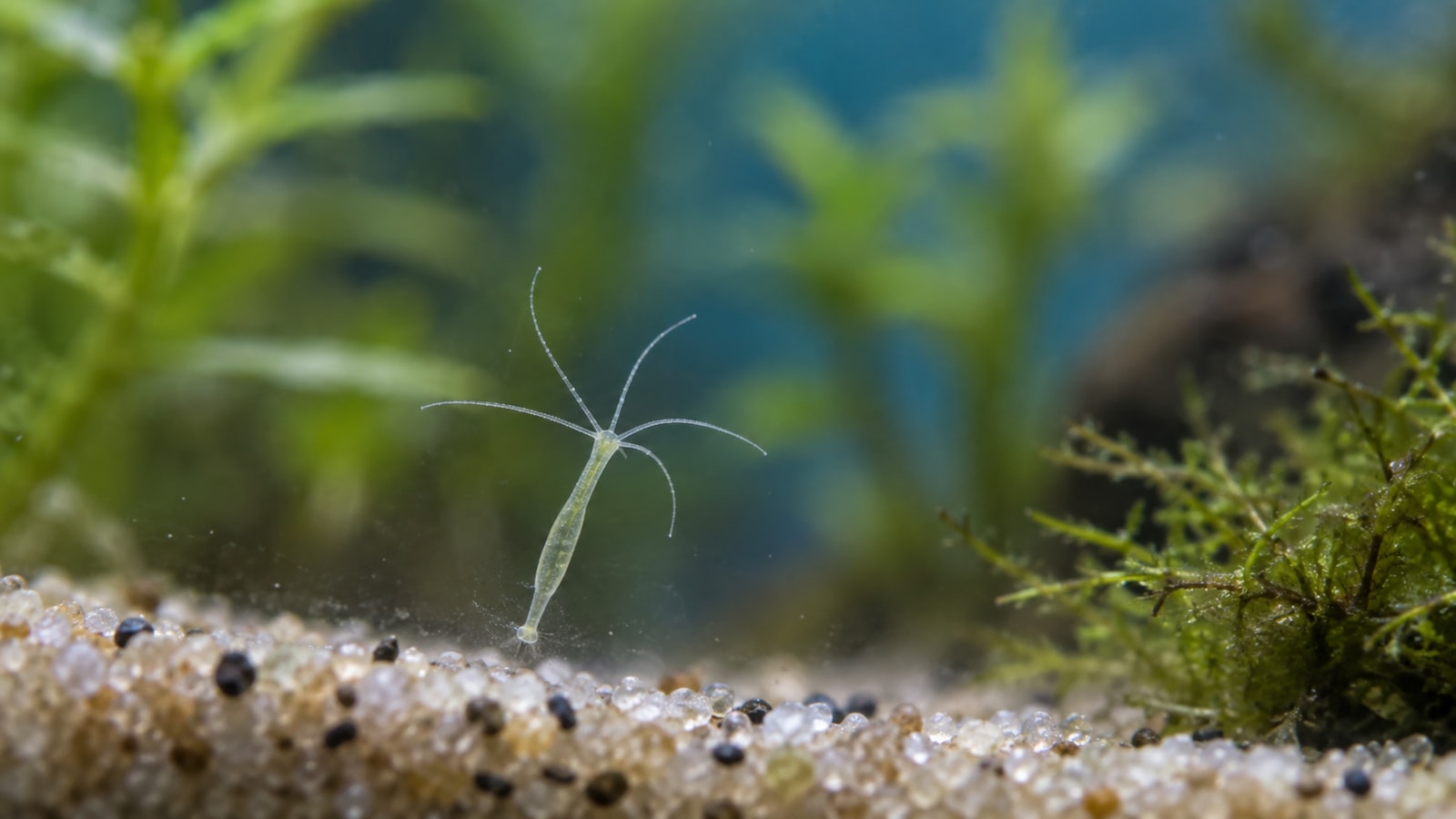
Hydra in an Aquarium: Harmless to Fish, Deadly to Fry
Hydra in an aquarium look like tiny stalks with tentacles. They are harmless to adult fish but eat fry and baby shrimp. How to starve them out or treat them.
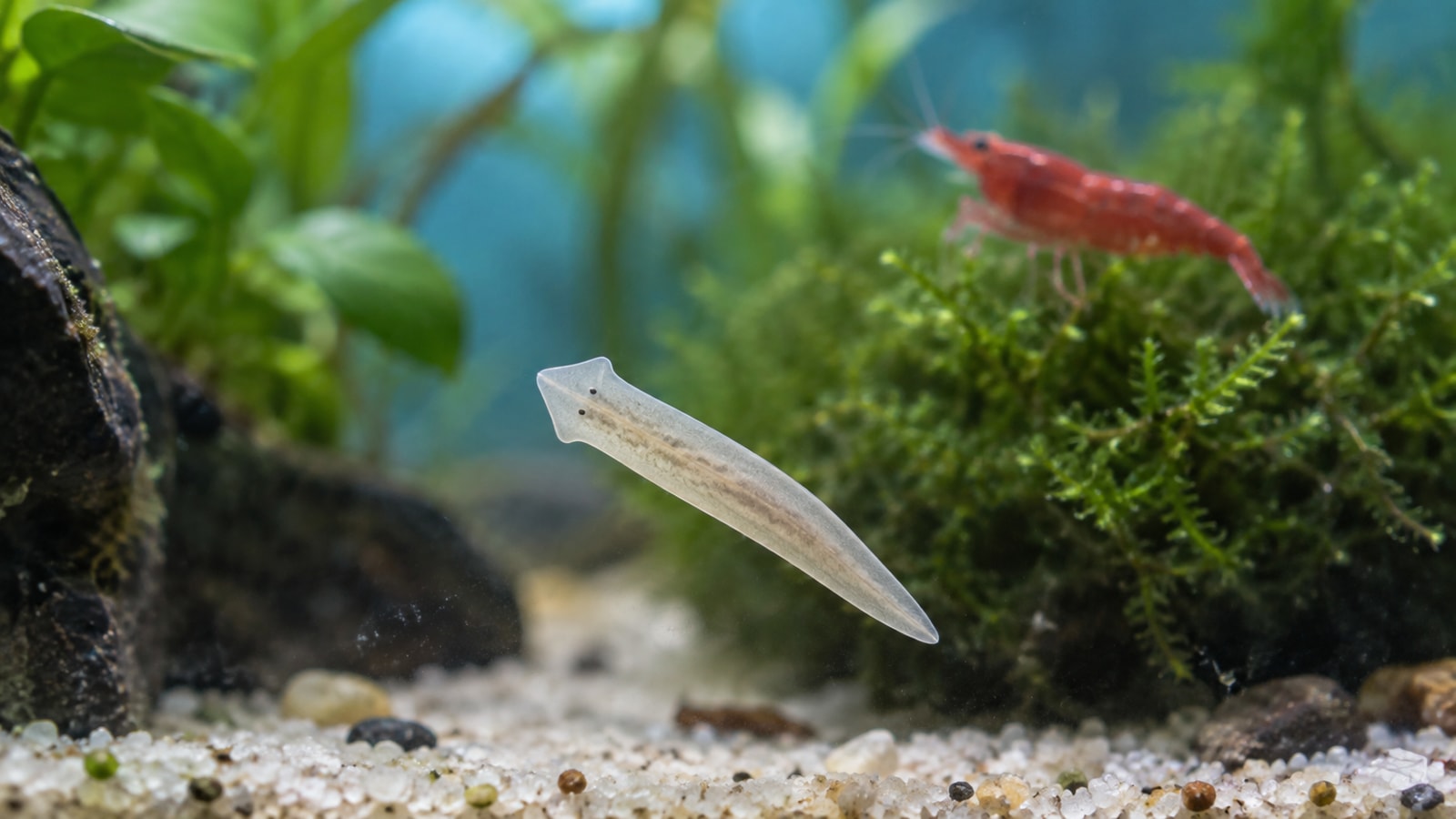
Planaria in an Aquarium: Harmless to Fish, Bad for Shrimp
Planaria in an aquarium are flatworms that glide on the glass. With fish they are harmless. In a shrimp tank, here is how to trap them and treat safely.
Scuds in an Aquarium: Harmless With Fish, a Problem With Shrimp
Scuds in an aquarium are tiny curled crustaceans that swim on their side. With fish they are free live food. With only shrimp they are a rival.