Buy the smallest jar and replace it every two to three months. We picked these from maker labels and vet and university guidance, not from hands-on testing.
Full specs
| Food | Best for | Feeds at | Format | Protein (min) | Stabilized vitamin C | Smallest size | Price seen |
|---|---|---|---|---|---|---|---|
| TetraMin Tropical FlakesPrice on Amazon | Budget staple: livebearers, danios, most tetras, gouramis | Top and middle | Flake | 46% | Yes | 12 g (0.42 oz) | $13.97 / 7.06 oz (Petco); buy the 1 oz jar instead |
| Hikari Tropical Micro PelletsPrice on Amazon | Small-mouthed schooling fish: neons, embers, rasboras | Middle, sinks slowly | Micro pellet | 43% | Yes | 22 g (0.77 oz) | $7.99 / 22 g (Petco) |
| Fluval Bug Bites Tropical Micro GranulesPrice on Amazon | Mixed sizes; an insect-based staple | All levels, sinks slowly | Granule, 0.25–1.4 mm | 40% | Yes | 45 g (1.6 oz) | Not confirmed for this pack; check |
| Hikari Sinking WafersPrice on Amazon | Corydoras, loaches | Bottom | Wafer, 6.5–7.5 mm | 36% | Yes | 25 g (0.88 oz) | $5.99 / 0.88 oz (Petco) |
| Hikari Tropical Algae Wafers (or Mini)Price on Amazon | Plecos, otocinclus | Bottom, late in the day | Wafer, about 17–18 mm (Mini 6.5–7.5 mm) | 33% | Yes | 20 g (0.7 oz) | $5.99 / 0.7 oz (Petco) |
| Hikari Bio-Pure Blood Worms, frozen or freeze-driedPrice on Amazon | A weekly extra, not a staple | Wherever it falls | Frozen cube or freeze-dried | Freeze-dried 55% | Yes (both) | Freeze-dried 12 g; frozen 1.58 oz | Freeze-dried $9.99 / 0.42 oz (Petco) |
The best tropical fish food for a community tank is not one food but two or three: a staple flake or micro pellet small enough for your smallest fish, a sinking wafer for corydoras or plecos, and a frozen or freeze-dried extra once or twice a week. Pick foods whose label lists stabilized vitamin C, and buy the smallest jar, because opened food loses its vitamins within two to three months. For most tanks that means TetraMin Tropical Flakes as the budget staple, Hikari Tropical Micro Pellets for small mouths, and Hikari Sinking Wafers for the bottom.
How we chose. We have not fed these foods to our own fish. Every pick is based on the maker's guaranteed analysis, ingredient list, particle size and sinking behavior, guidance from the Merck Veterinary Manual and University of Florida IFAS, and the needs of a typical community tank. Specs and prices were checked on 28 October 2026. Prices are the item price shown on the retailer's page that day, before shipping and tax. Shipping depends on where you live and prices change often, so check the current price before you buy.
This page covers community tropical fish. A betta kept alone has different needs. Goldfish are cold-water fish and need their own food; see how often to feed goldfish.
Why one food rarely feeds a whole community tank
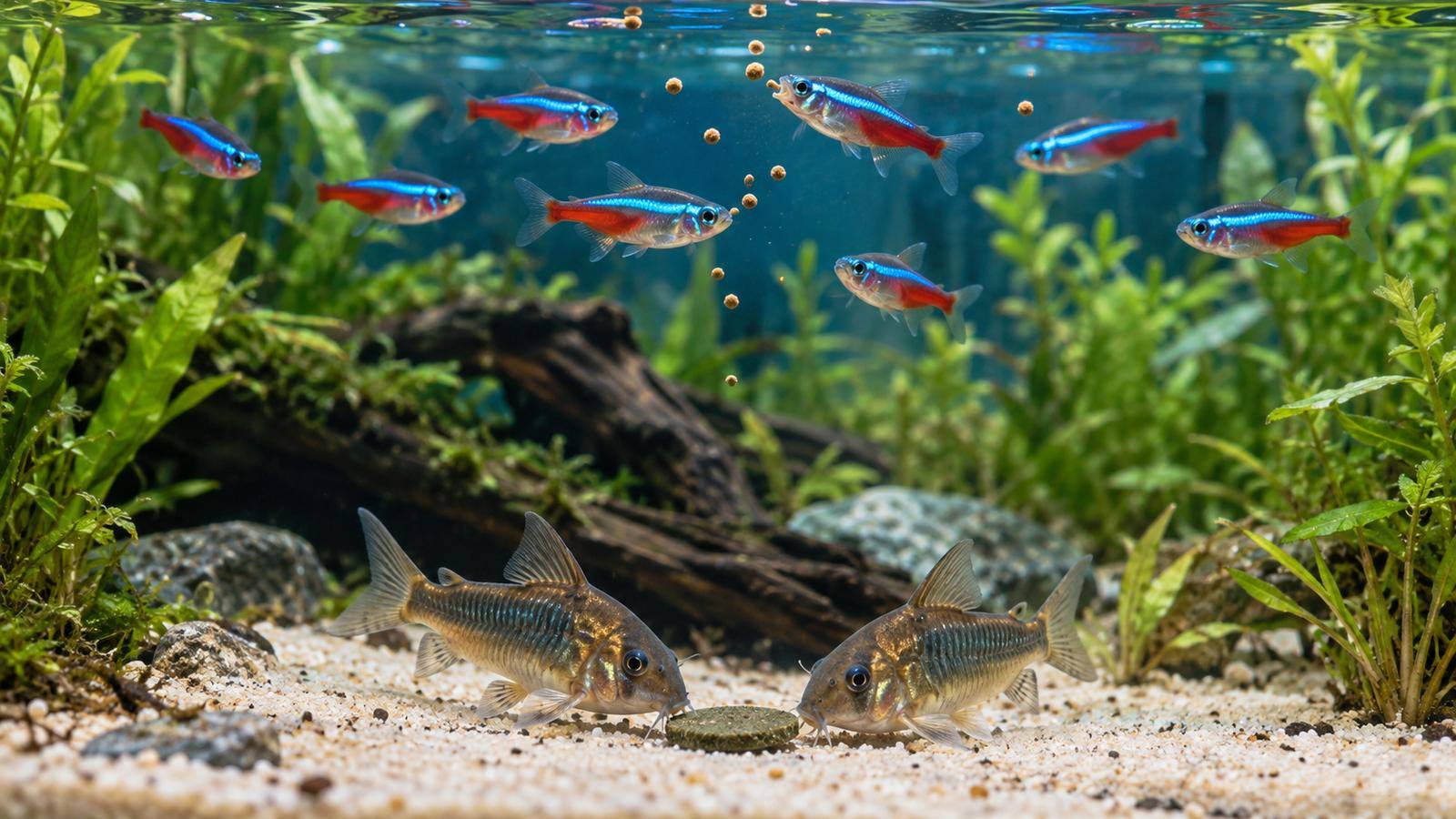
Bottom feeders need their own food, and most flakes never reach them. The Merck Veterinary Manual puts it plainly: "Fish that feed at the surface should be fed feeds that float, whereas bottom-dwellers should be fed items that rapidly sink."
Plecos, otos and corydoras are often bought as a clean-up crew and left to live on leftovers. Merck calls that "not an acceptable practice": "these fish should receive targeted feeding." Seriously Fish says the bronze corydoras should "under no circumstances" be expected to survive on leftovers. Mouth size is the other problem: Merck notes that flakes "may be too large for a small-mouthed fish" and suggests crushing them.
The good news is that University of Florida IFAS says most ornamental fish that do well in captivity are omnivores, so a single decent freshwater fish food can be the staple for most of the tank. You add a food for each level it misses:
- Top and middle swimmers: a floating flake or a slowly sinking micro pellet.
- Bottom feeders such as corydoras and loaches: a sinking wafer, dropped in after the lights dim if they are shy.
- Algae grazers such as plecos and otos: an algae wafer, late in the day.
The best tropical fish foods, by feeding level
TetraMin Tropical Flakes: the budget staple for top and middle feeders
For livebearers, danios, most tetras and gouramis, the best fish food is still a plain flake. Tetra calls TetraMin a "complete diet for optimal health in top- and mid-feeding aquarium fish". The label on the small cans guarantees at least 46% protein and 11% fat (the bigger tubs print slightly different figures), lists fish meal first, and includes stabilized vitamin C as L-ascorbyl-2-polyphosphate. Feed what the fish eat in three minutes.
The catch is the jar size. TetraMin comes in sizes from 12 g to a 2.05 kg bucket, and shops push the 7.06 oz (200 g) jar, $13.97 at Petco when we checked. A small tank cannot finish it while it is fresh (the storage section does the arithmetic). Buy the 1 oz (28 g) jar; we did not capture its price.
TetraMin Tropical Flakes
Budget staple: livebearers, danios, most tetras, gouramis
Hikari Tropical Micro Pellets: for small-mouthed schooling fish
For neon and ember tetras, rasboras and small barbs, the best fish food for tetras of this size is a pellet built for their mouths. Hikari describes these as "small pellets designed specifically for smaller-mouth fishes". Hikari calls them semi-floating and slowly sinking, so mid-water fish can take them on the way down. The label guarantees 43% protein and 7% fat, lists fish meal and krill meal first, and includes stabilized vitamin C. Feed what the fish finish in about a minute.
Seriously Fish says the neon tetra, which reaches about 30 mm not counting the tail, does best on a varied menu and recommends "a quality dried product, freeze-dried bloodworm and freeze-dried Daphnia." A micro pellet plus the weekly extra below covers that. One gap: Hikari publishes no pellet diameter, so we cannot tell you exactly how small "micro" is. The 22 g bag was $7.99 at Petco.
Hikari Tropical Micro Pellets
Small-mouthed schooling fish: neons, embers, rasboras
Fluval Bug Bites Tropical Micro Granules: one food for mixed sizes
For a tank that mixes small tetras with gouramis or larger barbs. Fluval sizes these at 0.25 to 1.4 mm and says "all fish can feed at their preferred depth". The first ingredient is black soldier fly larvae, up to 40% of the food. The label guarantees 40% protein and 12.5% fat, lists stabilized vitamin C, and Fluval says it has no artificial fillers, colors or preservatives. Feed what the fish eat in two minutes.
One thing to know: University of Florida IFAS says fish meal should be a major protein source. Bug Bites' main protein is insect larvae rather than fish meal, though salmon and fish protein concentrate come next on the list. We could not confirm a current price for this exact 1.6 oz (45 g) pack, so check it before you buy.
Fluval Bug Bites Tropical Micro Granules
Mixed sizes; an insect-based staple
Hikari Sinking Wafers: for corydoras and loaches
Hikari says these were "specifically developed for corydoras catfish, loaches and other bottom feeders". The wafers are 6.5 to 7.5 mm across and sink to the bottom. The label guarantees 36% protein and 9% fat, lists fish meal first, and includes stabilized vitamin C.
Corydoras and loaches have mouths that face down, and Hikari's FAQ steers them to these rather than its algae wafers. Feed what the fish finish in 20 minutes and remove the leftovers so nothing rots. For pygmy corydoras, break a wafer up. The 0.88 oz pack was $5.99 at Petco.
Hikari Sinking Wafers
Corydoras, loaches
Hikari Tropical Algae Wafers: for plecos and otocinclus
Hikari developed these for "the hard to feed plecostomus and other algae eating bottom feeders". The standard discs are about 17 to 18 mm; Hikari's smaller Mini Algae Wafers, at 6.5 to 7.5 mm, are the size to pick for otocinclus and other small grazers. The label guarantees 33% protein and 4% fat. Fish meal is the first ingredient, followed by wheat and starches, with seaweed meal, alfalfa and chlorella further down, and it lists stabilized vitamin C.
They are fed differently: Hikari says to give no more than the fish finish within two hours, late in the day, because many bottom feeders are nocturnal. Many keepers also offer blanched zucchini, but that is common practice, not something we found a vet source for. The 0.7 oz pack was $5.99 at Petco.
Hikari Tropical Algae Wafers
Plecos, otocinclus
Frozen or freeze-dried bloodworms: the weekly extra
The Merck Veterinary Manual recommends "feeding a wide variety of feeds" to help meet nutritional needs, and says it also helps stop fish eating only one type of food. Bloodworms are the easy way to do that, once or twice a week, not every day.
Hikari says its Bio-Pure Frozen Blood Worms are "3 Step Sterilized for safety" and "free of harmful parasites and bacteria"; that is the maker's claim. Feed no more than the fish eat in 30 to 45 seconds. Merck says to throw out commercial frozen foods such as bloodworms after a year, and never to refreeze them once thawed. We could not find the Hikari frozen pack priced online, since frozen food is usually sold in store; Petco listed San Francisco Bay Brand Frozen Bloodworms, 3.5 oz, at $8.99.
Hikari's freeze-dried bloodworms keep on the shelf instead, at 55% protein; use them within 90 days of opening. The 0.42 oz jar was $9.99 at Petco.
Other names you will see: Omega One Freshwater Flakes, Tetra PRO PlecoWafers and Aqueon Tropical Flakes. We have not checked their labels in the same detail; retailer listings for Omega One disagree on its protein and fat, and we could not confirm the current figures from the maker.
Hikari Bio-Pure Blood Worms
A weekly extra, not a staple
Which foods does your tank need?
The best food for tropical fish is the set that reaches every level of your tank. The 10 gallon stockings below come from how many fish fit in a 10 gallon tank.
| Your tank | Buy | Skip |
|---|---|---|
| 10 gallon, a shoal of neon or ember tetras | Micro Pellets, plus freeze-dried bloodworms | Wafers: nothing lives on the bottom |
| 10 gallon, pygmy corydoras and chili rasboras | Micro Pellets, Sinking Wafers (broken up), freeze-dried bloodworms | Algae Wafers |
| 10 gallon, guppies | TetraMin (1 oz jar), plus a weekly extra | Wafers |
| 20 gallon mixed community with corydoras and a bristlenose pleco or otos | Bug Bites or TetraMin, Sinking Wafers, Algae Wafers (Mini for otos), frozen bloodworms weekly | Bulk tubs |
| Any tank with only top and middle swimmers | One staple and one weekly extra | Wafers |
If your smallest fish are nano species such as chili rasboras or ember tetras, make the micro pellet the staple, or crush the flakes.
Flakes or pellets?
Neither wins for every tank. Pellets are the more complete diet and hold their vitamins longer; flakes are soft enough for the smallest fish to eat.
University of Florida IFAS says "pellets are typically the most complete diets." Flakes are soft enough for very small fish and sink very slowly, but the volume fish need to eat "may be deceptively high", and a small fish's mouth may not fit a larger pellet. Dr. Jessie Sanders, a fish vet, agrees: "Pellets are better nutrition than flakes, unless you have very small fish," because flakes have more surface area and lose water-soluble vitamins faster.
So the best flake fish food still has a place for the smallest mouths and for top feeders, and fish food pellets made small, such as micro pellets, close most of the gap.
| Format | Sinks? | Best for | Watch out for |
|---|---|---|---|
| Flakes | Very slowly | Top feeders, the tiniest mouths | Lose vitamins faster once opened; easy to overfeed |
| Micro pellets | Slowly | Small tetras, rasboras, small barbs | No published size for Hikari's |
| Granules | Slowly | Mixed sizes at every level | Check the granule range against your smallest fish |
| Wafers | Yes | Corydoras, loaches, plecos, otos | Remove leftovers so they do not rot |
How to read a fish food label
Judging by the ingredient lists here, most fish food is a protein meal (fish, krill or insect), grains or starch, oils, and a vitamin and mineral mix. A high quality fish food shows two things on the label: where the protein comes from, and stabilized vitamin C.
Protein, and where it comes from
University of Florida IFAS says maintenance diets may contain as little as 25 to 35% crude protein, diets for growing fish approach or exceed 40%, and fry foods often exceed 50%. Dr. Sanders gives 35 to 45% for herbivores and omnivores and 40 to 55% for carnivores. The staples here run from 40 to 46%; the algae wafers, at 33%, sit inside UF's maintenance range.
UF also says fish meal should be a major protein source and does not recommend cheap formulas that replace it with soy. Look for fish or krill meal near the front of the ingredient list.
Stabilized vitamin C
University of Florida IFAS says most fish species tested cannot make their own vitamin C, that stabilized forms are used "in many, but not all, fish feeds", and that "feeds that do not contain stabilized ascorbic acid are not recommended for fish." A lack of it can cause what Merck and UF both call broken back disease: scoliosis, a curved spine.
On the label, look for L-ascorbyl-2-polyphosphate or L-ascorbyl-2-monophosphate. All five staples and wafers on this page list one of them, and so do both Hikari bloodworm products.
Ignore "color enhancing"
None of the vet or university sources here suggests a beginner's community tank needs a color-enhancing version, so we left the dedicated color foods out.
- At least 35% protein for an omnivore staple, with fish or krill meal near the top of the ingredients.
- L-ascorbyl-2-polyphosphate or L-ascorbyl-2-monophosphate in the vitamin list.
- A particle size your smallest fish can swallow, and a sink rate that matches where it feeds.
- A jar small enough to finish within two to three months of opening.
How often to feed tropical fish, and how much
Once or twice a day is enough for adult fish; feed only what they finish in the time on the label, usually one to three minutes for flakes and pellets. Merck says most aquarium fish should be fed at least daily. University of Florida IFAS says one feeding a day is plenty for most pet fish and that fish should "probably be fed at least 5 days per week", so an occasional missed day does no harm.
How much is harder to pin down. Merck says adults should ideally get 3% of their body weight a day; UF says 0.5 to 1% is adequate. Call it somewhere between 0.5 and 3%. Nobody weighs their tetras, so the label's timer does the measuring, and the labels' two to three meals a day work only if each is tiny. The timers vary more than you would expect:
| Food | Label instruction |
|---|---|
| TetraMin Tropical Flakes | "Feed two to three times daily, only as much as your fish can consume within three minutes." |
| Hikari Tropical Micro Pellets | "Feed two (2) to three (3) times daily the amount your fish will completely consume in about a minute." |
| Fluval Bug Bites Tropical | "Feed as much as fish can eat in two minutes, two or three times daily." |
| Hikari Sinking Wafers | "Feed the amount your pet will completely consume in 20 minutes." Remove leftovers. |
| Hikari Algae Wafers | "Feed no more than the amount your fish will completely consume within two (2) hours." Feed late in the day. |
| Hikari Bio-Pure Frozen Blood Worms | "Feed no more than your fish will consume within 30-45 seconds no more than twice daily." |
| Hikari Bio-Pure FD Blood Worms | "Provide as a treat up to three (3) times daily the amount your aquatic pet will completely consume within a minute." |
UF calls over-feeding "the most common mistake made by pet owners", and it usually shows up as worse water. Food that is not eaten turns into ammonia, all the nitrate in a tank started as food, and uneaten food rotting in the gravel is a common reason a tank smells.
Does fish food expire? Why the small jar wins
Yes, in practice. Once a jar is opened its vitamins break down, and vet and university sources say to throw out dry food after two to three months, even if the date on the jar is later. University of Florida IFAS says vitamin C "is highly volatile", so feeds should be bought often, ideally at least monthly. The sources disagree on the exact window:
| Source | Rule |
|---|---|
| Merck Veterinary Manual | Opened, at room temperature: discard after 2 months. Commercial feeds kept in the freezer: 6 months. Frozen bloodworms and brine shrimp: 1 year; never refreeze. |
| University of Florida IFAS | Buy at least monthly; never keep dry food more than 3 months. Don't refrigerate it (too moist); freezing is acceptable. |
| Hikari | Use pellets and freeze-dried foods within 90 days of opening. |
| Dr. Jessie Sanders, fish vet (2018) | Throw out opened food after 6 months. The loosest of the four; the stricter sources win. |
Now the jar math. At Merck's 3% a day, every 10 g of fish eats about 0.3 g of food a day. Over 90 days that is about 27 g, so a tank holding 10 g of fish finishes the 1 oz (28 g) jar of TetraMin in about three months, right at UF's limit. The 7.06 oz (200 g) jar would take the same fish about 22 months. At UF's lower 1%, they eat about 9 g in 90 days, and the 12 g jar is plenty. By Merck's stricter two months, they would use about 18 g.
We found no reliable weight for any species, so scale the 10 g example to your own tank: twice the fish, twice the food. For almost any beginner tank, the answer is the smallest jar on the shelf. The 10 gallon setup guide already says a small tub lasts months.
Keep the lid shut and the jar somewhere cool and dry, not in the fridge; Merck asks for a pest-proof container. If you buy bigger to save money, freeze the unopened spare stock and use it within six months, Merck's limit for feeds kept in the freezer.
Left out, and why
Feeder and vacation blocks. University of Florida IFAS says fish should probably be fed at least five days a week, so healthy adult fish need nothing for a weekend away. For longer trips, how long a fish can go without food on a trip compares automatic feeders with a sitter.
Live foods. University of Florida IFAS says cultured live foods can be good nutrition but can spread infectious disease, and that wild-caught food items are "also risky". Frozen or freeze-dried does the same job with less risk.
The one thing worth taking from this
Feed by level, not by brand. One staple sized for the smallest mouth in the tank, a sinking food for whoever lives on the bottom, a weekly extra, and a small jar replaced every two to three months. The best tropical fish food is the one that reaches every fish in the tank while it is still fresh.
Sources
- Petty, Francis-Floyd and Yanong. Nutritional Diseases of Fish. Merck Veterinary Manual, reviewed May 2022.
- Seriously Fish. Corydoras aeneus.
- Francis-Floyd. Fish Nutrition. University of Florida IFAS Extension, VM114, revised May 2022, reviewed June 2025.
- Tetra. TetraMin Tropical Flakes.
- Petco. Product listings for TetraMin Tropical Flakes, Hikari Tropical Micro Pellets, Sinking Wafers, Algae Wafers and freeze-dried Blood Worms, and San Francisco Bay Brand Frozen Bloodworms, seen 28 October 2026.
- Hikari. Tropical Micro Pellets.
- Seriously Fish. Paracheirodon innesi.
- Fluval. Bug Bites Tropical Micro Granules, 1.6 oz / 45 g.
- Hikari. Sinking Wafers.
- Hikari. Frequently asked questions.
- Hikari. Tropical Algae Wafers and Mini Algae Wafers.
- Hikari. Bio-Pure Frozen Blood Worms and Bio-Pure Freeze Dried Blood Worms.
- Sanders. How to Choose the Best Fish Food. cafishvet.com, 2019.
- Sanders. What is the best fish food for my fish? cafishvet.com, 2018.
Questions people ask
Mentioned in this guide
Related guides
Best Food for Betta Fish: Picks by Size, With Label Data
The best food for betta fish is a betta pellet sized to its mouth. Six picks compared on label protein and pellet size, plus how many to feed a day.
How Often to Feed Goldfish: Schedule by Age and Water Temp
How often to feed goldfish: once or twice a day, what they eat in 1-2 minutes. See how much in grams and a pond feeding chart by water temperature.
How Long Can a Betta Go Without Food? A Week Is Fine, Two Is Not
A healthy adult betta can go about a week without food, and survives up to two. How to plan a trip, which feeders to avoid, and why a betta stops eating.