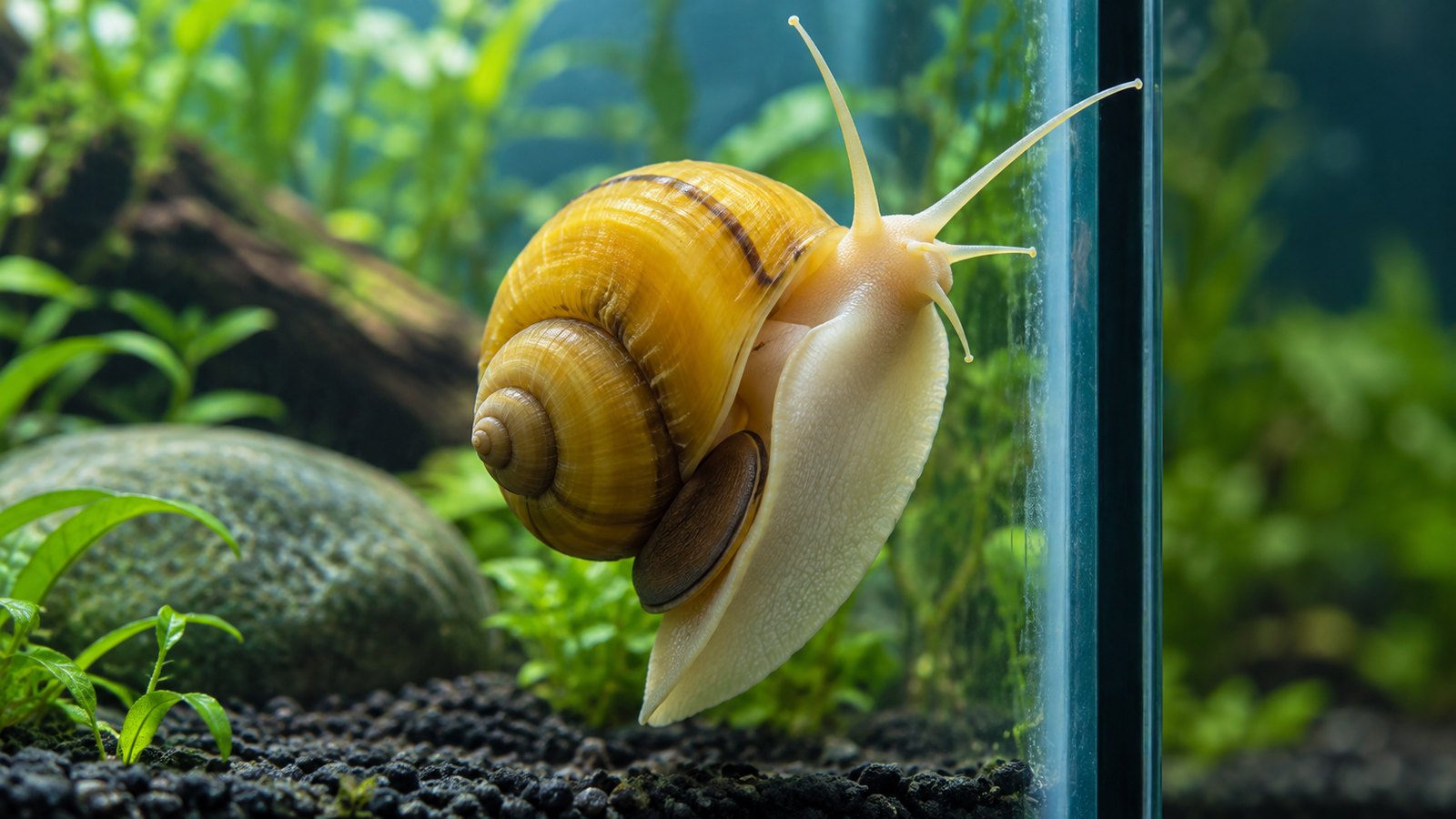
A trapdoor shut tight means it is alive, because a dead snail's muscles relax and the door stays at least partly open. A limp body sagging out of the shell, or a smell that makes you pull back, means it is dead. Floating and not moving are not signs of death on their own. If it is dead, remove it today and test ammonia and nitrite: both should read 0.
The numbers
| What you see | What it means | What to do |
|---|---|---|
| Gripping the glass, a plant or a rock | Alive | Nothing. Leave it alone |
| Trapdoor shut tight, no smell | Alive, resting or sealed in | Put it back. Check the temperature and feed a little less |
| Floating at the surface | Not a sign either way | Scoop it out and check the trapdoor and the smell |
| Trapdoor open, no smell, no response to touch | Not sure yet | Breeder box in the tank, check again in 24 hours |
| Body hanging limp, or a strong rotten smell | Dead | Remove it today. Test ammonia and nitrite |
To tell if a mystery snail is dead, lift it out of the water, look at its trapdoor, then smell it. A trapdoor shut tight means it is alive: once a snail dies, its muscles relax and the door stays at least partly open. A limp body sagging out of the shell, or a smell that makes you pull back, means it is dead. Floating and not moving are not signs of death on their own.
False alarms are common. Mystery snails are apple snails (Pomacea diffusa, the spike-topped apple snail) with a lung as well as a gill. They float when the lung is full of air, they barely move when they are well fed, and they do most of their moving at night. The grip and smell checks work for any aquarium snail, and the trapdoor check works for any snail that has a trapdoor.
How to tell if a mystery snail is dead: three checks, in order
Do these in this order. Each one either settles it or sends you to the next.
- Is it holding on to something? If it is stuck to the glass, a plant or a rock, and you feel it grip as you lift it, it is almost certainly alive. Dead snails don't keep holding onto surfaces, unless one has got wedged between the glass and something else (Hepper, vet-reviewed). Stop here.
- Look at the trapdoor. The trapdoor (operculum) is the brown, horny plate on the back of the foot that seals the shell opening when the snail pulls in (applesnail.net). Take the snail out of the water and look. If the door is completely closed, "you can be sure that the snail is alive", because once a snail is dead "the muscles are relaxed and the shell door stays at least partly open" (applesnail.net). A light touch on the door is fine, and a live snail will almost always pull away or tuck further in (Hepper). Don't pry the door or pull on it: you can tear the trapdoor off a healthy snail (Hepper). If the door is gaping or loose, or the body is sagging past it, go to step 3.
- Smell it. Hold it close, out of the water. A live snail smells of tank water, faintly fishy, or of nothing. A dead one stinks, and it starts to smell soon after death, because things decay quickly underwater (Hepper). The smell is unmistakable: if it reeks, it is dead. If you aren't sure what you are smelling, the snail is either alive or has only just died, so go to step 4. If the tank smells and you can't find the snail, the guide to a smelly fish tank lists where to look.
- Still not sure? Put it in a breeder box, or a net hung inside the tank so it stays in the same water, and check again in 24 hours. Drop in a little food and look at night, when mystery snails do most of their moving. Keepers on the Aquarium Co-op forum suggest much the same routine: isolate the snail and smell it every day. A trapdoor that closes and no smell means it is alive.
One optional extra: in a young snail, or one with a thin shell, you can sometimes see the heartbeat by holding it in front of a strong light (applesnail.net). Seeing it is a good sign, but treat it as backup: the AVMA notes that in fish the heart can keep beating after death, so a heartbeat is not a reliable sign of life. Not seeing it proves nothing.
What does a dead mystery snail look like?
| Sign | Alive | Dead | Why |
|---|---|---|---|
| Trapdoor | Shut flush with the shell opening, or pulled in behind it | Gaping, loose, or pushed aside by the body | After death the muscles relax and the door can't stay shut |
| Smell | Tank water, or nothing | Strong rot, close up | Soft tissue decays quickly in water |
| Grip | Holds onto the glass, plants or decor | Lies loose, rolls or drops off when touched | Holding on takes a living foot |
| Body position | Inside the shell, or out and moving | Hanging limp out of the opening, or slid out completely | The muscle that anchors the body to the shell lets go |
| Response to touch | Pulls in or tightens the door, sometimes slowly | None at all | Loss of response is one of the AVMA's signs of death |
| Floating | Common and normal | Also happens | Air in the lung floats a live snail, so floating proves nothing |
| Tissue | Firm | Soft, limp, falling apart | Limpness is another of the AVMA's signs of death |
The hanging body is the sign most people notice first, and there is a reason for it. A mystery snail is held in its shell by one strong muscle, the columella muscle. When the snail dies, that muscle weakens and breaks, and the body comes out of the shell (applesnail.net).
It works the other way too. A snail whose body has come fully out of its shell won't survive even if it is still moving: without the shell, the mantle cavity collapses and neither the lung nor the gill works properly (applesnail.net). If that is what you are looking at, skip to the humane end below.
Partly out and moving is different. Keepers report snails lying half out of their shells for several days while still alive. If the body moves, it reacts to touch and there is no smell, the snail is alive. In a male, the penis sheath sits close to the edge of the shell opening (applesnail.net), so a small tube there can be normal anatomy rather than a sign of trouble.
The AVMA, writing about fish and aquatic invertebrates, lists loss of movement, no response to any stimulus and early limpness as the signs of death. It also warns that for slow, sedentary animals death "may be more difficult to assess" (AVMA, 2020). Stillness alone is not enough. That is why the trapdoor and the smell come first.
Why is my mystery snail floating?
Because it has a lung. Mystery snails breathe air through a siphon, a breathing tube formed by a fold of the mantle that they stretch up to the surface, and they kept their gill as well (applesnail.net). When the lung holds a lot of air, the snail floats. In applesnail.net's words, floating "doesn't indicate that there is something wrong or that he/she is dead" (FAQ).
Dead snails float too, though. Applesnail.net's disease page shows a floating snail captioned as one that had died a few days earlier (applesnail.net). So do dead snails float or sink? Both. Floating tells you nothing on its own.
If you find a floater, scoop it out and run the trapdoor check and the smell test. A floater with its door shut tight and no smell can go straight back in.
Is my mystery snail dead or sleeping?
A resting mystery snail can look dead for days. These are the usual reasons a live one doesn't move:
- It is well fed. "Apple snails are rather lazy animals," says applesnail.net. They move when they are hungry or want to breed, and with plenty of food "they will show almost no activity". Its advice: feed less for a week, and check on them at night.
- It is daytime. The species is "relatively inactive during the day", and does most of its moving at night (applesnail.net).
- The water is cold. Mystery snails do best between 65 and 82°F. At around 65°F they go dormant, dig in and become very inactive, and below that the death rate climbs quickly (applesnail.net). Below 50°F they become completely inactive and die within a few days (FAQ). In an unheated tank in winter, look at the thermometer before anything else. Most tropical tanks run at 76–78°F, which suits them, so check your tank temperature if you aren't sure.
- It just ate a big meal or laid eggs. Keepers report mystery snails resting for days after a big feed, or after laying a clutch above the waterline, then carrying on as before. That is what keepers see, not a measured figure.
- It is sick, not dead. Normally the snail's tissue covers the whole inner face of the trapdoor. If that tissue has pulled back, or the trapdoor has come off altogether, the snail is unwell but not necessarily dead (in an old snail, some pulling back can be normal), and applesnail.net's advice is to check the water quality (applesnail.net).
Not moving for 24 to 48 hours does not mean dead
Several sites repeat a rule that a snail that hasn't moved for a day or two is dead. We found no source for it, and it doesn't fit apple snails, which "can be very inactive for days" (applesnail.net). Counting hours tells you nothing. The trapdoor and the smell do.
It's dead: what to do before the ammonia builds up
Once you are sure it is dead, deal with it today. A dead snail is organic matter, and as it decays it breaks down into ammonia, then nitrite (UF/IFAS). The smaller the tank, the less water there is to dilute it.
- Remove it now. Wear gloves or use a net, and wash your hands afterwards. Gloves and hand-washing are the CDC's advice for anyone who handles snails (CDC). Check under decor for any pieces left behind.
- Test ammonia and nitrite. Both should read 0. Don't go by your nose: ammonia "is colorless and, even at levels toxic to fish, odorless", and the only way to know it is there is to test the water (UF/IFAS). The rot you can smell is the snail, not the ammonia.
- If either reads above 0, change water. Do a water change with conditioner, and feed less until both read 0 again. UF/IFAS's first step for ammonia is to cut back or stop feeding, and it says a 25% to 50% water change helps remove ammonia. Nitrite is toxic to fish at levels as low as 0.10 mg/L, so treat any nitrite reading as real and bring nitrite back to zero with 50% changes.
- Test again the next day. In a small tank, test the day you find it and the day after. Keep going until two readings in a row are 0.
- Bag it and put it in the trash. Don't flush it, and never put a snail, alive or dead, into a pond, a stream or a garden. Mystery snails have established themselves in the wild in Florida and Alabama, mainly through the aquarium trade (USFWS). They are the one apple snail the USDA lets people move between states without a permit, because they are not known crop pests and mostly eat algae (USDA APHIS). Dumped aquarium snails are still how wild populations start.
Why did my mystery snail die?
Work down this list. The likeliest causes come first.
- Old age. Mystery snails don't live long. Applesnail.net gives 12–16 months at 77°F (FAQ). The USFWS summary gives about two years at that temperature, and three or more in water around 68–70°F (USFWS). Call it one to two years in a typical tropical tank, and a snail bought at full size has already lived part of that.
- Copper and some medications. Apple snails are "very sensitive" to copper and other metals (applesnail.net). Copper gets in two ways: from tap water that carries metals, and from medications. Copper-based treatments for parasites and fungus are on applesnail.net's list of drugs that are or could be toxic to snails, and so is malachite green, which contains no copper but is sold for ich (applesnail.net). A warning sign is snails that go completely still, or try to climb out of the water, right after a water change. A conditioner that binds metals deals with the tap-water route.
- Cold. Below 65°F the death rate climbs quickly, as above.
- Soft water. Apple snails need calcium-rich water. In soft water they can't build a strong shell and get shell damage (applesnail.net). A thin, pitted or cracked shell is the clue.
- Ammonia or nitrite. Snails follow the same water-quality rules as fish (applesnail.net). If your fish are dying too, the water is the first suspect.
If it's dying but not dead yet: a humane end
This is for a snail whose body has come fully out of its shell, or one that is collapsed and limp but still moving. It can't recover. Because it is so hard to tell when an invertebrate has died, the AVMA recommends two steps (AVMA, 2020):
- Put it to sleep first. Put the snail in a cup of tank water (about 250 mL). Slowly stir in 80-proof vodka or another clear spirit, a teaspoon at a time, up to about 2 tablespoons (30 mL). That brings the cup to a few percent alcohol, inside the AVMA's 1–5% range for ethanol, which it says should be "added slowly with mixing". Keep the cup at room temperature, because the AVMA notes ethanol may work less well in cooler water. Wait at least 10 minutes, the minimum immersion time the AVMA gives, and until the snail does not respond at all when touched.
- Then freeze it in the cup. The AVMA accepts freezing as the second step, as it does 70% alcohol.
- Bag it and put it in the trash, as above.
Freezing on its own does not meet the AVMA's standard, even though it is common hobby advice and applesnail.net suggests it. Leaving the snail out of the water to die is listed as unacceptable.
Sources
- Stanton (2025). How to Tell if an Aquarium Snail is Dead or Just Sleeping. Hepper, reviewed by Dr. Luqman Javed, DVM. Updated March 27, 2025.
- applesnail.net. Foot and mantle; Respiration.
- applesnail.net. Frequently asked questions.
- Aquarium Co-op forum. Sick mystery snail (keeper reports, not measurements).
- American Veterinary Medical Association (2020). AVMA Guidelines for the Euthanasia of Animals: 2020 Edition (Boston University mirror), sections S6.1.4 and S6.3.
- applesnail.net. Snail diseases and problems.
- applesnail.net. Pomacea diffusa.
- applesnail.net. Apple snail care.
- Francis-Floyd, Watson, Petty and Pouder (2022). Ammonia in Aquatic Systems. University of Florida IFAS Extension, FA16, revised June 2022.
- CDC. About Angiostrongylus (rat lungworm).
- US Fish and Wildlife Service (2017). Spike-topped Applesnail (Pomacea diffusa): Ecological Risk Screening Summary. November 2016, revised February 2017.
- USDA APHIS. Snails and slugs.
Questions people ask
Related guides
Snail Eggs in a Fish Tank: Which Snail, and Will They Hatch?
Snail eggs in a fish tank look different for every species. Identify yours in one table — clear jelly, pink clutch or hard white dots — and if they will hatch.
How to Get Rid of Duckweed in an Aquarium Without Hurting Fish
How to get rid of duckweed in an aquarium without hurting fish: net it, wipe the glass, pick it out of moss, then check for six weeks so it stays gone.
Biofilm in an Aquarium: The Slime You Mostly Want, and the Film You Don't
Biofilm is the thin layer of bacteria on every surface in a tank, and most of it is useful. When surface film or slime is a problem, and how to fix it.