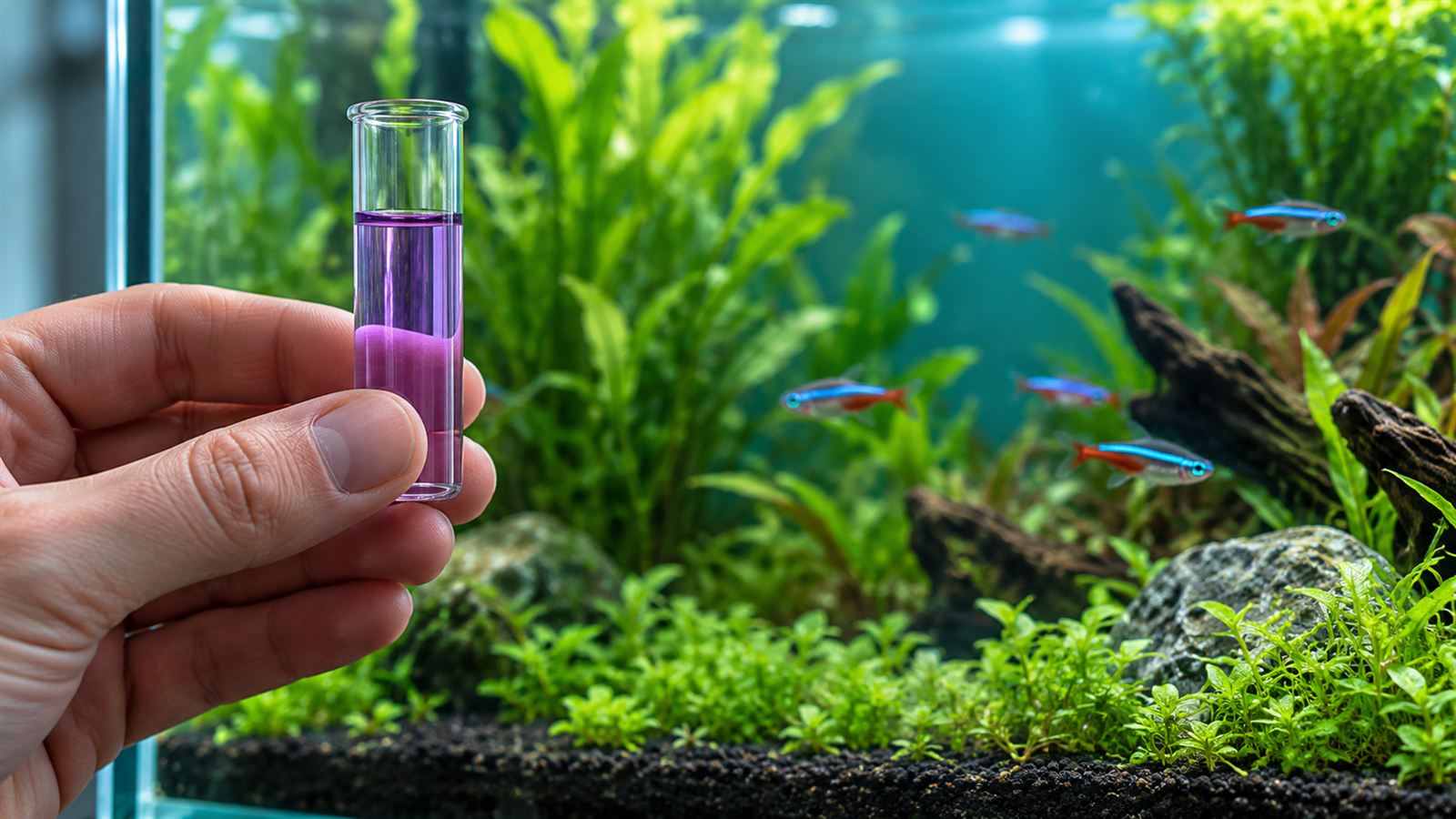
Add 1 level teaspoon of aquarium salt per 10 gallons: the chloride stops most of the nitrite getting into the fish's blood. Stop feeding for a day, add an air stone and leave the filter alone. Nitrite means the filter bacteria have fallen behind, and time is what fixes that.
Some links go to retailers. As an Amazon Associate, Aquarium for Beginners earns from qualifying purchases, at no extra cost to you.
The numbers
| Nitrite (API kit) | What it means | What to do |
|---|---|---|
| 0 ppm | The filter bacteria are keeping up | Nothing. Test weekly, or every two days in a new tank |
| 0.25 ppm | The bacteria are falling behind. Already stressful for fish | Change 30–50% today, feed lightly, test again tomorrow |
| 0.5–1 ppm | Harmful. The blood starts losing its ability to carry oxygen | Change 50% today, add salt, repeat the change daily |
| 2–5 ppm | Emergency. 5 is the top of the chart, so the real level may be higher | Change 50% now and again within 12 hours. Salt, air stone, no food |
To lower nitrites in a fish tank, change 50% of the water today, and keep changing it every day until your test reads 0 ppm. A water change is the only thing that takes nitrite out of the water straight away: a 50% change halves the reading within the hour. While you work on it, a level teaspoon of aquarium salt per 10 gallons stops most of the remaining nitrite from getting into the fish.
Nitrite comes from the bacteria in your filter. One group turns fish waste into nitrite, and a second, slower group turns nitrite into nitrate. When the second group falls behind, nitrite builds up. The water changes keep the fish alive while it catches up.
What to do today
- Test nitrite and ammonia, and write both numbers down. Tomorrow's test means more when you have today's to compare it with.
- Change 50% of the water. Dose the conditioner for the whole tank, not just the bucket, and match the new water to within 2°F of the tank.
- Add 1 level teaspoon of aquarium salt per 10 gallons, dissolved in a cup of tank water first. Skip this step if you keep shrimp or snails.
- Add an air stone, or point the filter outlet at the surface. Nitrite stops blood carrying oxygen, so extra oxygen in the water helps.
- Stop feeding for a day, then feed a small amount every other day until nitrite reads 0. Less food means less waste, and less waste means less nitrite.
- Leave the filter alone. Do not rinse, replace or clean the media: the bacteria you need live there.
- Do not add fish. Avoid medication unless a fish clearly needs it, because some antibiotics slow the filter bacteria down.
- Test again in 12 to 24 hours, and change another 50% if nitrite is still above 0.
If nitrite reads 2 ppm or more
Do a second 50% change within 12 hours of the first, rather than one huge change. Two 50% changes remove 75% of the nitrite without the temperature and pH swing of replacing three-quarters of the water at once. And 5 ppm is the top of the test chart, so a reading there could mean much more.
How much each water change takes out
A water change removes nitrite in proportion to the water you replace. Changing 50% halves it. Changing 30% takes out three-tenths. Repeated changes multiply:
| Starting at 5 ppm | After 1 change | After 2 | After 3 | After 4 |
|---|---|---|---|---|
| 50% changes | 2.5 ppm | 1.25 ppm | 0.6 ppm | 0.3 ppm |
| 30% changes | 3.5 ppm | 2.5 ppm | 1.7 ppm | 1.2 ppm |
That is the best case. While the bacteria are behind, they keep making nitrite between changes, so real readings fall more slowly than the table. That is why you test before each change instead of counting them.
Water changes do not set the cycle back. The bacteria live on the filter media, the gravel and the glass, not floating in the water, so the water you take out carries almost none of them.
Why a little salt protects fish
Nitrite gets into a fish through its gills, through the same cells that take up chloride, and the two compete for the same route (Kroupová et al., 2005). Inside the fish, nitrite turns haemoglobin into methaemoglobin, a form that cannot carry oxygen. The blood turns brown, which is why fish farmers call nitrite poisoning brown blood disease (SRAC 462).
Add chloride, and less nitrite gets in. The effect is large. In a study of guppies, raising chloride from 10 to 190 mg/L meant it took more than ten times as much nitrite to kill half the fish (Máchová et al., 2004, reviewed in Kroupová et al., 2005).
It is also why the same nitrite reading kills fish in one tank and not in another. Tap water already carries some chloride, and the amount varies a lot from town to town.
Fish farms rely on this every season. The usual target is at least 10 parts chloride to 1 part nitrite-nitrogen, and 20 to 1 is the level the guidance calls desirable (SRAC 4606).
How much salt that actually takes
In aquarium terms, very little.
| Your nitrite reading (API kit) | Salt for 20:1, per 10 gallons |
|---|---|
| 0.5 ppm | 0.2 g |
| 1 ppm | 0.4 g |
| 2 ppm | 0.8 g |
| 5 ppm | 1.9 g |
A level teaspoon of API Aquarium Salt weighs about 6 to 7 grams. API's own Nitra-Zorb instructions put 4 tablespoons of its salt at 80 g. So 1 level teaspoon per 10 gallons covers the top of the chart more than three times over, before counting any chloride already in your tap water. It is about a sixth of the dose printed on the box, which is meant for general use, not for nitrite.
How the numbers work
API kits read nitrite as NO₂⁻, the whole nitrite ion. Fish-farm ratios are written against nitrite-nitrogen, which is the reading divided by 3.28. At 5 ppm that is 1.52 mg/L. Twenty times that is 30 mg/L of chloride. Salt is about 61% chloride, so that is 50 mg/L of salt, or 1.9 g in 10 gallons (37.9 litres).
Three things to know before you add it:
- Salt does not lower the reading. The test shows the same nitrite afterwards. Salt changes how much nitrite reaches the blood, not how much is in the water.
- Only water changes take salt out. After each change, add salt only for the gallons you put back: half a teaspoon for 5 gallons. Once nitrite holds at 0, stop adding it, and your normal water changes dilute it away.
- Skip it with invertebrates. Shrimp and snail keepers widely report that these animals tolerate salt poorly. We found no published data with numbers, so the cautious choice is water changes alone.
What about Prime?
Seachem says its Prime conditioner "renders ammonia, nitrite, and nitrate non-toxic" for up to 48 hours, and that up to five times the normal dose can be used in an emergency (Seachem). The same page says the way it works on nitrite "is not well understood". We could not find an independent study that tested it.
So treat Prime as a possible bridge, not a fix. It does not take nitrite out of the water. Use it as the conditioner for your water changes, since you need one anyway, and keep testing and changing water until the reading is 0. Seachem does not say Prime changes a nitrite test result, so a reading taken after dosing still counts.
Why nitrite is high: the five usual causes
| Cause | The clue | What to do about it |
|---|---|---|
| A new tank that is still cycling | Tank under about two months old. Ammonia falling or at 0, nitrite rising | Water changes until the cycle finishes. See the nitrogen cycle guide |
| Filter cleaned or media replaced | Nitrite appeared a few days after the clean | Leave the filter alone now. Next time, rinse media in old tank water and never replace it all at once |
| Medication | Nitrite appeared during or after a treatment | Finish the course if the fish need it, change water, and test nitrite daily until it holds at 0 |
| A sudden jump in waste | Several new fish at once, a dead fish, overfeeding, or the filter stopped for hours | Remove the cause, feed lightly, and add fish a few at a time from now on |
| Falling pH | Tank pH below about 6.5, or well below your tap water | Weekly water changes put back the carbonate hardness the bacteria use up |
The bacteria use up carbonate hardness as they work, and they slow down as the pH falls (US EPA, 2002). The antibiotic oxytetracycline has been shown to slow nitrification in model aquariums (Klaver and Matthews, 1994).
Why nitrite lags behind ammonia in a new tank
The bacteria that turn ammonia into nitrite settle in first. The ones that turn nitrite into nitrate grow more slowly, and high ammonia holds them back further (Anthonisen et al., 1976). That is one reason overdosing ammonia stalls a fishless cycle. So in a new tank, nitrite usually peaks after ammonia has already started to fall. Zero ammonia with nitrite above zero means the cycle is past halfway, not that something has gone wrong.
Which bacteria eat nitrite, and which bottles contain them
For decades, aquarium books named Nitrobacter as the bacterium that eats nitrite. When researchers sampled the bacterial film in freshwater aquariums, they found Nitrospira instead, and did not detect Nitrobacter, even in tanks dosed with a product containing it (Hovanec et al., 1998). A 2024 study of 38 freshwater aquarium filter samples found Nitrospira in every one. In 30 of them, a type of Nitrospira that handles the whole chain, from ammonia right through to nitrate, was the dominant ammonia-eating microbe (McKnight and Neufeld, 2024).
That matters if you buy bottled bacteria:
- Tetra SafeStart Plus lists Nitrospira in its ingredients.
- Dr Tim's One & Only says it contains ammonia- and nitrite-oxidising bacteria. Its maker, Dr Tim Hovanec, was the lead author of the 1998 study.
- FritzZyme 7 and Seachem Stability do not name the nitrite-eating bacteria they contain.
A bottle can help a new or damaged filter get going. It will not clear a nitrite spike today. Keep doing the water changes either way, and judge the bottle by your test results, not by its label.
Signs of nitrite poisoning
Two signs point at nitrite in particular:
- Gasping at the surface, even though the filter and air stone are running. Fish farmers see it "even when oxygen levels are relatively high" (SRAC 462), because the water has oxygen but the blood can no longer carry it.
- Brown or tan gills instead of red. The blood and gills turn brown as methaemoglobin builds up (Kroupová et al., 2005).
In small aquarium fish the gills are hard to see, so gasping in water that is well aerated is the clearest sign. The same signs can come from ammonia, which is why the test kit comes first. If your fish are lying on the bottom rather than gasping, fish lying on the bottom of the tank covers the other causes.
There is good news. Once nitrite is gone, the blood returns to normal within one to three days (Kroupová et al., 2005). But nitrite weakens fish, and bacterial infections can follow one to three weeks after an episode. Watch for frayed fins, white patches or red streaks over the next few weeks.
How dangerous is your reading?
It depends on the fish, and the differences are enormous. In laboratory tests on young fish, half the guppies died within four days at around 30 ppm, as an API kit would read it. Zebrafish took about 240 ppm (Doleželová et al., 2011). Rainbow trout can die below 1 ppm (Boyd, 2014).
Two cautions. Those are the levels that kill, not the levels where fish start to suffer, and most aquarium species have never been tested at all. API's own instructions say any level above 0 can harm fish (API). Fish farms aim for under 0.1 mg/L of nitrite-nitrogen, which is about 0.33 ppm on an API kit. That is where the table at the top of this page comes from: 0.25 ppm is a warning, 0.5 ppm is harm, and 2 ppm is an emergency.
Check which units your kit uses
API kits report nitrite as the nitrite ion, NO₂⁻. Some kits, lab reports and research papers give nitrite-nitrogen (NO₂-N) instead. To compare a nitrite-nitrogen number with an API reading, multiply it by 3.28. The same goes for the US drinking water limit of 1 mg/L as nitrogen (US EPA), which is about 3.3 ppm on an API kit.
How to stop it coming back
- Add fish a few at a time, about two weeks apart, so the bacteria grow to match. How many fish fit in a 10 gallon shows how quickly a small tank fills up.
- Clean filter media in a bucket of old tank water, and never replace all of it at once. The chlorine or chloramine in tap water is there to kill bacteria, and it does not spare the ones you want.
- Feed what the fish finish in about two minutes, once or twice a day.
- Keep to weekly water changes. They replace the carbonate hardness the bacteria use up, and remove the nitrate they leave behind. See how to change fish tank water, and how to lower nitrates for sizing the change.
- Test nitrite for a week after anything that disturbs the tank: new fish, medication, a filter clean, or a power cut.
What you need
| Item | Why |
|---|---|
| API Freshwater Master Test Kit | Liquid tests for ammonia, nitrite, nitrate and pH. Strips read in bands too broad to track a nitrite drop |
| Seachem Prime | Conditioner for the water changes. Dose it for the whole tank volume |
| API Aquarium Salt | The chloride. At a teaspoon per 10 gallons, one small box lasts a long time |
| Tetra SafeStart Plus | Bottled bacteria that list Nitrospira, the nitrite-eater found in aquarium filters |
| Tetra Whisper air pump | Extra oxygen while the fish's blood carries less. Add airline tubing and an air stone |
| Gravel siphon | Makes daily 50% changes quick in a tank up to about 20 gallons |
The one thing worth taking from this
Nitrite is an emergency with a simple fix. Take it out with water changes, block it with a little salt, and give the bacteria time. Change water every day the test reads above 0. Products can help at the edges, but none of them replace the water changes.
Sources
- Durborow, Crosby and Brunson (1997). Nitrite in Fish Ponds. Southern Regional Aquaculture Center, Publication 462.
- Stone et al. (2013). Interpretation of Water Analysis Reports for Fish Culture. Southern Regional Aquaculture Center, Publication 4606.
- Kroupová, Máchová and Svobodová (2005). Nitrite influence on fish: a review. Veterinární Medicína 50: 461–471.
- Doleželová et al. (2011). Nitrite toxicity assessment in Danio rerio and Poecilia reticulata. Acta Veterinaria Brno 80: 309–312.
- Boyd (2014). Nitrite toxicity affected by species susceptibility, environmental conditions. Global Seafood Alliance.
- Hovanec et al. (1998). Nitrospira-like bacteria associated with nitrite oxidation in freshwater aquaria. Applied and Environmental Microbiology 64: 258–264.
- McKnight and Neufeld (2024). Comammox Nitrospira among dominant ammonia oxidizers within aquarium biofilter microbial communities. Applied and Environmental Microbiology 90: e00104-24.
- Anthonisen et al. (1976). Inhibition of nitrification by ammonia and nitrous acid. Journal of the Water Pollution Control Federation 48: 835–852.
- Klaver and Matthews (1994). Effects of oxytetracycline on nitrification in a model aquatic system. Aquaculture 123.
- US EPA (2002). Nitrification. Office of Ground Water and Drinking Water.
- US EPA. National Primary Drinking Water Regulations.
- API. Nitrite Test Kit instructions.
- Seachem. Prime.
- Tetra. SafeStart Plus; DrTim's Aquatics. One & Only.
Questions people ask
Mentioned in this guide
Related guides
Why Do My Fish Keep Dying? Work Out When, Then Why
When fish keep dying one after another, the timing names the cause: a new tank, a water change, new fish or a neglected tank. How to find yours and stop it.
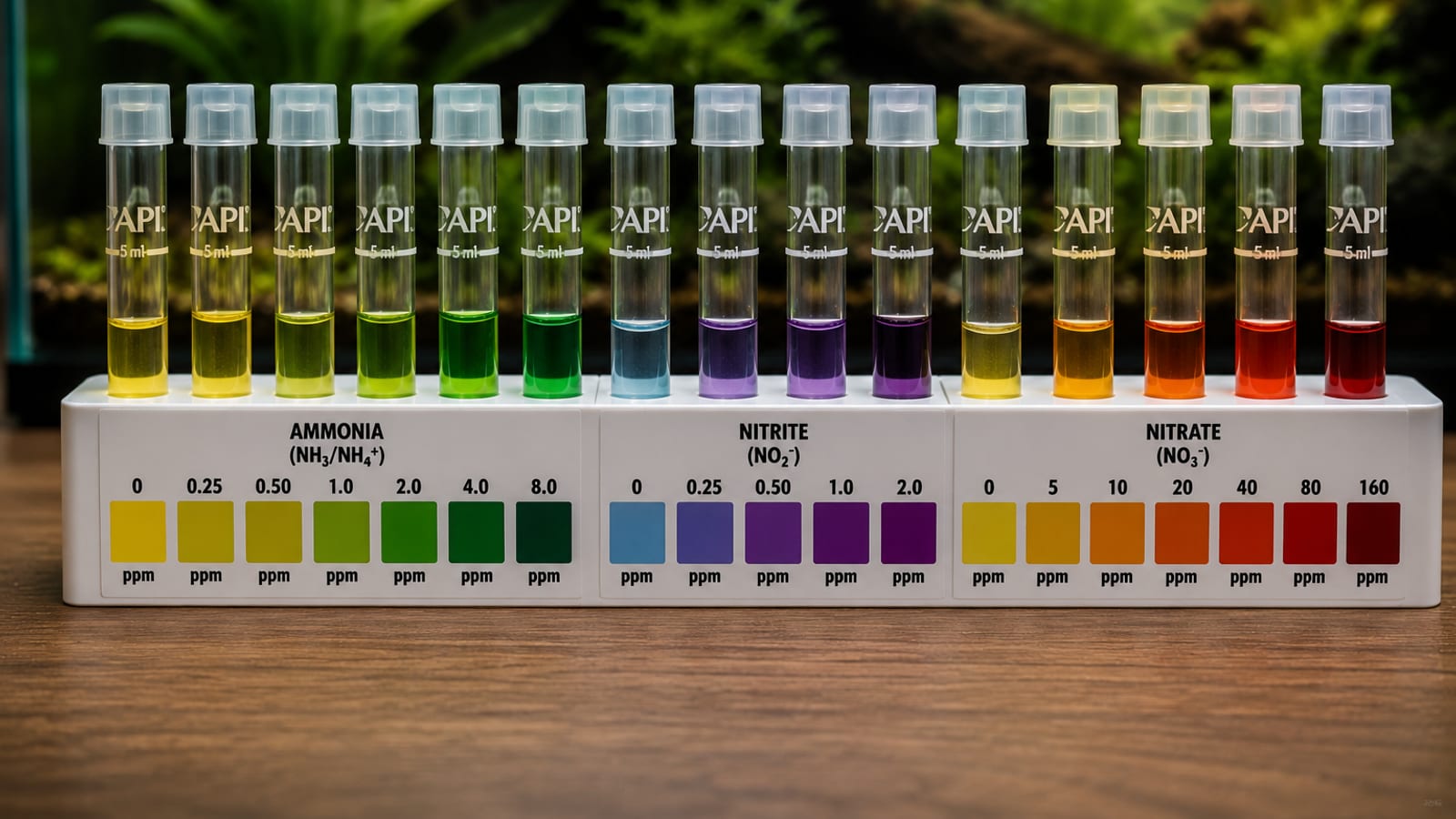
Nitrogen Cycle for Beginners: Why You Wait Weeks for Fish
Ammonia, nitrite and nitrate in plain English — how to run a fishless cycle step by step, and the one test that tells you the tank is ready for fish.
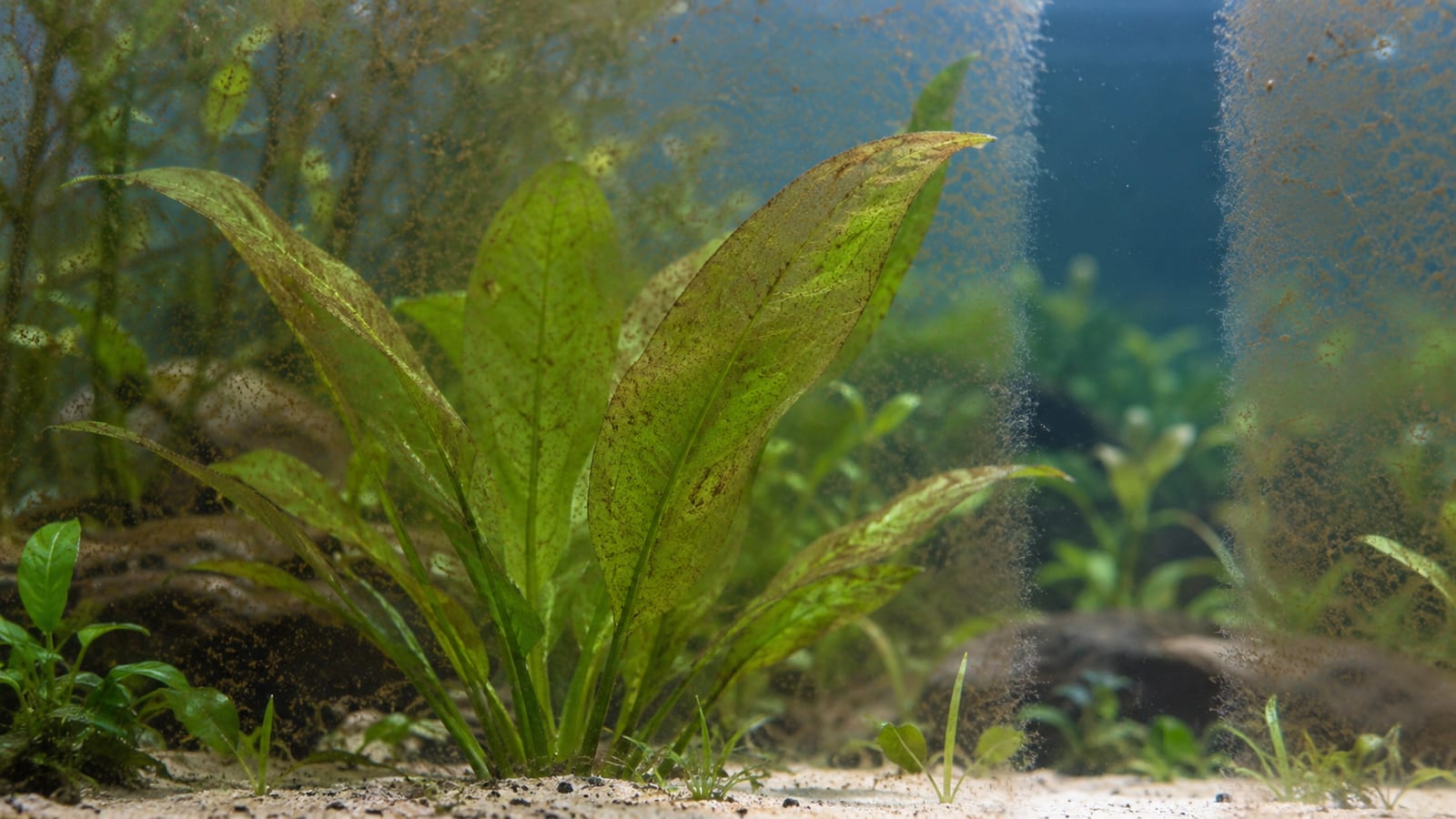
Brown Algae in Fish Tank: Why It Happens and When It Ends
Brown algae in fish tank? It is almost always diatoms. How to confirm it, how long a new-tank bloom lasts, and what actually clears it.