If you don't, you can't be sure; it may be young. Laying eggs proves female. Shell colour, size and trapdoor shape are not reliable, and there is no record of a mystery snail changing sex. Based on apple snail research and keeper reports, not on our own snails.
The numbers
| Clue | What it tells you | How reliable | Based on |
|---|---|---|---|
| Penis sheath, opposite the breathing tube | Seen: male | The best check there is | applesnail.net; USFWS species summary |
| No sheath visible | Nothing yet | Could be a young or sick male | Dr Rob Dillon's mystery snail project |
| Lays an egg clutch | Female | Proof | USFWS species summary |
| On top during mating | Male | Good, if you see it | applesnail.net; Dillon |
| Larger, rounder shell opening | Possibly male | A hint; compare several adults | USFWS species summary ("tends to") |
| Bigger snail | Nothing on its own | Not measured in mystery snails | Shown only in the channeled apple snail |
| Shell colour or see-through shell | Nothing | No evidence | No source found |
| Trapdoor concave or convex | Nothing, for this species | Shown only in another apple snail | Smithsonian NEMESIS (P. canaliculata) |
Look for the penis sheath. Lift the snail out of the water, turn it opening-up and wait for it to come out: a male has a sheath on the side opposite his breathing tube; a female has none. Not seeing one proves nothing, though. Laying eggs proves female.
That check is the only reliable way to tell a male mystery snail from a female without waiting. Most other tips online, such as shell colour, size and the shape of the trapdoor, are either unproven or were measured in a different apple snail. The table above grades each one. We have not sexed or bred mystery snails ourselves. This page is built from apple snail research, a snail biologist's project notes, a US Fish and Wildlife Service summary for this species, and what keepers report.
How to tell if a mystery snail is male or female
- Pick an adult. Mystery snails reach adulthood at around 2 cm of shell, about 3/4 in, according to Dr Rob Dillon, a freshwater snail biologist who runs a mystery snail genetics project. A smaller snail is probably too young to show anything, and Dillon adds that "there is no good way to predict when maturity might be reached". Hobby guides give three to six months; no study gives an age for mystery snails.
- Lift it out, don't pull it off. Wait until it lets go of the glass, or pick it up from the gravel. Never pry the snail or its trapdoor: the dead-snail check explains why, and why gloves or hand-washing afterwards are worth it.
- Turn it opening-up and wait. Hold it on its back in a damp hand or a shallow dish of tank water. Applesnail.net's method is exactly this: keep the snail on its back "and wait until the animal comes out of its shell". A few minutes is enough. No source gives a safe time out of the water, so that limit is our judgement.
- Find the breathing tube first. The siphon, the fleshy tube a mystery snail stretches up to the surface, forms from a fold at the left side of its neck (applesnail.net). The left half of the mantle cavity is the lung; the right half holds the gill.
- Look on the other side, near the edge of the shell. That is where a male's penis sheath, the fleshy fold that houses the penis, starts. The US Fish and Wildlife Service summary for the species puts it "to the right of the mantle in front of the gills", and says "females lack the penial complex". Applesnail.net describes the sheath starting "close to the edge of the shell".
Keepers call this the "two holes" check. Aquarium Co-op's care guide says "Females have two holes, one over each shoulder", while a male shows only one, because the sheath covers the other. The Shrimp Farm describes the same thing. It is the same check in different words.
Guides disagree on whether the sheath is on the left or the right because some mean the snail's side and some mean yours as you look down at an upturned snail. The landmark that never changes is the breathing tube: the sheath is on the opposite side. A long tube reaching up to the surface is always the siphon.
Practice helps. Applesnail.net says some experience is needed, but "once you have seen the difference between the male and the female snail you'll find it less difficult". A photo rarely settles it. Asked whether he can tell from a picture that a snail is female, Dillon answers: "No. It's just too hard to do that from photos."
No sheath doesn't mean your mystery snail is female
Almost every guide treats a snail with no visible sheath as female. Dillon puts it differently:
No sheath proves nothing
"If you can see a penis, you know your snail is a male, but if you cannot see a penis, you don't know anything. Your snail could be immature, or sick." (Dillon, Mystery Snail Project)
So a sheath you can see settles it: male. No sheath means not sure yet. Check again in a few weeks, once the snail is bigger, or wait for eggs.
A clutch is the only proof of a female. Only females lay eggs: pale pink to reddish, above the water surface (USFWS). If one has appeared on the lid or the glass, the snail eggs guide shows what a mystery snail clutch looks like and what to do with it.
Other ways to sex a mystery snail, from useful to useless
Mystery snails are Pomacea diffusa, the spike-topped apple snail. The apple snail most studied for differences between the sexes is a different species, Pomacea canaliculata, the channeled apple snail. Several hobby tips describe differences that were measured in it, not in mystery snails.
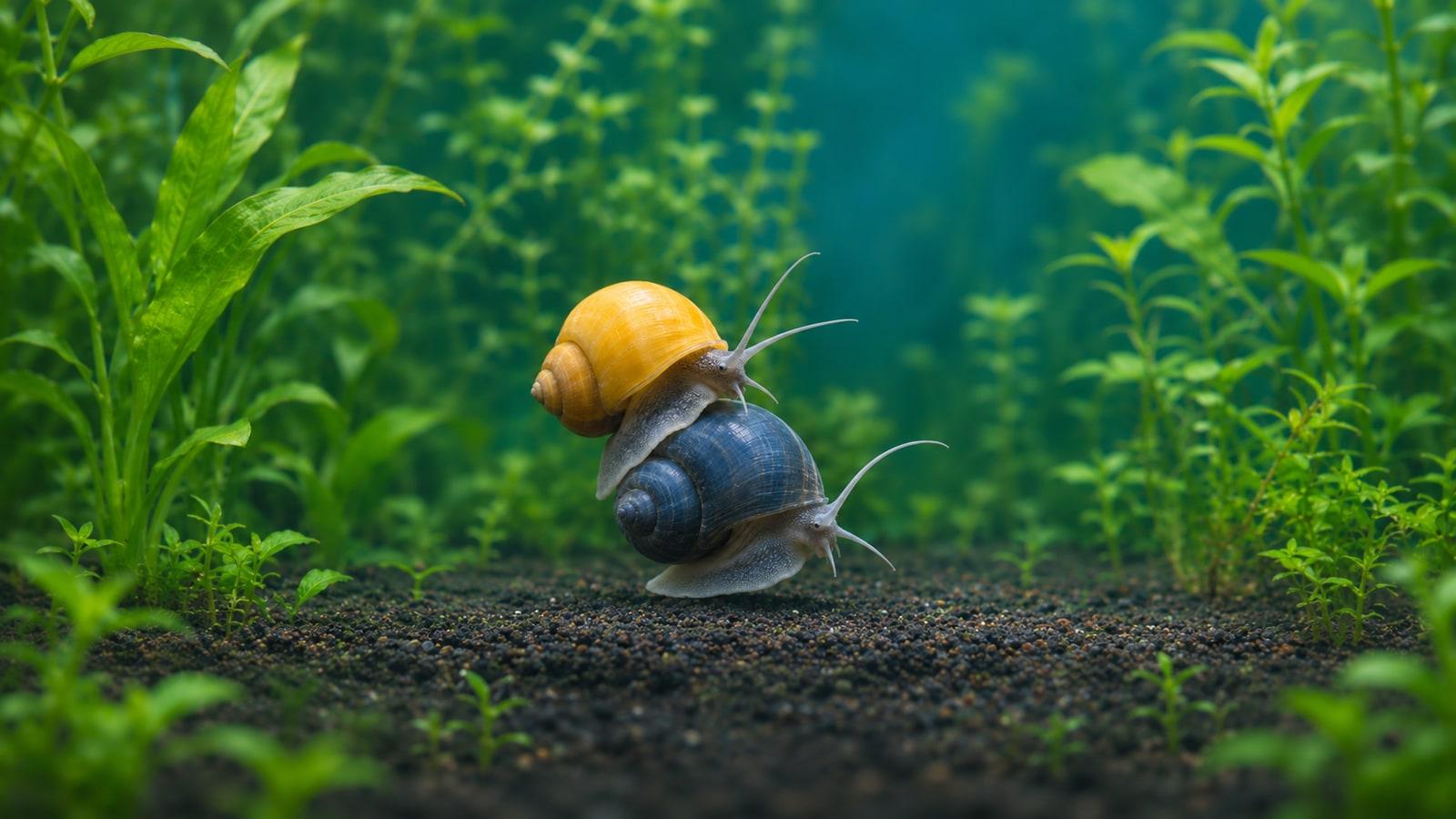
Watching them mate: useful. "When they're mating, the male snail creeps on the shell of the female", says applesnail.net, so "the one on top is the male". Dillon agrees: a snail on top of a partner, attempting to mate, is male. Mating can go on for hours. In the channeled apple snail, a review of research on that species gives 10 to 20 hours (Estebenet and Martín, 2002). Not seeing it proves nothing.
Eggs: proof, females only. See above.
A larger, rounder shell opening: a hint. The USFWS summary says "the shell opening of the male tends to be larger and rounder than females, due to the penial complex". "Tends to" is the source's own hedge, and the clue only works if you can compare several adults side by side, as applesnail.net suggests.
Size: not reliable. In the channeled apple snail, every group studied showed the same pattern: "females grew invariably to be larger than males" (Estebenet and Martín, 2002). Nobody has measured this in mystery snails. One seller says males are almost always smaller, without a source. Size also depends on age and food, so a bigger snail is not evidence on its own.
Shell colour, or a see-through shell: no evidence. We found no source that links either to sex. Even one of the pages that suggests the colour method admits it is "not scientifically proven". Colour is inherited, and Dillon's project exists to study how.
Trapdoor shape: wrong species. The Smithsonian's NEMESIS database says the channeled apple snail's trapdoor (operculum) is "concave in females, and convex in males". We found nothing showing the same in mystery snails. A 2023 study comparing shell shape in three South American apple snails found clear differences between the sexes only in the channeled apple snail and, less strongly, one other species, and it did not include the mystery snail (Tamburi et al., 2023).
A review of sex determination in molluscs makes the general point: "the external morphology is often unreliable in identifying sex" (Yusa, 2007). Look for the sheath.
Do mystery snails change gender?
There is no record of a mystery snail changing sex.
Apple snails have separate sexes. Applesnail.net says they are "NOT a hermaphroditic snail", and the USFWS summary calls the mystery snail dioecious, meaning each snail is either male or female. That is why "you'll need a male and a female to get baby snails" (applesnail.net).
The sex-change idea does have a source, a thin one. Applesnail.net says a change from male to female "has been described for some Pila and Pomacea apple snails", and that "the frequency at which this sex change occurs is not certain". It names no case in the mystery snail. A review of research on the best-studied apple snail, the channeled apple snail, says the possibility had been suggested, "but this was never reported for natural or laboratory populations" (Estebenet and Martín, 2002). Aquarium Co-op's guide says each snail "cannot change sexes".
So what explains "my male laid eggs" or "my lone snail had babies"? The snail was female all along, because no sheath proves nothing, and she was carrying stored sperm.
My single mystery snail laid eggs
She is a female mystery snail. The clutch settles that.
Whether the eggs hatch depends on whether she mated before you bought her, and she probably did. Female apple snails store sperm. Applesnail.net says it survives "for more than a month" inside the female. In the channeled apple snail, "females can store sperm for 140 days, laying up to 3,000 viable eggs along this period" (Estebenet and Martín, 2002). That is a different species, but it is why the safe working figure for a mystery snail is months.
Dillon thinks mating before sale is the norm: "It's a good bet that all the mystery snails in all our home aquaria are already inseminated, possibly by multiple partners, when they arrive in the pet shops." He notes that breeders "do not keep snail stocks that they mean for the retail market segregated by color".
Keepers report lone snails whose clutches hatched (one Fishforums keeper released "over 100" young from a single snail's clutch). The opposite answer is common too: a licensed vet technician answering a keeper on Petco's question-and-answer pages says that with no male "the eggs will be infertile". That is true of a female who never mated, and nothing tells you which kind you bought. Nobody has measured how often each happens. How to tell whether a clutch is developing, and what to do with it, is covered on the egg page.
Guppies do the same: a female guppy stores sperm for months, and lone females surprise keepers with fry.
How many mystery snails to buy for a pair, or to avoid one
If each snail is equally likely to be male or female, this is the chance a group contains at least one of each. It is our arithmetic, not a measurement:
| Snails bought | Chance of both sexes |
|---|---|
| 2 | 50% |
| 3 | 75% |
| 4 | 88% |
| 5 | 94% |
| 6 | 97% |
The even split is a fair starting point: applesnail.net puts the sex ratio in apple snail populations at around 0.5. But in the channeled apple snail, individual broods vary a lot (Yusa, 2007), and Dillon notes that wild populations are generally biased towards females. His guess is that most mystery snails in home tanks today are female. If he is right, the chance of getting a male is lower than the table shows. Aquarium Co-op recommends six or more; the table shows why. Six adults need room, though. Chewy's small-fish guide, written with a fish vet's input, gives mystery snails "at least 5 gallons per snail", so six full-grown snails want about 30 gallons, or a plan for the extras.
If you want no babies, keep one snail, and accept that a female may still lay fertile clutches from stored sperm for a while. Aquarium Co-op suggests buying one under 1 inch (2.5 cm) for that reason. Removing any clutch within a few days is the backstop, as the snail eggs guide explains. One snail is also what fits alongside a betta in a 5 gallon. If babies have already hatched, see how to get rid of snails.
Never release snails or hatchlings outdoors. Some US states restrict apple snails, and dumped aquarium mystery snails have been found living wild in Florida (USFWS).
The short version
A sheath opposite the breathing tube means male. No sheath means not sure yet. Eggs mean female. Colour, size and trapdoor shape tell you nothing reliable, and mystery snails don't change sex: a lone snail with fertile eggs was mated before you bought her.
Sources
- applesnail.net. Frequently asked questions.
- applesnail.net. Reproductive system.
- applesnail.net. Respiration; Foot and mantle.
- US Fish and Wildlife Service (2017). Spike-topped Applesnail (Pomacea diffusa): Ecological Risk Screening Summary, quoting Mackie and Claudi (2010).
- Dillon, R. T., Jr. Mystery Snail Project: Reproductive biology (updated 25 February 2026); FAQ; Our study organism. Freshwater Gastropods of North America.
- Estebenet and Martín (2002). Pomacea canaliculata (Gastropoda: Ampullariidae): life-history traits and their plasticity. Biocell 26(1): 83–89.
- Yusa (2007). Causes of variation in sex ratio and modes of sex determination in the Mollusca: an overview. American Malacological Bulletin 23: 89–98.
- Tamburi, Tiecher, Burela and Martín (2023). Sexual dimorphism in shell shape: is Pomacea canaliculata an exception or an example among Neotropical apple snails? Anais da Academia Brasileira de Ciências 95(2).
- Smithsonian Environmental Research Center. NEMESIS: Pomacea canaliculata.
- Aquarium Co-op. Care Guide for Mystery Snails. A retailer's guide, used for the "two holes" description and buying advice.
- Puts (2024). Breeding Mystery Snails. The Shrimp Farm, a retailer.
- Wright (2023). Male vs Female Mystery Snail. A-Z Animals, cited only for its own caveat on the colour method.
- Fishforums. Lone Apple Snail Laid Eggs (January 2008). A keeper thread, cited for one hatched clutch from a single snail.
- Chewy (2026). The 25 Best Small Aquarium Fish for Your Freshwater Tank. A retailer guide written with a fish vet's input, cited by title; the same figure is quoted in betta tank mates for a 5 gallon.
- Petco. Mystery snail laying eggs without a male? Will they hatch? Vet Q&A, answered by Angel Alvarado, LVT (2019). Cited by title; read 19 November 2026.
Questions people ask
Mentioned in this guide
Related guides
What Do Mystery Snails Eat? Algae Alone Isn't Enough
What do mystery snails eat? Rotting plants, algae and fish food, but a tank rarely grows enough. What to add, how often, and the calcium question.
Snail Eggs in a Fish Tank: Which Snail, and Will They Hatch?
Snail eggs in a fish tank look different for every species. Identify yours in one table — clear jelly, pink clutch or hard white dots — and if they will hatch.
How to Tell If a Mystery Snail Is Dead: A 3-Step Check
How to tell if a mystery snail is dead: check its grip, its trapdoor, then the smell. Floating is not a sign. Then head off the ammonia spike.