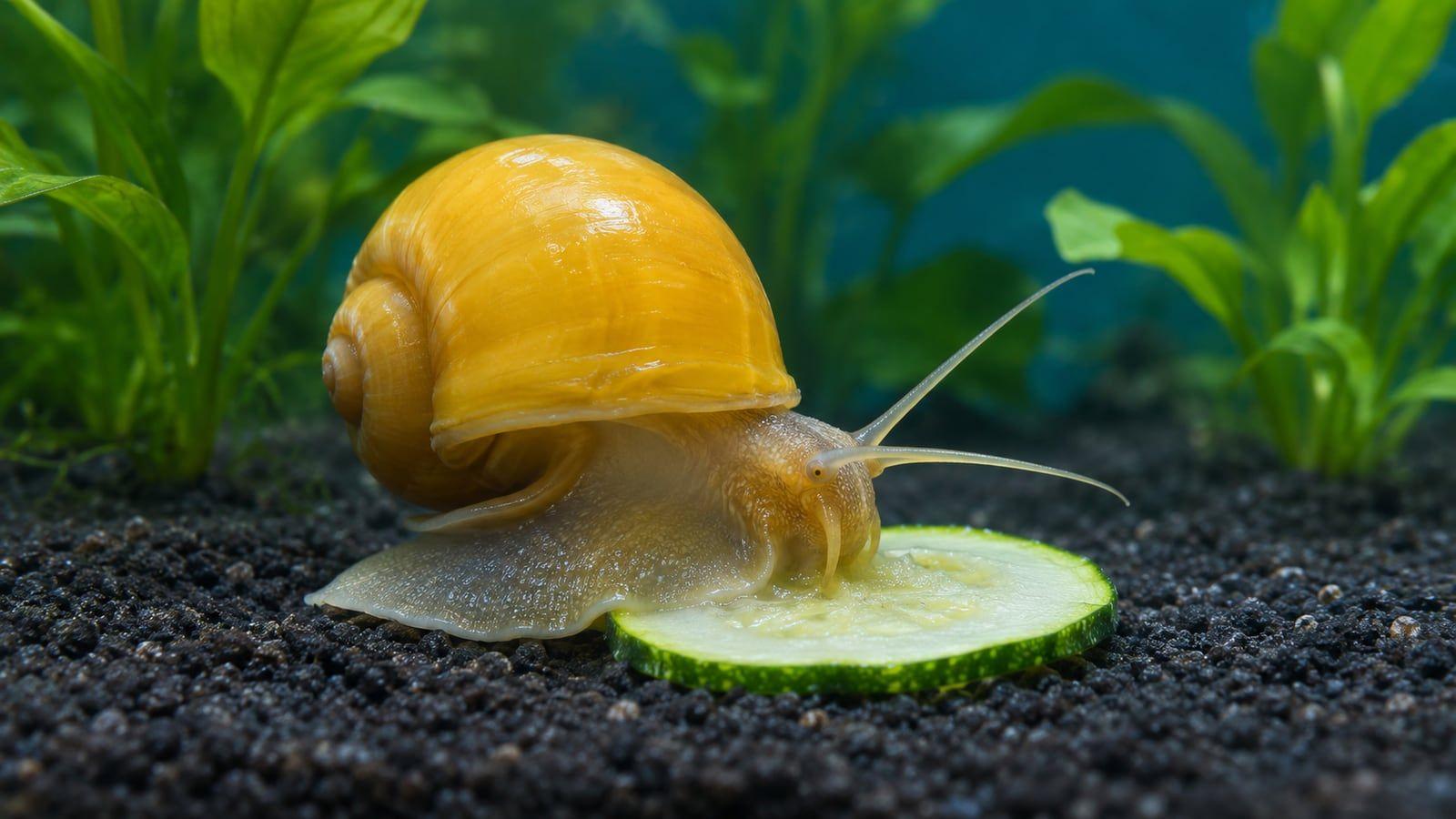
Add a sinking wafer or pellet every other day, or daily if the snail is alone, blanched vegetables once or twice a week, and remove leftovers by morning. Keep GH and pH up for the shell and keep copper medication out. Based on a university extension sheet, apple snail studies, retailer care guides and keeper reports, not on our own snails.
The numbers
| Food | How often | Notes |
|---|---|---|
| Rotting leaves, algae film, leftover fish food | All the time; the tank supplies it | Their natural food, but rarely enough on its own |
| Sinking wafer, shrimp or catfish pellet | Every other day; daily if the snail is alone | The staple. Young mystery snails grew best on a fishmeal-based diet in a lab study |
| Blanched courgette, cucumber, green beans, kale | Once or twice a week | Wash first; remove by the next morning |
| Spinach | Now and then | Fine as food; a poor calcium source, at least in people |
| Thawed bloodworm or brine shrimp | Now and then | Extra protein |
| Cuttlebone or calcium-enriched snail food | Optional | Keeper practice. Hard water matters more for the shell |
| Healthy live plants | Rarely eaten | Mostly left alone; duckweed is the exception |
| Copper medication | Never | Kills snails; treat fish in another tank |
Mystery snails eat rotting plant matter, algae film and leftover fish food, but a tank rarely grows enough of it. Add a sinking wafer or pellet every other day, blanched vegetables now and then, and keep the water hard.
Mystery snail food is not complicated, but the evidence points somewhere most care guides skip. The University of Florida says they "feed mostly on decaying vegetation". In feeding trials they barely touched living plants. And applesnail.net warns they can starve in a planted tank if nobody feeds them. This page is built from a university extension sheet, a US Fish and Wildlife Service species summary, feeding and shell studies on apple snails, retailer care guides and keeper reports. We have not kept or fed mystery snails ourselves, and the table above is that evidence put into a routine, not a feeding trial of our own.
Mystery snail diet: what they eat in a tank
Mystery snails (Pomacea diffusa, the spike-topped apple snail) are scavengers that live mostly on what rots and what falls. Ranked by the evidence:
- Rotting plant matter. The University of Florida's extension sheet says they "feed mostly on decaying vegetation" (Fasulo, UF/IFAS). Applesnail.net puts "dead and rotting plants" first. Aquarium Co-op, a retailer, says that a snail that seems to be eating your plants is "most likely" "nibbling on melted or sickly leaves".
- Fish food that reaches the bottom. Applesnail.net lists "artificial foods like fish food" alongside rotting plants as what this species prefers. They can also fold the foot into a funnel to gather floating flakes, Co-op notes, but they usually eat off the bottom.
- The algae film on glass, wood and leaves. A study quoted in the US Fish and Wildlife Service summary concluded that the species "feeds primarily on aufwuchs", the thin film of algae, bacteria and debris on surfaces, which keepers call biofilm.
- Dead animals and eggs. A dead fish is eaten quickly, and the eggs of other snails and of fish are "an easy target for a hungry apple snail" (applesnail.net FAQ). One older study also saw them feed on carcasses, worms and snail eggs (Aditya and Raut, quoted by USFWS).
Do they eat live plants? Almost never. Applesnail.net says this species "doesn't eat healthy plants unless no other food is available". Dr Rob Dillon, who runs a research project on the species, is blunter: "They will not eat your aquarium plants." In one trial reported by USFWS, none of 18 water plants were eaten beyond a "slight nibble on leaf tips" of one; in another, "consumption and growth was minimal for P. diffusa on all macrophytes" (Howells, 2002; Morrison and Hay, 2011). Duckweed is the known exception, according to Co-op.
In the wild, that algae film and rotting plant matter is what they live on, which is why the USDA describes them as snails that mostly eat algae. A home tank is a different place.
Is algae enough for a mystery snail?
Rarely. A clean tank, or one with a few small fish, does not grow enough algae film and dead leaves for a snail that can reach about 2 inches across. Applesnail.net is direct about this species: they "tend to starve to dead [sic] in the middle of the vegetation if you don't provide them with enough food."
The one feeding study on young mystery snails points the same way. Juveniles fed a high-fishmeal artificial diet grew better than juveniles fed dehydrated lettuce, and growth improved as the protein in the feed rose from 20 to 30% (Mendoza et al., 1999). That was lab culture of juveniles, not a home tank, but a protein-rich prepared food beat greens alone.
If algae control is the job, mystery snails are the wrong pick. Aquarium Co-op says they are "not as good at algae eating as nerite snails", and The Shrimp Farm, another retailer, would not recommend them for it. A keeper on the Aquarium Co-op forum says the same: algae and leftover fish food are not enough on their own.
A snail that roams the glass day and night may well be hungry; applesnail.net says apple snails "only creep around if they need to". A full one barely moves; a well-fed snail can look dead.
What to feed a mystery snail
Good mystery snail food is anything that sinks and gets eaten before it rots.
- Staple: a sinking wafer or pellet. An algae wafer, a shrimp or catfish pellet, or the sinking food your fish already get. Two lab studies grew apple snails on prepared feed: a fishmeal-based diet for young mystery snails, and tilapia feed for Pomacea flagellata in a calcium study (De Jesús-Navarrete et al., 2023).
- Vegetables. Courgette (zucchini), cucumber, green beans, kale or lettuce, once or twice a week. Applesnail.net's list for the plant-eating apple snails is lettuce, cucumber, small pieces of carrot, green beans and celery. Blanch them for a minute in boiling water so they sink and soften, the same method the pest snail guide uses as a trap. Wash them first: applesnail.net says vegetables "should be free of insecticides and molluscides".
- Spinach. Fine as food, but a poor calcium source. In people, the oxalate in spinach bound its calcium so that only about 5% was absorbed, against about 28% from milk, while kale's was absorbed at least as well as milk's (Heaney and colleagues, 1988 and 1990). That is human data, untested in snails, but it explains the split between care guides that recommend spinach for calcium and ones that warn against it: treat it as food, not a supplement.
- Protein now and then. Thawed frozen bloodworm or brine shrimp. That is keeper practice; the studies above only tell us protein helps young snails grow.
Fresh vegetables cloud water faster than dry food, applesnail.net notes. That is why they come out by the next morning.
How often and how much to feed a mystery snail
Advice splits widely. Fishkeeping World says "at least once a day". Fishkeeping Advice says there is no set rule and suggests every other day where there is another food source. The Shrimp Farm says to "leave something edible out for them at all times". None of these is a measured figure, and we found no study of how often adult mystery snails should be fed.
The one method with a source behind it comes from applesnail.net: "see how much they eat on a daily base and supply them with that amount every day", and give less when they are cooler. The table below is our reading of the sources, not a feeding trial.
| Your tank | How often | Why |
|---|---|---|
| Community tank, fish fed daily, some algae | A piece of wafer or a few pellets every other day | Leftovers and algae film cover part of it |
| Snail alone, or very few fish | A small amount every day | Little food falls to the bottom |
| New or very clean tank | A small amount every day | No algae film to graze yet |
| Tank runs cooler than the usual 76–78°F | Less; watch what is left | They eat less when it is cooler |
| Snail roams the glass constantly | A little more | A hungry snail moves; a full one barely does |
How much: an amount the snail finishes overnight. The Shrimp Farm says to remove uneaten food after 12 hours, Fishkeeping Advice after 24; we split the difference: vegetables out by the next morning, anything else out within a day. Food left longer turns into ammonia. Fish rules like "what they eat in two minutes" do not work for a snail.
Mystery snails do most of their moving at night (applesnail.net), and keepers feed after lights-out, dropping the food near the snail so the fish do not take it first. Overfeed, and the leftovers feed pest snails too; their eggs on the glass are a feeding gauge.
Calcium for mystery snails: water first, food second
A snail's shell is calcium carbonate, and for apple snails the studies test the calcium in the water, not in the food. Applesnail.net: "Like most snails, apple snails prefer calcium rich water." In soft water they "aren't able to build a strong shell".
The studies are on related apple snails. In the Florida apple snail, shells grew more over six weeks at 28 mg/L of calcium or more than at 14 or less, and snails kept at 3.6 mg/L with a pH below 6.5 grew least and showed shell erosion (Glass and Darby, 2009). In Pomacea flagellata, more calcium in the water gave bigger, harder shells, on the same diet in every group (De Jesús-Navarrete et al., 2023). We found no study that varies calcium in the food of any apple snail.
In GH terms (our arithmetic): 28 mg/L of calcium on its own is about 4 dGH (70 ppm). GH also counts magnesium, so a GH reading of 4 holds somewhat less calcium than that; treat 4 as a floor, not a target. A typical hard US tap runs 8–12 dGH, well above it; the water hardness guide explains the scale. Aquarium Co-op targets GH above 8 dGH (150 ppm) and a pH of at least 7.2; that is one retailer's figure, from a company that sells the mineral supplement it recommends. Our line: test GH and pH. If GH is under about 4 dGH or pH under 7, add minerals. Tanks filled with distilled or RO water start at zero and always need them.
Test before you add
Adding calcium to water that is already hard does nothing for the shell. A GH and pH reading tells you whether there is a problem to fix.
To raise calcium in the water: applesnail.net says calcium carbonate added to the water does it. Crushed coral or aragonite in the filter is calcium carbonate; it also pushes KH and pH up, which suits a snail but not every fish.
Calcium in food: cuttlebone, calcium-enriched snail foods and homemade "snello" are keeper practice. One keeper reports a snail that never touched its cuttlebone and did fine on wafers. Use them if you like, but water comes first.
What damage looks like: a thin, pitted or cracked shell is the clue. For holes in the oldest, top part of the shell, applesnail.net says "one cannot speak of a dangerous problem, as long as this process is slow". Keepers report that old damage stays and new growth at the opening comes in smoother once the water is fixed, and that erosion speeds up as pH drops into the low 7s.
What not to feed, and what to keep out of the tank
Copper kills mystery snails
Seachem's label for its copper treatment says "Remove all invertebrates - these are extremely sensitive to copper". Treat a sick fish in a separate tank, never in the snail tank.
- Copper medication. Applesnail.net lists copper drugs for protozoa and fungus among those toxic to snails. Copper-based snail killers can keep leaching for months, as the pest snail guide explains.
- Copper on a food label. A different question. Some care pages warn against any fish food that lists copper, without a source. We found no study testing ordinary fish food on mystery snails, either way. That is the same position as what cherry shrimp eat.
- Pesticides. On unwashed vegetables and on shop plants; quarantine new plants as in the pothos guide.
- Salt. Aquarium Co-op says they are sensitive to salt and copper-based medications.
- Rotting food. The commonest way feeding harms a snail tank. Take leftovers out.
Feeding a mystery snail while you are away
In our judgement, a week away is fine for a healthy adult in a tank with some algae and leftovers. Feed normally before you go and leave no extra food, which rots. That matches the site's advice for fish: how long fish can go without food covers the rest of the tank.
Nobody has measured how long an adult mystery snail can go without food. The only figure is for the channeled apple snail, a different species: with no food at all, hatchlings lasted a mean maximum of 52.6 days in the lab, and about 3.3% of adults lasted beyond 200 days (Tamburi and Martín, 2016). That is a lab fast, not a target.
There is a reason not to push it. Hungry apple snails go for the eggs of other snails and fish, and with no food at all, applesnail.net reports cannibalism, "mainly on young snails". For longer than a week, ask someone to drop in a wafer twice a week; that is our judgement, not a measured figure.
The short version
Feed what rots and what falls, then add a sinking wafer every other day and vegetables now and then. Keep GH and pH up for the shell, take leftovers out by morning, and keep copper medication out.
Sources
- Fasulo (2004, revised 2024). Applesnails of Florida, Pomacea spp. UF/IFAS Extension, EENY-323 / IN598.
- US Fish and Wildlife Service (2016, revised 2017). Spike-topped Applesnail (Pomacea diffusa) Ecological Risk Screening Summary. Quotes the feeding trials of Morrison and Hay (2011, Biological Invasions 13: 945–955) and Howells (2002, Ellipsaria 4: 14–16), the review by Rawlings et al. (2007), and Aditya and Raut (2001, Current Science 80: 919–921).
- Applesnail.net. Pomacea diffusa, Apple snail care and FAQ.
- Mendoza, Aguilera, Montemayor and Rodríguez (1999). Utilization of artificial diets and effect of protein/energy relationship on growth performance of the apple snail Pomacea diffusa (Prosobranchia: Ampullariidae). The Veliger 42(2): 101–111. Abstract on applesnail.net.
- Dillon. Our study organism. Mystery Snail Project.
- Glass and Darby (2009). The effect of calcium and pH on Florida apple snail, Pomacea paludosa, shell growth and crush weight. Aquatic Ecology 43(4): 1085–1093.
- De Jesús-Navarrete, Aguilar Sanchez and Ortiz-Hernández (2023). Growth and shell hardness of the apple snail Pomacea flagellata reared at three calcium concentrations. PeerJ 11: e14840.
- Tamburi and Martín (2016). Effects of absolute fasting on reproduction and survival of the invasive apple snail Pomacea canaliculata in its native range. Current Zoology 62(4): 369–375.
- USDA APHIS. Snails and slugs.
- Heaney, Weaver and Recker (1988). Calcium absorbability from spinach. American Journal of Clinical Nutrition 47(4): 707–709; Heaney and Weaver (1990). Calcium absorption from kale. American Journal of Clinical Nutrition 51(4): 656–657. Human nutrition, used only for spinach and kale.
- Seachem. Cupramine product page.
- Aquarium Co-op. Care Guide for Mystery Snails. A retailer's guide; it sells the mineral supplement it recommends.
- Puts (2024). Mystery Snail Care. The Shrimp Farm, a retailer.
- Feeding frequency advice quoted for the range: Fishkeeping World, what do mystery snails eat; Fishkeeping Advice, what do mystery snails eat.
- Keeper reports (read as search snippets; the threads did not load): Aquarium Co-op forum threads "Feeding mystery snails", "Adding calcium for snail health", "Mystery snails shell lacking calcium" and "Shell damage, how to add calcium?"; Fishlore threads "Mystery snail shells" and "Mystery snail shell question".
Questions people ask
Mentioned in this guide
Related guides
Male vs Female Mystery Snail: Look for the Sheath
Male vs female mystery snail: a male has a penis sheath opposite his breathing tube. How to check, why none proves nothing, and why only eggs prove female.
How to Tell If a Mystery Snail Is Dead: A 3-Step Check
How to tell if a mystery snail is dead: check its grip, its trapdoor, then the smell. Floating is not a sign. Then head off the ammonia spike.
Betta Tank Mates for a 5 Gallon: Snails Yes, Fish No
Betta tank mates for a 5 gallon tank: a nerite snail or two, shrimp if your betta allows it, and no fish. Why schools do not fit and what 10 gallons adds.