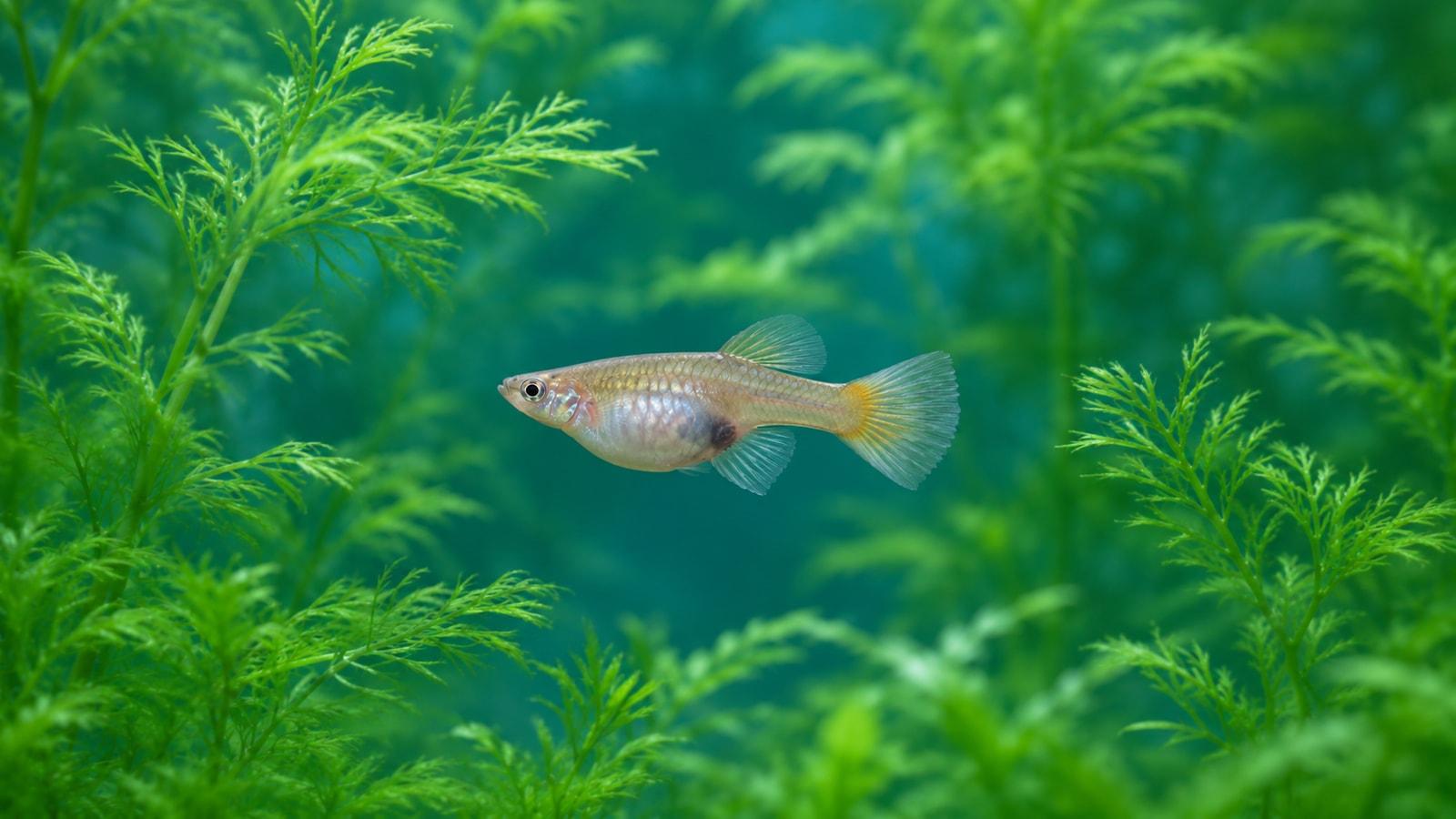
If it grows and darkens while her belly rounds out, she is pregnant. Sudden swelling, raised scales or a rod-shaped anal fin mean something else. Expect fry about four weeks after her last brood. Built from FishBase, Seriously Fish, lab studies and keeper reports, not our own breeding.
The numbers
| What you see | Pregnant | Overfed or bloated | Dropsy | A swollen male |
|---|---|---|---|---|
| Anal fin | Fan-shaped | Either | Either | Thin rod (gonopodium) |
| How fast the belly grew | Over weeks | Over a day or two | Can worsen quickly, often with other signs | Any speed |
| Belly shape | Round, then squared off seen from the front | Round; goes down after a short fast | Swollen all round | Round |
| Gravid spot | Grows and darkens week by week | Unchanged | Unchanged | None |
| Scales, seen from above | Flat | Flat | Raised like a pine cone | Flat, unless it is dropsy |
| Eating and swimming | Normal until near the end | Normal, may be sluggish | May stop eating or struggle to swim as it progresses | Depends on the cause |
| What to do | Decide whether you want the fry | Fast her for two or three days | Separate the fish today; see the dropsy guide | Feed lightly; watch the scales |
Check the dark patch at the back of her belly, just above the anal fin, twice, a week apart. If it is bigger and darker the second time and her belly is rounder, she is pregnant. Check first that the fish is female and that its scales lie flat.
That two-look test is how to tell if a guppy is pregnant with any confidence, because one look tells you very little. There is also a shortcut: a female that has shared a tank with a male, at home or in the shop, is probably pregnant already. Aquarium Co-op's guppy guide answers the question with "probably yes", and FishBase and Seriously Fish both note that females store sperm.
We found no vet care sheet that covers guppy pregnancy. PetMD's guppy care sheet, written by a vet, says mixed groups breed readily and stops there. So this page is built from FishBase, Seriously Fish, lab studies, a fish vet's dropsy guide and what keepers report. We have not bred guppies for it.
First, check it is a female
Male guppies have a gonopodium: the anal fin is a thin, stick-like rod pointing backwards, used for mating. Females have a fan-shaped anal fin, and they are larger and plumper than males, with duller colour (Seriously Fish, FishBase, Aquarium Co-op).
A swollen fish with a rod for an anal fin is a male, and a swollen male is overfed, constipated or ill, never pregnant. Keepers ask "pregnant guppy or bloated male?" often enough for it to be worth checking before anything else. Young guppies are harder to sex, and shops get it wrong.
What does a pregnant guppy look like? Read the gravid spot
The gravid spot is the dark patch at the back of a female's belly, just above the anal fin. FishBase describes it as a "black triangle between anal and pelvic fins"; Seriously Fish as a "darkened area behind her anal fin just behind the belly". They word it differently, but both point to the rear of the belly, near the vent and the anal fin.
The one study we found on what it actually is looked at a close livebearing relative of the guppy, the eastern mosquitofish. The colour comes from pigment building up on the wall of the sac that holds the developing young. The researchers found the spot's size and darkness "closely linked with both developmental stages and clutch size": it darkened as the embryos grew, and its size and darkness tracked how many young she carried. Females carrying only unfertilised eggs had a spot that was "consistently pale". At the final stage, the embryos' eyes were "visible to the naked eye" through the pigment (Norazmi-Lokman et al., 2016).
We found no study that measured the same thing in guppies, but it explains what keepers see. Keepers report that every grown female shows some colour in that spot, pregnant or not. So the useful rule is:
- A spot is not proof. A dark one on a female you have just bought tells you she might be pregnant, not that she is.
- A spot that grows and darkens over one to three weeks is. Look once, note its size and shade, and look again a week later. A photo from the same angle each time makes the comparison honest.
- A faint spot is no guarantee either way. Keepers report that pale and albino strains are harder to read, because the spot can look pink or orange rather than dark, and the site's guppy guide already makes the same point: a missing patch is no guarantee she is not carrying.
Is my guppy pregnant, fat or sick?
This is the real question for most people looking at a round guppy, and the table above sets the four possibilities side by side. Three checks settle most cases.
How fast did she swell?
Pregnancy builds over weeks. A belly that balloons in a day or two is overfeeding, constipation or illness. One keeper answering this question put it simply: "pregnancy should be more gradual". That keeper's first step was a two-to-three-day fast, then peas or daphnia, and watching whether the belly goes down.
Are the scales flat?
Look down at the fish from directly above, the same test as in the dropsy guide. Flat scales mean pregnant or overfed. Scales that lift away from the body like a pine cone are the sign of dropsy, which a fish vet describes as fluid building up inside the body, "causing visible swelling and raised scales". Other signs on her list are bulging eyes, a thickened tail area and difficulty closing the mouth (Sanders, PetMD, 2024). PetMD's guppy care sheet names "bloated appearance with raised scales" as a reason to call a vet. A dark spot does not rule dropsy out; the scales decide. If they are lifting, here is what to do about dropsy today.
Has she looked pregnant for months?
A female that stays heavily round for well over two months and never drops fry, or keeps her size after a birth, may not be pregnant at all. Keepers report that "fat pregnant looking livebearers can have intestinal worms that can make the females look ready to drop babies". Guppies are common carriers of camallanus worms, and an infected fish can look healthy for weeks. Swollen organs and tumours happen too, and no source says how often, so check worms and scales first.
Guppy pregnancy stages, week by week
The timing below assumes the usual cycle of about four weeks between broods in a warm tank (FishBase; Sato et al., 2021). In cooler water, and in a first pregnancy, every stage takes longer.
| Stage | Roughly when | Belly | Gravid spot | Behaviour (keepers report) |
|---|---|---|---|---|
| Just after mating or a birth | Week 1 | Slim, no visible change | Small, pale to grey | Normal |
| Early | Week 2 | Slightly fuller underneath | Starting to darken | Normal |
| Middle | Week 3 | Clearly round | Larger and dark | Normal |
| Late | Last week | Deep, squared off seen from the front | Very dark; tiny dots (the embryos' eyes) may show | Slower, hides more |
| Hours before birth | Last day | Boxy, sometimes bulging at the vent | Darkest | Hides, holds still near the heater or surface, may quiver |
| After birth | Day 0 | Slim again | Lighter | Receptive to males again |
Only two things in this table come from a study: the spot darkening with embryo development, and the eyes showing through it, and both are from the mosquitofish study above. The weeks are our own spacing of a four-week cycle, and the behaviour column is what keepers report.
Pregnant guppy behaviour
Most of the pregnancy, she behaves normally: same swimming, same appetite. The changes keepers describe come at the end, as slowing down and hiding. The last row is sourced. Researchers describe female guppies as receptive to males "only as virgins and for a short period following parturition" (Dill, Hedrick and Fraser, 1999), and in the guppy's livebearer family, fertilisation of the next brood follows 1 to 8 days after a birth (Sato et al., 2021, citing a review of the family). In a tank with males, the next pregnancy starts almost at once.
How long is a guppy pregnant?
About four weeks between broods in a warm tank, and four to six weeks is the figure FishBase and Seriously Fish give. A first pregnancy can take a good deal longer.
The lab detail explains the spread. A 2021 study describes the guppy's breeding cycle as typically "approximately 25–30 d", with 25 days about the shortest time an embryo needs. But for virgin females, the time from mating to birth "can vary anywhere from 20 to 65 d", partly, the same paper suggests, because she can delay fertilising her eggs after mating (Sato et al., 2021). Practical Fishkeeping, reporting on a 2010 lab study, gives broods "at regular intervals of around 25 days". Many care guides print "21 to 30 days" or "21 to 31 days" and cite nothing.
Two things change it. Temperature had "a significant effect" on the time between broods in one lab study (Dzikowski et al., 2001). And females mated with several males had shorter pregnancies than females mated with one (Evans and Magurran, 2000).
You can rarely count days anyway. Stored sperm, and the gap between mating and fertilisation, make the start date a guess. If you saw her last birth, count from that.
Do not turn up the heat to hurry her
Warm water shortens the cycle, but the same lab study that found the best fry production at 77 to 81°F (25 to 27°C) found that 90°F (32°C) caused "increased female and fry mortality, degeneration of ovaries and reduced brood size" (Dzikowski et al., 2001). Keep her inside the normal guppy range.
Pregnant guppy signs of delivery
We found no guppy study that describes the signs that birth is close. These are what keepers report, and only the second has any study behind it, in the related mosquitofish:
- Her belly looks squared off, almost boxy, seen from the front.
- The gravid spot is at its darkest, sometimes with tiny dark dots in it: the embryos' eyes.
- She hides in plants or a corner, often near the heater or the surface.
- She holds still, quivers or arches her body.
- She refuses food in the last hours.
Keepers say a guppy birth takes a few hours. In the mosquitofish study, births took from 5 minutes to 3 hours (Norazmi-Lokman et al., 2016). We found no published guppy figure.
What to do with a pregnant female guppy
Decide first whether you want the fry. If not, leave her alone: adult guppies eat their young (Seriously Fish; Aquarium Co-op). Keepers report that some will still survive in a planted tank, and in a small tank that adds up quickly. If the tank cannot take more guppies, the 10 gallon guide sets out what to do with a mixed group.
If you want some fry, add cover rather than moving her. Seriously Fish calls a densely planted tank with lots of floating vegetation the best way to ensure fry survive. A clump of moss and a layer of floating plants do most of the work. A sponge filter has no intake to pull fry in. Other tank mates eat fry too: a shrimp retailer says ghost shrimp go after them, which is why Amano shrimp vs ghost shrimp says to keep ghost shrimp out of a fry tank.
If you want nearly every fry, when to separate a pregnant guppy matters. Seriously Fish advises removing the adults after the fry are born. Moving her is the part keepers disagree on. In one thread, two keepers said a breeder box is far too small and stresses the female, and one put it plainly: "Female livebearers are always better being left in the main tank." One research paper notes that reports in guppies and mollies name handling stress as the main cause of premature births, though the sources behind that line are hobby references, not experiments (Norazmi-Lokman et al., 2016). Our reading is that this leaves one of two choices: a separate small, planted tank she moves into a week or two before she is due, or a roomy floating box only once birth is hours away. Either way, put her back in the main tank once the fry are out.
Feed her normally. A varied diet around a good flake staple is enough; no source supports a special pregnancy food.
Expect the next brood. She is receptive again within days of giving birth, so in a tank with males the next one is already on its way. More fish means more waste, which shows as nitrate rising faster between water changes; see keeping nitrate down. Raising the fry is a subject of its own.
Why a guppy can be pregnant with no male in the tank
This is the most common surprise. Female guppies store sperm "for extended periods, ranging from days to several months" (Gasparini and Evans, 2013), and Seriously Fish says they can keep producing young "for 6 months or more if no males are present". Most shop tanks hold both sexes, so a female you bought on her own has probably mated already.
She carries one brood at a time (Sato et al., 2021), so several broods from one mating come one after another, about four weeks apart, not all at once. For the full reasoning and what it means for stocking, see why an all-female tank still gets fry.
The short version
Look twice, a week apart. A gravid spot that grows and darkens, and a belly that rounds out over weeks, is a pregnancy. Sudden swelling, scales raised like a pine cone, or a rod-shaped anal fin is something else. Expect fry about four weeks after her last brood, longer in a first pregnancy, and do not turn up the heat to hurry her.
Sources
- FishBase. Poecilia reticulata, guppy.
- Seriously Fish. Poecilia reticulata.
- Aquarium Co-op. Care Guide for Guppies. A retailer's guide, used for sexing, how often females are pregnant, and fry being eaten.
- Zayas, M. (2026). Guppy Fish Care Sheet. PetMD.
- Sanders, J. (2024). Dropsy in Fish. PetMD.
- Norazmi-Lokman, Purser and Patil (2016). Gravid spot predicts developmental progress and reproductive output in a livebearing fish, Gambusia holbrooki. PLoS ONE 11(1): e0147711. A study of the eastern mosquitofish, not the guppy.
- Sato, Aihara and Karino (2021). Male coloration affects female gestation period and timing of fertilization in the guppy (Poecilia reticulata). PLoS ONE 16(12): e0261004.
- Dzikowski, Hulata, Karplus and Harpaz (2001). Effect of temperature and dietary L-carnitine supplementation on reproductive performance of female guppy (Poecilia reticulata). Aquaculture 199: 323–332.
- Dill, Hedrick and Fraser (1999). Male mating strategies under predation risk: do females call the shots? Behavioral Ecology 10(4): 452–461.
- Evans and Magurran (2000). Multiple benefits of multiple mating in guppies. PNAS 97: 10074–10076.
- Gasparini and Evans (2013). Ovarian fluid mediates the temporal decline in sperm viability in a fish with sperm storage. PLoS ONE 8: e64431.
- Practical Fishkeeping. Catch-up growth in guppies affects brood sizes, reporting Auer et al. (2010), Ecology Letters 13: 998–1007.
- Keeper reports: fishforums.net, "Is my guppy fat or pregnant" (2019); fishforums.net, "My guppy has been pregnant for 4 months" (2014–2018); fishforums.net, "Stressed guppy about to give birth??" (2017).
Questions people ask
Mentioned in this guide
Related guides
How Many Guppies in a 10 Gallon Tank? Five, All Male
How many guppies in a 10 gallon tank? Five, all male. Add females and two can drop 40 to 80 fry a month. See the breeding math and what to do instead.
Dropsy in Bettas: The Pine-Cone Sign and What You Can Still Do
Dropsy in a betta shows as a swollen body with scales raised like a pine cone. What causes it, whether it spreads, early treatment, and when it is too late.
Angelfish Tank Mates: Good, Risky and No, With Reasons
Angelfish tank mates that work, the risky ones and the ones to avoid, with adult sizes and temperatures. Why neon tetras get eaten and barbs nip fins.