Quick Verdict
Scuds are small freshwater amphipods that arrive on live plants. In a tank with fish they are harmless and most fish eat them. In a shrimp-only tank they outbreed and outcompete the shrimp, and no treatment removes them without risk to the shrimp as well.
Scuds are harmless in a tank with fish, and a real problem in a tank with only shrimp. They are tiny freshwater crustaceans, curled like a comma and 5 to 15 mm long, that swim in fast jerks on their side. Fish eat them. Shrimp have to compete with them.
So the first question is not how to kill them. It is which kind of tank you have.
What scuds look like
A scud is an amphipod, a relative of shrimp with a body flattened from side to side rather than top to bottom. That shape is the giveaway. At rest it curls into a C. Disturbed, it shoots across the tank in a jerky line, often tipped over on its side, and dives under the nearest leaf. The common name "side-swimmer" comes from exactly that.
Colour is no help. They run from near-white through grey and tan to a reddish brown, depending on what they have been eating.
Most people find them by accident: lifting a clump of moss, rinsing a filter sponge, or shining a torch into the tank an hour after lights-out, when they come out to feed.
Not sure it is a scud?
Watch how it moves. A baby shrimp walks and grazes and looks like a small copy of its parents. A scud is curled, darts, and hides. A flat worm gliding up the glass with a triangular head is planaria, which is a different problem with a different answer. The table above sets out all four.
Scuds in a fish tank: leave them alone
Nearly every common aquarium fish treats a scud as food. Bettas, tetras, danios, guppies, mollies, loaches and cichlids all hunt them, and a pea puffer will clear a tank of them. With fish present the scuds stay few and stay hidden, living in the moss and the filter where nothing can reach them.
In that tank they are doing useful work. They shred dead leaves and eat leftover food before it rots, the same clean-up job that detritus worms do in the substrate. They add almost nothing to the waste load, and the ones that stray into open water become a meal.
There is one exception. In a breeding tank, scuds may eat fish eggs and the smallest fry. If you are raising egg-layers, keep the breeding tank free of them.
Scuds in a shrimp tank: a competitor, not a predator
A shrimp-only tank has no predators, and that is what changes the answer. Nothing eats the scuds, and they are built to win the race that follows:
- They reach breeding age in about three weeks. Cherry shrimp take about three months.
- A female carries 20 to 30 eggs and produces a new brood roughly every two weeks in a warm tank.
- They eat what shrimp eat — biofilm, algae, leftover food — and they are faster to it.
The result is not a massacre. It is a shrimp colony that stops growing, because the shrimplets are losing the contest for food. Keepers also report scuds picking at shrimplets and at adults that have just moulted and are still soft. That part is disputed, but scuds are omnivores, and a soft-shelled animal that cannot move away is within their range.
In a fish tank, scuds are food. In a shrimp tank, they are the other colony.
How to reduce scuds
- Feed less. Scud numbers follow the food supply. In a shrimp tank, feed an amount that is gone within two hours and skip a day or two each week.
- Trap at night. Put a slice of blanched courgette or a sinking pellet in a small jar laid on the substrate at lights-out. Lift it out an hour later with the scuds inside. Repeat nightly for two weeks.
- Clear the hiding places. Rinse the filter sponge in a bucket of tank water and swish moss clumps in the same bucket. Check the bucket for shrimplets before you tip it out.
- In a fish tank, do nothing. The fish are already handling it.
- Do not add a fish to a shrimp tank to eat the scuds. Anything that eats a scud eats a shrimplet.
Expect a reduction rather than an ending. Trapping and light feeding keep the numbers low enough for a shrimp colony to grow again. They very rarely remove every scud, and a handful is enough to rebuild the population.
If you need them gone completely, the dependable route is a restart. Move the shrimp into a clean tank by hand, checking each netful. Replace the plants with tissue-culture ones, and either dry out the old substrate and hardscape completely or replace them.
There is no shrimp-safe scud killer
Scuds and shrimp are both crustaceans, so what kills one threatens the other. Copper-based treatments kill shrimp and snails and linger in the silicone. Fenbendazole, the planaria treatment, turns up in scud advice, but it is a wormer: it clears planaria and hydra, and at the dose used in shrimp tanks the crustaceans carry on. Do not expect it to remove scuds. It does kill nerite and trumpet snails, and some keepers have lost shrimp after dosing it. Flooding a tank with carbonated water kills everything in it. None of these is worth the risk. Use the trap.
How scuds get in, and how to keep them out
They arrive on live plants. A juvenile scud is a few millimetres long and lives deep inside moss and root masses, which is exactly what gets bagged up and sold. It is the same route that brings snail eggs into a tank, and it is just as common.
If you keep shrimp, or plan to, two habits are worth having from the start. Buy tissue-culture plants, which are grown sterile in sealed cups. And keep a separate net and siphon for the shrimp tank, because a wet net carried over from a fish tank is enough to move them.
If you keep fish, none of this matters much. The scuds that make it in will be found.
The one thing worth taking from this
Decide by the tank, not by the animal. With fish, scuds are a free and harmless clean-up crew that doubles as live food. With only shrimp, they are a faster-breeding rival that is far easier to keep out than to remove. Act early, and do it with a trap and a lighter hand on the food, not a bottle.
Detailed Comparison
| Scud | Baby shrimp | Copepod | Planaria | |
|---|---|---|---|---|
| What you see | Curled, flattened side to side, like a tiny comma. 5–15 mm | Straight body, a miniature of the adult. 2–10 mm | White speck under 2 mm, often with two tails | Flat worm with a triangular head and two eye spots |
| How it moves | Fast and jerky, often on its side, then dives for cover | Walks and grazes. Swims forward, flicks backward when startled | Short hops across the glass | Glides smoothly along the glass |
| Harmful? | Not to fish. Competes with shrimp and may take eggs and fry | No — this is what you wanted | No. Fish food | Yes to shrimp. Preys on shrimplets and eggs |
| What to do | Fish tank: nothing. Shrimp tank: feed less and trap | Nothing | Nothing | Treat — this is the one that needs it |
Frequently Asked Questions
🔗 Related Resources
Explore More:
More Reviews:
Related Articles
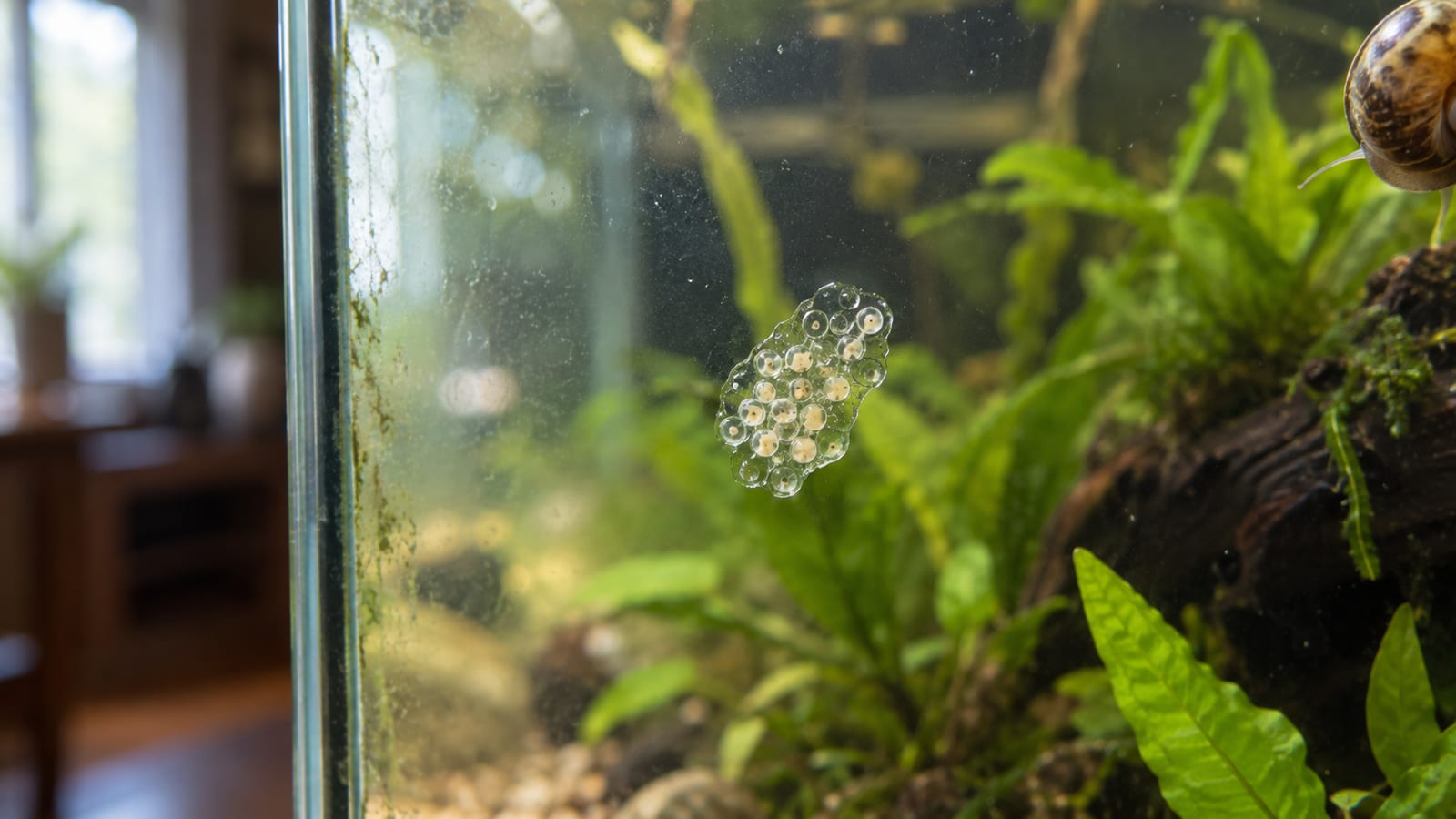
Snail Eggs in a Fish Tank: Which Snail, and Will They Hatch?
Snail eggs in a fish tank look different for every species. Identify yours in one table — clear jelly, pink clutch or hard white dots — and if they will hatch.
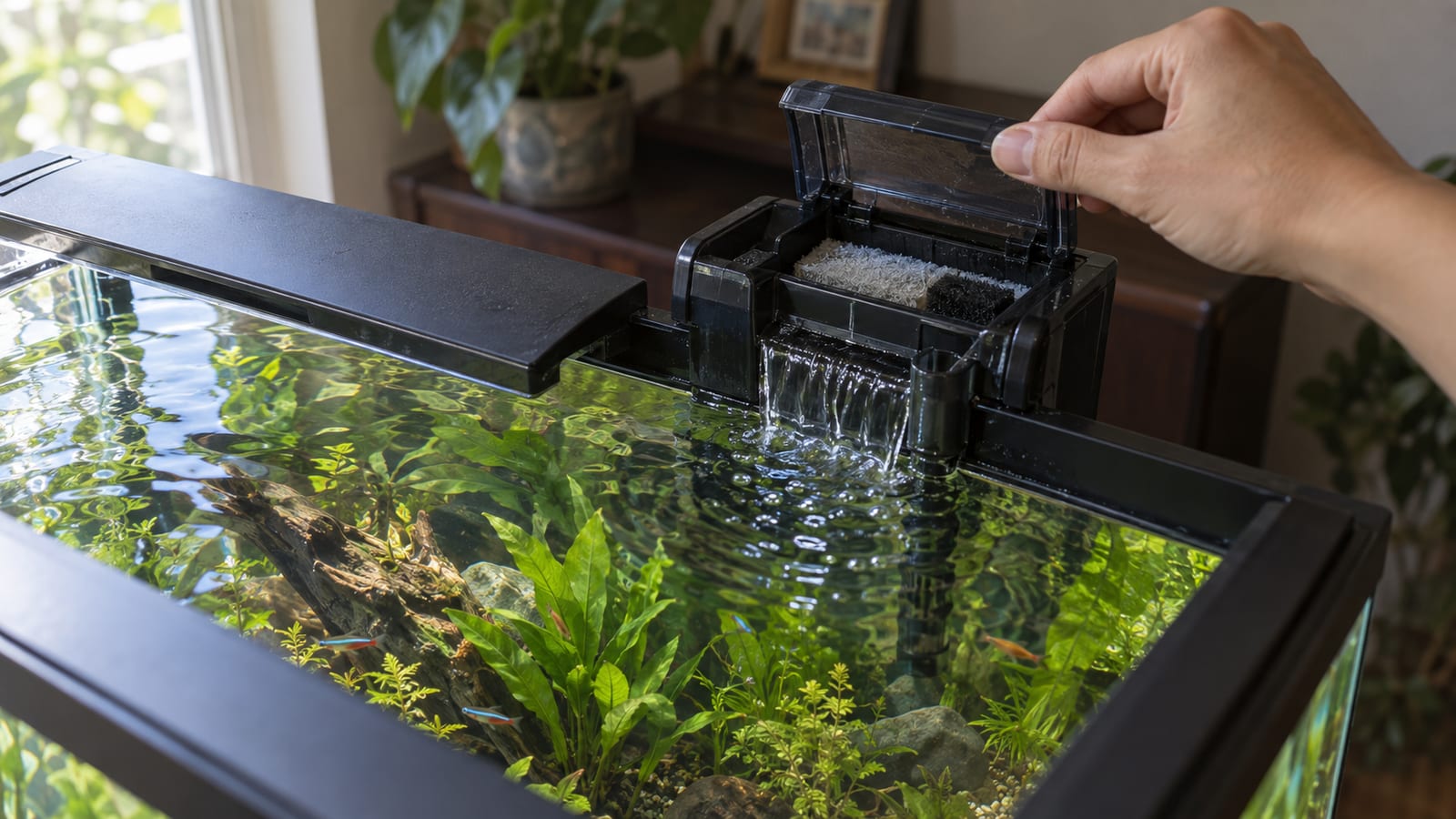
Why Does My Fish Tank Smell? Match the Smell to the Cause
Why does my fish tank smell? A healthy tank smells like damp soil. Rotten eggs, rotting fish and musty swamp each point to one cause — matched in one table.
Detritus Worms in a Fish Tank: Harmless, But Check First
Detritus worms in a fish tank are harmless waste eaters. A sudden bloom means overfeeding — and here is how to tell them apart from planaria, which are not.