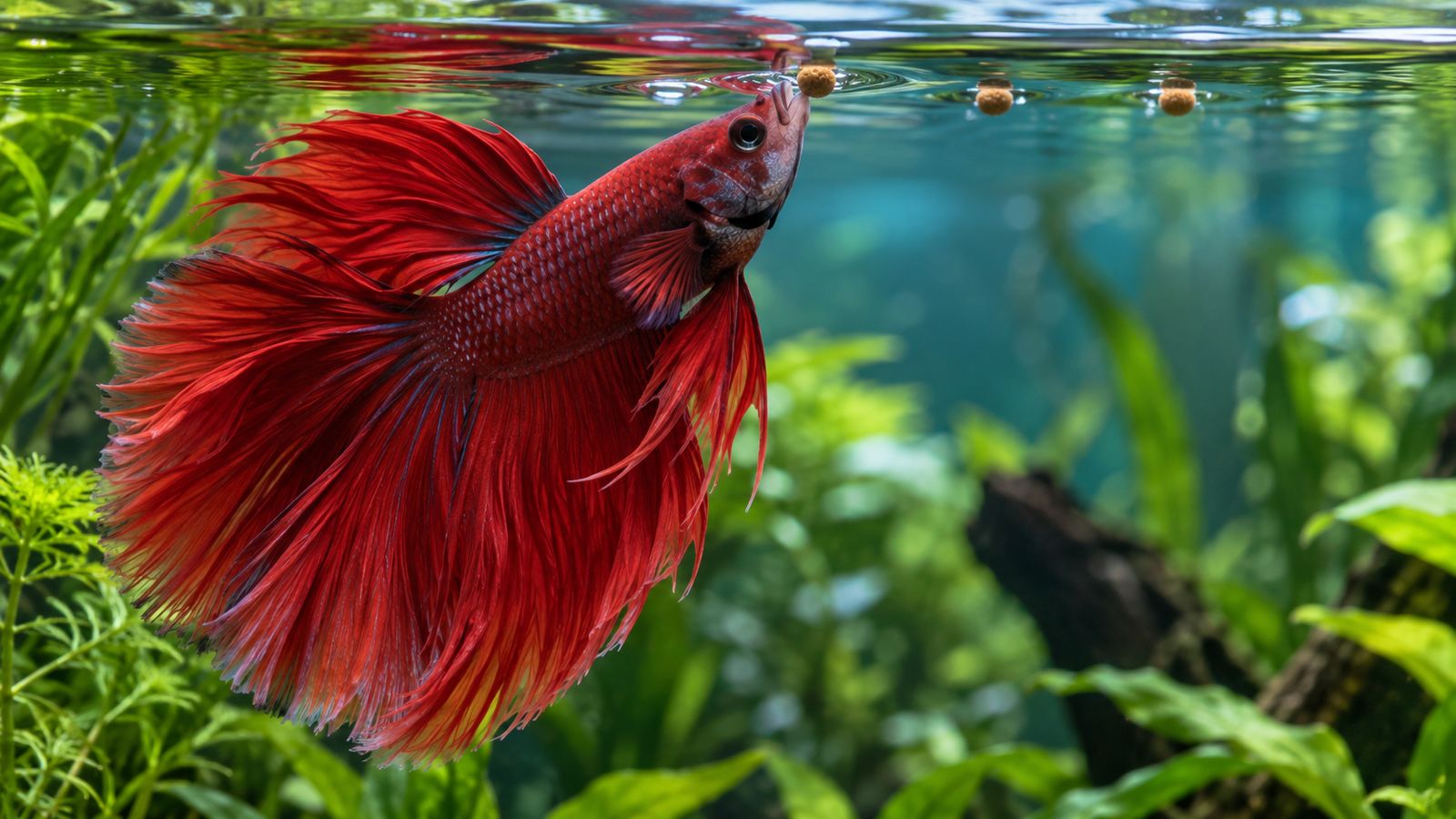
5 mm). Add a frozen meal once or twice a week and skip one day. We picked these from makers' labels and veterinary guidance, not from hands-on testing.
Full specs
| Food | Best for | Size | Floats? | Protein / fat / fiber / ash | First ingredient | Price seen |
|---|---|---|---|---|---|---|
| Hikari Betta Bio-GoldPrice on Amazon | Most adult bettas | About 1.1–1.4 mm | Floats | 38% / 4% / 3% / 12% | Fish meal | $7.49, 20 g (That Pet Place) |
| Hikari Micro PelletsPrice on Amazon | Bettas under 1.5 in | Small; no mm size published | Hikari says both semi-floating and slowly sinking | 43% / 7% / 7% / 17% | Fish meal | $6.99, 45 g (That Pet Place) |
| NorthFin Betta BitsPrice on Amazon | A cleaner label at 1 mm | 1 mm | Floats or slow-sinks: sources conflict | 45% / 5% / 5% / 9% | Whole Antarctic krill meal | $4.99, 20 g (That Pet Place) |
| Omega One Betta Buffet PelletsPrice on Amazon | Large bettas | 1.5 mm | Sold as floating; some buyers say it sinks | 42% / 8% / 2% / 8% | Salmon | $4.49, 1 oz (That Pet Place) |
| Fluval Bug Bites Betta FormulaPrice on Amazon | Bettas that ignore fish-meal pellets | 0.25–1.0 mm (Fluval US) | Slow-sinking | 45% / 12.5% / 5% / 9% | Black soldier fly larvae | $3.39, 1.05 oz (That Pet Place; may be a sale price) |
| Hikari Bio-Pure Frozen Daphnia | The weekly frozen meal | Frozen cubes, 3.5 oz | n/a | Not published | Daphnia | $4.49 (That Pet Place) |
The best food for betta fish is a betta-specific pellet small enough for your fish's mouth, fed as the staple most days. For a typical adult that is Hikari Betta Bio-Gold. For a betta under 1.5 inches it is Hikari Micro Pellets, and for a cleaner fish-first label, NorthFin Betta Bits or Omega One Betta Buffet. Add frozen daphnia or bloodworms once or twice a week, feed two to four pellets once or twice a day, and skip one day a week.
How we chose. We have not fed or compared these foods ourselves. The picks come from the makers' guaranteed analyses and feeding guides, veterinary sources (a vet-reviewed WebMD guide, PetMD's vet-written care sheets and the Merck Veterinary Manual), a peer-reviewed study on betta protein needs, and the questions keepers ask most. Specs and prices were checked on 28 October 2026. Prices are the item price shown on the retailer's page that day, before shipping and tax. Shipping depends on where you live and prices change often, so check the current price before you buy.
Best food for betta fish: the six picks
Hikari Betta Bio-Gold: the default staple for most adult bettas
If you want one best betta fish food to start with, this is the safe default. Hikari Betta Bio-Gold is a floating pellet of about 1.1 to 1.4 mm, which fits a typical adult betta's mouth. Hikari's label lists at least 38% protein and 4% fat, at most 3% fiber and 12% ash, and it carries stabilized vitamin C, which the Merck Veterinary Manual says most fish foods should have.
The catch is the ingredient list. Fish meal comes first, but wheat flour, soybean meal, rice bran and potato starch follow it, and it contains Red 3, an artificial colour. It is one of the most widely recommended betta pellets, not the one with the best ingredients.
It was $7.49 for 20 g at That Pet Place when we checked. Hikari also sells a 2.5 g pack ($2.79 there), and for one betta that is the better buy; the reason is in the section on how long betta food lasts.
Hikari Betta Bio-Gold
Most adult bettas
Hikari Micro Pellets: for a betta under 1.5 inches
A young betta can be too small for a standard pellet. Hikari's own feeding rule puts any betta under 1.5 inches, measured from the nose to the base of the tail with the fins left out, on Micro Pellets instead of Bio-Gold. They are made for smaller-mouthed fish, and the label reads 43% protein, 7% fat, 7% fiber and 17% ash.
The catch: Hikari's page describes them as both "semi-floating" and "slowly sinking", and gives no pellet size in millimetres. Expect some to drift down, and watch where they end up. They were $6.99 for 45 g at That Pet Place; Hikari also makes a 22 g pack, which is the better size for one fish. This is the answer to "baby betta fish food": move up to an adult pellet once the fish passes 1.5 inches.
Hikari Micro Pellets
Bettas under 1.5 in
NorthFin Betta Bits: the cleanest label at 1 mm
NorthFin Betta Bits 1 mm has the ingredient list Bio-Gold lacks: whole Antarctic krill meal, whole herring meal and whole sardine meal come first, then wheat flour, kelp, spirulina and garlic. The label reads 45% protein, 5% fat, 5% fiber and 9% ash, and the pellet is 1 mm, small enough for most adult bettas.
The catch is that we could not confirm two things. That Pet Place's label page says the pellets float, while other retailer listings call them slow-sinking, and buyers disagree too. And we found no maker spec page, so the numbers come from a retailer's transcription of the label. It was $4.99 for 20 g at That Pet Place.
NorthFin Betta Bits
A cleaner label at 1 mm
Omega One Betta Buffet: whole fish first, and the biggest pellet here
Omega One Betta Buffet Pellets list salmon first, then wheat flour, whole herring, pea protein and whole shrimp. The label reads 42% protein, 8% fat, 2% fiber and 8% ash, the lowest ash of the dry foods here.
At 1.5 mm this is the largest pellet size listed here. That makes it the pick for a large betta, and a poor one for a small fish, which may spit it out. Petco sells it as a floating pellet, though some buyers report that it sinks. The catch: Omega One's own site failed to load when we checked, so the spec comes from That Pet Place's and Petco's label copy, which agreed. It was $4.49 for 1 oz at That Pet Place and $6.99 at Petco.
Omega One Betta Buffet Pellets
Large bettas
Fluval Bug Bites Betta Formula: insect first, the closest to the wild diet
Wild bettas eat insects and their larvae, and this is the one food here built on them. The first ingredient in Bug Bites Betta Formula is black soldier fly larvae, followed by salmon. The label reads 45% protein, 12.5% fat, 5% fiber and 9% ash. It suits a betta that ignores fish-meal pellets, and its slow-sinking granules suit a betta in a planted community tank, where food drifts down.
Two catches. It has the most fat of the dry foods here, so portion it carefully. And the granules are small: Fluval's US listing gives 0.25 to 1.0 mm, and Practical Fishkeeping says the US betta formula maxes out at 1.0 mm. It was $3.39 at That Pet Place, which may have been a sale price.
Fluval Bug Bites Betta Formula
Bettas that ignore fish-meal pellets
Hikari Bio-Pure Frozen Daphnia: the weekly fibre meal
This is not a staple. Daphnia are tiny crustaceans, sold here as frozen cubes, and they are the one frozen food on the list. Keepers feed them as the frozen meal of the week, and especially the day after a fast or a bloated spell, because daphnia are often described as a gentle laxative. Hikari markets its daphnia as "a 100% natural laxative", but that is the maker's claim and keeper practice; we found no study testing it in bettas. If your betta keeps bloating, read about swim bladder problems first.
The listing says to feed only what the fish will eat within about a minute. It was $4.49 for 3.5 oz at That Pet Place. Many online shops will not ship frozen food, so a local fish store is usually the place to buy it.
Betta fish food compared on the label
The table near the top of the page puts all six side by side. The numbers are minimum protein and fat, and maximum fiber and ash, as printed on each label. Where sources disagree, the table says so rather than guessing.
What the numbers actually mean
Less than the labels suggest. A 2016 study in Boletim do Instituto de Pesca found that juvenile bettas need between 30 and 33% crude protein. Every dry food here clears that, from Bio-Gold's 38% to NorthFin's and Bug Bites' 45%. PetMD's general guidance for carnivorous fish is 40 to 55%. Nothing we found shows that a betta does better on 45% than on 42%, so do not choose on the protein figure.
The differences that matter are three. Pellet size, because a betta can only eat what fits in its mouth. Floating or sinking, because bettas feed at the surface, and a sinking food can end up uneaten in the gravel. And what comes first in the ingredient list: whole fish, krill or insects, against a fish meal followed by several fillers. Ash, the mineral content, varies from 8% to 17%. We found no source saying that any of these levels harms a betta, so treat it as a detail, not a deciding number.
What do betta fish eat?
Betta fish are carnivores. In the wild they eat small aquatic and land invertebrates, mostly insects and their larvae, in still and sluggish water such as rice paddies, swamps and ditches. In a tank, a vet-reviewed WebMD guide says a high-protein betta pellet should be the mainstay, and Seriously Fish adds that small live or frozen foods such as daphnia, brine shrimp and bloodworms should be offered regularly for colour and condition.
One myth needs retiring. A betta, or Siamese fighting fish, cannot live on the roots of a plant in a vase. WebMD says plainly that this is not true and can be harmful, and Hikari says the same. A betta needs animal protein every day it eats.
Pellets, flakes, frozen or live?
| Form | Role in the diet | How often | The catch |
|---|---|---|---|
| Betta pellets | The staple | Most days | Must fit the mouth |
| Flakes | A backup at most | Rarely | PetMD says flakes can lose up to 90% of their vitamins within 30 seconds in water |
| Frozen daphnia, brine shrimp, bloodworms | The weekly meal or treat | 1–2 days a week | Bloodworms and brine shrimp "sparingly", per Hikari |
| Freeze-dried bloodworms, brine shrimp | A treat | Occasionally | Keepers link routine use to bloat |
| Live foods | Optional | Rarely | Can carry parasites |
Pellets win on vitamins. PetMD's advice is simple: if a fish's mouth is big enough for a pellet, feed pellets, and fish vet Dr. Jessie Sanders notes that flakes lose vitamin C faster than any other fish food.
Bloodworms are the treat bettas like most, and they are not a diet. Practical Fishkeeping, in a feature sponsored by Fluval, describes them as having low nutritional value, and the same piece points out that brine shrimp, which live in brine lakes, are not a natural food for bettas. Feed both as treats, and keep the pellet as the staple.
Is live food worth it for a betta?
Not usually. Bettas take dry and frozen food readily, so live food for betta fish is optional, and it brings a real risk. In a study reported by Practical Fishkeeping, researchers in Munich found that six of seven samples of shop-bought "tubifex" worms carried parasites. Frozen foods cover the same ground with less risk. If you want to feed live, keepers' safer options are daphnia or baby brine shrimp from a culture you raise yourself; that is hobby practice, not a tested rule.
How many pellets to feed a betta
How much food to feed a betta fish comes down to a pellet count: two to four pellets, once or twice a day, is the vet-reviewed default from WebMD. Feed one pellet at a time, make sure each is eaten, and remove whatever is left, as Hikari's own instructions say. Our swim bladder guide suggests two to three pellets once or twice a day for an adult, which sits inside the same range.
Hikari also publishes a rule by body length. Measure from the nose to the base of the tail, fins excluded.
| Betta length | Food | Hikari's maximum | Conservative default |
|---|---|---|---|
| Under 1.5 in | Micro Pellets | 6 pellets, twice a day | Start lower and watch the belly |
| 1.5–1.75 in | Bio-Gold | 3 pellets, up to 3 times a day; extra feedings at least 3 hours apart | 2–4 pellets, once or twice a day |
| Each ¼ in longer | Bio-Gold | 1 more pellet a feeding, never more than 5 | Same default |
How many food pellets a betta needs, by length, per Hikari's Betta Bio-Gold page and FAQ.
Read Hikari's column as a ceiling, not a target. It is a maker's figure: up to nine pellets a day for a 1.5-inch fish and more for a bigger one, against a vet-reviewed default of two to four, once or twice a day. Seriously Fish warns that bettas seem particularly prone to obesity, and PetMD lists obesity, swim bladder disorders, constipation and poor water quality among the results of feeding badly. Hikari does make one point worth keeping: several small feedings are better than one big one. So if you feed twice, split the pellets; do not double them.
Many keepers soak pellets in a little tank water for a few minutes before feeding, so they swell outside the fish. That is common practice, not a proven effect.
A rounded belly just after a meal is normal. A belly that stays swollen, or a fish floating sideways, means overfeeding may be the cause, and swim bladder disease in bettas is the next read. If the scales stick out like a pinecone, it is dropsy, not food.
A weekly betta menu
WebMD's vet-reviewed guide says freeze-dried or fresh food can replace the pellet meal one or two days a week, and it lists frozen bloodworms and brine shrimp among betta treats. This menu uses thawed frozen food for those days. Add one day without food, which many keepers use, and the week looks like this:
| Day | Food |
|---|---|
| Monday | Pellets |
| Tuesday | Pellets |
| Wednesday | Frozen daphnia, instead of pellets |
| Thursday | Pellets |
| Friday | Pellets |
| Saturday | Thawed frozen bloodworms or brine shrimp, instead of pellets |
| Sunday | No food |
It is a template, not a rule. One frozen day is enough if that is easier, and the fast day can move. A healthy adult betta handles a day off with no trouble; for longer gaps, see how long a betta can go without food.
Why your betta spits out its food
The usual reason a betta fish is spitting out food is that the pellet is too big. Keepers report that bettas often spit a pellet out, then take it again once it softens, and some pellets barely fit an adult's mouth. The fix is a smaller food: a 1 mm pellet such as NorthFin Betta Bits, or Micro Pellets for a small fish.
If your betta ignores food altogether, look at the tank before the food. A new betta often skips its first meals for a day or so while it settles. Cold water slows digestion, so keep the water at 76–81°F, the range on PetMD's vet-written care sheet. And a betta lying on the bottom and refusing food may be cold or sick rather than fussy.
Buy the small bag: how long betta food lasts
Fish food goes stale long before it runs out, and nobody on the shelf tells you. The Merck Veterinary Manual is specific: discard a container of dry food kept at room temperature two months after opening, dry food stored in the freezer after six months, and commercial frozen foods such as brine shrimp and bloodworms after a year. Hikari's own figure for its pellets and freeze-dried foods is 90 days after opening.
Store it well while you have it. Merck says heat and humidity break the diet down, encourage mould and make it rancid, so keep food in a pest-proof container somewhere cool and dry. Dr. Sanders adds that the container should be airtight and opaque. The top of a warm tank hood is the worst place for it.
Then do the arithmetic. A betta eats a few pellets a day, so even a 20 g bag will be stale long before it is empty. Buy the smallest size you can find, like Bio-Gold's 2.5 g pack, and replace it on schedule rather than when it runs out.
Out of betta food, or going away?
If you are wondering what to feed a betta fish when you are out of food, the first answer is nothing for now: a healthy adult betta can safely miss a few days, so skipping meals until you can buy food is safer than improvising. Frozen daphnia or brine shrimp from a fish store, or a tropical pellet or granule, will do for a few days. Treat tropical food as a stopgap only: it is not sized or formulated for bettas, and WebMD's guide says pellets made for other fish will not be healthy for a betta in the long run. Goldfish food is a poorer stand-in, made for a different fish with a different diet. We found no tested homemade betta food, so we do not give a recipe.
For betta fish food for vacation, the short answer is that you usually do not need any. How long can betta fish go without food covers how long is safe, and what to do for longer trips.
Left out, and why
New Life Spectrum Betta. A popular choice, but we could not verify its current label, so it is not in the table.
Flakes as the staple. They lose vitamins fast in water, and a betta can eat pellets.
Freeze-dried foods as the staple. Fine as a treat; keepers link routine use to bloat.
Live tubifex. The parasite risk is documented, and frozen foods do the same job.
The one thing worth taking from this
The best food for betta fish is the one that fits its mouth. Match the pellet to your betta's size, feed less than you think it wants, and buy the smallest bag, because stale food is the problem nobody mentions. Add a frozen meal once or twice a week and a day off, and the diet is done. If the belly starts to swell, our guide to swim bladder disease in bettas is where to go next.
Sources
- Seriously Fish. Betta splendens.
- WebMD. What Do Betta Fish Eat?, medically reviewed by Vanesa Farmer, DVM, 2025.
- Zayas. Betta Fish Care Sheet. PetMD, 2026.
- Witherell. What Do Fish Eat? Your Guide to Feeding Pet Fish. PetMD, 2026.
- Zuanon, Morais, Carneiro, Campelo, Pontes and Salaro. Dietary crude protein levels for juvenile betta. Boletim do Instituto de Pesca 42(3), 2016.
- Petty, Francis-Floyd and Yanong. Nutritional Diseases of Fish. Merck Veterinary Manual, updated June 2026.
- Hikari. Betta Bio-Gold, Micro Pellets, Bio-Pure Frozen Daphnia and FAQ.
- Hikari. Betta owner tips.
- Sanders. Store Fish Food Correctly. cafishvet.com, 2019.
- Practical Fishkeeping. How to feed your new Betta. Sponsored by Fluval.
- Practical Fishkeeping. Study highlights dangers of tubifex to fish, reporting Hallett et al., Diseases of Aquatic Organisms 65, 2005.
- That Pet Place. Product pages for Hikari Betta Bio-Gold 20 g, Betta Bio-Gold 2.5 g, Hikari Micro Pellets, NorthFin Betta Bits 1 mm, Omega One Betta Buffet Pellets, Fluval Bug Bites Betta and Hikari Bio-Pure Daphnia, seen 28 October 2026.
- Petco. Omega One Betta Buffet Pellets, 1 oz, seen 28 October 2026.
- Fluval. Bug Bites Betta Micro Granules, 1.05 oz. Fluval US.
Questions people ask
Mentioned in this guide
Related guides
How Long Can a Betta Go Without Food? A Week Is Fine, Two Is Not
A healthy adult betta can go about a week without food, and survives up to two. How to plan a trip, which feeders to avoid, and why a betta stops eating.
Best Tropical Fish Food: Picks by Where Your Fish Feed
The best tropical fish food for a community tank: a staple for the smallest mouths, a sinking food for bottom feeders, and a jar you can finish in 3 months.
How Often to Feed Goldfish: Schedule by Age and Water Temp
How often to feed goldfish: once or twice a day, what they eat in 1-2 minutes. See how much in grams and a pond feeding chart by water temperature.