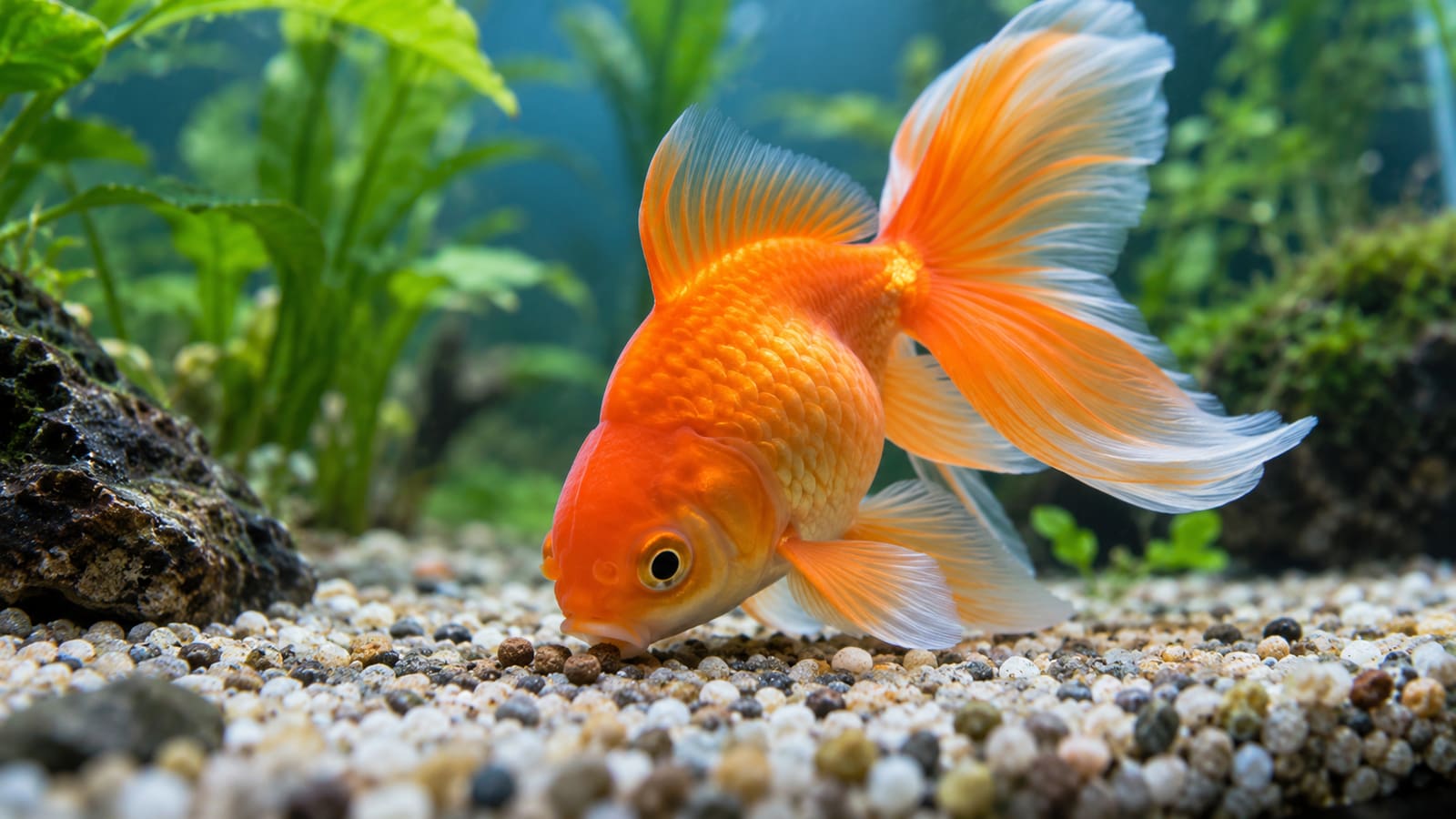
Goldfish have no true stomach, so they are built to eat little and often, and their begging is not hunger. Overfeeding is the most common goldfish-keeping mistake and a major cause of ammonia spikes. Use sinking food for fancy goldfish. In a pond, feed less as the water cools and stop when it drops below about 45–50°F.
Some links go to retailers. As an Amazon Associate, Aquarium for Beginners earns from qualifying purchases, at no extra cost to you.
The numbers
| Situation | How often | How much |
|---|---|---|
| Adult goldfish, indoor tank | Once or twice a day | What they finish in 1–2 minutes |
| Young goldfish | Three or four small meals a day | About 3% of body weight a day in total |
| Pond, water 60°F and above | Daily | What they finish within 5 minutes |
| Pond, water 50–59°F | Daily, or less | Small amounts: 0.2–1% of body weight |
| Pond, water below 50°F | Little or nothing. Stop below 45°F | Goldfish do not feed below 45°F |
| Ammonia or nitrite above zero | Stop for 1–3 days | Change 25–50% of the water, then feed small meals |
How often to feed goldfish: once or twice a day for adults, giving only what they finish in one to two minutes. PetMD's vet-written care sheet recommends small amounts once a day, eaten within one to two minutes, and RSPCA Australia says to feed only what can be eaten in under two minutes. The Merck Veterinary Manual notes that the carp family, which goldfish belong to, benefits from several feedings a day, so splitting the same amount into two meals is fine. Then stop, even though the fish will act as if they are still hungry. Goldfish always act hungry, and it is not a sign they need more.
Overfeeding is, in RSPCA Australia's words, "the most common problem with goldfish." Everything a goldfish eats becomes ammonia, so the more you feed, the harder the water has to work.
Why goldfish always look hungry
Goldfish have no true stomach. The Merck Veterinary Manual and the Southern Regional Aquaculture Center both point to this: food moves through in small amounts, so goldfish are built to eat little and often. Their begging is the behaviour of a fish designed to graze, not a fish that is going short.
That is why the clock and the one-to-two-minute rule are better guides than the fish. A goldfish that is fed every time it asks will eat far more than it needs.
How much to feed: the one-to-two-minute rule
Drop in a small pinch of food and watch. If it is all gone within a minute or two, that was about right. If some is still floating or lying on the gravel after that, it was too much: remove the leftovers with a net or siphon, and give less next time.
If you want an actual number, think in weight. Guidance runs from about 1% of the fish's body weight a day, the maintenance ration fish farmers use in ponds, to 3%, the figure the Merck Veterinary Manual gives for adult fish. Here is what that means in grams, using the length-to-weight table the Southern Regional Aquaculture Center publishes for goldfish (lengths include the tail):
| Goldfish length | Weight | Food a day at 1% | Food a day at 3% |
|---|---|---|---|
| 2 inches | 2.3 g | 0.02 g | 0.07 g |
| 3 inches | 7.7 g | 0.08 g | 0.23 g |
| 4 inches | 18.1 g | 0.18 g | 0.54 g |
It is less than most people expect. To turn it into pellets, weigh 20 pellets on a kitchen scale and divide. The one-to-two-minute rule still decides each meal: the grams are a check that the total is in the right range, not a target to hit. For how big your fish will get, see how big goldfish get.
Feeding by water temperature
A goldfish's appetite follows the water temperature. Its metabolism slows as the water cools, and it eats noticeably more when the water is warm: in one laboratory study, goldfish at 82°F foraged and ate far more than goldfish at 59°F.
Indoors, at the usual 65–75°F, feed normally. In a pond, the Southern Regional Aquaculture Center sets the daily ration by water temperature:
| Water temperature | Growth ration | Maintenance ration |
|---|---|---|
| Above 90°F | 1.0% of body weight | None |
| 70–90°F | 3.0% | 1.0% |
| 60–69°F | 2.0% | 0.5% |
| 50–59°F | 1.0% | 0.2% |
| 45–49°F | 0.5% | None |
| Below 45°F | None | None |
The figures are for fish under half a pound. The growth ration is for young fish you want to grow; the maintenance ration keeps adult fish healthy, and SRAC feeds it only five days a week. Below 45°F, goldfish stop feeding on their own. RSPCA Australia's advice is similar: limit feeding once the water falls below about 46°F (8°C), because a cold goldfish's digestion slows right down. SRAC adds that uneaten food creates water quality problems, so remove what is left.
Pond fish also get time and extra food from the pond itself. SRAC allows pond fish up to five minutes to finish a meal in warm weather, and never more than 15, and notes that pond fish also eat some natural food. In a tank, everything comes from you, so stick to the shorter window.
Warm, heated tanks
Goldfish handle warm water well, and in laboratory tests where they could choose, they settled at around 75–86°F. But warm goldfish eat more and produce more ammonia, so a goldfish in a warm room needs the same small meals and more frequent water changes, not bigger meals.
What to feed
- A good goldfish pellet or granule as the staple. Goldfish are omnivores, and a complete food covers what a tank fish cannot find for itself.
- Sinking food for fancy goldfish. Vets recommend it because fancy goldfish gulp air when they feed at the surface.
- Soak freeze-dried food before feeding, as RSPCA Australia advises, to avoid digestive upsets. Many keepers soak pellets too; it does no harm.
- Shelled, scalded peas now and then, as a supplement.
- Frozen brine shrimp or daphnia as an occasional treat.
- Keep dry food sealed, cool and dry. The Merck Veterinary Manual's pet owner guide suggests using it up or replacing it every two months, so buy small tubs.
Fancy goldfish and buoyancy trouble
Fancy goldfish, the round-bodied kind such as orandas and ryukins, are prone to buoyancy problems, where the fish floats, sinks or tips over. The Merck Veterinary Manual puts one common cause down to swallowing air at feeding time, and says it can be avoided by feeding sinking food.
If a goldfish starts floating awkwardly after a meal, the standard first step is to stop feeding for two or three days, then feed a crushed, shelled pea daily to help clear the gut. The same approach for bettas is in swim bladder disease in bettas.
Be realistic if it does not clear up. In one vet's review of 47 goldfish brought in for buoyancy problems, post-mortems often found internal disease, such as granulomas in a quarter of cases and kidney cysts in nearly a fifth, and the response to treatment was very poor. Short-bodied and long-bodied goldfish were affected in almost equal numbers. A buoyancy problem that lasts beyond a few days of fasting is a reason to see a fish vet, not to keep changing the food.
Young goldfish and fry
Young goldfish need more food, more often. In a feeding trial on juvenile goldfish, 3% of body weight a day split into four meals gave the best growth, and the Merck Veterinary Manual allows fry and fingerlings up to 5%. Feed small amounts three or four times a day, each one finished within a couple of minutes.
Newly hatched fry start feeding on their second or third day, and they need food small enough for their mouths: SRAC lists newly hatched brine shrimp or other foods of 200 to 300 micrometres.
Signs you are overfeeding
- Food left on the gravel after a couple of minutes.
- Cloudy water, or an algae bloom in a pond.
- Ammonia or nitrite above zero on a test.
- Fancy goldfish floating or tipping after meals.
If you have overfed
- Net or siphon out any food you can see.
- Test the water. University of Florida guidance is that the first thing to do when ammonia is present is to reduce or stop feeding.
- Change 25–50% of the water. The Merck Veterinary Manual advises changing at least half if total ammonia reaches 2 mg/L or higher. How to change fish tank water covers the method, and how to lower nitrites covers a nitrite reading.
- Skip feeding for one to three days. That does not typically harm a healthy adult fish, though it does harm fry.
Going away and wondering about the other extreme? See how long goldfish can go without food.
What you need
| Item | Why |
|---|---|
| Slow-sinking goldfish granules | A staple food that sinks, so fancy goldfish do not gulp air at the surface |
| Liquid test kit | Shows overfeeding as ammonia before the fish do |
| Gravel siphon | Lifts uneaten food out of the gravel during water changes |
The one thing worth taking from this
Feed by the clock and the one-to-two-minute rule, never by how hungry the fish look. A goldfish is built to beg, and the water pays for every extra pinch.
Sources
- Witherell. Goldfish Care Sheet. PetMD, 2024.
- RSPCA Australia. How should I care for my goldfish? RSPCA Knowledgebase, 2024.
- Petty, Francis-Floyd and Yanong. Fish Taxonomy and Nutritional Diseases of Fish. Merck Veterinary Manual.
- Francis-Floyd and Petty. Disorders and Diseases of Fish. Merck Veterinary Manual, pet owner version.
- Watson, Hill and Pouder. Species Profile: Koi and Goldfish. Southern Regional Aquaculture Center, Publication 7201, 2004.
- Masser. Water Gardens. Southern Regional Aquaculture Center, Publication 435, 1999.
- Watson, Francis-Floyd, Petty and Pouder. Ammonia in Aquatic Systems. University of Florida IFAS Extension.
- Chen, Wong, Chan and Wong. Mechanisms for Temperature Modulation of Feeding in Goldfish and Implications on Seasonal Changes in Feeding Behavior and Food Intake. Frontiers in Endocrinology 10: 133, 2019.
- Belsare and Dhaker. Feeding ration and frequency influences growth, feed utilization and body composition of goldfish (Carassius auratus). Indian Journal of Animal Research 53(1): 94–98, 2019.
- WikiVet. Buoyancy Disorders.
- Wildgoose. Buoyancy disorders of goldfish. World Aquatic Veterinary Medical Association webinar summary, 2016.
- Coutant. Compilation of Temperature Preference Data. Journal of the Fisheries Research Board of Canada 34: 739–745, 1977.
Questions people ask
Mentioned in this guide
Related guides
How Long Can Goldfish Go Without Food? Up to Two Weeks
A healthy adult goldfish can go a week without food easily and survives about two. How to prepare for a trip, why feeder blocks backfire, and ponds in winter.
Best Food for Betta Fish: Picks by Size, With Label Data
The best food for betta fish is a betta pellet sized to its mouth. Six picks compared on label protein and pellet size, plus how many to feed a day.
Best Tropical Fish Food: Picks by Where Your Fish Feed
The best tropical fish food for a community tank: a staple for the smallest mouths, a sinking food for bottom feeders, and a jar you can finish in 3 months.