
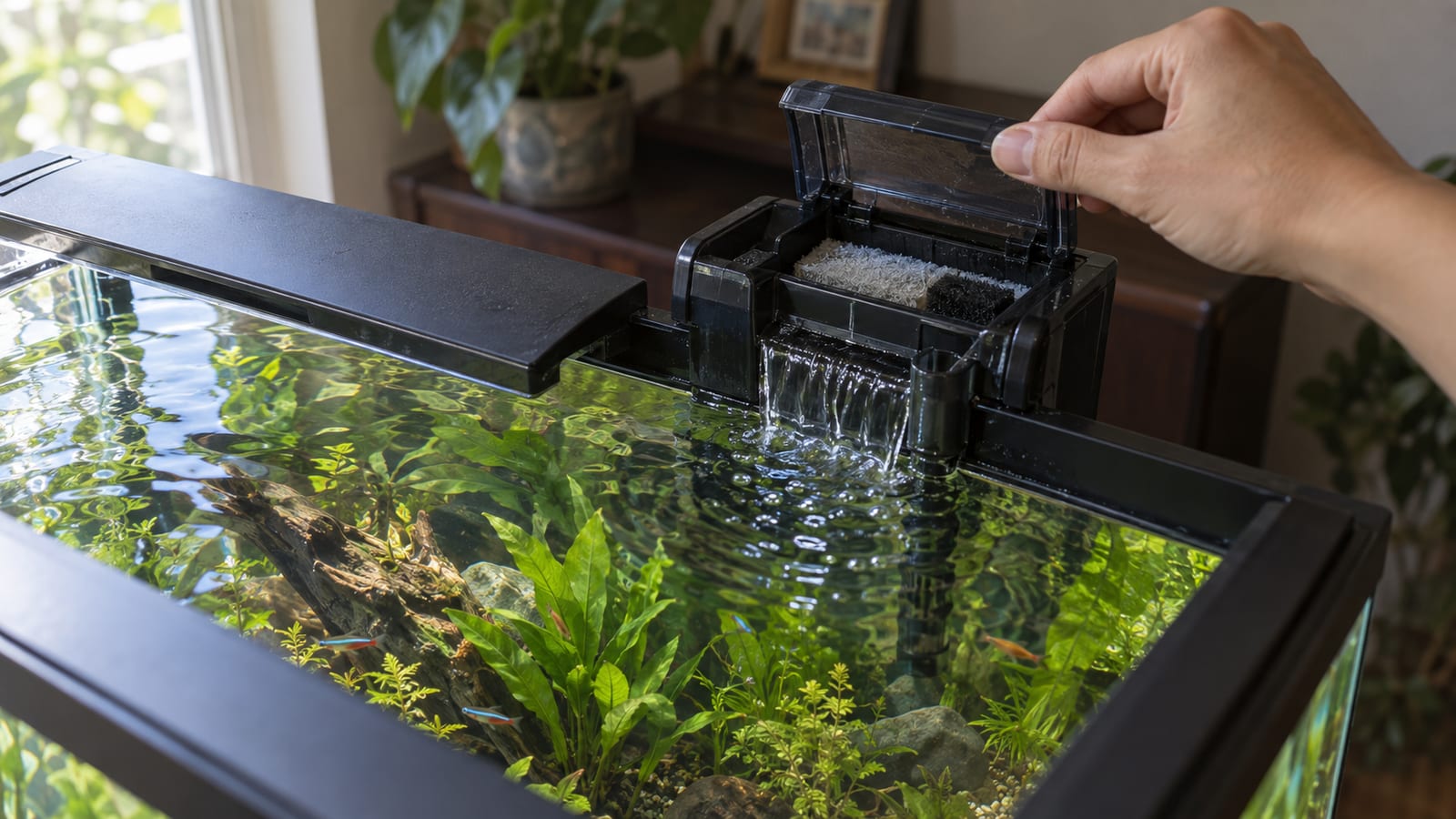
Quick Verdict
A healthy fish tank smells faintly of damp soil. A rotting smell means something dead or uneaten food, rotten eggs means an oxygen-starved pocket in the sand or a filter that stopped, and a heavy musty smell is usually cyanobacteria. Find the source before you change any water.
A healthy fish tank smells like damp soil, and only when your face is near the water. Anything stronger than that is organic matter rotting somewhere it should not be, and the kind of smell tells you where to look. Rotting points to something dead, rotten eggs to a place with no oxygen, and heavy must to cyanobacteria.
Find the source first. A water change on its own thins the smell for a day and leaves the cause in the tank.
Match the smell to the cause
The table above is the quick version. The detail on each:
Rotting or strongly fishy. Something is decomposing: a fish, a snail, or a layer of uneaten food in the gravel. A single dead snail can foul a small tank, and they die inside their shells under a rock where you will not see them. This is the most common cause by a wide margin, and the most urgent, because decay releases ammonia as it goes.
Rotten eggs. That is hydrogen sulphide, and it forms only where there is no oxygen. In a home aquarium that means one of two places: a deep or compacted sand bed that nothing stirs, or a filter that lost power. A black patch in the sand against the glass, or a bubble that rises and stinks when you disturb the substrate, confirms the first.
Heavy, musty, swampy. Look for dark blue-green or near-black slime lying in sheets over the substrate and plants, which lifts off in one piece when you touch it. That is cyanobacteria, and its smell is distinctive enough that experienced keepers identify it with the lid closed. It follows excess nutrients, low flow and long lighting hours.
Stale, and only with the lid open. Run a finger along the underside of the lid and the inside of the rim. The crust of dried minerals, splashed food and biofilm that collects there smells on its own, and so does the inside of a hang-on-back filter box. If the water itself smells fine in a cup, this is your answer.
Your nose cannot measure ammonia
Ammonia harms fish from about 0.25 ppm, and at that level it has no smell at all. A tank can be lethal and smell clean. Use the smell to find what is rotting, then use a liquid test kit to find out whether the water is safe.
Find the source, in this order
- Count your fish and snails. If anyone is missing, that is the first thing to find.
- Look where bodies end up: behind the filter and heater, inside ornaments, under rocks and wood, tangled in plant roots, and in the filter intake.
- Confirm the filter is running with normal flow. A trickle means a clogged intake or media.
- Stir a small patch of substrate with a finger. A puff of brown debris means trapped waste; a stinking bubble means an airless pocket.
- Test ammonia, nitrite and nitrate. Anything above zero for the first two turns this from a smell into an emergency.
- Smell the lid, the rim and the filter box separately from the water.
Fix it
Once the source is out, the repair is the same in nearly every case.
Change 30 to 50 percent of the water with dechlorinated water at the same temperature as the tank. Vacuum the substrate as you go, but work across a third of the tank rather than all of it, so you do not strip out the bacteria living there. Rinse the filter sponge in the bucket of old tank water, never under the tap. Then cut feeding to what the fish finish within two minutes, because in most tanks that is where the rotting material came from in the first place.
For cyanobacteria, siphon out every sheet you can reach, reduce the lights to six hours a day, and increase water movement across the area where it grew. It returns if the feeding does not change.
If the filter stopped for more than an hour or two
Do not simply plug it back in. The water inside has gone stagnant and the bacteria have begun to die, and restarting it pumps all of that into the tank at once. Take the media out, rinse it in a bucket of tank water, empty the filter body, and then restart it.
What not to do
Do not reach for a deodoriser or a "clarifier". Anything that removes the smell without removing the cause takes away the only warning you were getting.
Do not strip the tank down. Washing the gravel, scrubbing the decorations and replacing the filter media in one afternoon removes most of your bacterial colony and restarts the nitrogen cycle. The tank will smell clean for a week and then have a real problem.
Do not rely on carbon. It works on the smell and does nothing about the source.
A smell is the cheapest water test you own. It cannot tell you the number, but it tells you to go and look.
Stopping it coming back
Smell is a lagging signal of waste building faster than the tank clears it, the same surplus that produces detritus worm blooms and algae. A weekly partial water change with a substrate vacuum, a filter sponge rinsed in tank water once a month, and feeding that errs on the small side keep a tank at the damp-soil smell indefinitely. If you keep sand, stir the top inch with a chopstick during water changes so no part of it goes airless.
The one thing worth taking from this
The smell is a location, not a condition. Rotting means find the body, rotten eggs means find the place with no oxygen, must means find the slime — and whichever it is, test the water, because the dangerous part is the one you cannot smell.
Detailed Comparison
| Smell | Most likely cause | How urgent | First move |
|---|---|---|---|
| Damp soil, a clean pond | Nothing. This is what healthy bacteria smell like | Not at all | Leave it alone |
| Rotting, strongly fishy | A dead fish or snail, or food decaying in the substrate | Today | Count the fish, then look behind and under everything |
| Rotten eggs, sulphur | An oxygen-starved pocket in deep sand, or a filter that sat switched off | Today | Check the filter is running; rinse the media before restarting one that stopped |
| Heavy, musty, swampy | Cyanobacteria — dark blue-green sheets on the substrate and plants | This week | Siphon the sheets out, then reduce feeding and light |
| Stale, only with the lid open | Crust and biofilm on the lid, rim and filter, not the water | Whenever | Wipe the lid and rim with a cloth wrung out in tank water |
Frequently Asked Questions
🔗 Related Resources
More Reviews:
Related Articles
Scuds in an Aquarium: Harmless With Fish, a Problem With Shrimp
Scuds in an aquarium are tiny curled crustaceans that swim on their side. With fish they are free live food. With only shrimp they are a rival.
Snail Eggs in a Fish Tank: Which Snail, and Will They Hatch?
Snail eggs in a fish tank look different for every species. Identify yours in one table — clear jelly, pink clutch or hard white dots — and if they will hatch.
Detritus Worms in a Fish Tank: Harmless, But Check First
Detritus worms in a fish tank are harmless waste eaters. A sudden bloom means overfeeding — and here is how to tell them apart from planaria, which are not.