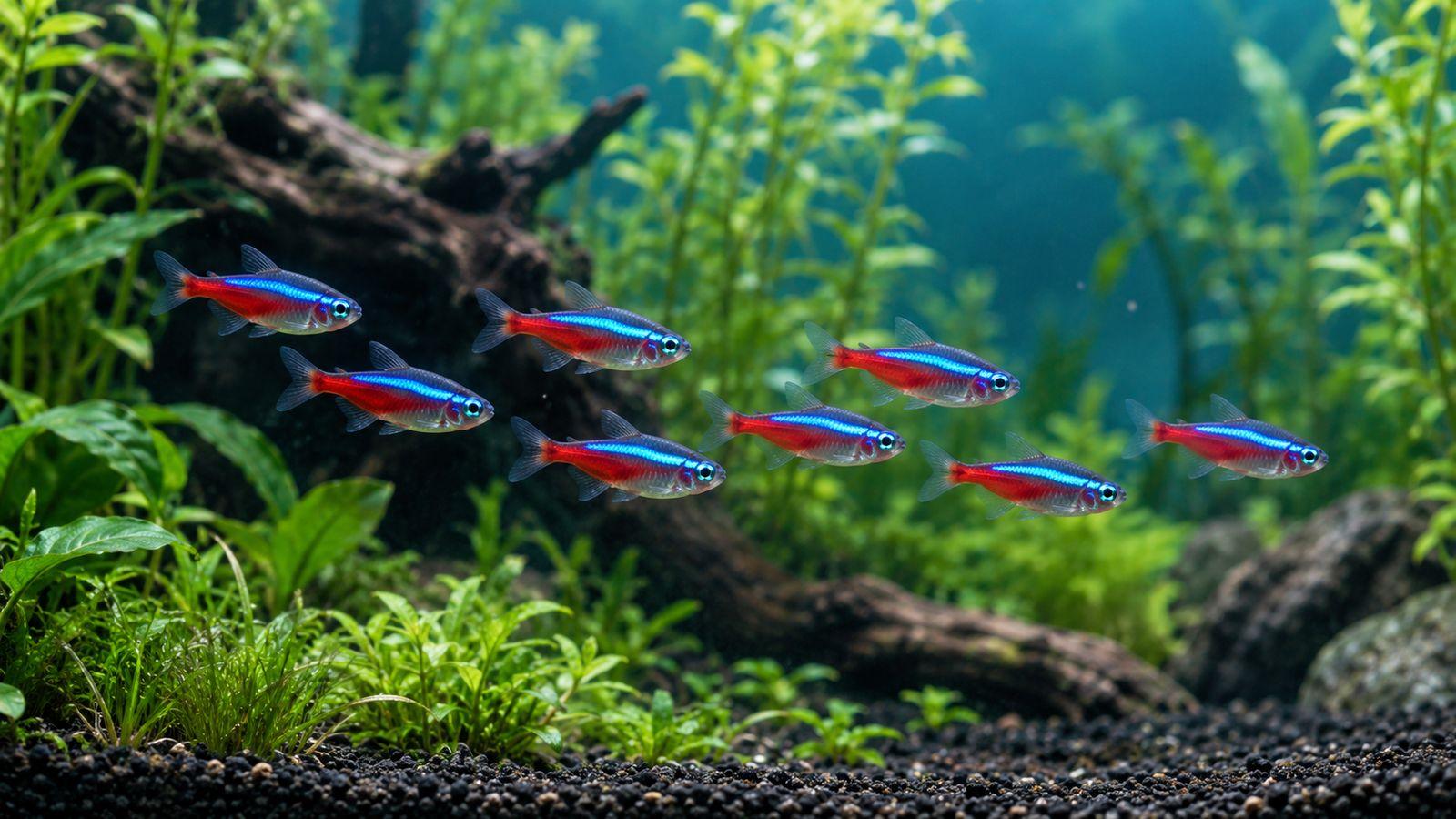
Six is the minimum for a school that behaves normally, and ten is the most it will take, with weekly water changes and no other fish. Add them in two batches of four, two weeks apart, and only after the tank has finished cycling.
The numbers
| Neon tetra | The number | Where it comes from |
|---|---|---|
| How many in a 10 gallon | 8 (6 minimum, 10 maximum, neons only) | School size plus tank length, worked through below |
| Adult size | About 30 mm (1.2 in) without the tail | Seriously Fish; FishBase lists 2.5 cm |
| Recommended tank | 24 × 12 in base, about 14 US gal | Seriously Fish; FishBase gives a 60 cm minimum |
| Group size | At least 8–10 | Seriously Fish; FishBase says 5 or more |
| Temperature | 70–77°F (21–25°C). Aim for 74–76°F | Seriously Fish; FishBase gives 68–79°F |
| pH | 4.0–7.5 | Seriously Fish, which notes farmed fish are more adaptable |
| How to add them | Cycled tank only, two batches of four | UF/IFAS on biofilter growth; see below |
Eight. That is how many neon tetras fit in a 10 gallon tank, if the tank is fully cycled and the neons are kept on their own. Six is the minimum for a school that behaves normally, and ten is the most it will take, with weekly water changes and no other fish.
Answers to this question run from six to "a dozen", and most of them show no working. This page shows the working, then covers the part that decides whether the neons survive: how you add them.
Why eight neon tetras in a 10 gallon tank is the right number
Four things set the number: how many neons it takes to make a school, how big they get, how long the tank is, and how much margin you leave for mistakes. Eight is where those meet.
Six is the floor, because they are a schooling fish
Neon tetras (Paracheirodon innesi) live in groups, and a small group is a stressed one. FishBase says to keep them "in groups of 5 or more individuals", and Seriously Fish goes further: "a mixed-sex group of at least 8-10 specimens" (Seriously Fish; FishBase).
There is research behind that advice. A 2010 study kept neon tetras in groups of one, two, five and ten. The larger groups showed less aggression and less darting and spent more time shoaling, and the authors concluded the larger groups had better welfare (Saxby et al., 2010; Practical Fishkeeping). It was a laboratory study comparing only those four sizes, so it does not prove six is a magic number. What it does show is that neons in the larger groups behaved better than neons kept alone or in pairs, which is the evidence against buying just a few.
Eight also meets Seriously Fish's minimum and gives you a margin. If one dies, you still have seven.
The tank's length is the real limit, not their waste
Neons are small: about 30 mm (1.2 in) long without the tail, according to Seriously Fish, and FishBase lists 2.5 cm. With the tail, an adult is roughly an inch and a half. Fish that size add little waste, so in a cycled tank with a filter, water quality is not the first thing that runs out.
Space is. Seriously Fish recommends a tank with a base of 24 × 12 inches (about 14 US gallons) or larger, and FishBase gives a 60 cm (24 in) minimum. A standard 10 gallon measures 20¼ × 10½ inches, according to Aqueon's dimensions chart. That is about 213 square inches of floor against the recommended 288, or roughly three quarters of the space. A school needs room to move as a group, and above ten, it has nowhere to go.
Ten is the ceiling, and only if you keep up
In 10 gallons, a missed water change or a heavy feeding shows up within days. More food means more ammonia, as University of Florida guidance puts it: "The more feed a fish is fed, the more ammonia the fish will produce" (Francis-Floyd et al., UF/IFAS FA16). Ten neons in a 10 gallon works if you change water every week and nothing else shares the tank.
Twelve is too many. Some keepers on forums say a dozen can live in a 10 gallon if the water is kept clean, and in the short term they may. But it uses up all of the margin, and the school still has only 20 inches to swim in.
How many neon tetras per gallon?
About one neon per 1.25 gallons, if you divide eight by ten. But the ratio does not scale, and that is why per-gallon rules on other pages give anything from five to twelve.
The school minimum is six whatever the tank size, so a 5 gallon does not hold four neons. It holds none. The inch-per-gallon rule gives six or seven neons for a 10 gallon, which lands near the right answer for the wrong reason: it counts length, when what limits neons is group size and swimming room. The full case is in why inch-per-gallon fails.
Is a 10 gallon tank big enough for neon tetras?
Yes, for a school of eight, but it is smaller than the species databases recommend. Both Seriously Fish and FishBase recommend a 24 inch tank, and a 10 gallon is about 20 inches long. Most answers to this question leave that out, and you should know it before you buy.
Eight still work in a 10 gallon because of how neons live. They are just over an inch long without the tail, they stay in the middle of the water, and they do not swim long distances the way danios do. A planted 10 gallon gives a school of eight enough room to move and enough cover to feel safe.
If you have not bought the tank yet, a 20 gallon long is the better choice. It fits a bigger school, and more water is more forgiving of mistakes. The trade-offs are in best aquarium size for beginners.
How to add neon tetras without losing them
This is where most beginners lose neons. The number matters less than the order you do things in.
1. Only into a tank that has finished cycling
A new filter needs time to grow the bacteria that break down fish waste. University of Florida guidance says "a new biofilter requires six to eight weeks to build up sufficient bacteria to effectively reduce ammonia and nitrite levels" (FA16). The same guidance says ammonia "should always be zero" in a healthy tank, and nitrite "is toxic to fish at levels as low as 0.10 mg/L".
Neons are a poor choice for a tank that is not ready. Almost all neons in shops are farmed, and Seriously Fish notes that "years of commercial breeding have somewhat affected the genetic vigour of the ornamental strain". Run a fishless cycle first, and add fish only once a dose of 2 ppm ammonia reads 0 ammonia and 0 nitrite within 24 hours.
2. In two batches of four, two weeks apart
Add four neons. Test ammonia and nitrite every few days. After two weeks, if both still read 0, add the other four.
The bacteria in a newly cycled filter are sized for the waste they have been fed, so doubling the load in one day can outpace them. Our 10 gallon stocking guide says to add about a third of your fish at a time. For a single school of eight, thirds would mean groups of two or three, which is exactly what the group-size research argues against. Two batches of four is the compromise.
3. Choose healthy fish at the shop
Look closely at the sales tank before you buy.
- No pale or whitish patches on the body, especially beneath the dorsal fin. That is the classic sign of neon tetra disease (Fish Pathogens database).
- No fish hanging alone, away from the group, or swimming erratically.
- No dead fish in the tank. Neon tetra disease is caused by a parasite called Pleistophora hyphessobryconis, and spores released from dead fish are a likely source of infection (Sanders et al., 2010). A dead neon in the sales tank means the rest have been exposed.
Imported neons have a history of heavy losses. When University of Florida researchers worked out how to farm them in Florida, a Florida fish-farm owner told UF News that retailers' losses on imported neons "can run as high as 50 percent" (UF News, 2001). Ask how long the shop has had the batch, and prefer fish that have settled there for a while. Once home, acclimate them to the tank.
4. The first two weeks
- Keep the tank at 74–76°F. That is inside both Seriously Fish's range (70–77°F) and FishBase's (68–79°F). Our fish tank temperature guide gives 76–78°F as the general community setting, and notes that neons are happiest at the cool end, which is why this page aims a little lower.
- Feed lightly. Every extra pinch becomes ammonia in a filter that is still catching up.
- Test every few days. If nitrite shows up, see how to lower nitrites.
- Remove any dead neon at once, before the others pick at it.
- Move a sick fish out. Neon tetra disease has no known cure, and the only way to treat the tank is to remove infected fish (Seriously Fish; Fish Pathogens database). A similar-looking bacterial infection, columnaris, sometimes called false neon tetra disease, can be treated with antibacterial medication, so it is worth isolating a fish rather than giving up on it.
If several die in the first weeks, work through why fish keep dying before you buy more.
Do not chase a low pH
Wild neons come from blackwater and clearwater streams in the Amazon basin, and FishBase lists pH 5.0–7.0 and very soft water (1–2 dH). That is why some guides tell you to lower your pH. Seriously Fish notes that commercially farmed neons are more adaptable, and lists a pH range of 4.0–7.5. Pushing the pH down can also stall your filter bacteria, which slow sharply below about 6.5, as our nitrogen cycle guide explains. Stable water matters more than a target number.
Changing the number: tankmates, bettas and cardinal tetras
Eight is the answer for neons on their own. Here is how other choices change it, including the wider question of how many tetras fit in a 10 gallon tank.
With a clean-up crew
Shrimp and snails barely add to the load, so eight neons can share the tank with a few cherry shrimp and a couple of nerite snails. Keep the neon count at eight. Adding another school of fish means cutting the neons back, and below six that stops working.
With a betta
Not recommended. Neons are listed at 70–77°F, and bettas do best at 76–81°F, with 78–80°F as a good target, according to our temperature guide. The two only overlap at 76–77°F, which is the top of the neon range and the bottom of the betta's. Betta temperament also varies: some ignore tankmates and some attack them, and you cannot know which you have before you try. If you want a betta with tetras anyway, the 10 gallon stocking guide suggests ember tetras.
Cardinal tetras instead
Cardinals look similar but grow slightly bigger, about 35 mm without the tail, and prefer warmer water, 73–84°F (Seriously Fish). Seriously Fish gives them the same 24 × 12 inch tank and the same group of at least 8–10, so the 10 gallon caveat applies to them too. Keep six to eight. Many cardinals are still wild-caught, and Seriously Fish notes that "wild fish are less tolerant of deteriorating water conditions than commercially-produced ones", so buy from a shop that has held them for a while.
Ember tetras
Ember tetras are the other tetra that suits a 10 gallon, and the stocking guide uses the same number of eight. Larger tetras are a different question and are not covered here.
Setting up a 10 gallon for a school of neons
- Gentle flow. A sponge filter or a hang-on-back filter turned down. Small schooling fish should not have to fight the current. See best filter for a 10 gallon tank.
- Plants and cover, so the school feels safe enough to use the open water.
- A heater set to 74–76°F, and a thermometer to check it.
- A lid, to cut evaporation.
The full equipment list and costs are in setting up a 10 gallon tank.
The short version
Eight neon tetras, on their own, in a fully cycled 10 gallon, added in two batches of four. Six is the floor and ten the ceiling. For other species and mixes, see the full 10 gallon stocking guide.
Sources
- Seriously Fish. Paracheirodon innesi (neon tetra).
- FishBase. Paracheirodon innesi summary.
- Saxby, Adams, Snellgrove, Wilson and Sloman (2010). The effect of group size on the behaviour and welfare of four fish species commonly kept in home aquaria. Applied Animal Behaviour Science 125(3–4): 195–205.
- Practical Fishkeeping. Study shows that schooling fish do best in larger numbers.
- Aqueon. Aquarium sizing information chart (PDF).
- Francis-Floyd, Watson, Petty and Pouder. Ammonia in Aquatic Systems. University of Florida IFAS Extension, FA16 (revised 2022).
- Fish Pathogens database. Pleistophora.
- Sanders et al. (2010). Pleistophora hyphessobryconis (Microsporidia) infecting zebrafish (Danio rerio) in research facilities. Diseases of Aquatic Organisms 91(1): 47–56.
- University of Florida News (2001). UF scientists figure out how to breed neon tetras profitably.
- Seriously Fish. Paracheirodon axelrodi (cardinal tetra).
Questions people ask
Mentioned in this guide
Related guides
How Many Guppies in a 10 Gallon Tank? Five, All Male
How many guppies in a 10 gallon tank? Five, all male. Add females and two can drop 40 to 80 fry a month. See the breeding math and what to do instead.
How Many Fish in a 10 Gallon Tank? A Straight Answer
How many fish in a 10 gallon tank? Six to eight small schooling fish, or one betta plus a clean-up crew — and why inch-per-gallon keeps killing tanks.
What Fish Can Live With Goldfish? A Short, Honest List
What fish can live with goldfish? Another goldfish first, then a few cool-water fish and snails, with temperatures, sizes and the ones to avoid.