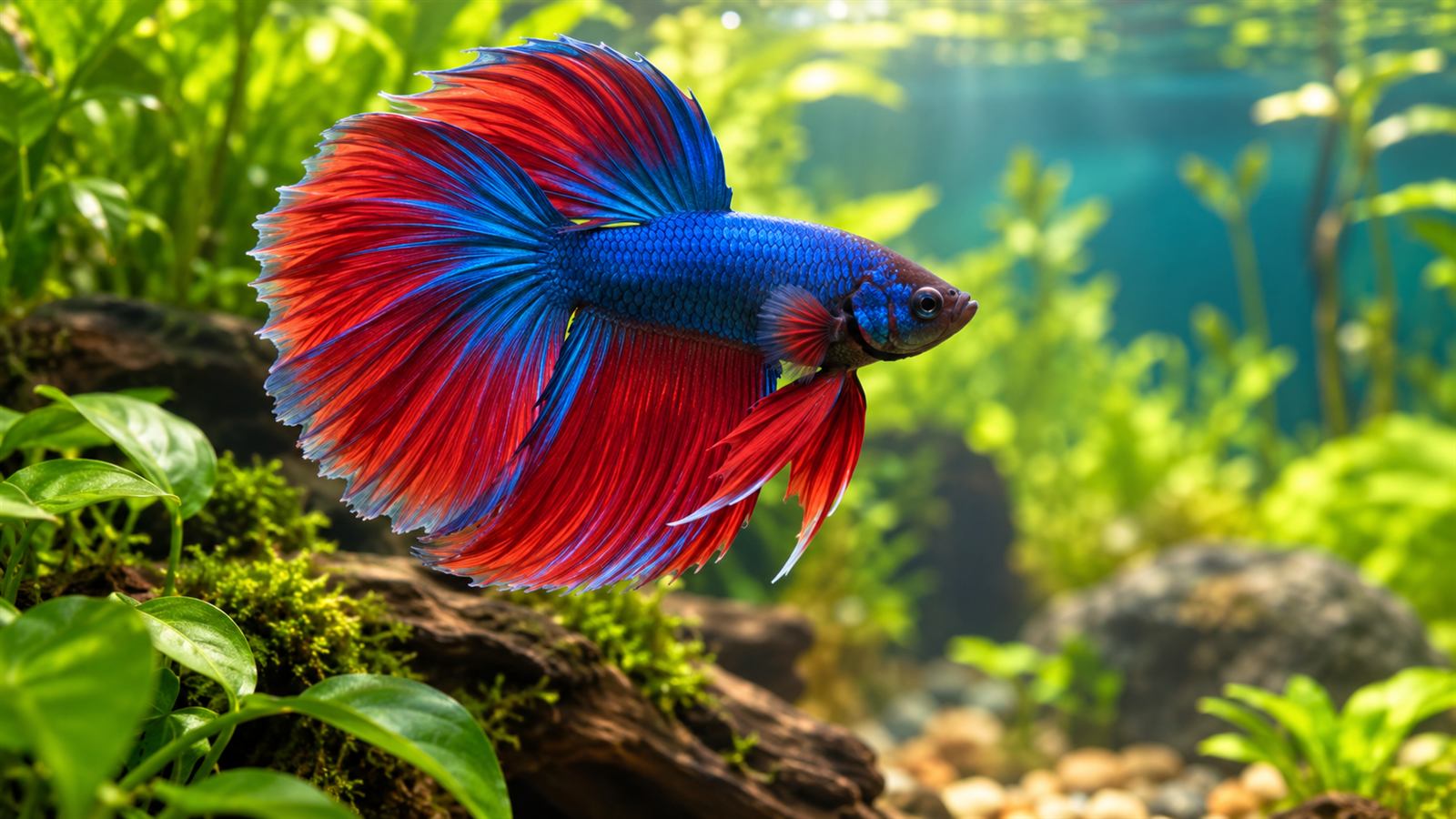
Test the water, change 50%, keep the betta at 78–80°F, and photograph the fins every two days. If the edge is still moving inward after about a week of clean, warm water, or the rot reaches the body, treat in a separate tank with an antibiotic aimed at the usual fin rot bacteria. White or yellowish patches, or a pale band around the body, most likely mean columnaris, which needs treatment today.
Some links go to retailers. As an Amazon Associate, Aquarium for Beginners earns from qualifying purchases, at no extra cost to you.
The numbers
| What you see | Most likely | What to do |
|---|---|---|
| Ragged fin edges, a little shorter every few days, edges dark or whitish | Early fin rot | Clean water and 78–80°F. Photograph every two days |
| A large piece gone overnight, a clean edge, then no change | Tail biting or a snag injury | Remove sharp decor, reduce stress, watch it does not turn into rot |
| Rot still moving inward after a week of clean, warm water | Fin rot the fish is not beating | Hospital tank and a full course of an antibiotic for fin rot |
| Rot reaching the body, red streaks, fish not eating | Severe fin rot | Treat today. A fish vet if it keeps spreading |
| White or yellowish patches, a pale band around the body, fast spread | Columnaris, not ordinary fin rot | Treat today with an antibiotic that lists columnaris |
| Thin, clear or pale tissue along the edge | Usually new growth | Keep doing what you are doing. Colour returns over weeks |
Betta fin rot is fin tissue breaking down after bacteria get into damaged fins, and dirty or cold water is usually what lets them in. Fix the water first: test it, change 50%, and keep the betta at 78–80°F. Most mild cases stop there. If the rot is still moving inward after about a week of clean, warm water, it is time for an antibiotic, given in a separate tank.
The one sign that cannot wait is a white or yellowish patch, or a pale band around the body. That is most likely columnaris, a faster and more dangerous infection, and it needs treatment today.
What fin rot actually is
Fin rot is not one disease. It is a sign: the fin margins break down, usually after a small injury that bacteria then get into (Ellis et al., 2008). The bacteria most often isolated from sick freshwater fish include Aeromonas and Pseudomonas, and most fish pathogens are of a type called Gram-negative, which matters when you choose a medicine (Merck Veterinary Manual).
Those bacteria live in most tanks without causing trouble. What tips a fish over is stress, and the Merck Veterinary Manual names the usual ones: poor water quality, waste build-up, handling and transport, sudden temperature changes and low oxygen. A fact sheet on columnaris adds high ammonia and high nitrite to that list (SRAC 479). If either reads above zero, see how to lower nitrites and the water change guide.
Why bettas get it so often
- Long fins tear. A show betta's fins are far longer and heavier than a wild fish's, and they catch on plastic plants and rough decor. Every tear is an opening.
- Cold water. Bettas are tropical fish that "do not do well in cold water" (UF/IFAS FA212), and vets put the range at 76–81°F (PetMD). Aim for 78–80°F. See what temperature a fish tank should be.
- Small, unfiltered containers. Waste builds up fast in a bowl. A 2024 study found male bettas in 0.5-litre bowls, the kind used in shops, swam significantly less than those in larger tanks, and that at least 10 litres was needed for normal swimming (Oldfield and Murphy, 2024). Five gallons, heated and filtered, is the starting point.
Fin rot, tail biting or a tear? The two-day photo test
Three things shorten a betta's fins, and they need different responses. The table above sets them side by side. The quickest way to tell them apart is to watch what happens next.
Photograph the fins today, side-on, in good light. Take the same photo in two days, and again two days after that.
- Fin rot moves. The edge keeps creeping inward, a little every few days, and it often looks ragged, with a dark or whitish margin.
- Tail biting and tears do not. A betta that bites its own tail can lose a large piece overnight, with a fairly clean edge, and then nothing changes until the next bout. A snag on decor looks similar: a split or a missing piece, then no progress.
- Healing grows outward. New tissue is thin and pale or see-through at first, and the colour fills in from the base over weeks. In studies of fin regrowth, the new tissue starts out whitish and gains colour gradually (Pfefferli and Jaźwińska, 2015).
Tail biting and tears are not infections, but an open wound in dirty water can become one. Fix the cause, keep the water clean and keep taking the photos.
Columnaris is not ordinary fin rot
Columnaris shows as white or yellowish-brown patches on the fins, body or mouth, sometimes as a mucus-like growth, and sometimes as a pale white band around the body known as saddleback. It is caused by a different bacterium, it spreads quickly and it can kill quickly (SRAC 479). White, cottony tufts on a damaged fin can also be a fungus growing on the injured tissue, which product labels note often follows fin rot. Either way, do not wait a week with clean water. Move the fish to a hospital tank and treat today with an antibiotic whose label lists columnaris.
Step 1: fix the water
- Test ammonia, nitrite and nitrate. Ammonia and nitrite should read 0 ppm, and nitrate under 20.
- Change 50% of the water, with conditioner dosed for the whole tank and the new water within 2°F of the old.
- Check the heater with a thermometer, and hold 78–80°F. Warm water supports the immune system and speeds regrowth.
- Take out anything a fin could snag on: plastic plants, sharp ornaments, rough rocks. If it snags a pair of pantyhose, it can tear a fin.
- Remove any tank mate that nips. Tiger barbs are known fin-nippers (PetMD).
- Photograph the fins, and repeat every two days.
- Keep changing 25–50% every two to three days, and feed small meals, so the water stays clean while the fish heals.
Fish-health guidance from the University of Florida says the same thing, in stronger terms: antibiotics only hold the bacteria back long enough for the fish's immune system to clear them, and stressors such as poor water quality should be fixed "before antibiotics are even considered" (Yanong, UF/IFAS FA084).
What about aquarium salt?
Salt is not an antibiotic, and no study has tested it as a fin rot treatment. What university guidance does support is a low dose, 1 to 3 grams per litre, to boost slime-coat production and ease water balance during stress such as handling and transport (Francis-Floyd, UF/IFAS VM-86).
If you want to use it, do it in a separate container, not the main tank, where it would also reach plants and any snails or shrimp. One level teaspoon of aquarium salt per gallon is about 1.8 g/L. Bettas tolerate it well: in a laboratory study it took around 9 g/L over 18 days to kill half of adult female bettas, about five times that dose (Zuanon et al., 2009). Keep it to about a week, and do not combine it with an antibiotic course.
Step 2: when to medicate
Give clean, warm water about a week. Then look at your photos.
Medicate if:
- the edge is still moving inward after about a week of clean, warm water;
- the rot has reached the base of a fin or the body;
- you see red streaks, the fish stops eating, or it is sitting on the bottom (see betta lying on the bottom of the tank);
- there are signs of columnaris, in which case do not wait the week.
Choose a medicine aimed at the right bacteria. Fin rot bacteria are mostly Gram-negative. Erythromycin, the antibiotic in some well-known fish products, works mainly against Gram-positive bacteria, and the University of Florida notes it is not very effective as a bath treatment (UF/IFAS FA084; Merck).
| Product | Active ingredient | What to know |
|---|---|---|
| Seachem KanaPlex | Kanamycin | Its label lists fin rot and columnaris ("mouth rot"). One measure per 5 gallons every 48 hours, up to 3 doses |
| Fritz Maracyn Two | Minocycline | Aimed mainly at Gram-negative bacteria |
| API Fin & Body Cure | Doxycycline (per API's safety data sheet) | Its label lists fin and tail rot. Freshwater only |
| Fritz Maracyn | Erythromycin | Mainly Gram-positive. Not a good first choice for fin rot on its own |
| API Furan-2 | Nitrofurazone | Its label warns of tumours in lab rodents, so wear gloves |
| API BettaFix / MelaFix | Melaleuca (tea tree) oil | Not an antibiotic. No good evidence it treats fin rot |
Active ingredients and label claims are from the makers' own labels: KanaPlex, Fin & Body Cure and the Furan-2 label, plus DailyMed labels for Maracyn, Maracyn Two and BettaFix.
How to treat so it works
- Use a hospital tank. A 5-gallon tank or a large clean container, with a heater at 78–80°F and a gentle sponge filter. Labels warn that snails and shrimp are sensitive, and some say antibiotics can harm the filter bacteria in the main tank.
- Dose the real volume of water, not the size printed on the tank. Gravel and decor take up space.
- Remove carbon and other chemical filter media. They pull the medicine out of the water.
- Finish the course. No half doses, no stopping early because the fins look better.
- Use one medicine at a time. Seachem advises against mixing medications, and the University of Florida advises against combining antibiotics and warns that trying one after another makes resistance "almost certain" (UF/IFAS FA084).
That resistance risk is real. In a study of tropical ornamental fish imported into the UK, about half of the Aeromonas bacteria isolated tolerated 15 or more antibiotics (Verner-Jeffreys et al., 2009). Antibiotics are for fins that clean water has not saved, not a first resort.
When to see a fish vet
If the rot keeps spreading after a full course, reaches the body, or the fish stops eating for several days, a fish vet can take a sample, find out which bacterium it is and which drug it responds to, and prescribe properly. More vets treat fish than most people expect; search for a fish or aquatic vet near you.
A note on aquarium antibiotics in the US
None of the antibiotics sold in pet shops for aquarium fish is approved by the FDA. The FDA's own guidance for owners says marketing them is illegal, and in December 2023 it sent warning letters to nine companies selling unapproved antibiotics for fish and pet birds (FDA guidance; FDA announcement). That is one reason products come and go from the shelves. It is also why we name these medicines but do not link to shops selling them.
How long fins take to grow back
Once the rot stops, fins regrow from the healthy tissue outward. In zebrafish, the standard laboratory model for fin regrowth, a tail fin regrows in about two to four weeks, faster in warmer water (Pfefferli and Jaźwińska, 2015). A betta's fins are much longer, so expect weeks to a few months for a full recovery. We found no study measuring it in bettas.
New growth starts as a thin, clear or pale band. The colour comes back over the following weeks. Severe damage can leave a fin a little shorter or a different shape, which is usually only cosmetic.
How to stop it coming back
- 5 gallons or more, heated and filtered. It is the single biggest difference.
- Weekly water changes, and test the water when anything changes.
- Smooth decor. Silk or live plants instead of hard plastic, and the pantyhose test for everything else.
- Peaceful company or none. A betta alone in its own tank is a complete setup. Can a betta live with a goldfish covers what it can and cannot share with.
- Watch for tail biting. If the betta keeps biting its fins, look for stress: too much flow, a too-bright tank, a reflection it keeps flaring at, or a cramped space.
Fin rot is also a sign worth reading in the wider sense. A betta with fin rot is telling you something about its water. If it ever looks swollen with raised scales, that is dropsy, a different and more serious problem.
What you need
| Item | Why |
|---|---|
| API Freshwater Master Test Kit | Ammonia, nitrite and nitrate tell you whether the water is the cause |
| Small adjustable heater | Holds 78–80°F in a 5–10 gallon tank |
| Digital thermometer | The only way to know the heater is doing its job |
| Marineland Portrait 5 gallon kit | A proper permanent home for a betta, or a hospital tank |
| Sponge filter | Gentle flow for long fins and a hospital tank. Runs on an air pump |
| API Aquarium Salt | Optional, for a separate container only, at 1 level teaspoon per gallon |
The one thing worth taking from this
Fin rot is the fins showing what the water is like. Fix the water and the warmth first, photograph the fins, and give it a week. Reach for an antibiotic when the photos say the rot is still winning, and choose one aimed at the bacteria that cause it.
Sources
- Ellis et al. (2008). Fin erosion in farmed fish. In Fish Welfare, Blackwell, 121–149.
- Merck Veterinary Manual. Bacterial Diseases of Fish.
- Merck Veterinary Manual. Macrolide Use in Animals.
- Yanong. Use of Antibiotics in Ornamental Fish Aquaculture. University of Florida IFAS Extension, Circular 84.
- Francis-Floyd. The Use of Salt in Aquaculture. University of Florida IFAS Extension, VM-86 (archived copy).
- Durborow et al. (1998). Columnaris Disease: A Bacterial Infection Caused by Flavobacterium columnare. Southern Regional Aquaculture Center, Publication 479.
- Oldfield and Murphy (2024). Life in a fishbowl: Space and environmental enrichment affect behaviour of Betta splendens. Animal Welfare 33: e1.
- Pfefferli and Jaźwińska (2015). The art of fin regeneration in zebrafish. Regeneration 2: 72–83.
- Zuanon et al. (2009). Acute and chronic salinity tolerance in adult Siamese fighting fish, Betta splendens. Revista Brasileira de Zootecnia 38(11): 2106–2110.
- Verner-Jeffreys et al. (2009). High prevalence of multidrug-tolerant bacteria and associated antimicrobial resistance genes isolated from ornamental fish and their carriage water. PLoS ONE 4: e8388.
- US FDA. Ornamental Fish Drugs and You.
- Nugroho et al. (2017). Terminalia catappa L. extract improves survival, hematological profile and resistance to Aeromonas hydrophila in Betta sp.. Fisheries & Aquatic Life 25: 103–115.
- UF/IFAS. Betta fish (FA212); PetMD. Betta fish care sheet.
- Seachem. KanaPlex; API. Fin & Body Cure; DailyMed. API Furan-2 label.
Questions people ask
Mentioned in this guide
Related guides
Dropsy in Bettas: The Pine-Cone Sign and What You Can Still Do
Dropsy in a betta shows as a swollen body with scales raised like a pine cone. What causes it, whether it spreads, early treatment, and when it is too late.
Swim Bladder Disease in Bettas: Usually Food, Sometimes Not
A betta floating sideways, stuck at the top or unable to leave the bottom usually has a digestion problem, not a disease. How to tell, and the 3-day fix.
Betta Lying on the Bottom of the Tank: Resting, Cold or Sick?
Bettas rest on the bottom more than most fish, and often it means nothing. How to tell a resting betta from a cold or sick one, and what to check first.