Letting water sit or boiling it removes chlorine but not reliably chloramine, which more than one in five Americans now get from the tap. Your annual water report says which you have. Based on US EPA and CDC guidance, utility fact sheets, the Merck Veterinary Manual and manufacturer labels, not our own testing.
The numbers
| Method | Chlorine | Chloramine | How long | Verdict |
|---|---|---|---|---|
| Conditioner that lists chloramine | Removes | Neutralises; ammonia left unless it also binds it | Makers say instantly; a magazine allows up to 5 minutes | Use this |
| Conditioner for chlorine only | Removes | Some brands not at all | Same | Check the label |
| Letting it stand | Slowly | No | Days for chlorine; weeks for chloramine | Chlorine-only water, and test first |
| Air stone in a bucket | Faster | No | 12 hours or more | Same as standing |
| Boiling | Usually | Disputed; one utility needed a 20-minute boil | 20 minutes' boil, then cooling | Not practical for a bucket |
| Vitamin C | Removes | Neutralises; ammonia left | — | Works, but most guides overdose it |
| Activated carbon filter | Removes | Only with long contact time | Plumbed units built for it | For large volumes |
| Reverse osmosis alone | Passes through | Passes through | — | Still needs conditioner |
| UV steriliser | No | No | — | Myth at aquarium scale |
To dechlorinate tap water for fish, add a water conditioner whose label says it treats chloramine, dosed for the new water, before it reaches the tank. Letting water sit or boiling it removes chlorine, but many utilities now use chloramine.
That second disinfectant is the whole story. More than one in five Americans drink water treated with chloramine, according to the US EPA, and the CDC says fish should not be kept in water containing either. Your annual water quality report says which one your supply uses; the first section below shows how to read it. This page is built from US EPA and CDC guidance, water-utility fact sheets, the Merck Veterinary Manual, manufacturer labels and keeper reports. We have not tested these products or methods, and the table above is that evidence sorted by method.
Chlorine or chloramine? How to tell which your tap water has
Chlorine is the older disinfectant, and it gasses off water left open. Chloramine is chlorine combined with ammonia, used because it lasts far longer in the pipes. Both are "highly toxic to fish", in the words of the Merck Veterinary Manual, which reports harm from 0.02 mg/L and deaths at 0.04 mg/L. US tap water may carry up to 4 mg/L (CDC). UK supplies usually hold 0.5 mg/L or less (Drinking Water Inspectorate), which is still more than ten times the level that kills fish. The US EPA adds that both enter the bloodstream through the gills and can prevent the growth of the bacteria a tank depends on.
Three ways to find out which you have:
- Get your annual water quality report. US community water systems must send one each year by July 1 (CDC). If you rent, ask the landlord or the utility; the EPA also has a lookup at epa.gov/ccr. The same report gives your hardness, which softening aquarium water explains how to read.
- Read the disinfectant line. "Chloramine" is plain. A residual reported as "total chlorine" usually means chloramine, because US rules measure chloramine as total chlorine and chlorine as free chlorine. The CDC warns that "Some utilities switch back and forth between chlorine and chloramine at different times of the year", so a report that says chlorine does not cover every month.
- Test it with a total-chlorine kit, not a free-chlorine one. The water utility in Sioux Falls puts it plainly: "A free chlorine test of chloraminated water would read zero but still be toxic to fish." The Merck manual says to test for both free and total chlorine, and that none should be detectable once fish are in the water.
In the UK, look up your supplier's water-quality report for your postcode; SES Water, for one, offers a postcode search. Well water usually has no chlorine in it, and the CDC notes that some groundwater utilities add no disinfectant at all; well, bottled and RO water have their own checks.
If you are unsure after all that, buy a conditioner whose label names chloramine, and treat your water as chloraminated.
How to dechlorinate tap water, step by step
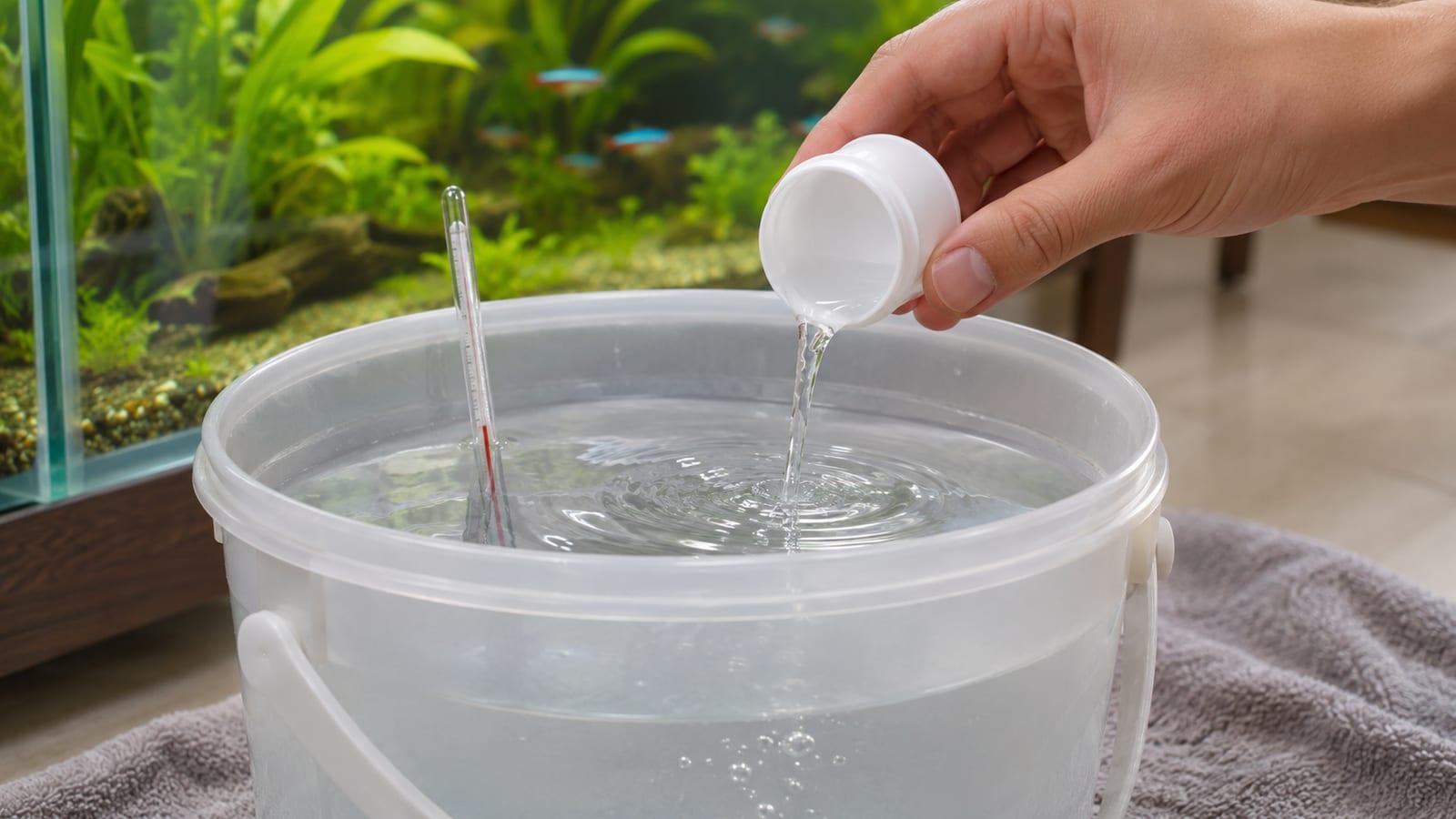
- Fill a bucket kept only for the tank, one that has never held soap, from the tap.
- Adjust hot and cold until a thermometer reads within 2°F (1°C) of the tank. The ranges are in what temperature a fish tank should be.
- Add conditioner at the dose on the label for the volume of the bucket, and stir. Seachem's label says dosing is "better if added to new water first".
- Pour slowly into the tank.
Filling straight from a hose: add the conditioner to the tank before the new water goes in, dosed for the whole tank volume. Seachem's label says the same: "If adding directly to aquarium, base dose on aquarium volume."
Know your volumes. The Merck manual names a wrongly calculated water volume as one cause of dechlorination that fails. Measure your bucket once, and remember that a "20 gallon" tank usually holds about 17 (real volume).
How long to wait. API describes its conditioner as working instantly; Practical Fishkeeping allows up to two minutes for chlorine and five for chloramine. Stirring it into the bucket before you pour covers both.
How much water to change, how often, and the siphon are in how to change fish tank water, and the whole cleaning routine is in how to clean a fish tank.
How much water conditioner, and can you use too much?
Follow your own bottle, because doses differ. Seachem Prime asks for 5 mL per 50 gallons (200 litres) of new water, and Seachem says each thread of the cap holds about 1 mL, which helps with small buckets. API Tap Water Conditioner's current label asks for 1 mL per 10 gallons for chlorine and 5 mL per 30 gallons for chloramine. Aquarium Co-Op's Easy Dechlorinator is 1 mL per 10 gallons. So for 10 gallons of new water, that is 1 mL of Prime, or about 1.7 mL of API if your water carries chloramine (our arithmetic from the labels). Some retailer listings print different API figures, another reason to read your own bottle.
Chloramine can need more. API prints a separate, larger chloramine dose, and Seachem says "For exceptionally high chloramine concentrations, a double dose may be used safely." Practical Fishkeeping warns that "some brands are unable to reduce chloramines at all". If the label does not name chloramine, it is the wrong bottle for chloraminated water.
A double dose is fine; a large overdose costs oxygen. Seachem allows up to five times its normal dose to detoxify nitrite in an emergency, and Aquarium Co-Op says its own product can go to five times within 24 hours. Practical Fishkeeping calls conditioners harmless "except where ludicrous dose rates are involved". The risk at that end is oxygen. Co-Op says the chemicals "use up oxygen when removing chlorine from the water" and suggests an air stone for three to four hours after a large dose; San Francisco's water utility warns that too much "may wind up the oxygen in the water" and the fish may suffocate. Seachem asks for a half dose above 86°F (30°C) when chlorine and ammonia are low; warm water holds less oxygen to begin with. No controlled study of conditioner overdoses in aquariums turned up.
Forgot it altogether? Add a full-tank dose straight to the tank at once, as the water change guide says. Forum replies to keepers who forgot give the same advice. Untreated tap water is one of the usual causes behind fish dying after a water change.
How long to let tap water sit to dechlorinate it
Only for chlorine, and it takes longer than most guides say. The CDC says chlorine can be removed "by letting it sit out for a few days", then: "You cannot remove chloramine this way, however." San Francisco's utility says chlorine "may take days to dissipate in a pitcher left on a counter and it will take longer for chloramine." An air stone speeds up the chlorine: Practical Fishkeeping says "heavy aeration of water in a bucket for at least 12 hours", and Aquarium Co-Op says 12 to 24 hours with an air stone, or one to five days without.
Chloramine barely moves. Health Canada gives monochloramine a half-life of over 300 hours at 4°C (39°F) and 75 hours at 35°C (95°F). Those are laboratory figures; in an open bucket air and sunlight speed decay (SFPUC), but they show the scale: at the warm end, half of it is still there after three days. The utilities in Sioux Falls and Tampa Bay both say chloramine "may take weeks" to dissipate, and the US EPA is blunt: "Allowing water to sit at room temperature does not remove monochloramine from drinking water."
If your water really is chlorine only, with the report and a total-chlorine test agreeing, standing it with an air stone works. Test before you use it. One keeper on FishForums warns that an open bucket collects "gunk in your house falling on its surface", and another sums up the alternative: "There is no point doing both as the dechlorinator will deal with everything you need."
Even a water company's sheet can mislead. SES Water's sheet for fish keepers says its chlorine "is present in the form of monochloramine", then recommends leaving water "to stand for a while", with treatment chemicals as the alternative. Against the figures above, standing does not deal with chloramine. As the distilled water guide puts it, letting tap water stand overnight is no longer a reliable substitute.
Dechlorinating without conditioner: boiling, vitamin C, UV and more
Boiling
Boiling usually drives chlorine off, though less consistently in San Francisco's tests. On chloramine the sources disagree. The US EPA says "Boiling water does not remove monochloramine", and Sioux Falls says the same. San Francisco's utility found that "20 minutes of gentle boil" removes chloramine and its ammonia completely, while "a short boil of water to prepare tea or coffee removed about 30%". Both can be true: a short boil takes only some of it, twenty minutes the rest. Either way it means twenty minutes on the stove per pan, a scalding risk the utility itself mentions, and then cooling to tank temperature, for one bucket. It is not a method.
Vitamin C
Vitamin C (ascorbic acid) is a real dechlorinator. It is in the American Water Works Association standard for dechlorinating disinfected water mains (SFPUC), and the US Forest Service uses it. The problem is the dose hobby guides print. The Forest Service puts it at one gram per 100 gallons for each mg/L of chlorine. At the US maximum of 4 mg/L, that is about 40 mg per gallon (our arithmetic). San Francisco's utility used 1,000 mg for a bathtub. The "one teaspoon per gallon" on two of the pages that rank for this question is about 4 grams (supplement labels): on the order of a hundred times what the chlorine needs.
Ascorbic acid is also "weakly acidic", so pH "may decrease slightly" (SFPUC), and on chloramine it leaves the ammonia, like any dechlorinator. We give no vitamin C dose for fish. A conditioner is easier to dose correctly.
UV sterilisers
An aquarium UV steriliser does not dechlorinate. "The usual dose for removal of free chlorine is 15 to 30 times higher than the normal disinfection dose," writes the president of Aquionics, a UV maker, in Water & Wastes Digest; reactors built for it are industrial. In a laboratory study, 513 mJ/cm² of UV, about five times the top drinking-water disinfection dose, removed less than a quarter of the total chlorine. No source gives the dose a tank steriliser delivers, but it is sized to disinfect. It also only treats water that is already in the tank, with the fish.
Carbon filters and reverse osmosis
Activated carbon removes chloramine only with "high quality granular activated carbon" and "sufficient contact time" (Sioux Falls); San Francisco's utility says such a filter can take 1 to 2 mg/L down to under 0.1. That means a plumbed unit built for chloramine, not a carbon pad in a hang-on-back filter. Reverse osmosis alone does not work: "chloramine will pass through the membrane" (SFPUC), and the EPA agrees. RO and distilled water are covered in distilled and RO water for a fish tank.
Removing chloramine: the ammonia it leaves behind
Neutralising chloramine frees its ammonia. The Merck manual: "When chloramines are treated with sodium thiosulfate to eliminate the chlorine, ammonia is released into the system." Aquarium Co-Op says most dechlorinators deal only with the chlorine half, and "The remaining ammonia ions left in the water are toxic to fish."
In a cycled tank this is a small load. Merck: "A properly conditioned biofilter should be able to metabolize the ammonia as it is released." That biofilter is the filter bacteria a new tank spends weeks growing.
In a new tank that is not yet cycled, Merck recommends "a dechlorinator specifically designed to deal with chloramines by also binding the ammonia byproduct". Seachem says Prime does this, while also saying it "does not remove ammonia, nitrite, or nitrate from the system". No independent study of that claim turned up; the nitrite guide covers the same gap for Prime's nitrite claim, and why it is worth testing a glass of chloraminated tap water for nitrite once.
The short version
A conditioner whose label names chloramine, dosed for the new water, every time. Read your water report once, test with a total-chlorine kit if unsure, and treat standing, boiling, vitamin C and UV as chlorine tricks at best.
Sources
- CDC. About Water Disinfection with Chlorine and Chloramine. Reviewed 10 November 2026.
- CDC. How to Read Drinking Water Quality Reports, 1 May 2024; and US EPA, Consumer Confidence Reports.
- US EPA. Chloramines in Drinking Water. Updated 12 March 2026.
- US EPA. Can chloraminated or chlorinated water be used for dialysis or in an aquarium? Common Health Questions Related to Monochloramine, Q22, 2009. Archived EPA copy.
- US EPA. How can I remove monochloramine from my drinking water? Q29, 2009. Archived EPA copy.
- Oregon Health Authority. Maximum Residual Disinfectant Level (MRDL) monitoring; and US Code of Federal Regulations, 40 CFR 141.65.
- Health Canada. Guidelines for Canadian Drinking Water Quality: Guideline Technical Document – Chloramines, 2020.
- Drinking Water Inspectorate. Chlorine.
- Francis-Floyd, Yanong and Petty. Environmental Diseases of Aquatic Animals in Aquatic Systems. Merck Veterinary Manual.
- City of Sioux Falls Water Purification. Chloramines and Fish, 2005.
- San Francisco Public Utilities Commission. Questions Regarding Chlorine and Chloramine Removal From Water, updated March 2015 (copy hosted by a third party).
- Tampa Bay Water. Monochloramine Information for Fish Owners.
- SES Water. Information for fish keepers, July 2020.
- Land, B. Using Vitamin C To Neutralize Chlorine in Water Systems. USDA Forest Service Tech Tip 0523-1301-SDTDC, April 2005. Teaspoon weight from ascorbic acid supplement labels in the NIH Dietary Supplement Label Database (Source Naturals Ascorbic Acid Crystals: "a spoon contains approximately 4.22 grams").
- McClean, J. Using UV for dechlorination. Water & Wastes Digest, 14 September 2021. Written by the president of a UV maker.
- Astuti, Xie and Satyadharma. Laboratory and pilot plant scale study on water dechlorination by medium pressure ultraviolet (UV) radiation. MATEC Web of Conferences 101, 2017; earlier version, Astuti and Xie, Application of ultraviolet (UV) technology on water dechlorination, Journal of Environmental Engineering & Waste Management 1(1), 2016.
- Seachem. Prime.
- API. Tap Water Conditioner.
- Hill, N. What you need to know about dechlorinating. Practical Fishkeeping, undated.
- Aquarium Co-op. Water Dechlorinator: How It Works and How Much to Use in Aquariums and Does letting water sit remove chlorine? A retailer's guides, undated.
- Keeper reports: FishForums, Does Leaving Tap Water Out For 24 Hrs Dechlorinate It? (2008); FishLore, Aquarium Co-Op forum and FishForums threads on forgotten conditioner.
Questions people ask
Mentioned in this guide
Related guides
Can You Use Distilled Water in a Fish Tank? Not on Its Own
Can you use distilled water in a fish tank? Not by itself — it has no minerals and cannot hold a stable pH. Use it for top-offs and to soften hard tap water.
How to Change Fish Tank Water, and How Often to Do It
How to change fish tank water: replace 25% once a week, with new water dechlorinated and matched to within 2°F. The steps, and how to set your own schedule.
How to Soften Aquarium Water: Lower GH Without Crashing pH
How to soften aquarium water: mix RO or distilled with tap at a measured ratio to lower GH. Get the formula, and why softeners and almond leaves fail.