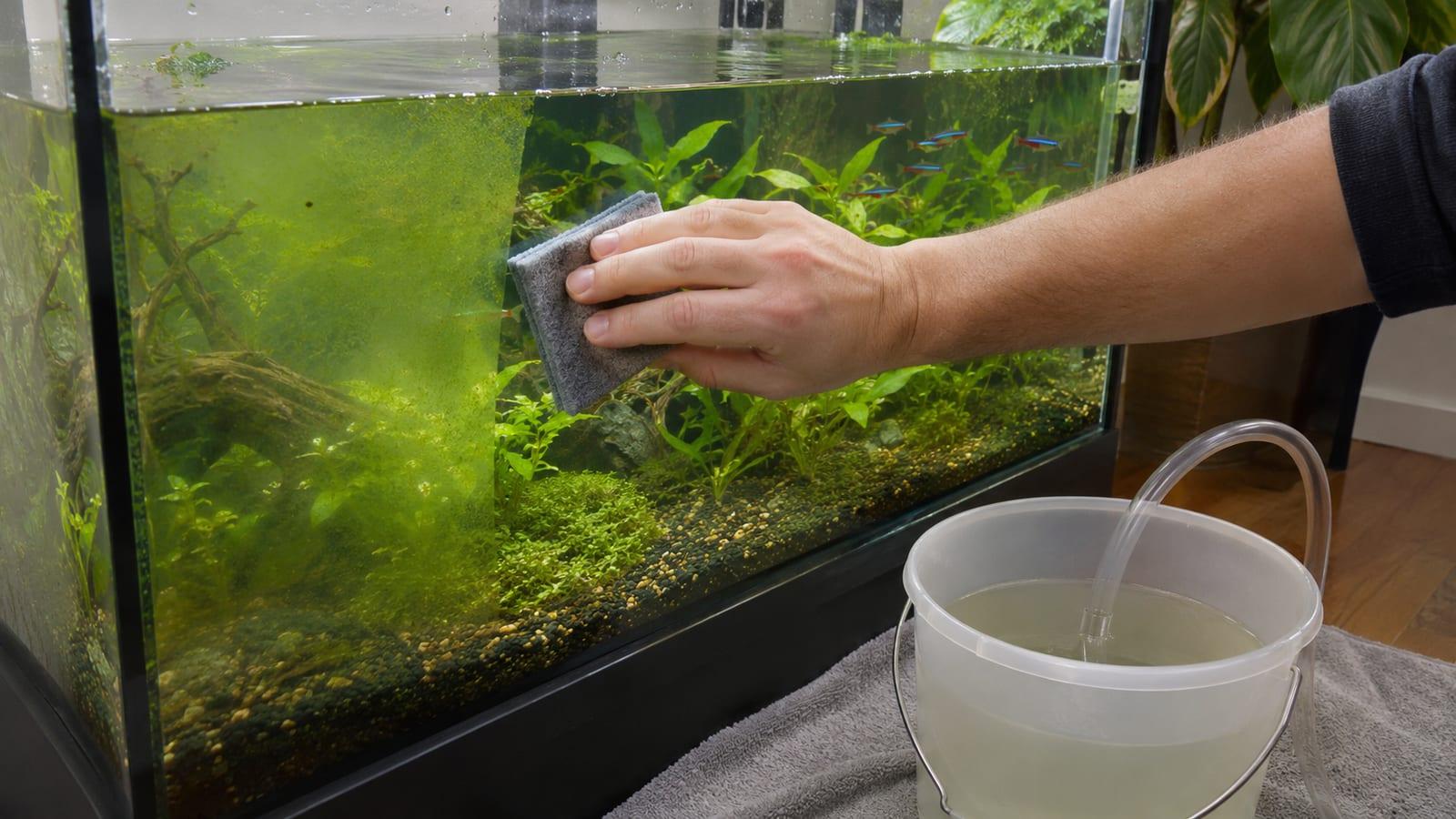
Every week, change 25% of the water, wiping the front glass first and vacuuming a third of the gravel. Once a month, squeeze the filter in that bucket of old tank water. Scrub decorations only when they look bad, leave the back glass film, and never strip a running tank. Based on vet-written and welfare-body care guides and this site's maintenance guides, not our own testing.
The numbers
| Job | How often | How | Never |
|---|---|---|---|
| Water change | Every week, 25% (heavily planted, few fish: every one to two weeks) | Siphon it out; refill dechlorinated, within 2°F | All of it at once in a running tank |
| Gravel | A third of the floor each week, during the water change | Push the siphon in, lift, move along | The whole floor in one session |
| Inside glass, front and sides | Every week, before the siphon | Algae pad or magnet; razor on glass only | A razor on acrylic |
| Filter | About monthly, or when the flow slows | Squeeze in the bucket of old tank water | Tap water; all the media at once |
| Decorations | When they look bad | Out of the tank; hot water and a toothbrush | Soap or the dishwasher |
| Back glass, wood, gravel film | Leave it | It is biofilm; shrimp and baby fish graze it | Scrubbing it bare |
| Outside glass and lid | When smeared | Paper towel and white vinegar | Household glass cleaner |
| Whole tank, empty and scrubbed | Never in a running tank | Only a used tank, or after a diagnosed disease | With fish in the room |
To clean a fish tank, change a quarter of the water each week: wipe the glass, then vacuum a third of the gravel as you siphon. Squeeze the filter in that old water monthly, and never strip the tank.
Decorations get cleaned only when they look bad, the film on the back glass can stay, and the fish stay in. Many guides tell beginners to do a monthly "full clean" of everything at once. Jessie Sanders, a fish vet writing for PetMD, says not to completely clean a tank "unless there is a serious issue". This page is built from vet-written care pages, animal-welfare care sheets, CDC and MedlinePlus guidance, a veterinary manual, an aquaculture extension sheet, an invasive-species council's disinfection card, retailer guides and keeper reports. We have not cleaned these tanks; the table above is that evidence turned into a schedule.
How often to clean a fish tank
There is no single interval, because each job has its own. The table above is the schedule; here is the logic behind it.
Every week: the water change, with the glass and a third of the gravel. Replace about 25% of the water. RSPCA Australia recommends weekly partial water changes, and RSPCA Victoria "a weekly 20-30% water change". A heavily planted tank with few fish can stretch to every one to two weeks, and a crowded tank or a goldfish tank needs more; how much and how often to change the water has the figure for each kind of tank.
About once a month: the filter. Squeeze the media in the bucket of old water from that week's change, or sooner if the flow slows. How to clean a fish tank filter covers each filter type.
When they look bad: decorations, and the outside glass when it is smeared. Not on a timer.
Never: the whole tank at once.
Why not a full clean once a month? The bacteria that turn ammonia into nitrate live on every surface in the tank, most of them in the filter (the nitrogen cycle explains how). Each cleaning job removes some of them. Doing every job on one day removes a lot at once, and ammonia can show up a few days later. Chewy's guide, How to Clean a Fish Tank: Freshwater Tank Instructions, recommends "a full cleaning (going through each step above) once a month", and on the same page says to "Avoid completely emptying or scrubbing the tank on a routine basis". We side with the second line, and with the vet.
To check that your routine is enough, test nitrate just before a water change. Under 20 ppm means it is working; the water change guide explains what to do above that. Keepers report the same pattern on forums: lightly stocked tanks get by with less, crowded tanks need more, and keepers with planted tanks vacuum the gravel lightly.
How to clean a fish tank, step by step
One session, in this order. The fish stay in throughout; PetMD's vet: "Do not remove fish when cleaning a fish tank because it can cause unnecessary stress."
- Wash your hands, and wear gloves, above all if you have a cut or graze. The CDC says to wear gloves when cleaning a fish tank, and not to let children under five clean or handle aquarium items.
- Unplug the heater and the filter. A heater left running above the waterline can overheat and crack, and a filter run dry can burn out.
- Wipe the inside of the front and side glass with an algae pad or magnet, before the siphon, so the loosened algae leaves with the old water. Leave the back glass.
- If a decoration is due, lift it out now: debris collects underneath it, says Aquarium Co-Op, a fish retailer. Scrub it in a bucket, never in the tank; how to clean aquarium decorations has the method. Not on filter week.
- Trim any dead or melting plant leaves, so they leave with the water.
- Siphon out a quarter of the water, vacuuming a third of the gravel as you go. Never start the siphon by sucking on the hose (RSPCA Australia). Aquarium sand is vacuumed differently.
- Once a month, squeeze the filter media in that bucket of old tank water, never under the tap. That week, the gravel gets only its usual third, and the decorations wait.
- Refill with water within 2°F (1°C) of the tank, dechlorinated before it reaches the fish.
- Plug the filter and the heater back in, and check that the filter is moving water.
- Wipe the outside glass and the lid with a paper towel and plain white vinegar. Unplug a light fitted to the lid first.
- Check the bucket for baby snails and shrimp, then tip the old water into a bath, a laundry sink or outside, not the kitchen sink, as the CDC advises. Wash your hands.
Keep one bucket for the tank, one that has never held soap; RSPCA Australia calls it a "dedicated (labelled) fish bucket". No soap touches anything that goes in the tank.
The filter and the gravel on the same day is the one point where the sources split. PetSmart's guide says to clean the filter about monthly, "but not during the gravel cleaning as too much beneficial bacteria can be lost at once". PetMD's vet and Aquarium Co-Op list both jobs in the same session. This site does the filter on water change day, because that is where the old tank water comes from, and keeps the rest of that day light: the usual third of the gravel, no decorations. After a heavy clean, the filter waits a week.
How to clean aquarium glass, inside and out
Inside a glass tank: an algae pad, a magnet, or a razor blade for hard spots. Chewy's guide says glass takes "harder and sharper tools"; PetMD's vet says glass tanks "can handle more abrasive algae scrubbers". Keep sand and gravel from getting caught under the pad or blade, because trapped grains scratch (Aquarium Co-Op). Keep a blade off the silicone in the corners: that bead is what holds the panes together.
Inside an acrylic tank: a soft sponge or a pad made for acrylic, nothing sharper. Acrylic tanks "require softer sponges to avoid scratches" (PetMD), and a razor blade "can leave scrapes" (Chewy).
What you are wiping off. A brown dust on the glass of a new tank is diatoms, and wipes away with almost no pressure (brown algae). A white crust at the waterline is minerals from evaporated water: a plastic razor blade takes it off glass, or white vinegar above the water softens it.
Outside: a paper towel with plain white vinegar. Never a household glass cleaner; Chewy's guide: "Most household glass cleaners contain ammonia and other chemicals that are toxic to fish."
What not to clean
Strip the tank and you restart the cycle
Washing the gravel, scrubbing the decorations and replacing the filter media in one afternoon removes most of the bacterial colony, as why a fish tank smells puts it. The tank looks clean for a week, then ammonia appears.
- All the water. Not in a running tank. PetMD's vet: "Never replace more than 50% of your tank water at one time."
- The film on the back glass, wood and gravel. It is biofilm, shrimp and baby fish feed on it, and it regrows within days of scrubbing.
- Brown, tea-coloured water from new wood or leaves. That is tannins, not dirt (brown algae sets the two side by side), and some keepers want it: see blackwater aquariums.
- Anything with soap, a dishwasher or a household cleaner. WebMD's vet-reviewed guide: "You never want to use any kind of soap when you clean your fish tank."
- Filter media under the tap. Chlorine and chloramine are there to kill bacteria, and the filter's bacteria are bacteria.
- The filter on a heavy-clean day. After a heavy clean, such as scraping stubborn algae off the glass or bleaching decorations, Chewy's guide says to skip the filter and "clean your filter in a week or so". This site counts vacuuming all the gravel as heavy too.
After any bigger clean than usual, test ammonia and nitrite for a few days. If fish die after a clean, the cause is usually the water, and that guide matches the timing to the cause.
When to deep clean a fish tank
A deep clean means an empty tank, scrubbed and disinfected. It has two uses, and a dirty tank is not one of them.
A neglected tank is not one
A tank left for months without a water change is fixed with small changes, 10–15% a day for a week, not by stripping it. The fish have adapted to the old water, and a sudden reset is the bigger shock. The water change guide has the routine.
A used fish tank, bought second hand
- Check the silicone seams for peeling or gaps and the edges for chips, then leak-test it outdoors or in a bath for 48 hours.
- Clean off the dirt and scale first, with vinegar for the crust, then rinse. The Canadian Council on Invasive Species warns that organic material "can significantly reduce" how well bleach works.
- Fill the tank with a measured bleach solution: 5 ml per litre of 5.25–6.25% bleach, or 2.5 ml per litre of 8.25% (about 4 teaspoons or 2 teaspoons per US gallon; check the strength on the label). Do it outdoors or in a room with no fish: the Merck Veterinary Manual says bleach should not be used in closed areas containing live fish. Wear rubber gloves and goggles, and keep the air moving, as Canada's workplace safety centre (CCOHS) advises for bleach. Never add vinegar to bleach.
- Leave it for an hour. The Canadian card says at least five minutes; the Merck Veterinary Manual says a chlorine solution of 200 mg/L for one hour "will destroy most organisms of concern, including most viruses". By our arithmetic, the card's mix works out at roughly 200 to 300 mg/L, about that strength, so the only real difference is time. With a tank whose history you do not know, the hour costs nothing.
- Siphon or bail it out; never tip or lift a tank with liquid in it. The card says to pour the solution down a drain or on the ground away from any pond or stream, and that these protocols are not suitable for septic systems. Rinse thoroughly, then fill with water and a double dose of dechlorinator for 30 minutes, the same step the decorations guide uses. Air-dry until you cannot smell bleach.
- Boil rocks and gravel for 10–20 minutes at a rolling boil, and let them cool before handling (the Canadian card). Ornaments get the decorations guide's treatment.
- Buy the heater new. Our judgement is to start with new filter media too, since old media carries whatever lived in the last tank.
- Cycle it like a new tank, three to six weeks, before fish go in.
The decorations guide uses a stronger mix, 1 part bleach to 9 parts water, because it soaks one ornament in a bucket for ten minutes. A whole tank holds far more solution, and the card's weaker mix, left longer, is sized for that. If you are emptying a tank to move it rather than to disinfect it, see how to move a fish tank.
A tank that had sick fish
Most fish diseases are treated in the fish, not the glass. Medicate in a hospital tank when the medicine would harm the filter bacteria, snails or shrimp, as the fin rot guide describes, and keep the main tank's water clean. Do not strip a running tank. White spot (Ich) is an example: the Merck Veterinary Manual calls it "an obligate pathogen that cannot survive without the presence of living fish", so it is the fish that need treating.
After a death, remove the body at once and test the water. If ammonia or nitrite reads above zero, change half the water, the water change guide's emergency change, then watch the readings for a week. Chewy's guide gives the same order.
The exception is fish TB (mycobacteriosis), diagnosed by a vet. SRAC Publication 4706, an aquaculture extension sheet by Ruth Francis-Floyd, says there is no effective treatment for infected fish, that the gravel and filter media "should be discarded and replaced", and that bleach, "even at concentrations as high as 50,000 mg/L, is only moderately effective" against it. It lists ethyl alcohol at 50 or 70% among the agents that do work. It was written for farms and display aquaria, so ask the vet who made the diagnosis for the protocol. Wear gloves: the CDC lists it among the germs a tank can pass to people, and MedlinePlus says it gets in through a cut that touches the water. SRAC calls human infections "relatively rare".
The short version
A quarter of the water and a third of the gravel every week, glass first. The filter monthly in that bucket, decorations when they look bad, and never the whole tank at once. A deep clean is for an empty tank.
Sources
- Sanders, DVM. How To Clean a Fish Tank. PetMD, 7 May 2026.
- RSPCA Australia. How should I care for my tropical fish? RSPCA Knowledgebase, 2024.
- RSPCA Victoria. Fish. Undated.
- Centers for Disease Control and Prevention. Fish. Healthy Pets, Healthy People, 15 April 2024.
- MedlinePlus. Mycobacterium marinum infection. US National Library of Medicine, reviewed 6 February 2025.
- Yanong, Francis-Floyd and Petty. Production Medicine and Biosecurity in Aquaculture. Merck Veterinary Manual, updated April 2025.
- Petty, Francis-Floyd and Yanong. Parasitic Diseases of Fish. Merck Veterinary Manual, full review May 2022, updated June 2026.
- Francis-Floyd. Mycobacterial Infections of Fish. SRAC Publication No. 4706, November 2011.
- Canadian Council on Invasive Species and Nova Scotia Invasive Species Council. Disinfecting Your Home Aquarium and Equipment. Don't Let It Loose rack card, 2025.
- Canadian Centre for Occupational Health and Safety. Bleach. OSH Answers, the safety page the rack card links to.
- WebMD Editorial Team, reviewed by Farmer, DVM. How to Clean a Fish Tank. WebMD, 18 July 2025.
- PetSmart. Aquarium Maintenance Guide. A retailer's guide, undated.
- Aquarium Co-Op. How to Properly Clean Your Fish Tank. A retailer's guide, undated.
- Chewy (2026). How to Clean a Fish Tank: Freshwater Tank Instructions. Alexandra Rose, with input from Dr Tim Hovanec and Dr Stephan Tanner (not vets); updated 28 October 2026. A retailer's guide, cited by title.
- Keeper reports: Monster Fish Keepers, "How often do you guys clean your tank?"; FishLore, "How often should gravel be cleaned?"; PlanetCatfish, "how often to clean". Forum threads.
Questions people ask
Mentioned in this guide
Related guides
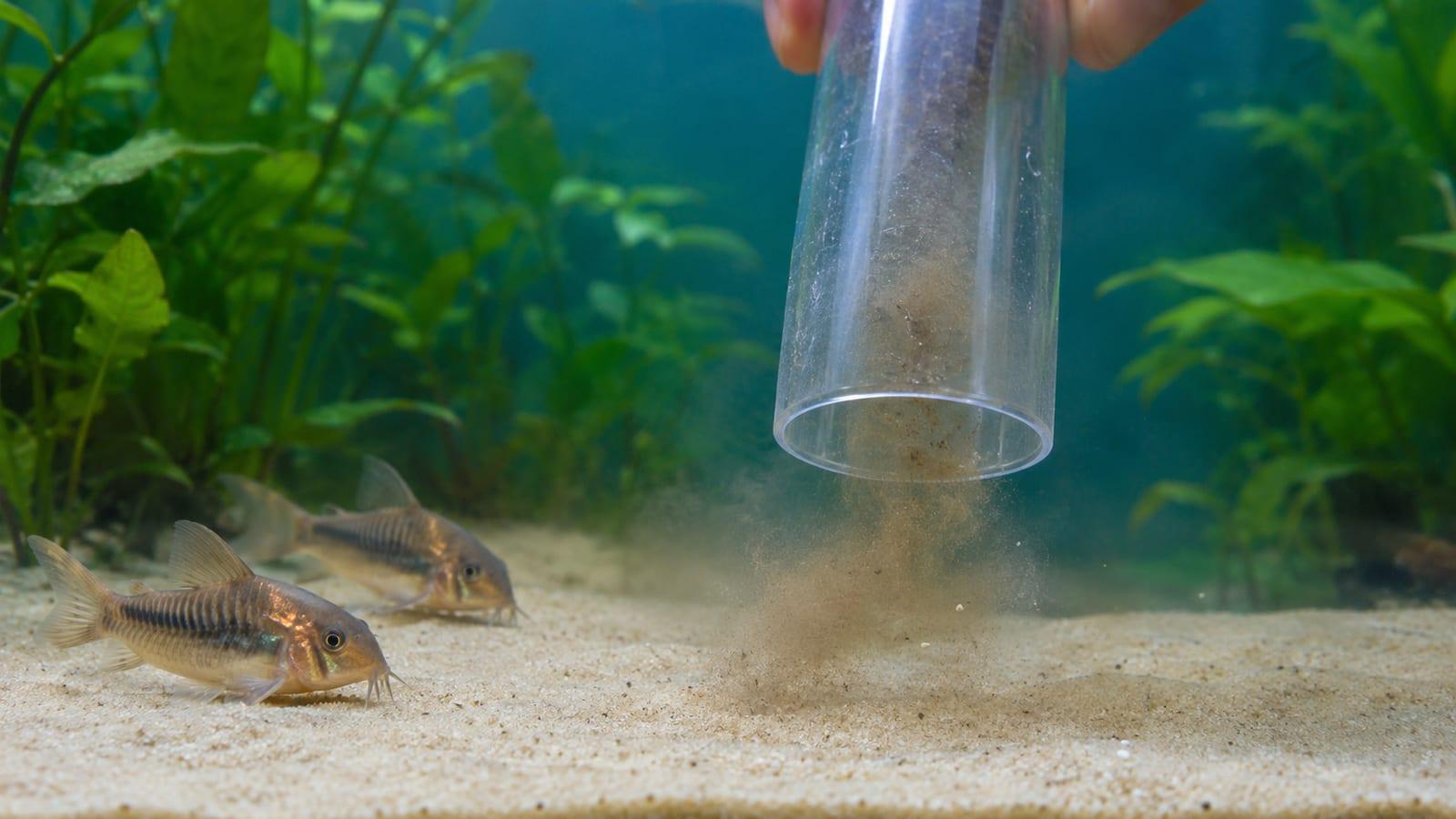
How to Clean Aquarium Sand Without Sucking It Up
How to clean aquarium sand: rinse new sand in small batches, then hover the gravel vacuum above the bed instead of digging. Plus gas bubbles and corydoras.
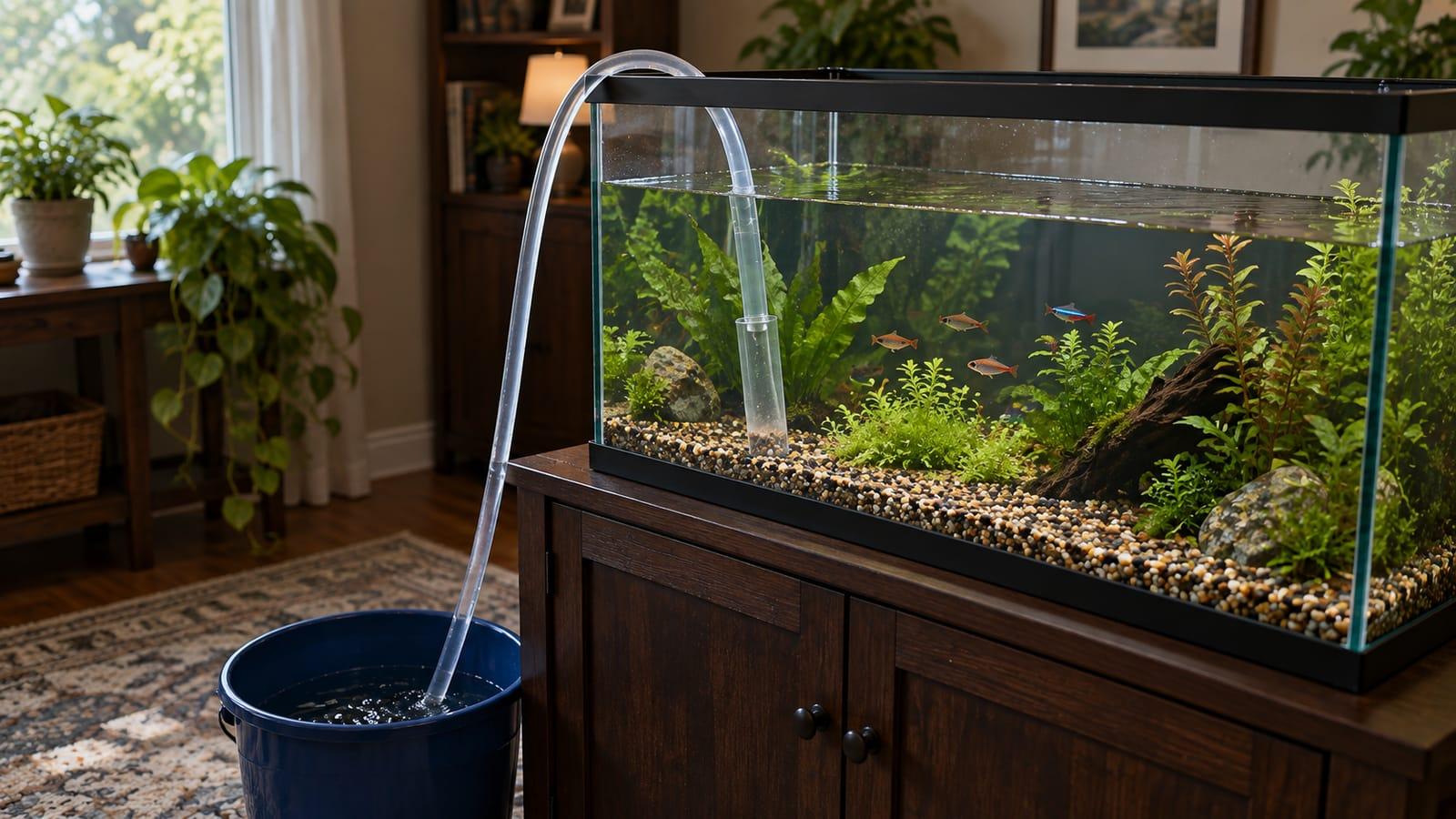
How to Change Fish Tank Water, and How Often to Do It
How to change fish tank water: replace 25% once a week, with new water dechlorinated and matched to within 2°F. The steps, and how to set your own schedule.
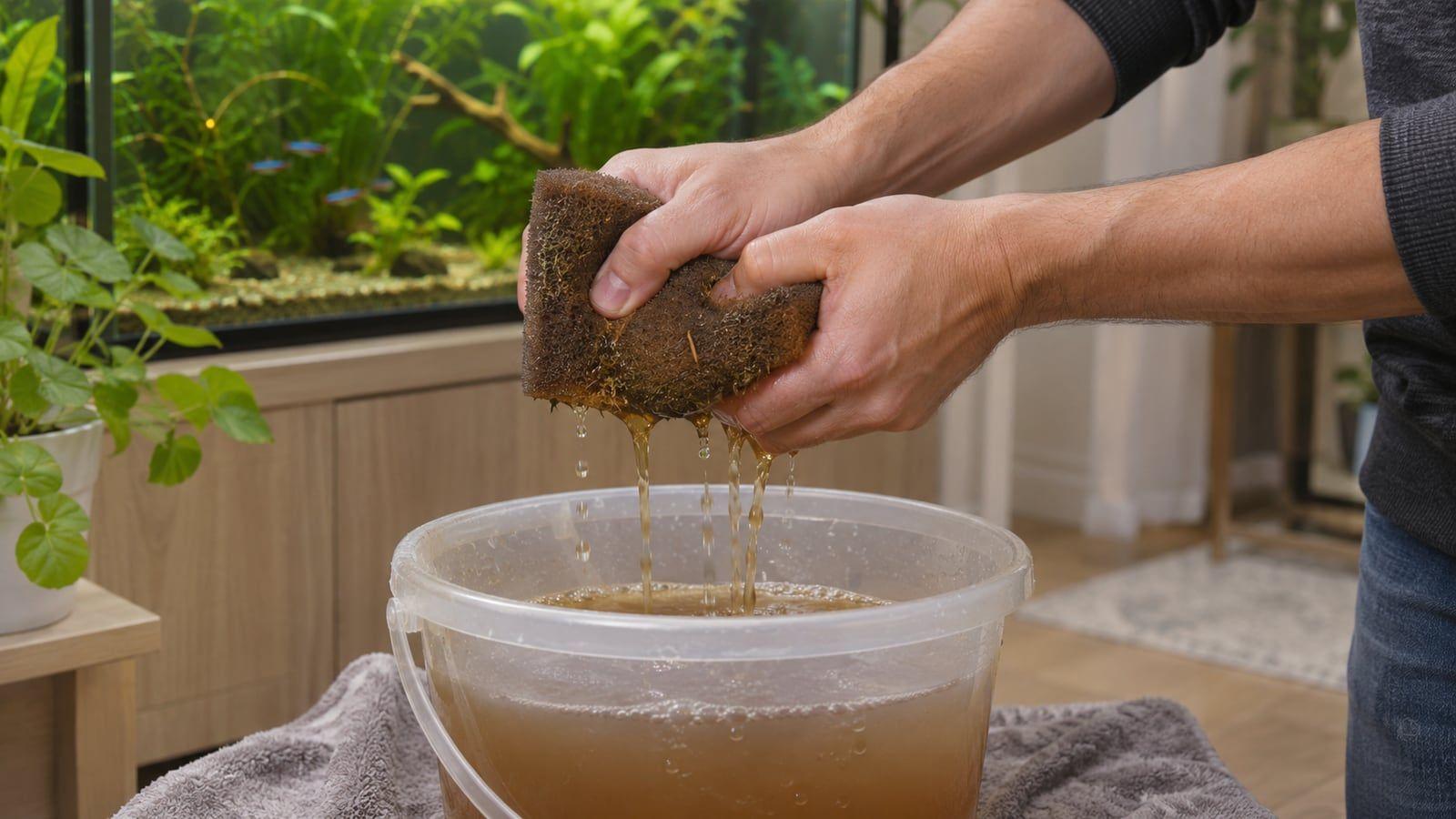
How to Clean a Fish Tank Filter Without Crashing the Cycle
How to clean a fish tank filter: old tank water, never the tap, about monthly. Steps for sponge, hang-on-back and canister filters, and the cartridge trap.