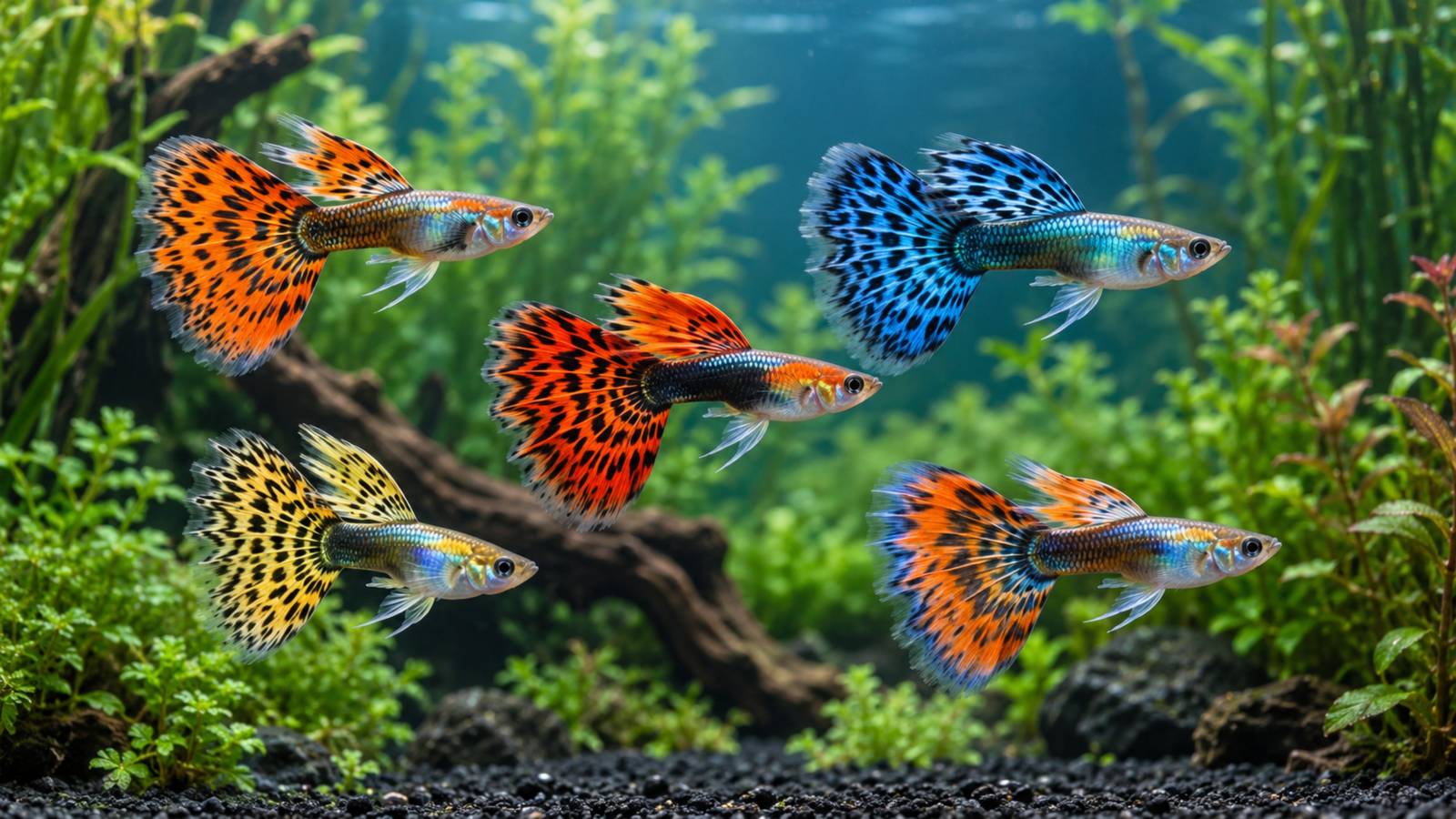
Mixed sexes breed about every four weeks, and even an all-female group can keep dropping fry for months from stored sperm, so in a 10 gallon tank the only guppy group that stays the size you chose is males only.
The numbers
| Setup | How many | What happens |
|---|---|---|
| All male | 5 | Recommended. No fry, and males are the smaller sex |
| All male, vet-conservative | 3 | What PetMD's rule of 5 gallons plus 2 per extra fish gives |
| 1 male + 2–3 females | 3–4 to start | The textbook ratio. Broods about every four weeks; past five fish after the first round |
| All female | 4–5 to start | Stored sperm can mean fry for months with no male in the tank |
| All male, heavy maintenance | 7–8 | What some keepers suggest with good filtration and regular water changes. Not a beginner number |
Five, all male. The right number of guppies in a 10 gallon tank is about five, and they should all be males: males are the smaller sex, and a group with no females cannot breed. Add females and the number stops being yours to choose. FishBase puts a guppy brood at 20 to 40 young, with a new one about every four weeks, so two females can drop 40 to 80 fry a month between them.
That answer sits between two others. PetMD's vet-written rule is more conservative and works out to three. Some keepers suggest seven or eight. Both are explained below, along with the breeding math that decides the question.
How many guppies in a 10 gallon tank, and why only males
Male and female guppies are not the same size, and the difference matters in a small tank:
| Average length | Maximum (body only, no tail) | |
|---|---|---|
| Male | 1.4 in (3.5 cm) | 2 in (5 cm) |
| Female | 2 in (5 cm) | 2.4 in (6 cm) |
The averages are from the IUCN Global Invasive Species Database and the maximums from FishBase. PetMD gives "up to 2 inches" for an adult guppy. The IUCN database describes males as about half the size of females. A female is the bigger fish, and she is the one that fills the tank with more fish.
PetMD's care sheet, written by a vet, says one adult guppy needs a minimum of 5 gallons, plus "at least two extra gallons" for each additional fish. That gives three in a 10 gallon tank: 5 + 2 + 2 is 9, and a fourth would need 11. The same page calls groups of four to six "ideal", which does not fit its own rule at this size. We go to five because an all-male group is made of the smaller sex and stays at five, but three is the cautious answer and a perfectly good tank.
Seriously Fish puts the minimum tank for guppies at about 41 litres, roughly 11 US gallons. So a 10 gallon is the floor, not a roomy home. On hobby forums, replies range from five to eight males, and one keeper put it at eight "with good filtration and regular water changes". That is a number for people who already know their tank, not a starting point.
If you are wondering why we do not just count inches of fish, the inch-per-gallon rule fails for reasons that apply to guppies as much as anything else.
The male-to-female guppy ratio problem
The standard advice is to keep two to three females for every male (PetMD). Seriously Fish says the same thing in its own words: "keep several females to each male as males can be quite vigorous in their constant pursuit of females."
The ratio exists for a real reason. Male guppies chase and court almost constantly, and it costs the females. In a study at the University of St Andrews, extra male attention "significantly reduced the number of offspring produced" by females, and the authors concluded that "male harassment causes a direct reduction in female short-term fitness" (Ojanguren and Magurran, 2007). A 2008 paper on invasive guppies in Mexico opens with the same point: "Persistent courtship by male Trinidadian guppies (Poecilia reticulata) is costly for conspecific females" (Valero et al., 2008).
Now apply the ratio to a 10 gallon tank:
- The smallest group that meets the advice is one male and three females. That is four fish, most of the tank.
- Three females is the arrangement that produces the most fry, the fastest.
- Within a couple of months, the tank holds far more than four fish, and the ratio no longer means anything.
The short version
The 1 male to 2–3 females ratio is advice for a breeding tank. In a 10 gallon, the way to protect females from males is to keep none.
To tell them apart: males have a gonopodium, a rod-like fin under the body that is a modified anal fin (Seriously Fish). Females have an ordinary anal fin and are the larger fish.
The breeding math: what one male and two females become
No page we found that answers this question does the arithmetic, so here it is. The inputs:
- Brood size: 20 to 40 live young (FishBase). Seriously Fish gives a wider 5 to 100.
- How often: about every four weeks (FishBase). Practical Fishkeeping, reporting a lab study (Auer et al., 2010), gives intervals of around 25 days and a first brood at 60 to 70 days old.
- Gestation: four to six weeks (FishBase, Seriously Fish).
- Maturity: males at about 2 months, females at about 3 (FishBase).
- Shop females are often already pregnant, because shop tanks are mixed and females store sperm (see the next section).
- Adults eat fry, so not every baby survives (Seriously Fish).
How many fry survive in a community tank is not a number anyone has published, so the table runs several guesses. It starts from one male and two already-pregnant females, and every surviving female drops her first brood at about 13 weeks old. That is later than the 60 to 70 days reported for lab fish, so the model errs on the slow side.
| Fry survival assumed | Brood size | Week 13 | Week 17 | Week 26 |
|---|---|---|---|---|
| 10% | 20 | ~15 | ~23 | ~55 |
| 10% | 30 | ~21 | ~36 | ~99 |
| 25% | 20 | ~33 | ~68 | ~220 |
| 50% | 20 | ~63 | ~183 | ~740 |
Our own simple model, not a measurement. Survival rates are assumptions, and the model ignores adult deaths, so read it as the shape of the curve, not a forecast.
Take the most cautious row. Even if nine fry in ten are eaten, two females at the low end of the brood range give four survivors per round. After the first round, three fish are seven, already past the tank's limit. By three months they are about fifteen, and by six months more than fifty.
Adults do not die off to make room, either. PetMD gives guppies a lifespan of two to three years with proper care, so every fish that survives keeps adding to the total for a long time.
Why an all-female guppy tank still gets fry
Leaving the males out sounds like the fix. It usually is not.
Female guppies store sperm. A 2013 lab paper describes storage "ranging from days to several months" (Gasparini and Evans, 2013), and Seriously Fish notes that females can keep producing young for six months or more with no male present. In a wild population in Trinidad, researchers found males siring offspring up to 10 months after they had died, through sperm the females had stored, and 10 months was the longest their dataset could measure (López-Sepulcre et al., 2013). That is wild data, but it shows how long the effect can last.
Most shop tanks hold males and females together, so a female you buy has probably already mated. Keepers say the same thing: "females are most likely pregnant in the LFS" on one forum, and "it is safer to get males since females might already store sperm" on another. A pregnant female often shows a dark patch behind the anal fin, which Seriously Fish calls the gravid spot, but a missing patch is no guarantee.
So an all-female tank delays the fry by a few months. It may not prevent them, and once the first fry grow up, some of them will be male.
Setting up a five-male guppy tank
Buying male guppies
Check every fish for a gonopodium before it goes in the bag. Young guppies are hard to sex, and shops get it wrong. One keeper bought three young guppies she was told were all females: "One very male guppy and several generations of fry later, I have one rather overstocked ten gallon." A single wrong fish is enough to start the table above. Fancy guppies are the same species and the same count: five males. Seriously Fish warns that many commercially bred guppies are not very hardy, which is one of the reasons new fish keep dying, so pick active fish from a tank with no dead ones.
Will male guppies fight?
Keepers report some chasing and occasional fin nipping in all-male groups. We found no study that measures it, so treat that as hobby experience, not fact. Plants and decor that break up lines of sight help, and five males spread the attention better than two or three.
Before they go in
- Cycle the tank before the guppies go in. In an uncycled tank, the fish sit in their own ammonia.
- Set the heater for 72 to 82°F, PetMD's range for guppies, with a pH of 6.8 to 7.8.
- Plant the tank, or add decor that blocks sight lines between males.
- Acclimate them properly rather than tipping the bag in.
- Check the equipment list in what a 10 gallon setup needs and costs.
If you already have males and females
If the tank is already mixed, the options, in rough order:
- Return or rehome the females, including every young one you can catch. This is the option that ends it: the males left behind cannot breed on their own. Any juvenile female you miss starts it again, so check the tank for a few weeks afterwards.
- Or return the males. Because of stored sperm, the females can keep dropping fry for months. Any male fry that grow up start it all again, so you will have to keep removing them.
- Never add more females. Each one can mean another 20 to 40 fry about every four weeks.
- Do not count on the adults. They eat many fry, but Seriously Fish recommends a densely planted tank with floating plants precisely because cover keeps fry alive. In a planted 10 gallon, enough survive to keep the numbers climbing.
If you keep some fry, hang-on-back filter intakes can pull them in. A sponge filter, which has no intake to pull fry in, is the safer choice. An overrun tank shows up as nitrate that climbs faster between water changes, so test weekly and see keeping nitrate down for how big the water changes need to be. Raising fry is a subject of its own.
If you actually want a breeding colony, that is a bigger tank: a 20 gallon setup is the usual next step.
Guppy tankmates in a 10 gallon
Five males is a full tank. A couple of small snails add little to the waste load and are fine. Anything else on the bottom means fewer guppies, and everything else a 10 gallon can hold covers those trade-offs.
Guppies with a betta is a combination we would skip. Some bettas ignore tankmates and some attack them, and keepers commonly warn that bright, long-finned fish like male guppies can be taken for a rival. You cannot tell which kind of betta you have until it goes wrong.
The short version
Five male guppies in a 10 gallon tank, or three if you want PetMD's margin. Any female, bought alone or with males, can mean fry for months. If you want to breed guppies, start with a bigger tank.
Sources
- FishBase. Poecilia reticulata, guppy.
- Zayas, M. (2026). Guppy Fish Care Sheet. PetMD.
- IUCN Global Invasive Species Database. Poecilia reticulata.
- Seriously Fish. Poecilia reticulata.
- Keeper reports: fishprofiles.com, "How many guppys in a 10 gallon" (2006); fishforums.net, "How many guppies can I keep in a 10 gallon".
- Ojanguren and Magurran (2007). Male harassment reduces short-term female fitness in guppies. Behaviour 144: 503–514.
- Valero, Macías Garcia and Magurran (2008). Heterospecific harassment of native endangered fishes by invasive guppies in Mexico. Biology Letters 4: 149–152.
- Practical Fishkeeping. Catch-up growth in guppies affects brood sizes, reporting Auer et al. (2010), Ecology Letters 13: 998–1007.
- Gasparini and Evans (2013). Ovarian fluid mediates the temporal decline in sperm viability in a fish with sperm storage. PLoS ONE 8: e64431.
- López-Sepulcre et al. (2013). Beyond lifetime reproductive success: the posthumous reproductive dynamics of male Trinidadian guppies. Proceedings of the Royal Society B 280: 20131116.
Questions people ask
Mentioned in this guide
Related guides
How Many Neon Tetras in a 10 Gallon Tank? Eight, and Why
How many neon tetras in a 10 gallon tank? Eight, kept on their own. Six is the floor and ten the ceiling. The math, plus how to add them without losses.
How Many Fish in a 10 Gallon Tank? A Straight Answer
How many fish in a 10 gallon tank? Six to eight small schooling fish, or one betta plus a clean-up crew — and why inch-per-gallon keeps killing tanks.
What Fish Can Live With Goldfish? A Short, Honest List
What fish can live with goldfish? Another goldfish first, then a few cool-water fish and snails, with temperatures, sizes and the ones to avoid.