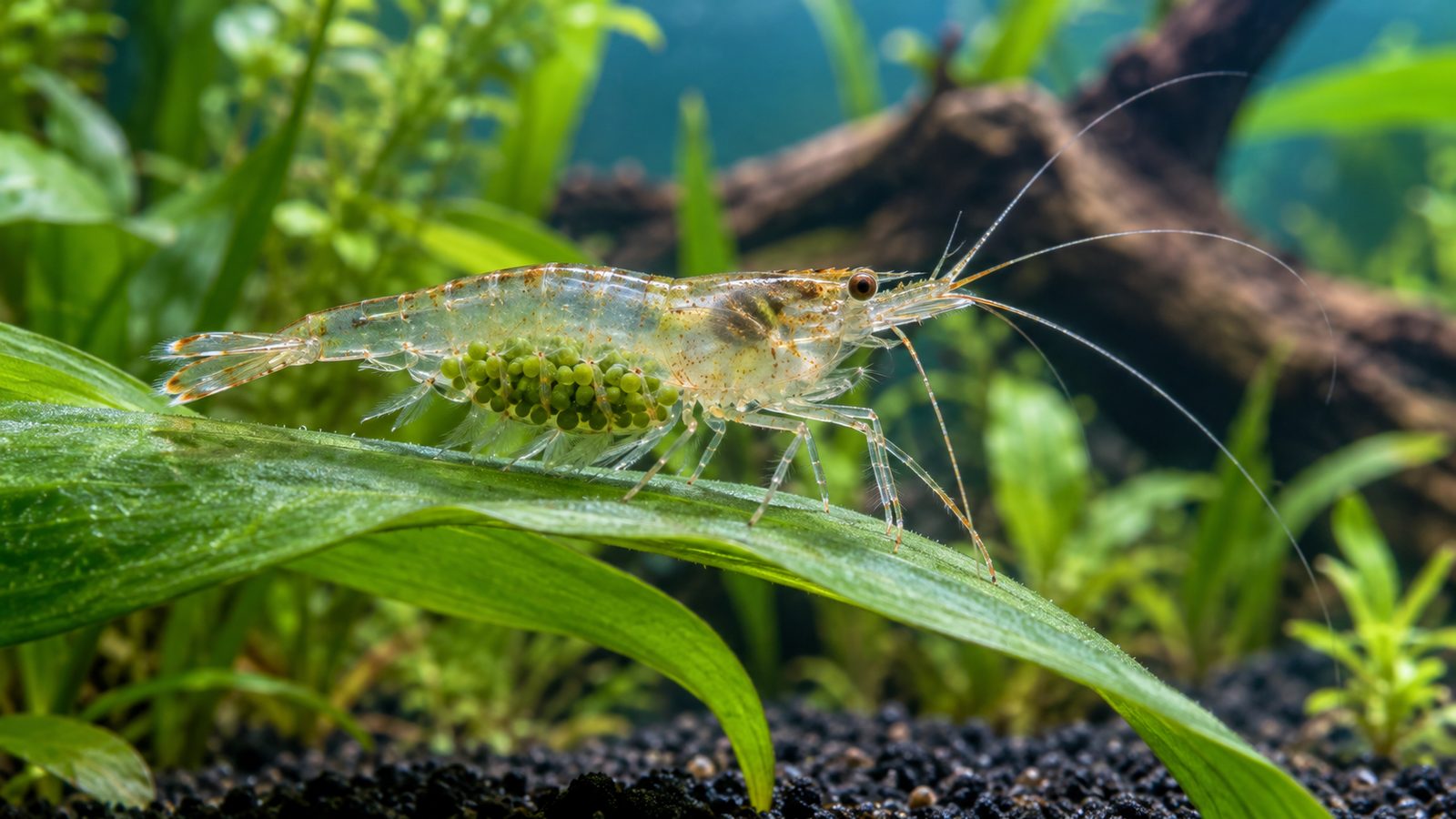
Move a female carrying eggs to a small tub with a sponge filter and no fish, keep it warm, and do not add salt: in a lab, salt stopped the larvae of one species sold as ghost shrimp from developing. The larvae of the most common species need little or no food before they turn into baby shrimp. The exception is the daggerblade grass shrimp, an estuarine bait shrimp that keepers report finding among feeder shrimp, whose larvae need brackish water and will not survive in a freshwater tank.
The numbers
| Shrimp | How it turns up in the US | Larvae | Salt for the larvae? |
|---|---|---|---|
| Eastern grass shrimp (Palaemonetes paludosus) | The most commonly sold ghost shrimp | 3 stages. A baby shrimp in 5–10 days | No. Freshwater |
| Mississippi grass shrimp (Palaemonetes kadiakensis) | Also sold as ghost shrimp, bait and fish food | 6 stages. 16–30 days at 67–75°F | No. At 3.5 ppt (a tenth of sea water) they stopped developing |
| Daggerblade grass shrimp (Palaemonetes pugio) | Bait shrimp; keepers report it among feeder shrimp | Need brackish or sea water | Yes. The larvae will not survive in a freshwater tank |
| Whisker or long-arm shrimp (Macrobrachium lanchesteri) | Can turn up in batches sold as ghost shrimp | 9 stages. First baby shrimp after 30 days at 79–82°F | No, but slow to raise, and keepers report the adults hunt |
Most ghost shrimp sold in the US are freshwater grass shrimp, and ghost shrimp breeding works in a plain freshwater tank. A female carries 8 to 85 eggs under her tail for about two weeks in warm water (79–82°F), and keepers report closer to three weeks in a cooler tank. The larvae of the most common species turn into tiny shrimp within 5 to 10 days. When babies never appear, missing salt is usually not the reason: fish and filters eat the larvae.
There is one real exception. "Ghost shrimp" is a shop label, not a species, and keepers report that some shrimp sold as feeders are an estuarine species whose larvae do need brackish water. The table above sets out the four you are most likely to have, and the rest of this page covers the eggs, the larvae and how to raise them.
Do ghost shrimp breed in freshwater? It depends which "ghost shrimp" you bought
Yes, for the species most stores sell. No, for one estuarine species that is used as bait and that keepers report among feeder shrimp.
The usual US ghost shrimp is the eastern grass shrimp, Palaemonetes paludosus; the shrimp retailer The Shrimp Farm calls it "the most commonly sold 'Ghost Shrimp' in North America" (The Shrimp Farm). It is now classed as Palaemon paludosus (WoRMS). It is native to fresh water on the Atlantic coastal plain from southern New Jersey to Florida, and the US Geological Survey lists "ghost shrimp" and "glass shrimp" among its common names (USGS). Its larvae pass through three stages and become baby shrimp in 5 to 10 days, in fresh water (Dobkin).
The same names belong to the Mississippi grass shrimp, Palaemonetes kadiakensis. USGS notes "they are readily available for sale on Internet commerce sites" (USGS), and the Smithsonian says it is "sold through the aquarium trade". Its larvae take longer, 16 to 30 days at 67–75°F, through six stages. They developed well in fresh water, but at 3.5 parts per thousand of salt (ppt; sea water is about 35) they did not get past the third stage (Smithsonian NEMESIS). So adding salt, which forum threads often suggest, can work against this one. The Smithsonian puts its limit for reproduction "somewhere between 0 and 3.5 PSU", so the safe amount of salt is none.
The daggerblade grass shrimp, Palaemonetes pugio, is the one that really needs salt. In lab tests, adults tolerated nearly fresh water, but half of the first-stage larvae died within four days at 16 ppt, roughly half-strength sea water, and the authors conclude the larvae need brackish to marine water (Knowlton and Kirby, 1984). It is a popular bait shrimp on the Atlantic coast (Delaware Surf Fishing), and keepers on shrimp forums report it turning up among feeder shrimp; no survey shows how often. Kept in a freshwater tank, it can live and still never raise a single baby there.
Whisker or long-arm shrimp (Macrobrachium lanchesteri) can turn up in batches sold as ghost shrimp: The Shrimp Farm notes the label can cover "Macrobrachium species (also known as long arm shrimp)" (The Shrimp Farm). This one is among the few in its group whose larvae can develop in fresh water, but they go through nine stages (Wong, 1988), and in a lab the first reached the baby-shrimp stage 30 days after hatching, at 79–82°F (Wong, 1994). They are slower to raise, and keepers report that the adults catch small fish and shrimp.
Where does the "they need brackish water" belief come from? Probably from the Amano shrimp, a popular algae eater whose larvae coped with 17–34 ppt salt water in lab tests (Kondo et al., 2021). That advice is right for Amanos. It is wrong for most ghost shrimp.
Can you tell which one you have?
Mostly, no. Telling the eastern and Mississippi grass shrimp apart takes a microscope: one difference is the number of large spines at the tip of the male's second pair of swimming legs, four in the eastern grass shrimp and three in the Mississippi (USGS). It does not matter much, because both breed in fresh water.
A long-arm shrimp is easier to spot. Adults, males especially, have one pair of claws that is clearly longer and thicker than the rest. Daggerblade grass shrimp cannot easily be picked out by eye either. The clue is where they came from: feeder or bait shrimp whose larvae die within a few days in clean fresh water, clutch after clutch.
To be plain about it: the label covers several species, and nobody can promise which one a store tank holds. If your shrimp's larvae turn into baby shrimp in fresh water, you have one of the freshwater species. That is the only test that settles it.
Male vs female ghost shrimp
Can you tell male and female ghost shrimp apart? You can make a good guess by eye, and one sign settles it.
- Size. Keepers find the biggest shrimp in a group are usually females. In the eastern grass shrimp, females carry eggs once they pass about 20 mm (0.8 in), and adults reach up to 50 mm (2 in) (USGS).
- The underside. Keepers look for a deeper, wider curve under the tail section on females. That is the space where the eggs ride.
- Eggs. A shrimp carrying eggs is female. This is the only certain sign you will see without equipment.
- Under a microscope. The definitive difference is on the male's second pair of swimming legs. That is how scientists sex them, and it is too small to see in a tank.
If you want to breed them, buy a group rather than one or two. Ghost shrimp are cheap, and a group makes it far more likely you have both sexes.
How ghost shrimp breed
The female sets the timing. The sequence goes like this:
- She moults. A female ready to breed sheds her shell, and the new one is soft for a short while.
- The males go frantic. Keepers describe them swimming fast around the tank, searching for her. Beginners often read this as stress. It is mating behaviour.
- They mate within hours. In experiments with daggerblade grass shrimp, a close relative, 80% of females mated when males met them within 2 hours of this moult, and only 30% when males met them 6 to 8 hours later (Caskey and Bauer, 2005).
- The eggs appear under her tail. She passes them onto her swimmerets, the small paddle-like legs under her tail, and keepers usually see them within a day or so.
- She carries and fans them. She beats her swimmerets to keep water moving over the eggs until they hatch.
Ghost shrimp do not give live birth. They lay eggs and carry them under the tail, and the eggs hatch into free-swimming larvae that look nothing like shrimp at first.
Pregnant ghost shrimp: what the eggs look like
A pregnant ghost shrimp, or "berried" female as keepers say, carries a cluster of small, round eggs under the tail, between the swimmerets. Each egg is about 1 mm across, roughly 1/25 of an inch (USGS). Keepers describe them as clear to greenish. Because the shrimp is see-through, the eggs are often the most visible thing about her.
Ghost shrimp carry their eggs on their own bodies, not on plants or glass. Clusters stuck to the glass or a leaf are almost always snail eggs.
How many eggs?
Between 8 and 85, and bigger females carry more (Beck and Cowell, 1976, summarised by USGS). That is a small clutch, so set expectations: one female gives you a handful to a few dozen babies at most, and fewer if the larvae hatch in a tank with fish.
Stages you can see
- Fresh eggs: a full, pale cluster under the tail.
- Close to hatching: keepers report that the eggs darken and tiny eye dots show through as the larvae develop.
- Hatched: the swimmerets are empty. Keepers report this often happens overnight, which is why many never see it.
How long are ghost shrimp pregnant?
About 12 to 14 days at 79–82°F (26–28°C). That is the incubation period measured in the laboratory for the eastern grass shrimp (USGS; Beck and Cowell, 1976; Animal Diversity Web). In cooler, unheated tanks, keepers commonly report closer to three weeks.
| Water | Eggs hatch after | Where the number comes from |
|---|---|---|
| 79–82°F (26–28°C) | 12–14 days | Lab measurement |
| Unheated, cooler tank | About 3 weeks | Keeper reports, not measured |
Temperature is the likely reason other pages give anything from 12 to 24 days: they are describing different tanks. Animal Diversity Web even says females carry eggs "for up to 2 months", which probably reflects cold wild water. Colder water slows shrimp development. If you want the eggs to hatch on schedule, how warm to keep the tank covers holding the temperature steady.
Why did the eggs disappear?
Most often, they hatched at night and nobody noticed. The larvae are tiny and clear, and in a tank with fish they are eaten within hours. Less often, keepers report, a female drops her eggs after stress, a rough net or a move. If the eggs vanished well before two weeks in a warm tank, that is the more likely reason.
How to breed ghost shrimp: the rearing tub
Are ghost shrimp easy to breed? Getting eggs is easy. Getting babies past the larval stage in a tank with fish and a power filter is not, because the larvae are tiny and drift wherever the water takes them. A separate ghost shrimp breeding tank, even a plastic tub, fixes most of that.
- Set up a small tank or tub. A few gallons is enough. Use a sponge filter and nothing with an intake. A sponge filter is the gentle choice for shrimp for the same reason: nothing gets sucked in.
- Make sure it is cycled. Squeeze a used sponge from the main tank into it, or run the tub's sponge filter in the main tank for a few weeks first.
- Add java moss or a similar fine plant. Baby shrimp cling to it and graze it. You do not need gravel.
- Keep it warm. A heater set around 79–80°F brings the hatch closer to two weeks. Match the main tank's temperature before the move.
- Move the female a few days before the eggs are due. Lift her in a cup of her own water, so she never leaves the water, and move her gently.
- Put her back once the eggs have hatched. Whether adults eat larvae is disputed among keepers. Removing her costs nothing.
- Check moss and plants before they go in. Planaria and hydra both prey on tiny shrimp, and a tub full of larvae is an easy meal for them.
Breeding in the main tank instead
It can work, but only with no fish and a filter intake covered with a sponge. Even then, expect a few survivors at most. With fish in the tank, a ghost shrimp breeding attempt in the main tank mostly feeds the fish.
Ghost shrimp larvae: what they look like and what to feed them
Newly hatched larvae, which keepers often call ghost shrimp fry, are tiny and clear, and they do not look like shrimp yet. Keepers describe them hanging or swimming head-down in open water. A moderator on the PetShrimp forum called them "HUGE compared to Amano shrimp larvae" (PetShrimp forum), which fits: eastern grass shrimp lay large, yolky eggs, 1.1 to 1.8 mm on the long side (Dobkin).
That yolk matters. In a lab, 200 of 302 eastern grass shrimp larvae reached the baby-shrimp stage in 5 to 10 days without being fed at all (Dobkin). The researcher noted they needed "much less care" than the larvae of a related species.
So for the first days, do not pour powdered food or infusoria into the tub. Uneaten food can foul a small tub faster than the larvae would starve. Keep the water clean with small, gentle water changes, matched for temperature.
If the larvae are still swimming freely after about 10 days, you may have the Mississippi grass shrimp, whose larvae take 16 to 30 days (Smithsonian NEMESIS). Keepers then add a little green water or infusoria. That is hobby practice rather than something the studies tested, so add very little and watch the water.
Never add salt. The common species does not need it, and at 3.5 ppt it stopped the larvae of the Mississippi grass shrimp from developing.
Baby ghost shrimp: from postlarva to adult
When the larval stages end, the young settle onto surfaces and look like tiny copies of the adults. Scientists call this a postlarva; keepers just say baby shrimp. They walk and graze rather than drift.
Their first food is the biofilm on the glass, moss and sponge filter, so leave it there. A small pinch of fine food every day or two is enough on top of that.
Small, curled creatures that dart sideways are probably scuds, not baby shrimp. A baby ghost shrimp has a straight body and moves like the adults.
In water above 79°F, eastern grass shrimp grow from hatching to adult in two to three months, and in cooler water it took four to five months (Animal Diversity Web; Beck and Cowell, 1976). Move them to the main tank once they are too big for a fish's mouth or a filter intake. Keepers usually wait until they are about the size of a fingernail.
Ghost shrimp breeding problems: why the larvae die
Some losses are normal. Even in the lab, about two in three larvae made it. When a whole clutch dies, the sign usually points at the cause.
| What you see | Likely cause | What to do |
|---|---|---|
| Larvae gone within hours in the main tank | Eaten by fish, or pulled into the filter | Use a rearing tub with a sponge filter |
| Larvae die within a few days in a clean freshwater tub, every clutch, from feeder or bait shrimp | Possibly daggerblade grass shrimp, whose larvae need brackish water | A pinch of salt will not fix it. These are the wrong shrimp for freshwater breeding |
| Tub water cloudy or smelly | Overfeeding | Feed nothing until the larvae settle as baby shrimp |
| Larvae still swimming after about 10 days, then die | A slower-developing species | A little green water or fine food, as keepers do |
| Larvae stall after salt was added | Salt stopped Mississippi grass shrimp larvae in a lab | Stop adding salt and change the water back to fresh |
| Tiny white worms, or small stalks with tentacles | Planaria or hydra | Remove them before the next clutch |
How often do ghost shrimp breed?
In the wild, eastern grass shrimp in the northern part of their range carry eggs from early February to mid-October, in water from 64 to 91°F. In the warmer water of southern Florida they breed all year and can breed twice a year (USGS; Animal Diversity Web). That suggests a warm, steady tank can keep them breeding outside the northern season.
They do not keep breeding for years, though, because the ghost shrimp life cycle is short. The eastern grass shrimp lives about one year, and in the wild adults die after spawning, between April and October (Beck and Cowell, 1976). Laying eggs does not kill a ghost shrimp. But a female carrying eggs is often near the end of her life, which is why a berried female dying a few weeks later is common and not something you did wrong.
Can ghost shrimp breed with cherry shrimp?
No. Ghost shrimp belong to the family Palaemonidae and cherry shrimp to Atyidae, so they cannot interbreed (WoRMS). They can share a tank, and each breeds on its own. Babies of both are food for any fish in the tank.
Sources
- Curtis (2010). What is a Ghost Shrimp? The Shrimp Farm (a shrimp retailer).
- WoRMS. Palaemon paludosus and Neocaridina davidi. World Register of Marine Species.
- Daniel (2019). Palaemonetes paludosus (Eastern Grass Shrimp). US Geological Survey, Nonindigenous Aquatic Species Database.
- Dobkin (prepared 1967). Abbreviated Larval Development in Caridean Shrimps and its Significance in the Artificial Culture of These Animals. FAO. See also Dobkin (1963), The Larval Development of Palaemonetes paludosus (Gibbes, 1850), Reared in the Laboratory. Crustaceana 6: 41–61.
- Daniel and Benson (2019). Palaemonetes kadiakensis (Mississippi Grass Shrimp). US Geological Survey, Nonindigenous Aquatic Species Database.
- Smithsonian Environmental Research Center. Palaemon kadiakensis. NEMESIS. Larval data from Broad and Hubschman (1963), The Larval Development of Palaemonetes kadiakensis in the Laboratory, Transactions of the American Microscopical Society 82: 185–197, and Hubschman (1975).
- Knowlton and Kirby (1984). Salinity tolerance and sodium balance in the prawn Palaemonetes pugio Holthuis, in relation to other Palaemonetes spp. Comparative Biochemistry and Physiology A 77: 425–430.
- Delaware Surf Fishing. Common Grass Shrimp (Palaemonetes pugio). Angler's bait page.
- Wong (1988). Developmental and genetic studies of the genus Macrobrachium. PhD thesis, University of Stirling.
- Wong (1994). Larval Development of the Palaemonid Prawn, Macrobrachium lanchesteri (De Man) Reared in the Laboratory. Crustaceana 67: 296–315.
- Kondo, Hamasaki and Dan (2021). Larval performance of three amphidromous shrimp species in the genus Caridina under different temperature and salinity conditions. Crustacean Research 50: 41–54.
- Caskey and Bauer (2005). Behavioral Tests for a Possible Contact Sex Pheromone in the Caridean Shrimp Palaemonetes pugio. Journal of Crustacean Biology 25: 571–576.
- Beck and Cowell (1976). Life History and Ecology of the Freshwater Caridean Shrimp, Palaemonetes paludosus (Gibbes). American Midland Naturalist 96: 52–65.
- Animal Diversity Web. Palaemonetes paludosus. University of Michigan Museum of Zoology.
- PetShrimp forum. Discussion of ghost shrimp larvae. Hobbyist forum post; anecdote, not a study.
Questions people ask
Mentioned in this guide
Related guides
How to Get Rid of Duckweed in an Aquarium Without Hurting Fish
How to get rid of duckweed in an aquarium without hurting fish: net it, wipe the glass, pick it out of moss, then check for six weeks so it stays gone.
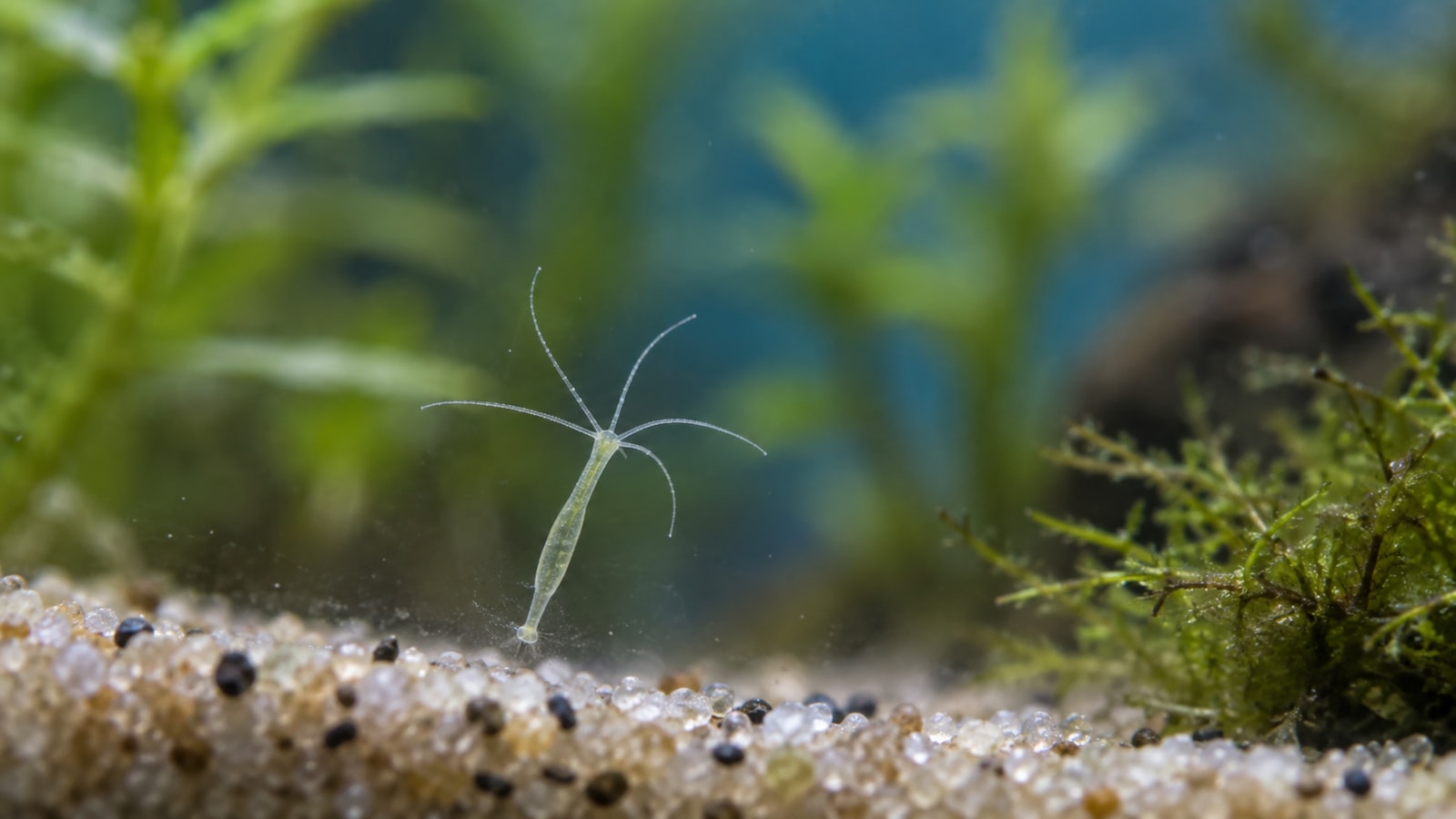
Hydra in an Aquarium: Harmless to Fish, Deadly to Fry
Hydra in an aquarium look like tiny stalks with tentacles. They are harmless to adult fish but eat fry and baby shrimp. How to starve them out or treat them.
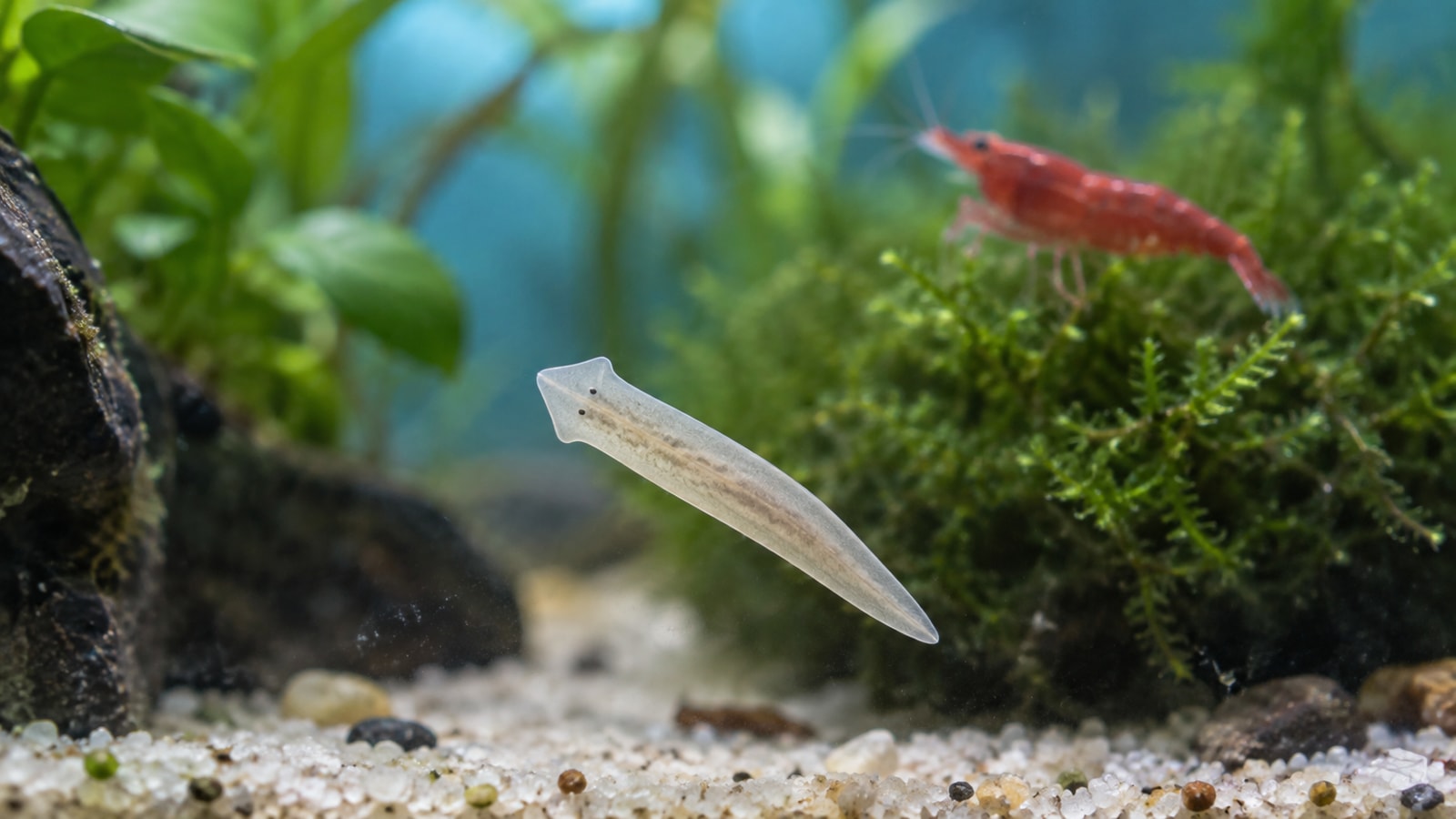
Planaria in an Aquarium: Harmless to Fish, Bad for Shrimp
Planaria in an aquarium are flatworms that glide on the glass. With fish they are harmless. In a shrimp tank, here is how to trap them and treat safely.