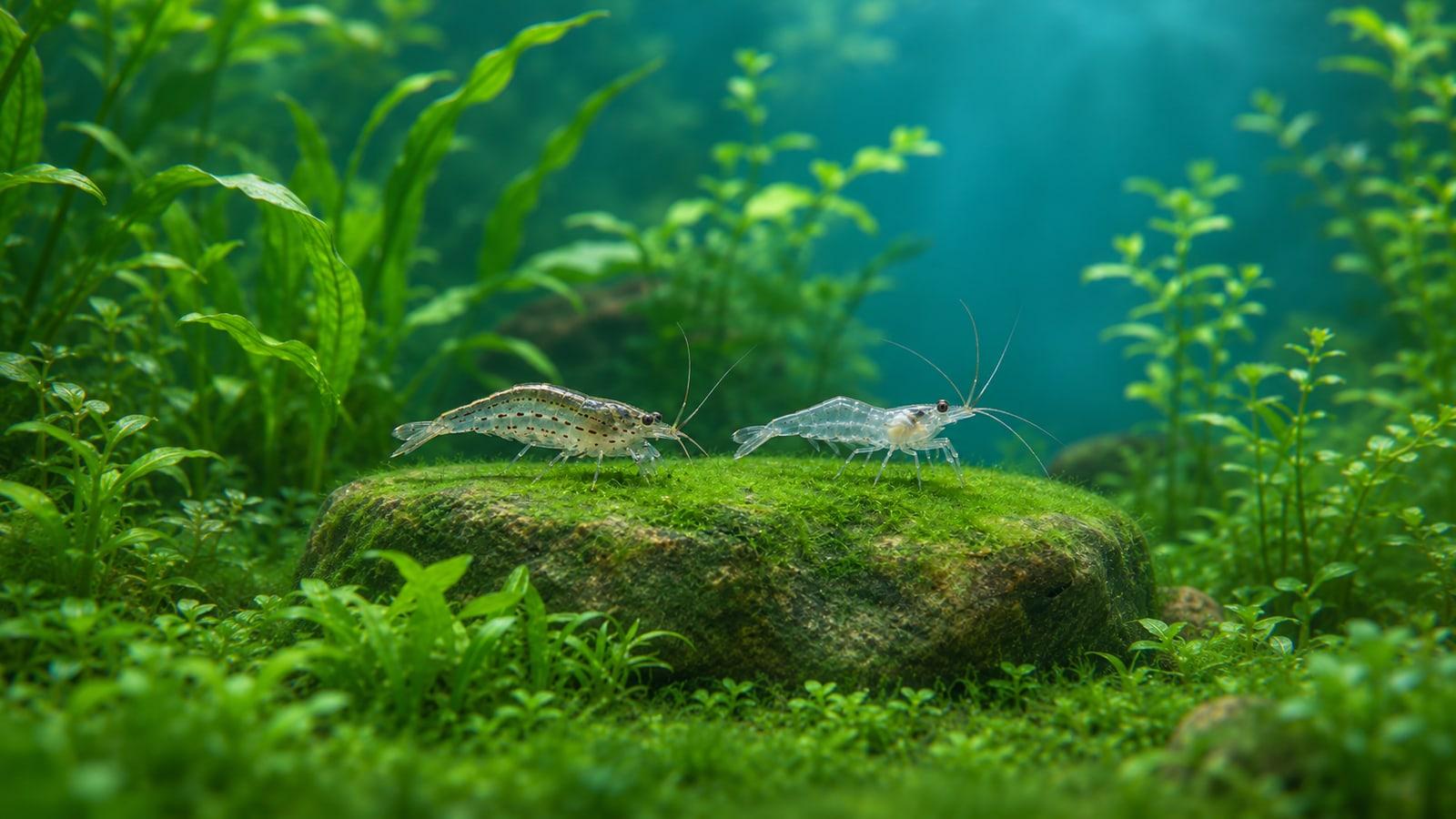
Both grow to about 2 inches. Amanos eat hair algae and live for years, but cannot breed in fresh water and cost about $6–7 each. Ghost shrimp cost under $1, live about a year, breed readily and may take fish fry. Built from species databases, lab studies, care guides and keeper reports, not from our own tanks.
The numbers
| Amano shrimp | Ghost shrimp | |
|---|---|---|
| What it is | Caridina multidentata, from rivers in Japan and Taiwan | A shop label; usually the eastern grass shrimp, a North American freshwater shrimp |
| How to tell | Dashed line of dots along the side | Near-clear body |
| Full-grown size | About 1.5–2 in (4–5 cm) | About 1.5–2 in; rarely over 2 in (50 mm) |
| Lifespan | Several years, by magazine and retailer figures; no study | About a year |
| Algae | Hair and thread algae; nibbles young black beard algae | Grazes soft film; mostly seen on leftovers |
| Breeds in a freshwater tank? | No: the larvae need salt water | Yes, the common species |
| Risk to fish fry | Low: a species profile says it may catch young fry; free-swimming fry generally safe | Higher: a seller of both sees it take fry more often |
| Price (US, Nov 2026) | About $6–7 each | Under $1 |
| Best for | Algae in a planted tank | A cheap scavenger |
Choose Amano shrimp to eat algae and ghost shrimp for a cheap scavenger. Amanos eat hair algae and live longer, but cannot breed in fresh water and cost about $6–7 each. Ghost shrimp cost under $1, live about a year, breed readily and may take fry.
Amano shrimp vs ghost shrimp is not a choice between two versions of one animal. They belong to different families, and "ghost shrimp" is a shop label for several species. This page is built from species databases, a Japanese prefectural red data book, lab papers, care guides and keeper reports. We have not kept or tested either shrimp, and the table above is that evidence, with prices checked on US store websites in November 2026.
Are ghost shrimp and Amano shrimp the same?
No. The Amano shrimp is Caridina multidentata, a member of the family Atyidae from large, rocky rivers in Japan and Taiwan (US Fish and Wildlife Service, quoting the IUCN assessment). Older books call it Caridina japonica; a 2006 revision showed the two names are the same species. Practical Fishkeeping credits the aquascaper Takashi Amano with making it popular in the 1980s.
The ghost shrimp most US shops sell is the eastern grass shrimp, Palaemonetes paludosus, a North American freshwater shrimp in the family Palaemonidae. Animal Diversity Web lists "glass shrimp, eastern grass shrimp, or ghost shrimp" as its common names. The label also covers other species, including long-arm shrimp; the ghost shrimp breeding guide sets out which ones turn up in shop tanks.
Different families, so the two cannot interbreed, the same reason ghost shrimp and cherry shrimp cannot.
How to tell them apart in the shop
Look at the side of the body, not the size. Hyogo Prefecture's red data book says the Amano is easy to tell from other shrimp of its family by "rows of dots in dashed lines" running from the carapace along the abdomen (our translation from the Japanese). A ghost shrimp is near-clear, which is where "glass shrimp" comes from. Size is no help, for the reason in the next section.
Amano vs ghost shrimp: which eats more algae?
The Amano, and by a wide margin for the stringy algae keepers want gone. Do Amano shrimp eat hair algae? Yes: Aquarium Co-op's care guide says they "will go after hair algae, thread algae, and even black beard algae", and Chewy's vet-reviewed guide, What Are the Best Aquarium Cleanup Crews?, lists hair and thread algae among what they eat. Both name a limit. Co-op says Amanos "aren't as good at eating flat types of algae that grow on surfaces", and Chewy says they do not control green spot algae.
On black beard algae, this site's position stands: Amanos nibble young tufts and do not clear an established patch. They do graze the diatoms behind brown algae.
There is one measured figure. In a test by the plant grower Tropica, on tiles coated with a film of green algae and diatoms, one Amano ate about twice as much as a nerite snail and about six times as much as a cherry shrimp. The original page is no longer online; the text survives in a 2014 forum repost. Ghost shrimp were not in the test, and the algae was film, not hair algae.
Do ghost shrimp eat algae?
Yes, whatever the forums say. "Ghost shrimp don't eat algae.. they are scavengers" is a 2004 forum answer, and a second keeper in the same thread said the same. In the wild, the diet of the eastern grass shrimp "is dominated by algae (diatoms and green algae)", with plants, detritus and small insects as well (Animal Diversity Web). In a tank they graze the soft film on glass and plants, the biofilm every shrimp picks at.
What keepers do not report is ghost shrimp clearing hair algae. One keeper in a 2006 thread put it this way: "Amanos will eat up on various algae buildups while the ghost shrimp will most munch on leftover food." Another in the same thread thought ghost shrimp pick at hair algae, and that neither shrimp makes much difference to algae "unless you have a lot of them". Chewy's Ghost Shrimp Aquarium Care says they even eat brush algae, without a source.
No test has compared the two on the same algae. The ranking rests on Tropica's Amano figure and on what keepers see. Two more things are worth knowing:
- A well-fed Amano eats less algae. Co-op says they "will happily steal fish food from their tank mates".
- Neither shrimp fixes the cause. Algae comes back while the light and the feeding stay the same.
Size, lifespan and price of Amano and ghost shrimp
| Amano shrimp | Ghost shrimp | |
|---|---|---|
| Full-grown size | About 1.5–2 in (4–5 cm); females larger | About 1.5–2 in; rarely over 2 in (50 mm) |
| Lifespan | Several years, by magazine and retailer figures; no study | About a year; 6–13 months in the wild |
| Price (US, Nov 2026) | About $6–7 each | Under $1 |
Size. Shop pages say Amanos are noticeably bigger; The Shrimp Farm's comparison gives "up to 2.5 inches" against 2 for ghost shrimp. The species records put them closer. Hyogo's red data book gives the Amano a body length of 40 mm (1.6 in) and calls it the largest shrimp of its family in the prefecture; Aquarium Co-op says 1.5 to 2 inches, with males smaller. Animal Diversity Web puts the eastern grass shrimp at about 47 mm, adults "usually do not exceed 50 mm". What you see in a shop tank depends on age as much as species: The Shrimp Farm says Amanos commonly arrive at around 1 inch. Size is not a safe way to tell the two apart.
Lifespan. Ghost shrimp live about a year; Animal Diversity Web gives 6 to 13 months in the wild, and a newly bought one may already be months old. How long ghost shrimp live covers why many die in the first days. For the Amano we found no study at all. Practical Fishkeeping says "up to four years" and The Shrimp Farm's care sheet "about 3-5 years". Treat both as keeper and seller figures.
Price. PetSmart lists ghost shrimp at $0.79; Petco lists Amanos at $6.49 each, and The Shrimp Farm at $6.99 each in a pack of five (checked 19 November 2026; prices change). The ratio is what matters: one Amano costs about as much as eight ghost shrimp.
Do Amano shrimp breed in fresh water? Why it changes what you buy
Amano eggs hatch in fresh water, and the larvae drift down to the sea; Hyogo's red data book says the larvae "grow in the sea". In a lab study, Amano larvae developed across 17 to 34 parts per thousand of salt (ppt; sea water is about 35), according to Kondo et al. (2021). Fresh water was not one of the conditions tested, so the safe statement is that they need salt water to develop. Aquarium Co-op says they are "not capable of reproducing in regular freshwater tanks at all".
The consequence nobody spells out: an Amano group never grows. Females may carry eggs, but every Amano you will own is one you bought, at about eight ghost shrimp apiece. If a few die of age, you buy again.
The common ghost shrimp is the opposite. Its larvae become baby shrimp in 5 to 10 days in plain fresh water. In a tank with fish, most of them are eaten, so a ghost shrimp group rarely grows much either unless you raise the young apart; ghost shrimp breeding covers the eggs, larvae and rearing tub. If you want a shrimp that keeps its own numbers up, that is the cherry shrimp, in a tank of its own; what cherry shrimp eat covers feeding them.
Fry, fins and other tank mates
Will ghost shrimp eat fish fry?
They can. The Shrimp Farm, which sells both, says it has "never really seen" Amanos go after fry, "something that ghost shrimp will more commonly do", and that ghost shrimp may be "a little more prone" to picking at long fins. The Amano is not risk-free: FishProfiles' species profile says it "will eat unprotected fish eggs and young fish fry if it is able to catch them", while free-swimming fry are "generally considered safe". Part of the reason is the label: long-arm shrimp sold as ghost shrimp catch small fish, keepers report. Nobody has measured how often any of this happens. If you are expecting fry from a pregnant guppy, keep ghost shrimp out of that tank.
With a betta
Vet sources name ghost shrimp as a possible betta tank mate, PetMD and the University of Illinois vet school both, and neither mentions Amanos. Some shop blogs call Amanos the safer choice because they are bigger. They are bigger than a cherry shrimp; full grown, they are about the size of a ghost shrimp. Nobody has measured the risk, and both depend on the betta. Cherry shrimp with a betta and betta tank mates for a 5 gallon cover it in full.
With bigger fish
A goldfish eats small invertebrates as a normal part of its diet, so a goldfish tank is no place for either shrimp. The same goes, by our reading, for any fish with a mouth big enough for a 2-inch shrimp.
Can Amano and ghost shrimp live together?
Yes. "They're both peaceful and wouldn't fight with each other (as far as I've heard)," as one keeper put it in 2006, and we found no source that reports either species killing healthy adults of the other. Two things keepers watch for:
- Food. Amanos eat first and take what they can, so make sure some sinks to the bottom for the ghost shrimp, which Animal Diversity Web says are more active at night.
- Moults. A shrimp that has just shed its shell is soft for a while. Moss and plants give it somewhere to hide.
A normal tropical tank suits both. Aquarium Co-op gives Amanos 65–82°F (18–28°C) and pH 6–8. Animal Diversity Web gives wild eastern grass shrimp a preferred range of 50 to 95°F (10–35°C), and Aqueon says both shrimp are "not particular about pH or alkalinity as long as extremes are avoided"; we found no reliable aquarium pH range for ghost shrimp. Our suggestion, inside both: about 72–78°F (22–26°C).
For both shrimp:
- Drip acclimate over an hour or more.
- Never use a copper medicine in their tank. Seachem's copper treatment says "Remove all invertebrates - these are extremely sensitive to copper", and copper lingers in the tank afterwards.
- Fit a lid. Co-op calls Amanos "expert escapers".
Amano or ghost shrimp: which should you buy?
- Hair or thread algae in a planted tank: Amano.
- A cheap scavenger for leftovers in a community tank: ghost shrimp.
- A tank with fry, or one you breed fish in: Amano, the lower risk. Ghost shrimp are the likelier of the two to take fry.
- A betta: either is a gamble that depends on the betta; see the betta pages above.
- A goldfish: neither. The goldfish eats them.
- Trying shrimp for the first time on a tight budget: ghost shrimp, knowing they live about a year.
How many? The Shrimp Farm suggests groups of at least three and "around 1 shrimp per gallon"; Aquarium Co-op says Amanos do not need a group. No study sets a number. Shrimp add little to the waste load, which is why a 10 gallon stocking plan barely counts them. If you want another animal that cleans up rather than a second shrimp, mystery snails are the other common choice.
The short version
Amano for algae, ghost shrimp for a cheap scavenger. Same full-grown size, different families, different life cycles: Amanos never breed in your tank and live for years; ghost shrimp breed in fresh water, live about a year and are best kept away from fry.
Sources
- US Fish and Wildlife Service (2017). Clean Shrimp (Caridina multidentata) Ecological Risk Screening Summary. Quotes De Grave, Shy and Cai (2013), IUCN Red List, and Cai et al. (2006) on the name.
- Hyogo Prefecture. Red Data Book, invertebrates, entry 19, ヤマトヌマエビ (Amano shrimp). In Japanese; translations are ours.
- Baranowski (2011). Palaemonetes paludosus. Animal Diversity Web, University of Michigan Museum of Zoology.
- Kondo, Hamasaki and Dan (2021). Larval performance of three amphidromous shrimp species in the genus Caridina under different temperature and salinity conditions. Crustacean Research 50: 41–54.
- Tropica. Test of algae eaters. The original page is offline; text read in a 2014 repost on the Aquatic Quotient forum.
- Aquarium Co-Op. Care Guide for Amano Shrimp. A retailer's guide.
- Hill. Amano shrimp: Spineless heroes. Practical Fishkeeping.
- Puts (2024). Amano Shrimp vs Ghost Shrimp, and Curtis (2024), Amano Shrimp Care Sheet. The Shrimp Farm, a shrimp retailer.
- Chewy Editors (2025). Ghost Shrimp Aquarium Care; and Jaffe, reviewed by Ivan Alfonso, DVM (2026), What Are the Best Aquarium Cleanup Crews? Chewy.
- Aqueon. Freshwater Shrimp care guide.
- Seachem. Cupramine product page.
- Zayas, M. (2026). Betta Fish Care Sheet. PetMD.
- Mueller, quoting Dr. Krista Keller (2019). Bettas Need More Than Bowls. University of Illinois College of Veterinary Medicine.
- Prices, checked 19 November 2026: PetSmart, Ghost Shrimp; Petco, Amano Shrimp ($6.49, read in a browser that day); The Shrimp Farm, Amano Shrimp.
- Keeper reports: Aquaria Central, "Amano or Ghost shrimp?" (2006); fishforums.net, "will ghost shrimp get rid of hair algae?" (2004).
- FishProfiles. Caridina japonica species profile.
Questions people ask
Mentioned in this guide
Related guides
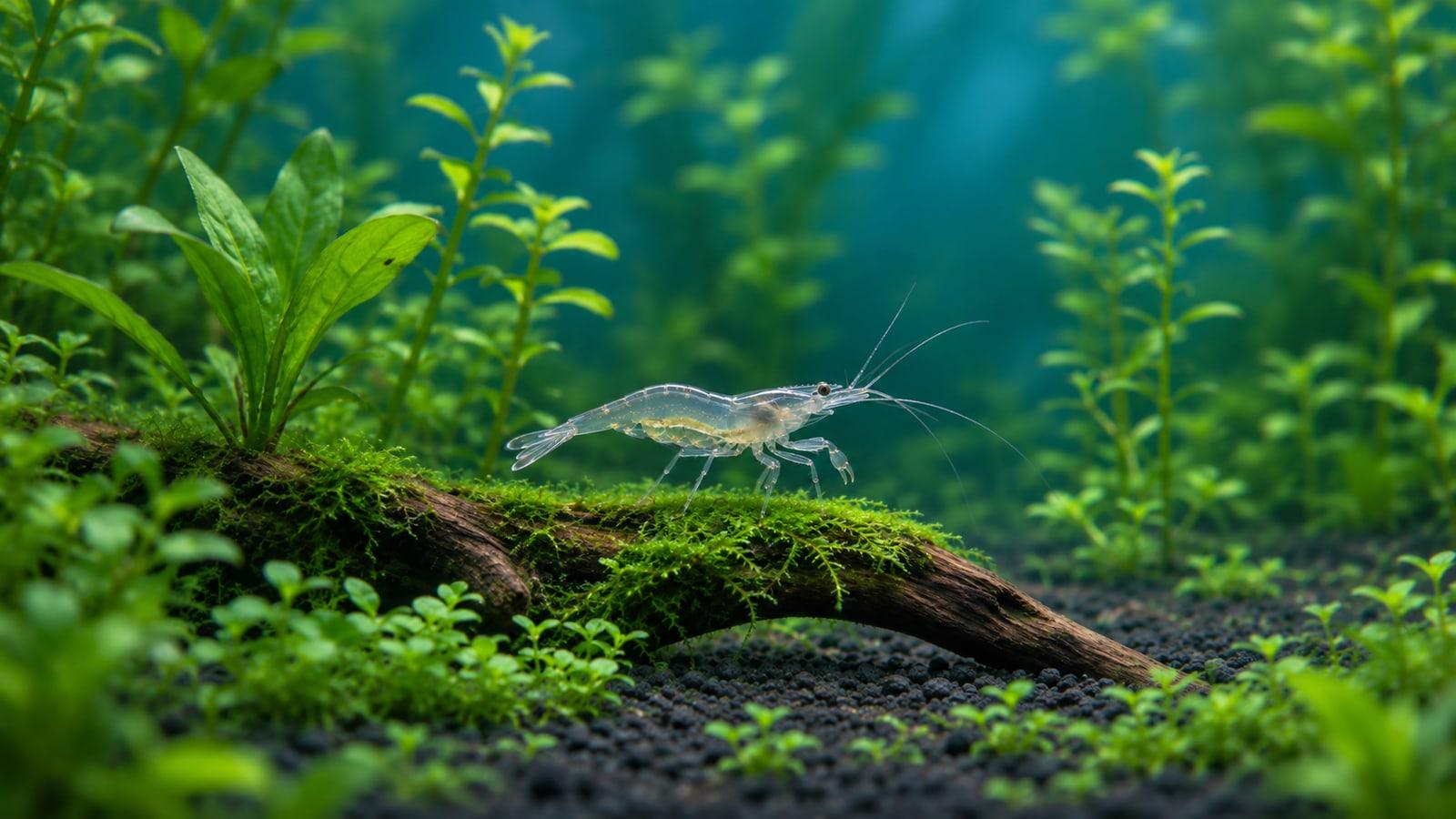
Ghost Shrimp Lifespan: How Long Do They Live? About a Year
How long do ghost shrimp live? About a year. Why many die within days or weeks of purchase, and how to tell old age from a tank problem.
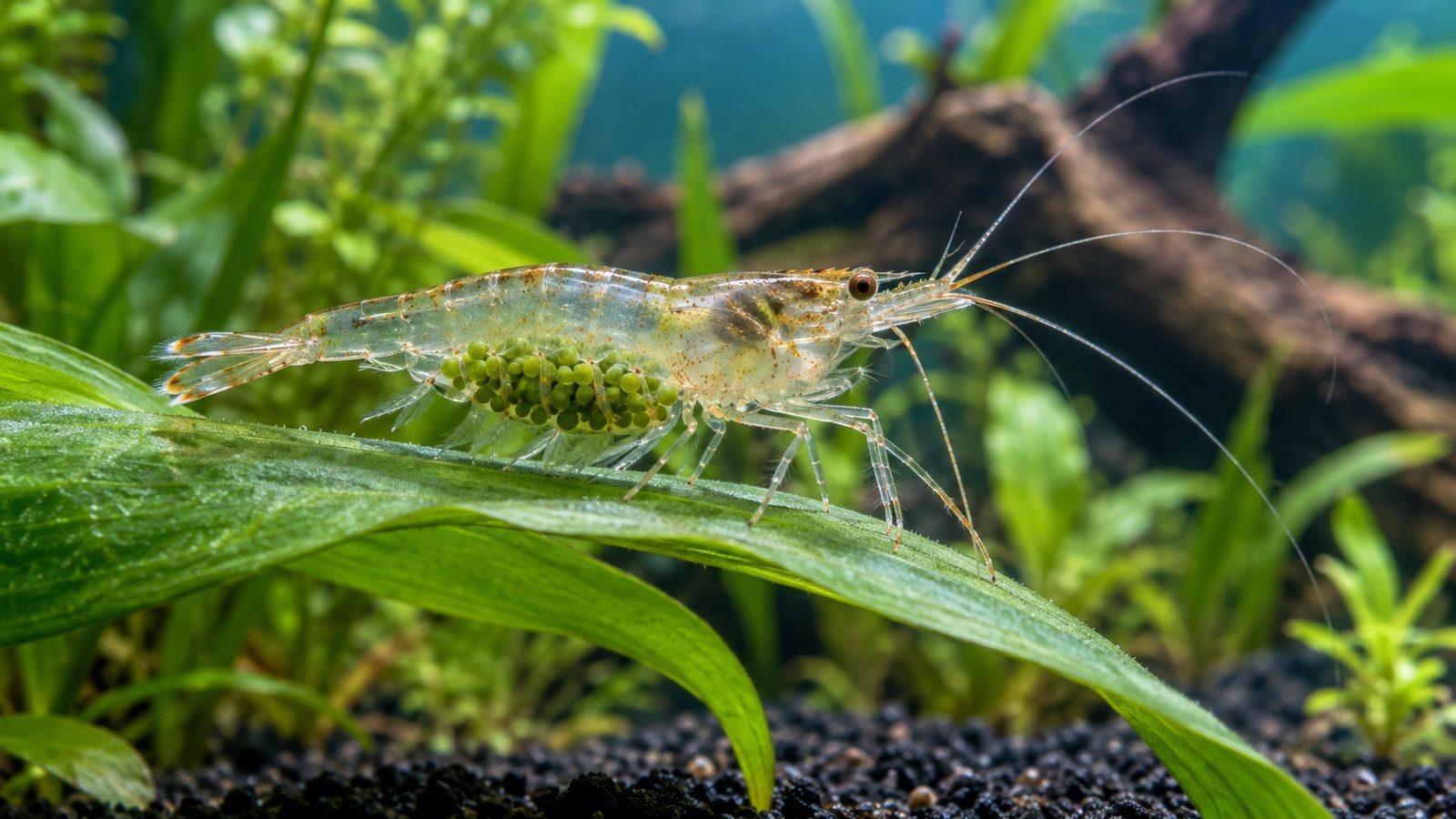
Ghost Shrimp Breeding: Eggs, Larvae and Which Ones Need Salt
Ghost shrimp breeding works in freshwater for most US ghost shrimp. How to spot the eggs, when they hatch, raising the larvae, and which kind needs salt.
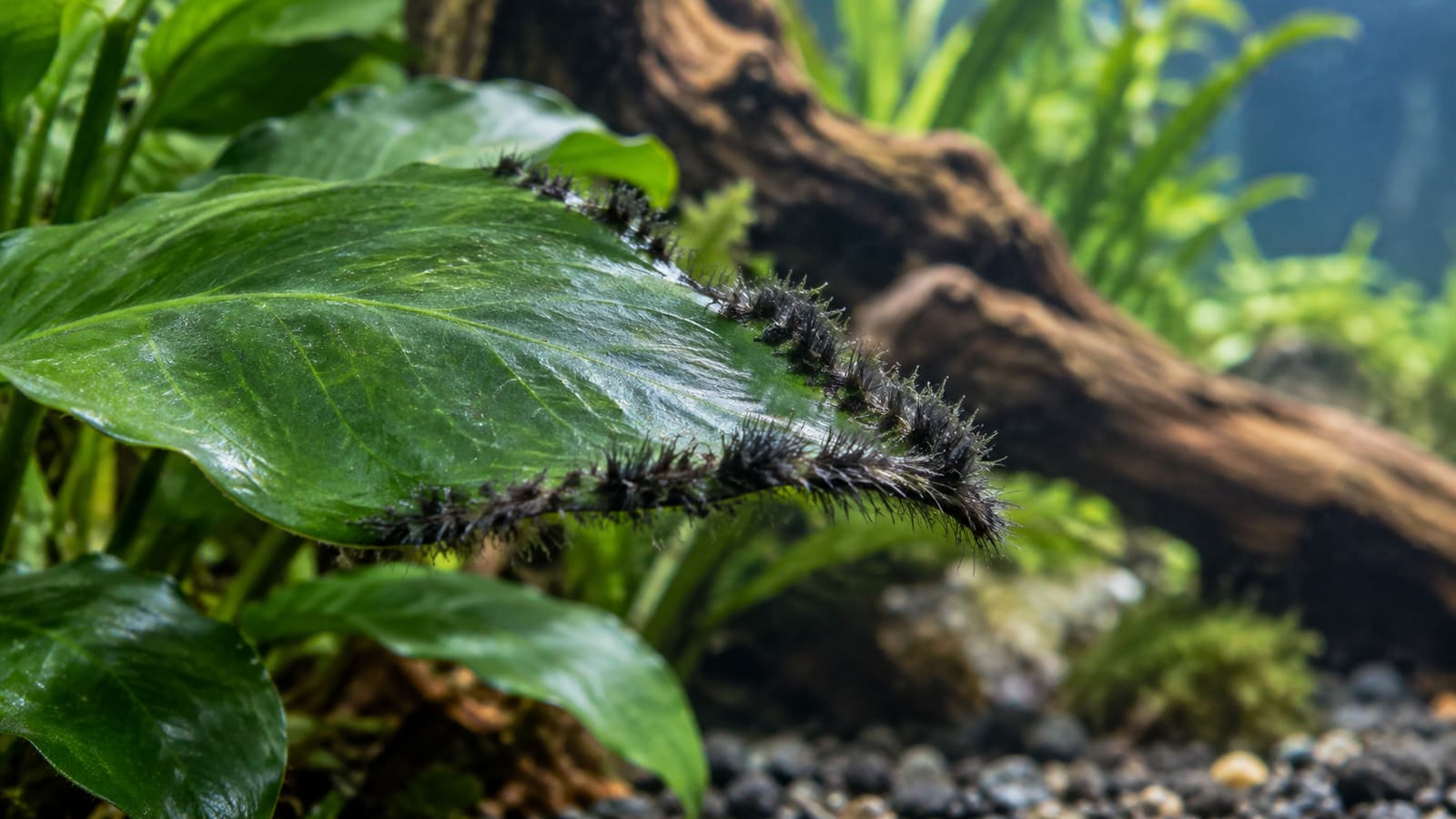
Black Algae in a Fish Tank: Black Beard Algae and How to Remove It
Black algae in a fish tank is almost always black beard algae: dark tufts on leaf edges and wood that will not wipe off. Why it grows and how to get rid of it.