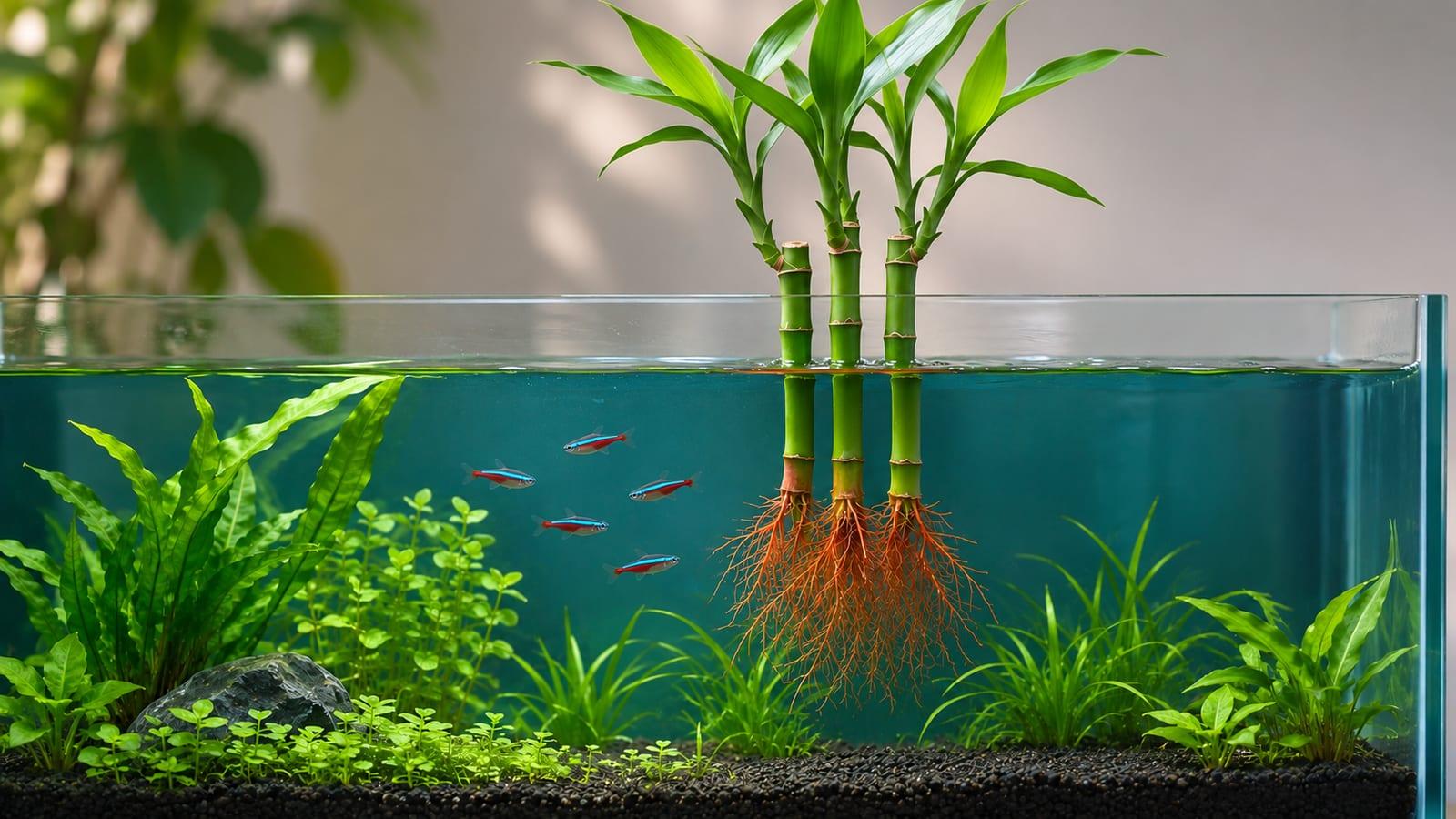
Fully submerged, it rots. Healthy roots have no reported effect on fish, but the plant is toxic to cats and dogs that chew it. It takes up a little nitrate, slowly, less than pothos. Based on extension care sheets, poison-control listings and keeper reports, not our own growing.
The numbers
| Setup | Works? | How | Watch for |
|---|---|---|---|
| In a hang-on-back filter | Yes | Stalk in an empty chamber, roots in the flow, leaves out | Roots blocking the flow; a filter in a dark cabinet needs a light |
| Clipped at the rim or through a lid cut-out | Yes | Roots and an inch or two of stalk underwater, leaves in the room | A cat reaching the leaves |
| Base in the gravel, leaves above water | Yes, in an open-top or low-water tank | Bury the base so it stands; every leaf above the waterline | The water level rising over the lowest leaves |
| Fully submerged | No | Do not | Keepers report the leaves yellow and the stalk rots |
| Betta vase with the plant on top | No | Do not | No heater, no filter, too small; the roots are not food |
Yes, lucky bamboo can go in an aquarium, as long as only the roots and the bottom of the stalk sit in the water and every leaf stays above it. It is Dracaena sanderiana, a land plant, and its leaves rot underwater.
Despite the name, it is not bamboo. Clemson Extension calls it "not true bamboo", and NC State Extension says "Lucky bamboo is not a bamboo at all." It is an understorey shrub from Central and West Africa, in the asparagus family (NParks, NC State, Kew). It is sold as cane cuttings that root easily in water; the University of Arkansas Extension calls it "one tough little plant" that is easy to keep going "for a year or more in just water". The "bamboo" pet shops sell for fish tanks is usually this same plant.
It works on the same split as pothos: roots under the water, leaves above it. It grows more slowly and carries a different toxin, and both change the advice. This page is built from university extension care sheets, Singapore's NParks, poison-control listings, vet-reviewed articles, papers and keeper reports. We have not grown lucky bamboo in a tank, and the table above is that evidence turned into placements.
Can lucky bamboo be fully submerged? Why the leaves stay out
No botanical source calls lucky bamboo an aquatic plant. NParks describes a multi-stemmed understorey shrub that "grows well in either soil or directly in water". Our reading: it roots readily in water, which is how the trade sells it, but its leaves are land leaves.
Every care sheet that grows it in water covers the roots and a little stem, nothing more:
- Clemson Extension: "The stems of lucky bamboo should be submerged in enough water to cover the roots and at least one inch of the stem."
- Chewy's Growing Hydroponic Plants for Aquariums: "Only roots and stems remain in the water."
- PetSmart's US listing, Top Fin Lucky Bamboo Live Aquarium Plant for Fish Tanks – 8 in, which sells it as an aquarium plant: "Plant top must remain above water."
Keepers report the same. On Monster Fish Keepers, members say only the roots and the bottom of the stalk go in and the rest rots if submerged; a moderator says a stalk entirely in the water dies. Threads on FishLore and UKAPS describe submerged leaves dying and a fully submerged plant rotting after a few months.
The other side. PetSmart's Canadian listing, Top Fin Bamboo Live Plant, says the same plant "Can grow fully or partially submersed", and several content sites agree. A few keepers on FishLore report a submerged stalk lasting a long time, one for two years, while others in the same threads say theirs lasted a week to a month. One hobbyist's write-up on AquAnswers says a submerged stalk "does not rot and the leaves keep growing", with no dates or photos over time. Results seem to vary from plant to plant, and nobody has recorded how long a fully submerged stalk lasts.
We side with the care sheets. If a submerged stalk does rot, it rots inside your tank, and rotting plant matter adds ammonia. Keeping the leaves out costs nothing. If you want a plant that lives fully under the waterline, use a true aquatic plant such as java fern or anubias.
How to put lucky bamboo in a fish tank
- Quarantine it first if you keep shrimp or snails. Shop plants can carry systemic pesticides; use the five-day bucket method in the pothos guide.
- Take off whatever it came with: wire ties, gel, pebbles or packing material. Rinse the roots in dechlorinated water.
- Strip any leaves that would sit below the waterline.
- Pick a placement from the three below, so the roots and an inch or two (2.5 to 5 cm) of stalk are underwater and every leaf is above it.
- Secure it so it cannot shift or fall in. Chewy's guide says it "Needs to be secured in place so it won't shift around".
- Check it at each water change. A firm green stalk is fine. Chewy says to remove it "if it starts to yellow or develop slime"; a soft section comes out the same day.
Three placements that keep the leaves dry:
- In a hang-on-back filter. Chewy's guide names "an empty chamber of a hang-on back filter" as one way to hold a hydroponic plant: roots in the flow, leaves above the lid. Trim the roots before they block the outflow, as with pothos. A filter or sump inside a closed cabinet leaves the plant in the dark; keepers on Monster Fish Keepers say it then needs "a small light".
- At the rim or through a lid cut-out. Wedge or clip the stalk at the back edge so the roots hang in the water and the leaves are in the room.
- Base in the gravel. Only in an open-top tank, or one where the water sits below the lowest leaves. PetSmart's US listing says to "place this tall (background) plant in the back". In a lidded tank filled to the rim, the leaves end up underwater, so use one of the other two.
Light. Clemson recommends "bright, indirect light" and warns that "Direct sunlight will damage the leaves, causing them to turn brown." Ordinary room light on the leaves above the tank is the light it uses. Keep the tank out of direct sun anyway.
Temperature is not a problem. Clemson says to bring it indoors before nights fall below 65°F (18°C); a tropical tank runs at 76–78°F (24–26°C).
No houseplant fertiliser. Clemson's quarter-strength fertiliser every other month is for a vase of plain water. In a tank the fish feed it: Chewy's guide says "As long as the fish are properly fed, the plants should not need fertilizers." Its lucky bamboo notes do add that it "Might need fertilizer", but we found no source that tested houseplant fertiliser on fish, so we would not add it.
Is lucky bamboo toxic to cats, dogs or fish?
The pages that say "not at all toxic" are answering for fish and forgetting the cat. The two answers are different.
To cats and dogs: yes, mildly, if eaten
The ASPCA lists Dracaena as "Toxic to Dogs, Toxic to Cats", with saponins as the toxic principle and signs including "Vomiting (occasionally with blood), depression, anorexia, hypersalivation, dilated pupils (cats)." Pet Poison Helpline names lucky bamboo among its Dracaena common names and says the saponins are "within the leaves and stems". NC State Extension rates it "low severity" and toxic "if ingested, for cats and dogs".
The real risk of this setup is the cat
A stalk with its leaves sticking up from an open tank rim is at cat height. If a cat or dog chews it, call your vet or a pet poison line.
To fish: no reported harm from healthy roots
Keepers commonly grow lucky bamboo with its roots in tank water. The fish deaths blamed on it in forum threads come with no water readings, and replies in the same threads point as often to residue on a shop stalk, or a stalk that died and rotted, as to the plant itself. Keepers argue about it; nobody has shown it.
One caution, and it is where lucky bamboo differs from pothos. Pothos holds insoluble crystals that stay in the leaf, which is why the pothos guide can say they do not dissolve into the tank. Lucky bamboo's toxin is a saponin, and saponins dissolve in water. A Vietnamese study isolated a steroidal saponin from the roots of cây Phát lộc, which it names Dracaena braunii and gives D. sanderiana as a synonym (Lê Thị Ngà et al., 2023). As a class, saponins are "highly toxic to fish, because of the damage caused to the respiratory epithelium of the gills" (Francis and Becker), and the FAO's shrimp-farming manual uses teaseed cake, 10 to 15% saponin, to clear fish out of shrimp ponds.
Nobody has measured what a living stalk releases into a tank, and there is no report of it harming fish. The practical result is small: a healthy stalk stays, and a soft, yellow or slimy one comes out the same day, because a stalk breaking down is releasing what is inside it.
Is lucky bamboo good for an aquarium? What it does for nitrate
A little, slowly. Plants use nitrate as food, and fast growers use the most, as the nitrate guide puts it. NC State lists lucky bamboo's growth rate as slow, and Chewy's guide calls it "Slow-growing". Expect it to do less than pothos.
The one direct measurement is a 2026 lab study: lucky bamboo in a hydroponic set-up removed 71–73% of the nitrate from synthetic wastewater over five days at the lowest concentration, falling to about 51% at the highest (Moslih and Hazzaa). That was a lab tub, and the abstract does not give how much plant sat in how much water, so the figure does not transfer to a tank.
It is not a filter: the bacteria deal with ammonia. It does not change the weekly water change either. The nitrogen only leaves the tank when trimmed growth leaves with it.
Can a betta live in a vase with lucky bamboo?
The arrangement: a betta in a vase with a plant sitting in the neck, on the idea that the fish lives on the roots. It does not. WebMD, in an article reviewed by a vet, says the belief that bettas can survive "just by munching on the roots of plants" is "not true and can be harmful to your betta fish". A University of Illinois vet column says "plants are not a food source" and that bettas "should not live in bowls". A betta cannot live on the roots of a plant in a vase; it needs animal protein.
What a betta needs instead:
- At least 5 gallons (19 litres); a vase or bowl is too small.
- A heater holding 76–81°F (24–27°C), and a filter.
- Open water at the surface, because bettas breathe air there. Do not let roots mat over it.
Lucky bamboo itself is fine in a betta's tank, set up as above.
Why lucky bamboo turns yellow in a fish tank
- Too much stalk underwater. NC State lists yellowing leaves and rotting stems as signs of overwatering, and keepers report submerged parts rotting. Take it out, cut above any soft section, and set it back with less underwater.
- Direct sun on the leaves. Clemson says it turns them brown.
- Brown leaf tips. The University of Arkansas Extension puts tip burn down to "high salts or high fluoride concentrations in the water". The plant is also sensitive to chlorine (NParks), which dechlorinated tank water already deals with. Trim brown tips with clean scissors if they bother you.
- Slime or a soft stalk. Out the same day, as above.
The short version
Roots and the bottom inch or two of stalk in the water, every leaf out, cats kept off the rim, and any soft stalk out the same day. For nitrate, pothos does more; for a plant that lives underwater, use a real aquatic plant.
Sources
- Long. How To Grow and Care for Lucky Bamboo (Dracaena Sanderiana). Clemson Cooperative Extension, Home & Garden Information Center, 2 February 2026.
- NC State Extension. Dracaena sanderiana (Lucky Bamboo). Extension Gardener Plant Toolbox.
- Klingaman. Lucky Bamboo. University of Arkansas Cooperative Extension, Plant of the Week, 3 December 2004.
- National Parks Board, Singapore. Dracaena sanderiana. Flora & Fauna Web.
- Royal Botanic Gardens, Kew. Dracaena sanderiana. Plants of the World Online. Native range West Central Tropical Africa to north-east Angola; read via search record.
- ASPCA. Ribbon Plant. ASPCA Animal Poison Control, toxic and non-toxic plants list.
- Pet Poison Helpline. Dracaena.
- Lê Thị Ngà, Từ Quang Tân, Nguyễn Thị Hải Yến and Nguyễn Đức Hùng (2023). Nghiên cứu hoạt tính kháng khuẩn và phân lập hợp chất saponin từ cao chiết ethanol của rễ cây Phát lộc (Dracaena braunii Engl.) (Antibacterial activity and isolation of a saponin from the ethanol extract of Phát lộc roots; our translation). TNU Journal of Science and Technology 228(05), 28 April 2023. In Vietnamese; abstract read; the paper lists D. sanderiana as a synonym.
- Francis and Becker. Antinutrients in plant-derived fish feed ingredients. Global Aquaculture Advocate, 1 April 2002.
- FAO. Manual on Pond Culture of Penaeid Shrimp.
- Moslih and Hazzaa (2026). Evaluation of the efficiency of Dracaena sanderiana in removing nutrients from synthetic wastewater by phytoremediation technology. Samarra Journal of Engineering Science and Research 4(2): 22–34. Abstract read.
- WebMD. What Do Betta Fish Eat? Medically reviewed by Vanesa Farmer, DVM, 23 January 2025.
- Mueller, quoting Dr. Krista Keller (15 April 2019). Bettas Need More Than Bowls. University of Illinois College of Veterinary Medicine.
- Chewy (2026). Growing Hydroponic Plants for Aquariums. Hilary Jaffe, reviewed by Joseph Hiduke (not a vet); updated 2 July 2026. A retailer's guide, cited by title.
- PetSmart. Top Fin Lucky Bamboo Live Aquarium Plant for Fish Tanks – 8 in (US listing) and Top Fin Bamboo Live Plant (Canada listing). Retailer product pages, read 24 November 2026, cited by title.
- Momchil. Bamboo in an aquarium: truths and myths. AquAnswers, updated 3 January 2026. One hobbyist's account.
- Keeper reports: Monster Fish Keepers, Lucky Bamboo in an Aquarium? (2011); threads on FishLore, UKAPS, Aquaria Central and FishProfiles, read as search snippets.
Questions people ask
Related guides
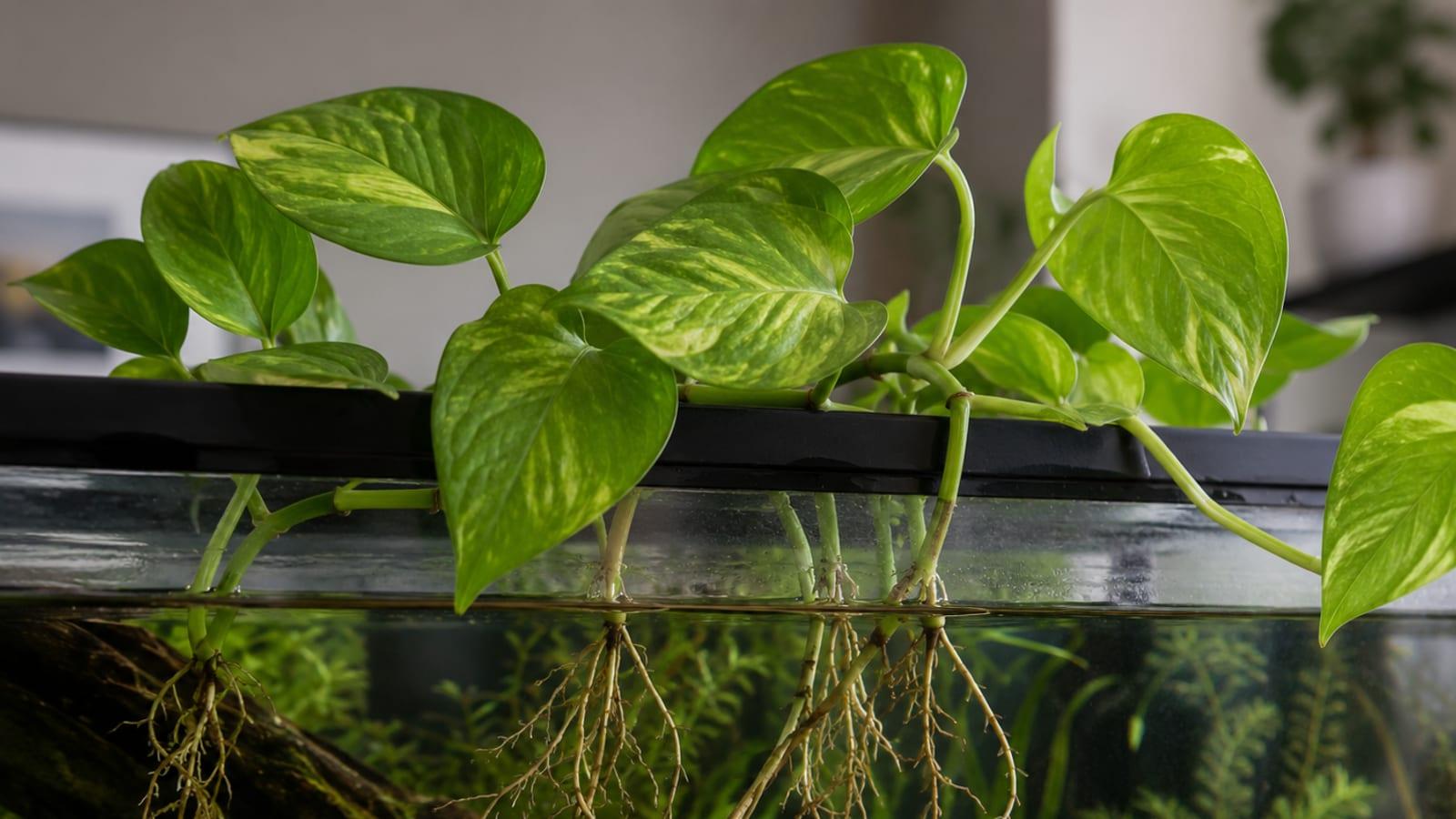
Pothos in an Aquarium: Safe for Fish, Risky for Shrimp
Pothos in an aquarium is safe for fish and a strong nitrate exporter — roots in the water, leaves in the air. The real risk is the pesticide on the plant.
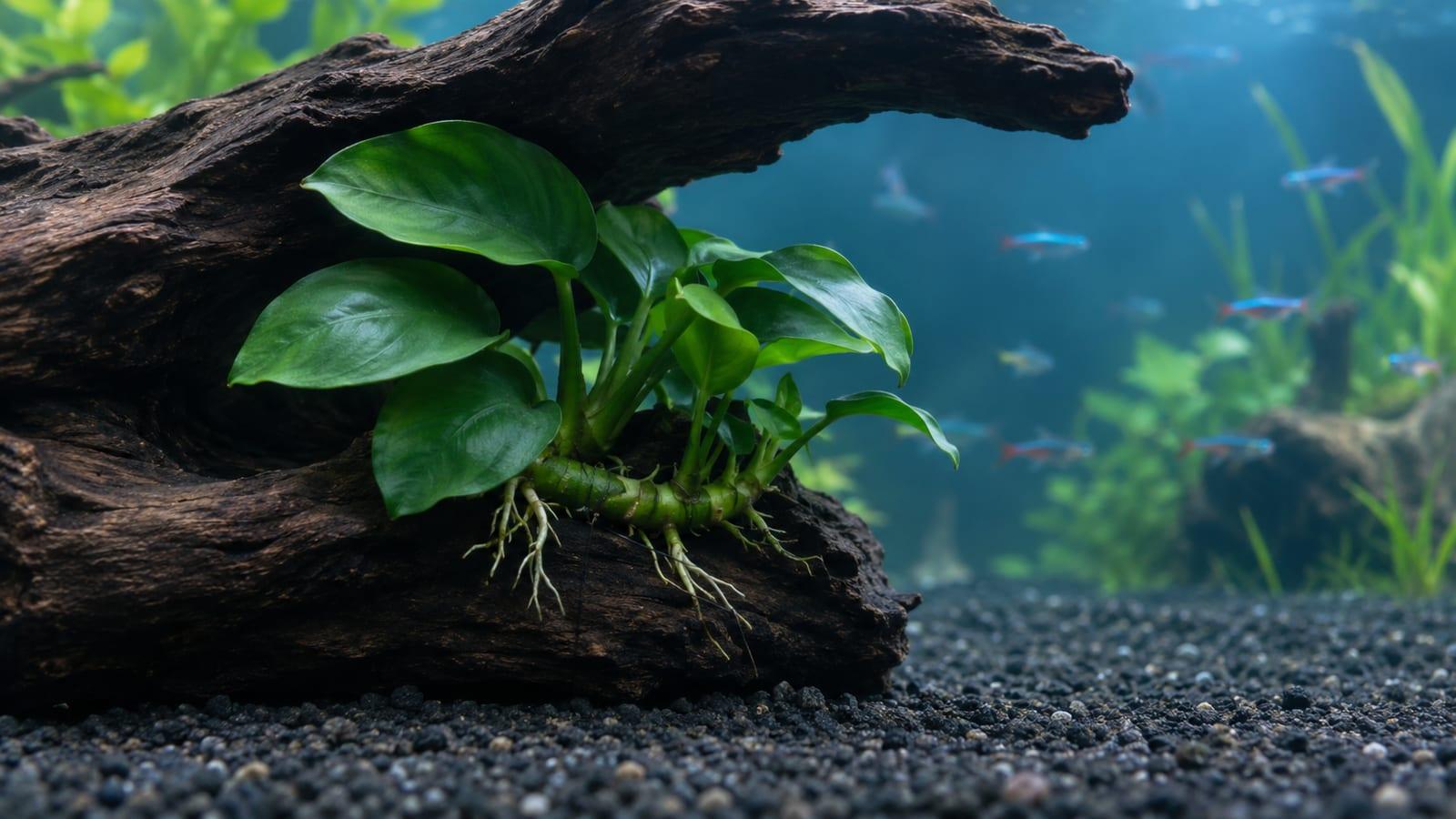
How to Plant Anubias Without Rotting the Rhizome
How to plant anubias: glue or tie it to wood or rock, or push just the roots into gravel. Keep the rhizome uncovered, pick a size, and stop it rotting.
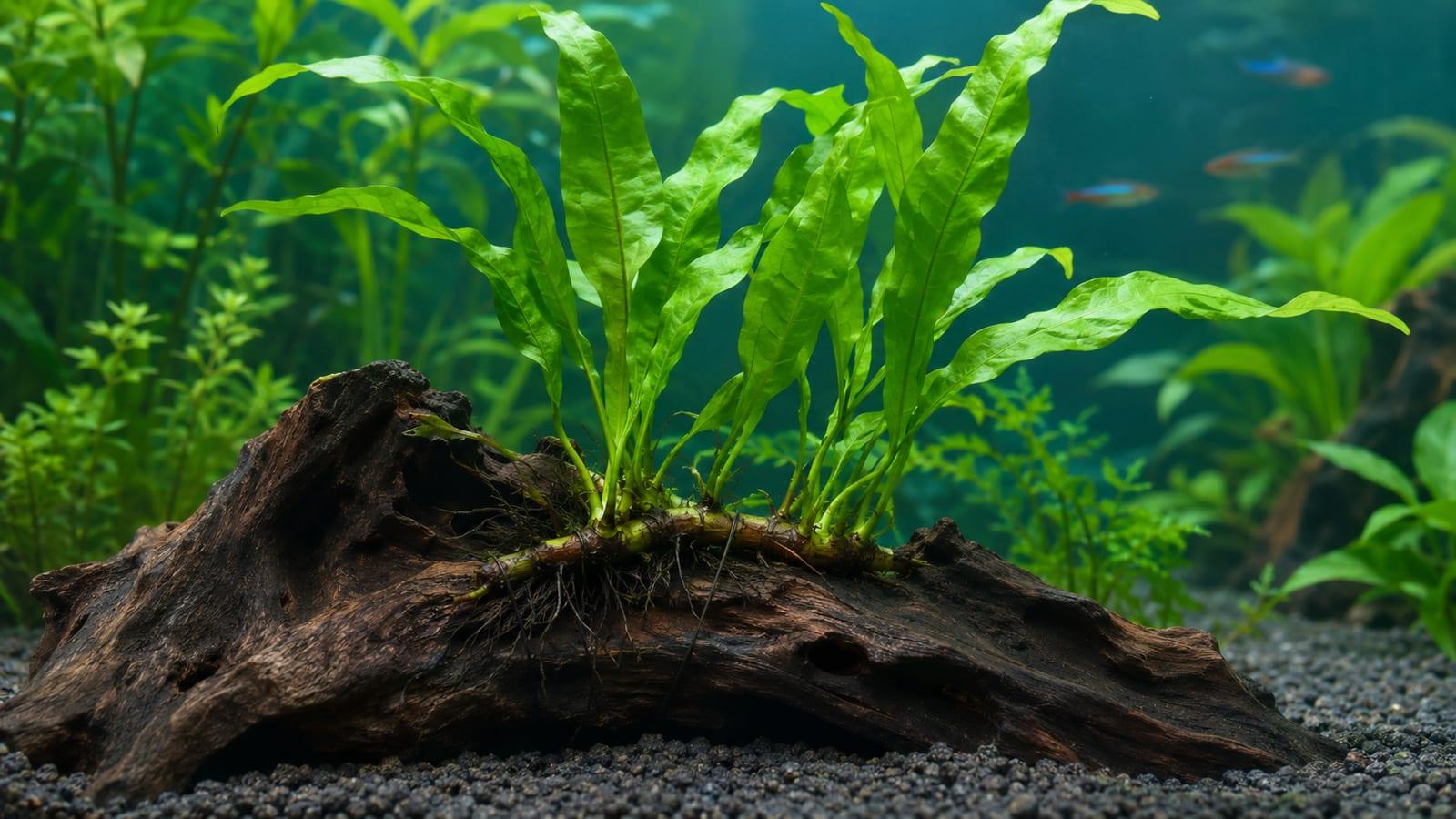
How to Plant Java Fern: Tie It, Glue It, Never Bury It
How to plant java fern: tie or glue the rhizome to wood or rock, or wedge it, and never bury it. Which glue, how much light, and why new ferns melt.