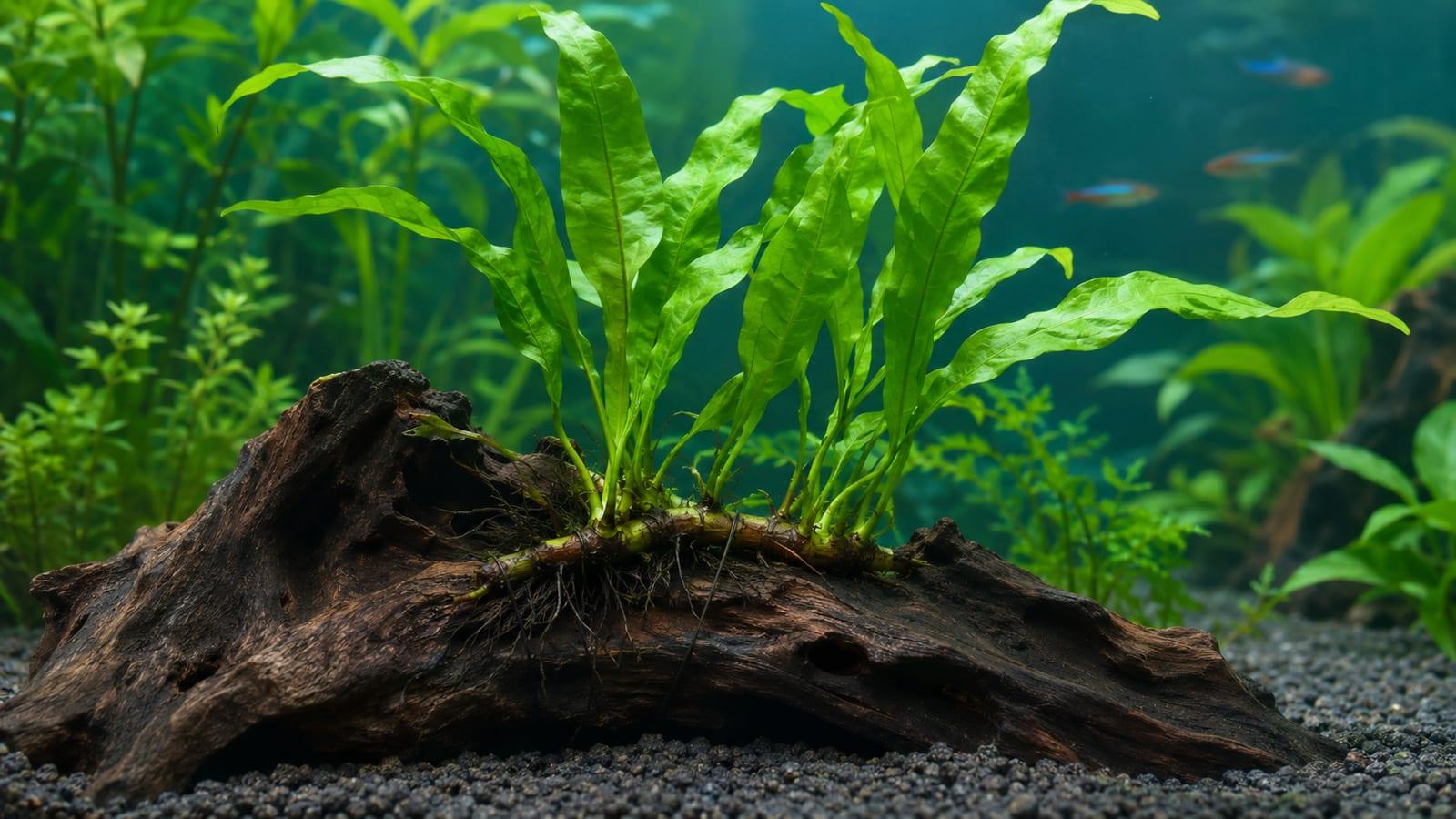
Never bury the rhizome: Tropica says it rots. The roots can go into gravel. Use cyanoacrylate gel glue on the roots, not the rhizome, give it ordinary light, and expect some leaves to melt in the first weeks. Based on plant growers' data, care guides and keeper reports, not our own growing.
The numbers
| Method | How | Best for | Watch out for |
|---|---|---|---|
| Thread or fishing line | Wrap between the leaves, round rhizome and wood, firm not tight | Driftwood you may move later | Weeks to months to grip; cut fishing line off once it holds |
| Gel super glue | A small bead on the wood or rock, press the roots in and hold until it stays put (Seachem: 20 seconds) | Rock, and the quickest job | Cyanoacrylate gel only; keep it off the rhizome and leaves; not on glass |
| Wedged | Push the rhizome into a gap between stones or a crack in the wood | Rockwork, no materials | Needs a gap that holds it; can work loose before the roots grip |
| Roots in gravel | Roots down into the gravel or sand, rhizome on top | When there is no wood or rock | The rhizome must stay uncovered |
| Floating | Let it drift | A stopgap | Drifts with the current; it may or may not catch on something and attach |
| Rhizome buried | Do not | Nothing | Tropica: a covered rhizome rots |
To plant java fern, tie or glue its rhizome, the thick horizontal stem the leaves grow from, to wood or rock, or wedge it into a gap. Never bury the rhizome, or it rots; the roots can go in gravel.
The reason is where it lives. A Botanical Survey of India datasheet puts java fern (Microsorum pteropus, now classed as Leptochilus pteropus) "in the flood zone of shaded streams or on wet rocks, usually in the spray zone", underwater when the stream runs high. It is an epiphyte, built to cling to a surface rather than sit in a bed of gravel, and it takes most of its food from the water, like the other plants that need no plant substrate. This page is built from plant growers' data (Tropica, Dennerle), botanical references, a glue maker's instructions, hobby care guides and keeper reports. We have not grown these plants, and the table above is that evidence turned into a method.
Find the java fern rhizome first
The rhizome is the thick horizontal stem the leaves grow from. The thin, dark roots hang from it. Leaves up, roots down, rhizome in between.
Get the plant ready:
- From a pot: take it out and pull away the rock wool. Tropica's planting guide says to cut off overgrown roots if they will not let go: "cut off the overgrown roots so that you can remove the pot and mineral wool." Roots grow back. The rhizome is what matters.
- From a tissue-culture cup: pull the clump out and rinse the gel off. Aquarium Co-Op says to do it over a bucket or bowl and put the gel in the bin, not down the drain. Tissue-culture plants are grown sterile, so they bring no snails with them.
- A bunch with no rhizome: Practical Fishkeeping warns against ferns sold in bunches without it. Look for the stem before you buy.
If you keep shrimp, shop plants can carry pesticides that kill them, so quarantine a potted fern first. Keep the plant wet while you work.
How to plant java fern, step by step
- Choose the spot: a piece of driftwood or a rough rock, in the middle or back of the tank. Do it now, because the fern does best left in one place once it is planted.
- Prepare the plant as above: pot, rock wool or gel off, roots trimmed if they are in the way.
- To tie it, lay the rhizome along the wood with the roots against it. Wrap fishing line or cotton thread round rhizome and wood between the leaves, firm but not tight. Practical Fishkeeping's method is the same: tie it to a rock or a piece of wood and let it grip.
- Or glue it. With the wood or rock out of the water, put a small bead of cyanoacrylate gel on the spot or on the roots, press the roots against the wood and hold until it stays put: Seachem's directions say 20 seconds, Aquarium Co-Op's 30 seconds to a minute or two. The rhizome sits on top of the glue, not in it.
- Or wedge it. Push the rhizome into a gap between two stones or a crack in the wood. Tropica says the plant "can be tied on or squeezed between stones or roots".
- Put the wood or rock in the tank. If it sits on the gravel, check the rhizome is above the gravel line, not under it.
- Leave the tie on until the roots have gripped, then cut fishing line off. Practical Fishkeeping says the fern attaches "over the next few months".
Anubias is planted the same way, with the same rule about the rhizome; how to plant anubias covers what differs.
Tie, glue or wedge, and can it go in gravel?
All three work. The table above has the trade-offs; what it cannot hold:
- Glue is the quickest, and the plant hides it once it grows. Aquarium Co-Op, a fish and plant retailer, calls super glue gel "the best thing" and says thread, fishing line and rubber bands "aren't ideal".
- Thread or fishing line suits wood you may rearrange, and needs nothing but patience. Fishing line holds until you cut it. Cotton thread rots away on its own, which saves a job, but keepers report it can go before a slow plant has gripped.
- Wedging needs no materials and suits rockwork. It only works where the gap holds the rhizome firmly.
Which glue. A gel super glue whose label says cyanoacrylate. Seachem sells exactly that chemistry for plants, "a superior cyanoacrylate gel for attaching moss and plants to rocks, driftwood, and even gravel", and Co-Op recommends a super glue gel from a hardware store: "Make sure it has cyanoacrylate". Gel rather than liquid: keepers prefer it because it stays where you put it. Keepers also report that it sets white in water, which the roots and leaves soon cover. Seachem says not to use its glue on glass, and its label warns that it "Bonds skin and eyes in seconds."
Is it safe? Here is what is known. Aquarium makers sell cyanoacrylate gel for attaching plants. On Coral-List, a coral scientists' mailing list hosted by NOAA, a correspondent wrote in 2004 that super glues had been in wide use in reef aquariums "for at least 10 years", while saying they could not vouch that it was completely non-toxic. We found no study testing it on fish, shrimp or plants. So use a small amount, on the wood or rock and the roots, and keep it off the rhizome and leaves. Co-Op: "Do not cover the rhizome in super glue or the plant may suffer."
Not zip ties or rubber bands. Petco's care sheet, Java Ferns Care, lists "rubber bands or even zip ties" among the ways to attach it. Keepers report that rubber bands perish underwater and leave bits in the tank, and a band or tie left tight round the rhizome can hold back its growth. Thread or fishing line is gentler, and whatever you use comes off once the roots hold.
Roots in the gravel. This is allowed. Push the roots into the gravel or sand and keep the rhizome on top: Co-Op says the same, and Tropica's warning is only about covering the rhizome. One plant retailer, 2Hr Aquarist, goes further and calls the no-substrate rule a myth, pointing out that java fern grows in thick mud in the wild; it still warns that substrate full of organic waste can rot the rhizome. We stay with the majority: roots in if you like, rhizome never.
Floating works too. Co-Op says java fern "will thrive while floating", and the current may carry it to something its roots can hold on to. Until then it goes wherever the current takes it, which is why most keepers fix it in place.
How much light it needs and how fast it grows
Light: any ordinary aquarium light. Dennerle, a plant grower, rates it "medium – low"; Co-Op says anything from low to medium-high. Practical Fishkeeping: "Anything from the most basic LED unit will be fine." Run the light six to eight hours a day on a timer, the same as the rest of this site recommends for a new tank. Too much light can do harm: Co-Op says you can "burn or melt it", and keepers describe brown or see-through patches.
Growth: slow. Java fern grows a new leaf every few weeks. Slow leaves sit under the light for months, which gives algae time to settle on them; black beard algae on the leaf edges is the usual one.
Water. Dennerle gives 72–82°F (22–28°C) and pH 5–8, which covers normal tropical temperatures. Co-Op says it copes with anything from soft acidic water to alkaline, so it also suits a blackwater tank.
Food. It takes most of its food from the water, so root tabs and plant substrate do little for it. Aquarium Co-Op suggests an all-in-one liquid fertiliser as needed.
Size. Dennerle gives up to 16 in (40 cm), so it belongs in the middle or back of most tanks.
The first few weeks: why new leaves melt and turn brown
Much shop java fern is grown out of water on a farm, or in tissue-culture gel. Underwater, those leaves are replaced. Aquarium Co-Op puts it this way: "the emersed-grown leaves die off completely and the plant may appear to be 'melting.'" Tissue-culture plants "may experience some melting" too.
What to expect: some brown or see-through leaves in the first weeks, and then, Co-Op says, "little shoots popping up within a few weeks" if the plant has healthy roots and is not moved once planted.
The check is the rhizome. Keepers report that a firm rhizome means the plant is alive, whatever the leaves look like. Soft, black and mushy means rot. Check it is not buried, since a covered rhizome is what Tropica says rots. A firm piece of rhizome with a few leaves can grow on by itself, so cut away any soft part and reattach what is left.
Cut off leaves that are mostly dead, at their base. Co-Op says rotting leaves can cause "nitrogen spikes or algae growth"; they add waste to the water like any other rotting matter.
If the browning carries on past the first month, look at three things: a buried rhizome, light that is too strong or on too long, or brown dust on the leaves of a new tank, which is diatoms and wipes off (brown algae).
Brown or black spots: spores, babies, rot or algae
| What you see | What it is | What to do |
|---|---|---|
| Brown or black dots spread over the underside of the leaves, leaf firm | Spore patches (sori), the fern's normal spore cases | Nothing |
| Tiny leaves and dark roots growing from a leaf, often at the tip | A plantlet | Leave it; see the next section |
| Soft brown or black patches that spread, leaf going see-through, rhizome mushy | Rot or melt | Check the rhizome and the light; cut off dead leaves |
| Dark tufts on the leaf edges | Black beard algae | See black beard algae |
| Brown dust that wipes off | Diatoms | See brown algae |
The spore patches worry people most. PROSEA, a botanical handbook of South-East Asian plants, describes them "irregularly scattered on the whole leaf under surface, generally absent from the marginal and midrib areoles". Dr Bodo Schnell of sera, the fish-care maker, answering a keeper who thought they were eggs, says black spots on the underside in "a more or less regular pattern" are very likely the fern's own sporangia. Purdue's extension horticulturist says the same of ferns in general: "They are fern spore cases and are not harmful to the plant."
PROSEA also says that kept underwater all the time, java fern reproduces "predominantly vegetatively (sori only incidentally produced)": new plants from its leaves and rhizome, not spores, are how it usually multiplies in a tank.
Propagating java fern: baby plants and splitting the rhizome
Java fern makes its own young plants on its leaves; PROSEA describes them at the leaf tips, and Dennerle lists "daughter plants from leaves and roots". Practical Fishkeeping says they "can then be pulled off when just a couple of inches long and be attached to a new surface". Tie or glue them like the parent. Co-Op notes that the mother leaf "will eventually die off" after it has grown a plantlet.
The other way is to cut the rhizome into pieces with a few leaves each, and attach each piece to wood or stone, which is how PROSEA describes aquarium plants being propagated.
The short version
Rhizome on the wood or rock, never under the gravel. Tie, glue or wedge it, give it ordinary light, and expect it to drop a few leaves before it grows. Dots under the leaves are spores; mush at the rhizome is rot.
Sources
- Tropica. Planting. Grower's planting guide.
- Dennerle Plants. Microsorum pteropus (116).
- Botanical Survey of India. Species Datasheet P-051.026.003, Microsorum pteropus. DBT Network Programme.
- Ong, Ipor, Aguilar and Somprasong. Microsorum. PROSEA (Plant Resources of South-East Asia), via Pl@ntUse.
- Wikipedia. Leptochilus pteropus, for the current name (citing Hassler and Schmitt, Checklist of Ferns and Lycophytes of the World, 2020).
- Gay. Frequently asked questions on aquarium ferns. Practical Fishkeeping, undated.
- Seachem. Flourish Glue.
- Aquarium Co-Op. Java Fern (Microsorum pteropus) an Easy Aquatic Plant, How to Plant Anubias or Java Fern on Rocks and How do I plant my anubias, java fern, or other rhizome plant? A retailer's guides, undated.
- Aquarium Co-Op. Why Do Aquarium Plants Melt? and Everything You Need to Know About Tissue Culture Aquarium Plants. A retailer's guides, undated.
- sera. Eggs or sporangia on Java fern? Answer by Dr Bodo Schnell.
- Lerner. Fern is healthier than it appears. Purdue University Yard and Garden, 8 May 2019. On ferns in general.
- 2Hr Aquarist. Java Fern Care (Microsorum pteropus). A plant retailer's guide.
- Petco (2024). Java Ferns Care. A retailer's care sheet, 21 May 2024, cited by title.
- Coral-List (NOAA). Glues for nubbins, 14 March 2004, quoting an earlier list message. Archived copy; the original list archive now redirects.
- Keeper reports: Monster Fish Keepers, Java Fern (2009); threads on Aquarium Advice, UKAPS, FishLore and the Aquarium Co-Op forum on attaching java fern, glue and melting.
Questions people ask
Mentioned in this guide
Related guides
How to Plant Anubias Without Rotting the Rhizome
How to plant anubias: glue or tie it to wood or rock, or push just the roots into gravel. Keep the rhizome uncovered, pick a size, and stop it rotting.
Best Substrate for a Planted Aquarium: Pick by Your Plants
The best substrate for planted aquarium setups depends on which plants feed by the root. Picks for 10 and 20 gallon tanks, with bag counts and costs.
Lucky Bamboo in an Aquarium: Keep the Leaves Above Water
Lucky bamboo in an aquarium is safe if only the roots and base sit in water. How to set it up, why leaves rot underwater, and what it does for nitrate.