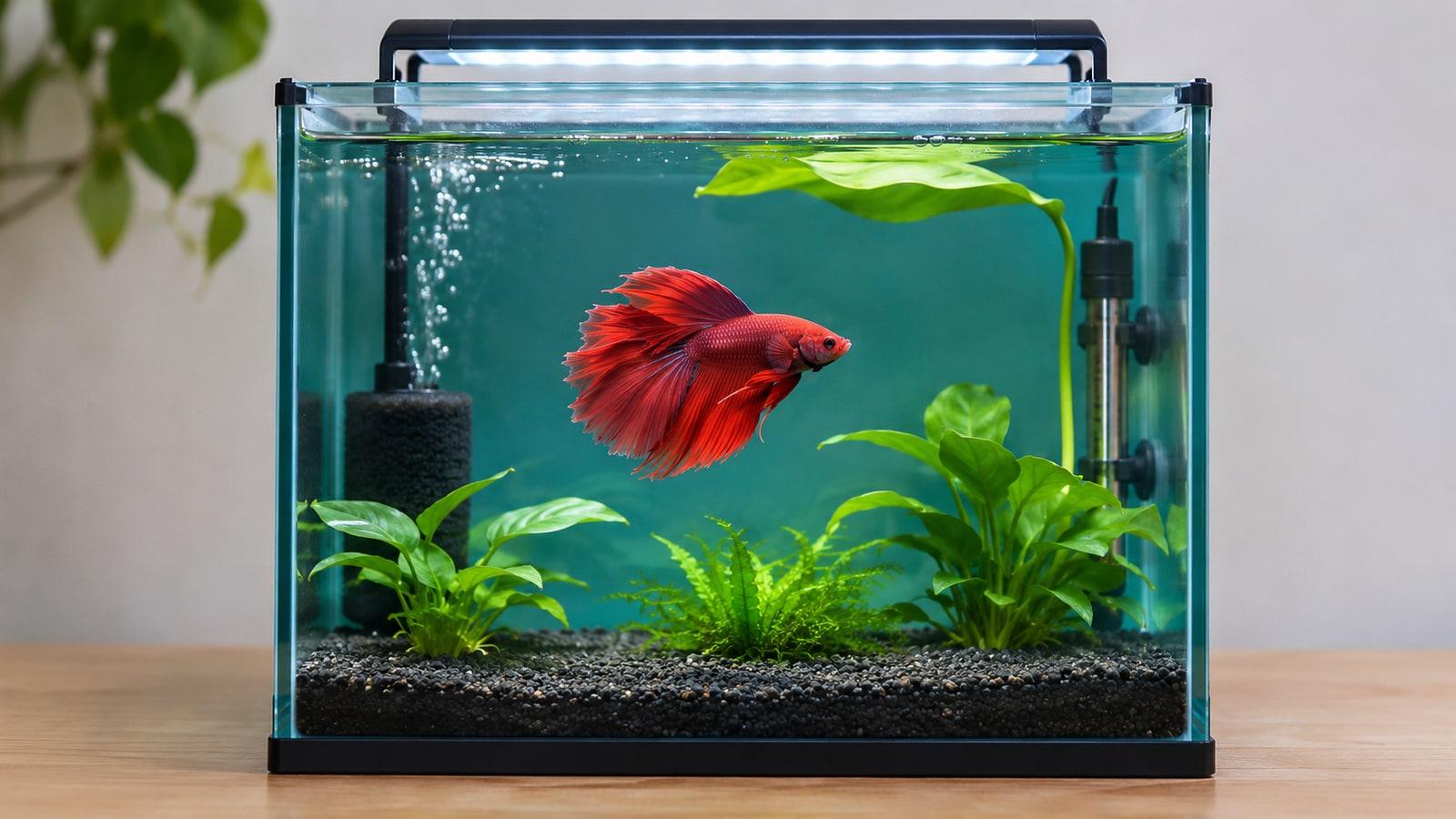
5 gallon is the lowest a vet source goes for a betta, and a 1 gallon should hold no fish at all. Small schooling fish need groups and far more room. Cherry shrimp and a nerite snail are what suit tanks this size, and 5 gallons is the better home for the betta.
The numbers
| Tank | Fish | What works instead | The catch |
|---|---|---|---|
| 1 gallon | None | Plants. Chewy's vet-advised guide points to snails or shrimp; no count is sourced | 3.8 litres. No vet, welfare body or study supports a fish in it |
| 2.5 gallon | One betta, at the floor | 5–6 cherry shrimp to start (our judgement) | PetMD's minimum for a betta. 9.5 litres before gravel, just under the RSPCA's 10 litre line |
| 3 gallon | One betta, at most | 5–6 cherry shrimp to start (our judgement) and one nerite snail | Clears the vet, welfare and retailer floors of 2.5 to 3 gallons. PetMD and the RSPCA still put the ideal at 5 or more |
| 5 gallon (for comparison) | One betta | A small shrimp colony | What this site recommends for a betta |
A 3 gallon tank holds one betta at most, and no other fish. A 2.5 gallon is the lowest a vet source goes for a betta, and a 1 gallon should hold no fish. Shrimp and snails are the better fit.
PetMD's vet-written care sheet puts the betta minimum at 2.5 gallons and the ideal at 5 to 10. If you searched for the best fish for a 3 gallon tank and found lists with neon tetras, guppies or zebra danios on them, those lists are choosing fish by body length. Body length is not what sets a fish's minimum tank.
Nothing on this page comes from tanks of our own. The figures are from vet-written care sheets, a welfare body, species databases and published studies, and where they disagree, the page says so.
What fish can live in a 1, 2.5 and 3 gallon tank
The table above is the whole answer, one row per tank. Read the "Fish" column as a ceiling, not a suggestion: "one betta, at most" means the tank can be defended for a betta, not that a betta is the best use of it.
For sizes in between:
- 2 gallons (7.6 litres) is below PetMD's 2.5 gallons and the RSPCA's 10 litres. One study's "larger than 5.6 L" would allow it on paper, but we side with the vet and the welfare body: no fish, as in the 1 gallon.
- 3.5 gallon kits get the 3 gallon answer.
Is 3 gallons enough for a betta?
Enough to be the floor. Not enough to be the recommendation.
Good sources disagree on the smallest tank for a betta, and the spread is wide:
| Source | Minimum for a betta | In US gallons |
|---|---|---|
| Clark-Shen et al. 2024 (study, for pets) | larger than 5.6 L | more than 1.5 |
| PetMD (vet-written) | 2.5 gallons | 2.5 |
| RSPCA Australia; Oldfield and Murphy 2024 (study) | 10 L | 2.6 |
| PetSmart (retailer) | 3 gallons | 3 |
| RSPCA Australia, ideal | 20 L or more | 5.3 |
| PetMD, ideal | 5–10 gallons in its table; "10 gallons or larger" in its text | 5–10 or more |
| Seriously Fish | about 41 L | about 11 |
Two of those rows are studies published in the journal Animal Welfare in 2024, and they measured what the others only state.
Oldfield and Murphy watched male bettas in 0.5, 10, 38 and 208 litre tanks. The fish in the half-litre bowls swam less, and the paper concludes that "at least a 10-L aquarium is required to ensure full expression of swimming behaviour." Ten litres was the smallest of the larger tanks. They tested nothing between 0.5 and 10 litres, so the study cannot say whether 5 litres would also do.
Clark-Shen and colleagues moved 13 males through 1.5, 3.3, 5.6 and 19.3 litre tanks. The fish were more active and rested less in the 19.3 litre tank, which is about 5 gallons, and "spent more time displaying behaviours that could be classified as 'abnormal' in the smaller tanks." Their recommendation: "For fish kept as pets, tanks larger than 5.6 L (larger than 'medium') are recommended."
The RSPCA's wording is the bluntest: tanks "ideally should be 20 litres or more in volume", "with 10 litres being the absolute minimum."
Here is where we land, and why. Seriously Fish stands apart at about 11 gallons. Every other source that names a floor puts it between 1.5 and 3 gallons. The sources that name an ideal, PetMD and the RSPCA, put it at 5 gallons or more, and the fish in the Clark-Shen study did best in the 19.3 litre tank. Nobody supports 1 gallon. So one betta in a 3 gallon is defensible, and 5 gallons, heated and filtered, remains what we recommend, as everywhere else on this site.
The 2.5 gallon sits on the line, not above it
A 2.5 gallon tank holds 9.5 litres before gravel and decor go in. That is PetMD's minimum exactly, and slightly under the 10 litres the RSPCA calls the absolute minimum. A 3 gallon holds 11.4 litres and clears it.
Why tiny fish still need a bigger tank
A fish's minimum tank is set by how many of them must be kept together and how much room the group needs to swim. Body length barely comes into it.
| Fish | Adult size | Minimum tank | Group needed |
|---|---|---|---|
| Chili rasbora | 0.8 in (2 cm) | about 11 gallons | 8–10 |
| Neon tetra | 1.2 in (3 cm) | 10 gallons (PetMD); about 14 (Seriously Fish) | 8–10; PetMD says at least 5 |
| Zebra danio | 2 in (5 cm) | about 21 gallons | 8–10 |
| Guppy | up to 2 in | 5 gallons for the first fish | 3 or more |
| Goldfish | — | 20 gallons or larger for one juvenile | — |
Sizes, tanks and groups for the first three are from Seriously Fish, which gives tank footprints; the gallon figures are its litre volumes converted. Guppy and goldfish figures are from PetMD's vet-written care sheets.
The chili rasbora makes the point. It is 0.8 inches long, a third the length of a betta, and Seriously Fish gives it the same 41 litre minimum, because it "really should be kept in a group of at least 8-10 specimens." That 41 litre tank has a base of 45 × 30 cm, close to the floor of a standard 10 gallon, which is why a shoal of chili rasboras is on our 10 gallon list. Zebra danios are "an active species so even a small group" needs a tank about 3 feet long.
Three neon tetras in a 3 gallon is not a small school. It is three schooling fish without a school. On this site a school starts at six, and six neons need a 10 gallon. Guppies do not fit either: PetMD's rule gives zero below 5 gallons, and the guppy numbers only start to work at 10.
The two near-misses
Two fish come close, and it would be wrong to pretend they do not exist. Seriously Fish says a single pea puffer can be kept in a tank as small as 12.6 litres, and a pair of least killifish in 12.5 litres. That is 3.3 gallons: a little more than a 3 gallon holds, and well over a 2.5.
We still do not recommend either for a first 3 gallon tank. The same profile says the pea puffer is "not usually recommended for the community tank" and that rival males "have been known to fight to the death", so it is one fish, alone, in a tank slightly too small. It is also hard to feed: the profile says dried foods are usually refused and that it needs small snails regularly to keep its teeth worn down. The least killifish is a livebearer that Seriously Fish says is "best to maintain in a small colony", and the profile calls it "nigh on impossible to prevent it breeding if both sexes are present", so a pair does not stay a pair. In a 5 gallon with the tank to itself, each becomes an option for an experienced keeper: see the best fish for a 5 gallon tank.
What does work in a 3 gallon tank: shrimp and a snail
Cherry shrimp
Cherry shrimp are the animal a tank this size suits. They complete their whole life cycle in fresh water and in small volumes: one lab study kept its breeding stock in 8 litre aquaria (Tropea et al., 2015).
They also tolerate company. In another study, cherry shrimp were grown for 90 days at 2.5, 5 and 10 shrimp per litre, and "survival was high and unaffected by treatment" (Vazquez et al., 2017). Growth did suffer with crowding: females at the lowest density weighed 45% more than those at the highest.
Do not read that as a stocking number. It is a lab culture, and even its lowest density would be about 28 shrimp in 3 gallons. It shows one thing: crowding is not what limits shrimp in a small tank. Stable water is.
Our number for a 2.5 or 3 gallon is five or six cherry shrimp to start, and then let the colony find its own size. That is our judgement. We found no vet or extension source that gives a shrimp-per-gallon figure for home tanks. How much to feed them is in what cherry shrimp eat.
Cherry shrimp do well at 72 to 82°F, so in a cool room the tank still wants a small heater. See the temperature chart.
One nerite snail
Chewy's small-fish guide, written with input from a fish vet, says "if enough food is available, a single nerite snail can be kept in a nano tank at least 3 gallons in capacity." It puts mystery, rabbit and Malaysian trumpet snails at 5 gallons or more per snail. So: one nerite in a 3 gallon, none of the larger snails, and no snail figure we can source for a 2.5.
A nerite will not overrun the tank. It lays eggs, but nerite eggs never hatch in fresh water. The risk runs the other way: a snail that dies unnoticed can foul the water, and the smaller the tank, the less water there is to dilute it. Learn how to tell if a snail is dead.
Betta or shrimp, not both
In a tank this small, choose one. Whether a betta leaves shrimp alone depends on the individual fish: keepers report bettas that ignore them and bettas that kill every one. Cover is what gives the shrimp a chance, and 3 gallons leaves little room for cover. That is our reasoning, not a measured result. We cover the question in whether cherry shrimp can live with a betta, and the combinations that have room to work in betta tank mates in a 5 gallon.
The 1 gallon tank: no fish
No fish in a 1 gallon
No vet, welfare body or study we found supports keeping any fish in 1 gallon, including a betta.
The sources line up on this one. PetMD's floor for a betta is 2.5 gallons. The RSPCA calls 10 litres "the absolute minimum" and says "small tanks or fish bowls do not provide adequate space to meet the fish's physical and mental needs." Chewy, a retailer, says "a 1-gallon tank isn't suitable permanent housing for a betta fish."
The reason is arithmetic. A 1 gallon holds 3.8 litres. The same waste is three times as concentrated as in a 3 gallon and five times as concentrated as in a 5. The RSPCA adds that "small fish bowls are usually too small to fit a suitable heater", and a betta needs one.
Two goldfish in a 1 gallon is not close. PetMD says a single juvenile goldfish needs 20 gallons or larger.
What a 1 gallon can hold is plants. Chewy's small-fish guide, the one written with a fish vet's input, says "a 1-gallon tank is too cramped to comfortably accommodate most fish" and that "very small tanks are a better fit for freshwater snails or shrimp." It gives no number, and neither does any other source we found, so if you try a few shrimp, treat it as an experiment and test the water often.
If you keep a betta in a 2.5 or 3 gallon tank
Some readers will do it anyway, and a 2.5 or 3 gallon set up properly is a different thing from a bare bowl. The floor only counts as the floor if all of this is in place:
- A heater. PetMD's range for a betta is 76 to 81°F, and it says to fit a heater even in a warm house. At its 3 to 5 watts per gallon, that is roughly 7.5 to 15 watts for these tanks. See how heater sizing works.
- A thermometer. PetMD says to use one to confirm the tank stays in range, and a small volume changes temperature quickly.
- A gentle filter. PetMD recommends low or adjustable flow, "since strong currents can stress bettas", and names air-driven sponge filters as ideal.
- A cycled tank. Cycle the tank first, before the fish goes in.
- A 25 to 30% water change every week, without skipping. PetMD's sheet says 15 to 25% weekly; we go a little higher in tanks this small. At this size that means a turkey baster or airline tubing and a jug: see changing water in a small tank.
Furnish it, too. The Clark-Shen study is specific: "All tanks should contain gravel, live plants and refuges."
A betta that stops moving can be a sign of a tank running cold or dirty. If that is what you are seeing, start with a betta lying on the bottom.
What to do instead
In order:
- Move the betta up to a 5 gallon. PetMD ties its 5 to 10 gallon ideal to "space and more stable water conditions", and a standard 5.5 gallon tank is only about 16 by 8 inches, four inches longer than a 2.5. The footprints are in tank dimensions.
- Keep the small tank for shrimp or plants. It is good at that, and it is not wasted.
- If you wanted several fish, think 10 gallons. That is where groups of small fish start to fit: see the best fish for a 10 gallon.
The short version
A 1 gallon: no fish. A 2.5 or 3 gallon: one betta at most, heated, filtered and cycled, and that is the floor. Without a fish, cherry shrimp suit both, with one nerite snail in the 3 gallon. If the fish matters more than the tank, get a 5 gallon.
Sources
- Zayas, M. (2026). Betta Fish Care Sheet. PetMD.
- RSPCA Australia Knowledgebase (2024). How should I care for my Siamese fighting fish?
- Oldfield and Murphy (2024). Life in a fishbowl: Space and environmental enrichment affect behaviour of Betta splendens. Animal Welfare 33: e1.
- Clark-Shen, Tariel-Adam, Gajanur and Brown (2024). Life beyond a jar: Effects of tank size and furnishings on the behaviour and welfare of Siamese fighting fish (Betta splendens). Animal Welfare 33: e62.
- Seriously Fish. Betta splendens; Boraras brigittae; Paracheirodon innesi; Danio rerio; Carinotetraodon travancoricus; Heterandria formosa.
- PetSmart. Betta Care Guide. Retailer.
- Chewy (2026). What Size Betta Tank Do I Need? and The 25 Best Small Aquarium Fish for Your Freshwater Tank. Retailer guides, cited by title.
- Zayas, M. (2026). Tetra Fish Care Sheet and Guppy Fish Care Sheet. PetMD.
- Witherell, M. (2024). Goldfish Care Sheet. PetMD.
- Vazquez, Delevati Colpo, Sganga and López Greco (2017). Density and gender segregation effects in the culture of the caridean ornamental red cherry shrimp Neocaridina davidi. Journal of Crustacean Biology 37(4): 367–373.
- Tropea, Stumpf and López Greco (2015). Effect of temperature on biochemical composition, growth and reproduction of the ornamental red cherry shrimp Neocaridina heteropoda heteropoda. PLoS ONE 10(3): e0119468.
Questions people ask
Mentioned in this guide
Related guides
Best Fish for a 5 Gallon Tank: 4 That Fit, 12 That Don't
Best fish for a 5 gallon tank: one betta, or one pea puffer, least killifish or licorice gouramis kept alone. Why neons and guppies need more room.
Betta Tank Mates for a 5 Gallon: Snails Yes, Fish No
Betta tank mates for a 5 gallon tank: a nerite snail or two, shrimp if your betta allows it, and no fish. Why schools do not fit and what 10 gallons adds.
Shrimp Tank Setup: A Cherry Shrimp Tank, Step by Step
Shrimp tank setup for cherry shrimp: the tank, sponge filter, substrate and heater, the water numbers, when the cycle is done, and how many to add.