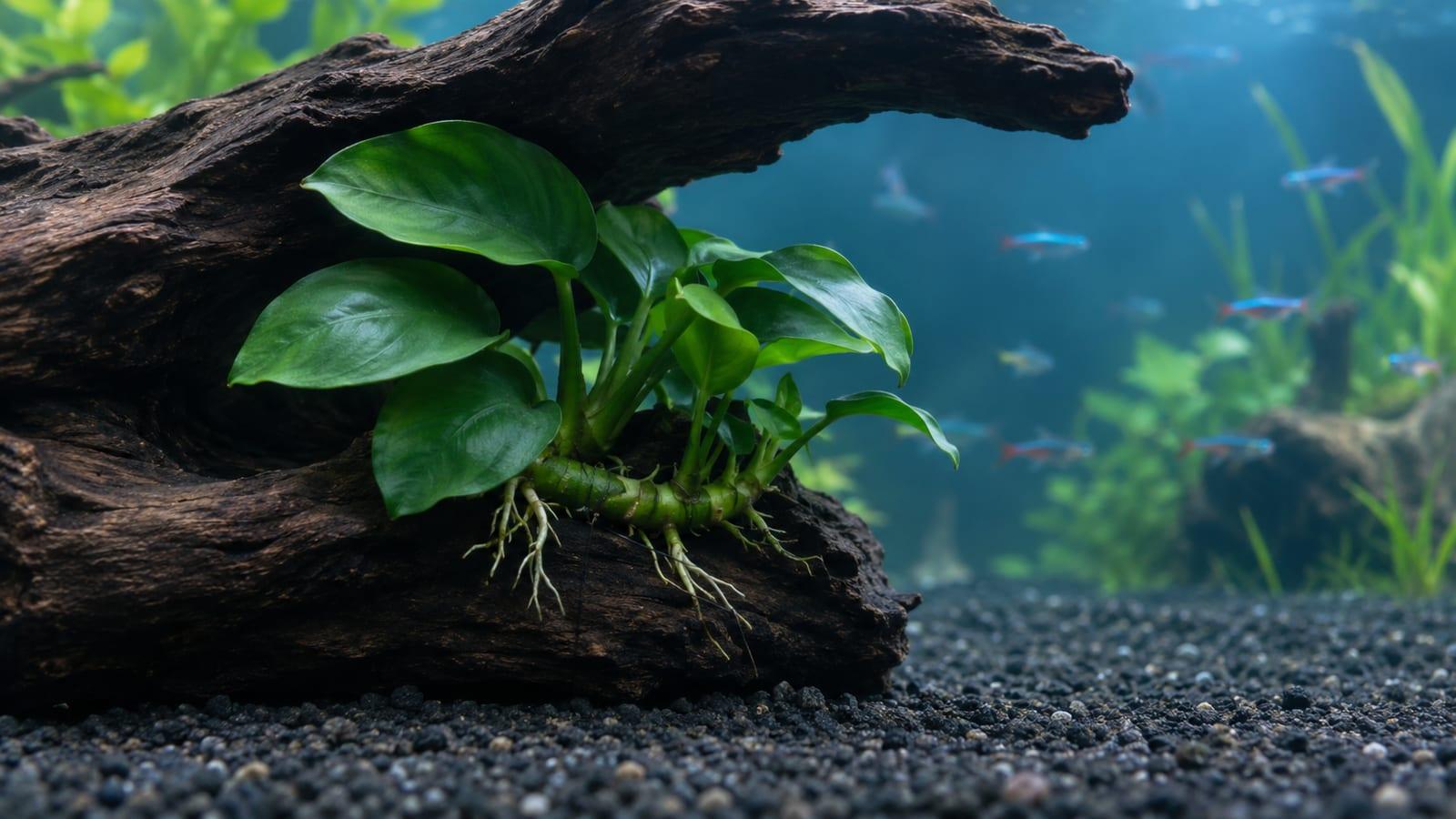
Keep the rhizome, the thick stem the leaves grow from, uncovered, or it rots. Pick a variety that fits the spot, keep it out of the strongest light so less algae settles on its slow leaves, and cut out any soft rhizome. Based on grower data, botanic-agency and hobby-magazine guides, plant shops and keeper reports, not our own growing.
The numbers
| Anubias | Height in a tank | Where it goes | Best way to plant it |
|---|---|---|---|
| Nana 'Petite' | About 1–2 in (3–5 cm) | Front of the tank, small stones, nano tanks | Glue to a pebble or a small stone |
| Nana | About 2–4 in (5–10 cm) | Front and middle, on wood or rock | Glue or tie; roots can go in gravel |
| Coffeefolia | About 6–10 in (15–25 cm), growers' listings | Middle | Tie to wood |
| Barteri var. barteri | About 8–12 in (20–30+ cm), up to about 18 in (45 cm) | Back, large driftwood | Tie to wood; roots in gravel behind it |
| Barteri var. caladiifolia | About 4–6 in (10–15+ cm) at first; the largest barteri, leaves up to about 9 in (24 cm) | Middle at first, back once grown | Tie to wood or wedge between stones |
To plant anubias, tie or glue it to driftwood or rock, or push only its roots into the gravel, and keep the rhizome, the thick stem the leaves grow from, uncovered. A buried rhizome rots and can kill the plant.
Anubias grows wild in marshes, streams and on riverbanks under forest shade in tropical West and Central Africa, and it takes most of its food from the water, so it needs no plant substrate. This page covers where to fix it, picking a size for the spot, keeping algae off its slow leaves, splitting it, and what to do if the rhizome goes soft. It is built from grower data (Tropica), a government botanic agency (National Parks Board Singapore), a hobby-magazine article, plant shops' and retailers' guides, the glue maker's instructions, a plant-disease database and keeper reports. We have not grown these plants ourselves.
Find the anubias rhizome before you plant
The rhizome is the thick horizontal stem the leaves grow from. Singapore's National Parks Board describes it as "a creeping rhizome on which adventitious roots form". The leaves grow up from it and the roots grow out from below it. Everything on this page comes down to keeping that stem in the open.
Take the plant out of its plastic pot and pull the rock wool, the fibre wadding packed round the roots, out of them. It is packing, not substrate. A plant sold in a sealed cup of gel is tissue culture, grown sterile; rinse the gel off and it is ready. An ordinary potted plant can carry snail eggs and pesticide, so rinse it and look it over first, and quarantine it before it goes into a shrimp tank.
Then look at the rhizome itself. Firm and green is healthy. Soft, see-through or dark patches are a problem before you start; see if the rhizome goes soft below.
How to plant anubias on driftwood or rock
- Glue it. A small dab of super glue gel (cyanoacrylate) on the roots and on the wood or rock, never on the rhizome, then hold it until it grips. Best for small plants on rock.
- Tie it. Fishing line or dark thread around the rhizome and the wood, snug but not cutting in. Best for larger plants on driftwood.
- Wedge it. Push the roots into a crack in the wood or the gap between two stones, so the rhizome rests on top.
The sources split on which is best. Aquarium Co-Op, a fish retailer that sells glue, prefers glue and says thread, fishing line and rubber bands "aren't ideal"; NParks says to tie it with fishing line or black thread; Buce Plant, a plant shop, lists both. Each has a place: glue for a small plant on a smooth stone, line for a heavy plant on wood, a wedge where the hardscape already has a gap.
Glue details. Glue the roots, not the rhizome: Co-Op warns "Do not cover the rhizome in super glue or the plant may suffer", and Buce Plant says to apply "a SMALL dab of superglue" to the roots. Holding times range from Seachem's "20 seconds" to Buce Plant's 30–45 seconds and Co-Op's "about a minute or two"; hold until it stays put on its own. Seachem says its gel "can even be used underwater", and if you work with the plant out of the tank, Co-Op says to finish within about 10–15 minutes "because these are water plants that dry out quickly". Keep it off your fingers: Seachem's label warns it "bonds skin and eyes in seconds". Glue gel is sold for attaching aquarium plants and keepers use it widely; we found no study of it on fish.
Tying details. Use fishing line rather than cotton. Keepers report that cotton thread can rot through in a few weeks, before a slow anubias has rooted, while fishing line holds until you cut it. Keepers also report four to eight weeks before the roots grip on their own, quicker in bright tanks; we found no grower figure. After that you can cut the line off, or leave it if it is not cutting into the rhizome.
The same three methods work for java fern; how to plant java fern goes through them step by step.
Can you plant anubias in gravel or sand?
Yes, the roots. Never the rhizome. You can push the roots into the gravel as long as the rhizome stays above it. Jacobson, writing in Tropical Fish Hobbyist: "While the roots can be planted, the rhizome cannot." Tropica's plant sheet says the same: if planted on the bottom, the rhizome must not be covered, because it tends to rot.
How to do it: press the rhizome and roots into the gravel together, then lift the rhizome until it sits on the surface with the roots below it (Aquarium Co-Op). The same rule applies in sand.
That settles the contradiction you will find online. Pages that say "never plant anubias" mean the rhizome; pages that say "dig a small hole" mean the roots. It is the same rule seen from two ends.
Still, wood or rock is the safer default for a beginner, and it is what this site's substrate guide recommends. Three things can go wrong with a floor-planted anubias: the gravel shifts or gets vacuumed over the rhizome, fish dig it up (the reason Aquarium Co-Op suggests a planter ornament), and, keepers report, moving the plant later pulls up a clump of gravel tangled in the roots. Some keepers have grown it in gravel for years; others lost a rhizome that was pushed in too deep.
For a plant on the floor without those risks, glue a small anubias to a pebble and set the pebble on the gravel. Seachem says its gel works on gravel too.
Types of anubias: choose a size for the spot
A common replant is the wrong size: a barteri bought for the front of a small tank, which outgrows it. The table at the top of this page has the heights and where each goes. The rule in one line: petite for the front and small stones, nana for the front and middle, coffeefolia for the middle, barteri and caladiifolia for the back and large driftwood.
Tropica's heights are the average after two months in a tank. The plants keep growing slowly after that: Aquasabi, a plant shop, puts a grown barteri at about 10–18 in (25–45 cm), and calls caladiifolia the largest barteri variety, with leaves up to about 9 in (24 cm). The coffeefolia range comes from growers' listings.
Wikipedia lists eight species in the genus, following Crusio's 1979 revision, but almost everything in shops is Anubias barteri and its varieties. Label names like 'Nana Gold' are colour or leaf forms of these. They plant the same way.
Anubias light: where to put it so the leaves stay clean
In the wild it grows "under shady cover of the forest" (NParks, which rates it "Semi-Shade"). Buce Plant says it does best in low to medium light, and Jacobson describes its growth "at low to moderate light". It grows at normal tropical temperatures.
Slow leaves collect algae. Anubias grows a new leaf every few weeks; Jacobson puts it at "approximately one leaf per month". A leaf that lives for many months sits under the light long enough for green spot algae or black beard algae to settle on it. Jacobson calls the plant "very prone to accumulating algae", and Wikipedia's genus page says it is grown in shade because otherwise "algae will develop on the leaves". Buce Plant says high light and nutrient imbalances leave it open to algae.
The fix is placement:
- Put it in shade: under an overhang of driftwood, beside taller plants, or at the end of the tank away from the brightest part of the light. Keepers report that green spots on anubias are mostly a placement problem, and moving the plant into shade is their usual fix. Shade slows new spots; it does not lift the ones already on a leaf.
- Cut off the worst leaves at the stalk, next to the rhizome. Aquasabi, a plant shop: "No new leaf will grow from the petiole stump but rather from the rhizome's shoot tip and side shoots."
- Shorten the lighting to six or seven hours a day on a timer if the spots keep spreading. The black algae guide has the full fix. To tell green spot algae from other algae on leaves, use the table in the blue-green algae guide.
One bonus of tough leaves: NParks notes they are unpalatable to herbivorous fish, so plant-eaters tend to leave anubias alone.
How to propagate anubias by splitting the rhizome
Split it when the rhizome has grown long, or has crept off the edge of its wood or stone. We found no source that gives a length to wait for.
- Lift the plant out, or work on it in place if it is firmly rooted.
- Cut the rhizome with a sharp blade or very sharp scissors. Aquasabi says a clean cut stops the stem from bruising, and to make sure the rhizome is not squeezed.
- Leave a few leaves on each piece if you can, so it keeps growing straight away.
- Tie or glue each piece as you would a new plant, rhizome in the open.
A piece with no leaves is not wasted. Aquasabi: "Even without leaves or roots, a rhizome can develop back into a complete plant." Jacobson: "If the rhizome is cut into several pieces, each piece will grow as a plant." A bare piece is slow, so give it months.
Anubias rot: if the rhizome goes soft
A soft rhizome has two different causes, and they need telling apart.
1. Buried and suffocated. Gravel over the rhizome. Tropica, NParks and Jacobson all say a buried rhizome rots, and Jacobson adds that the plant dies. Everything above is the prevention. If you catch it early, lift the plant, cut away the soft part and reattach the rest above the gravel.
2. "Anubias rot" on a plant that was never buried. Aquarium Co-Op's rot guide is the most detailed source. The signs it lists:
- leaves dropping off at the stalk, often the first sign
- a mushy or squishy rhizome
- patches that look like "clear-ish jelly, white, yellow, brown, or black"
- nearby roots discolouring and rotting away
- a foul, rotting smell
The cause is not known. Co-Op: "Researchers have yet to find a definitive cause for anubias rot." The EPPO plant-pest database records no rot organism from anubias itself: the fungi, water moulds and bacterium it lists for Anubias barteri are recorded for the aroid group (Aroideae) as a whole. No study has pinned anubias rot on one organism.
What works: cut through to firm, healthy tissue with a sharp knife or scissors, removing every damaged part, and throw the soft piece away. Co-Op says the rot resists "almost all chemical treatments", and its tests of antibiotics and antifungals did not heal it. Keepers report that cutting well back saves some plants and not others.
Where it comes from: Co-Op believes anubias rot "is present in all plant farms" and that "there's no way to avoid it unless you buy only tissue-grown plants". That is a retailer's view, not a study, but tissue culture is also the site's advice for keeping out pests.
A new plant dropping a leaf is not rot
Keepers report that a new anubias often loses a leaf or two in its first weeks underwater, as it switches from farm growth out of water to growth underwater. If the rhizome is firm, leave it alone.
The short version
Rhizome out, roots wherever you like: on wood, on rock, or in the gravel. Pick a size for the spot, keep it out of the strongest light, cut off old algae-covered leaves, and cut out anything soft.
Sources
- Tropica. Anubias barteri var. nana. Grower's plant sheet.
- Tropica. Anubias 'Petite'. Grower's plant sheet.
- Tropica. Anubias barteri var. barteri. Grower's plant sheet. Tropica's figure for A. barteri var. caladiifolia is from its pot label as reproduced by retailers (JL Aquatics).
- National Parks Board Singapore. Anubias barteri var. nana. Flora & Fauna Web.
- Jacobson, D. Anubias barteri var. "nana gold". Tropical Fish Hobbyist, undated.
- Crusio, W. (1979). A revision of Anubias Schott (Araceae). Mededelingen Landbouwhogeschool Wageningen 79(14): 1–48. Cited via Wikipedia, Anubias.
- Aquarium Co-Op. How to Plant Anubias or Java Fern on Rocks, How do I plant my anubias, java fern, or other rhizome plant? and Anubias Rot: Symptoms, Causes, and Solutions. A retailer's guides, undated.
- Buce Plant. How to Plant Epiphyte Aquatic Plants. A plant shop's guide, undated.
- Aquasabi. How to properly trim and divide aquatic plants, Anubias barteri var. barteri and Anubias barteri var. caladiifolia. A plant shop's wiki and plant pages.
- Seachem. Flourish Glue. Manufacturer's instructions.
- EPPO Global Database. Anubias barteri (AUIBA): pests.
- Coffeefolia heights: growers' listings (Azaqua, The Wet Leaf) and the UKAPS plant table.
- Keeper reports: Monster Fish Keepers, "tying the rhizome of anubias/java fern to driftwood"; UKAPS, "best way to attach anubias to driftwood" and "Anubias rot"; Aquarium Co-Op forum, "help attaching anubias" and "GSA lighting and anubias"; FishForums, "best way to plant anubias spp."; Aquarium Advice, "question about planting anubias"; FishLore, "Anubias not growing well"; Aquaria Central, "Anubias melting".
Questions people ask
Mentioned in this guide
Related guides
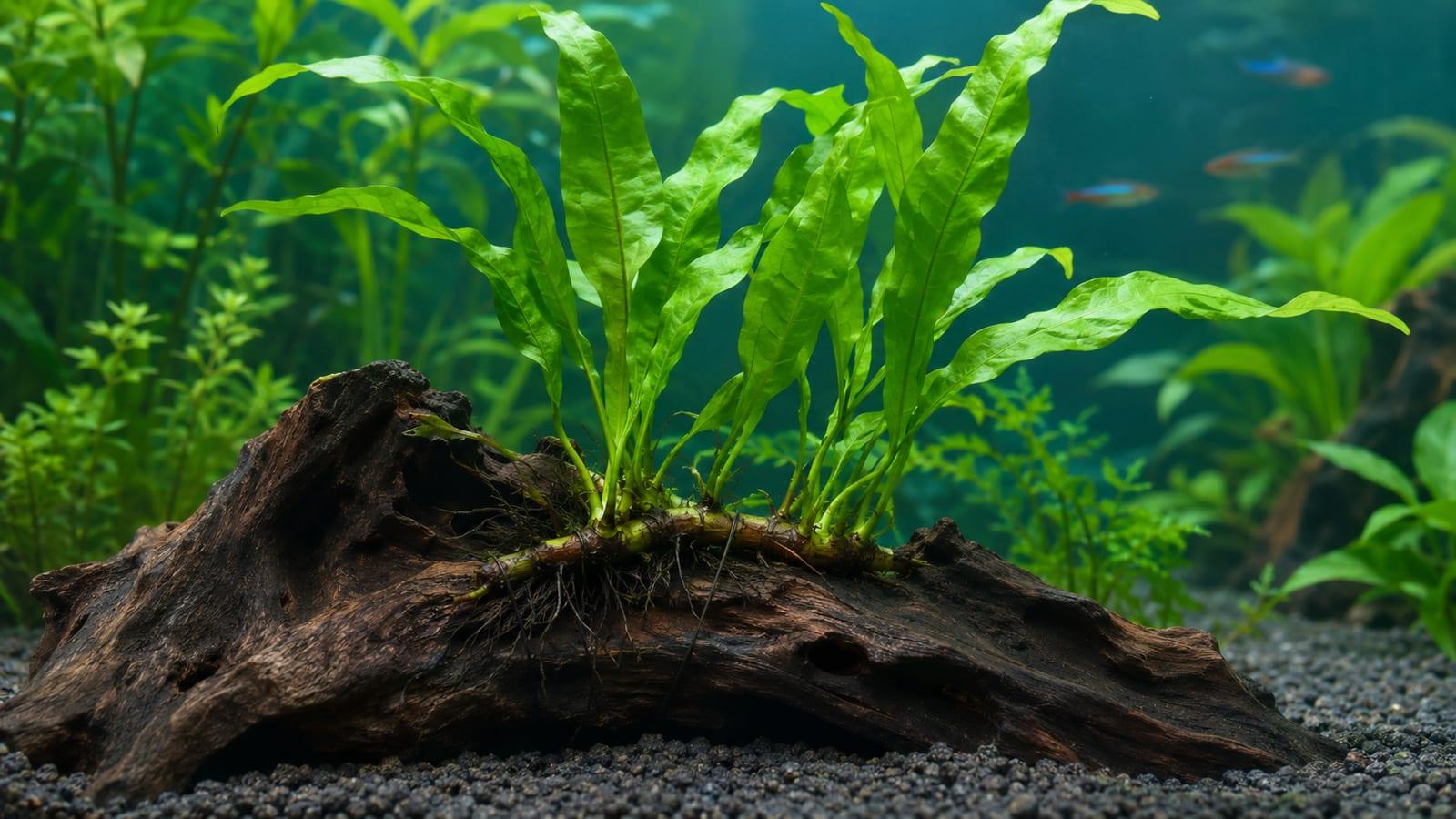
How to Plant Java Fern: Tie It, Glue It, Never Bury It
How to plant java fern: tie or glue the rhizome to wood or rock, or wedge it, and never bury it. Which glue, how much light, and why new ferns melt.
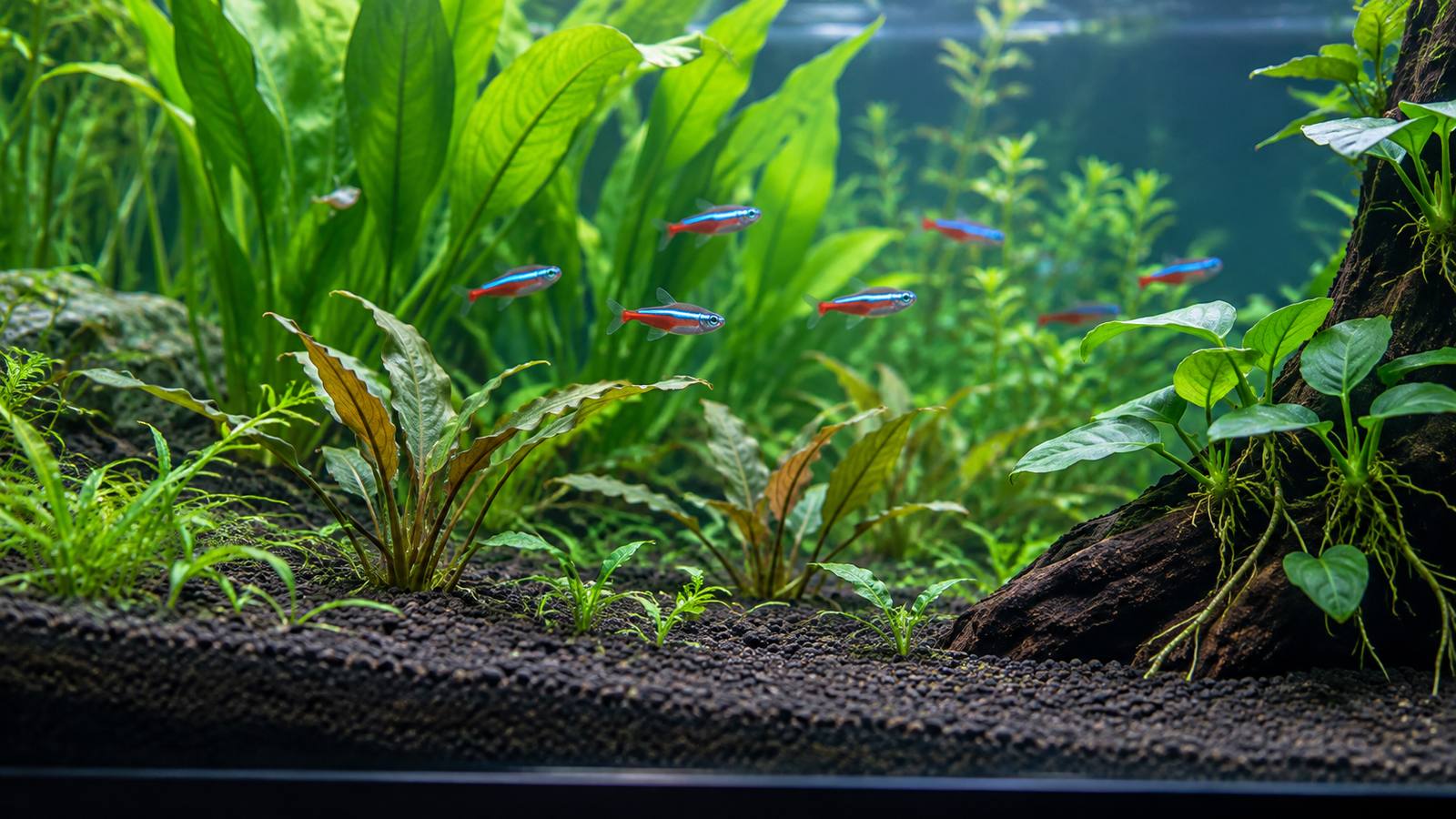
Best Substrate for a Planted Aquarium: Pick by Your Plants
The best substrate for planted aquarium setups depends on which plants feed by the root. Picks for 10 and 20 gallon tanks, with bag counts and costs.
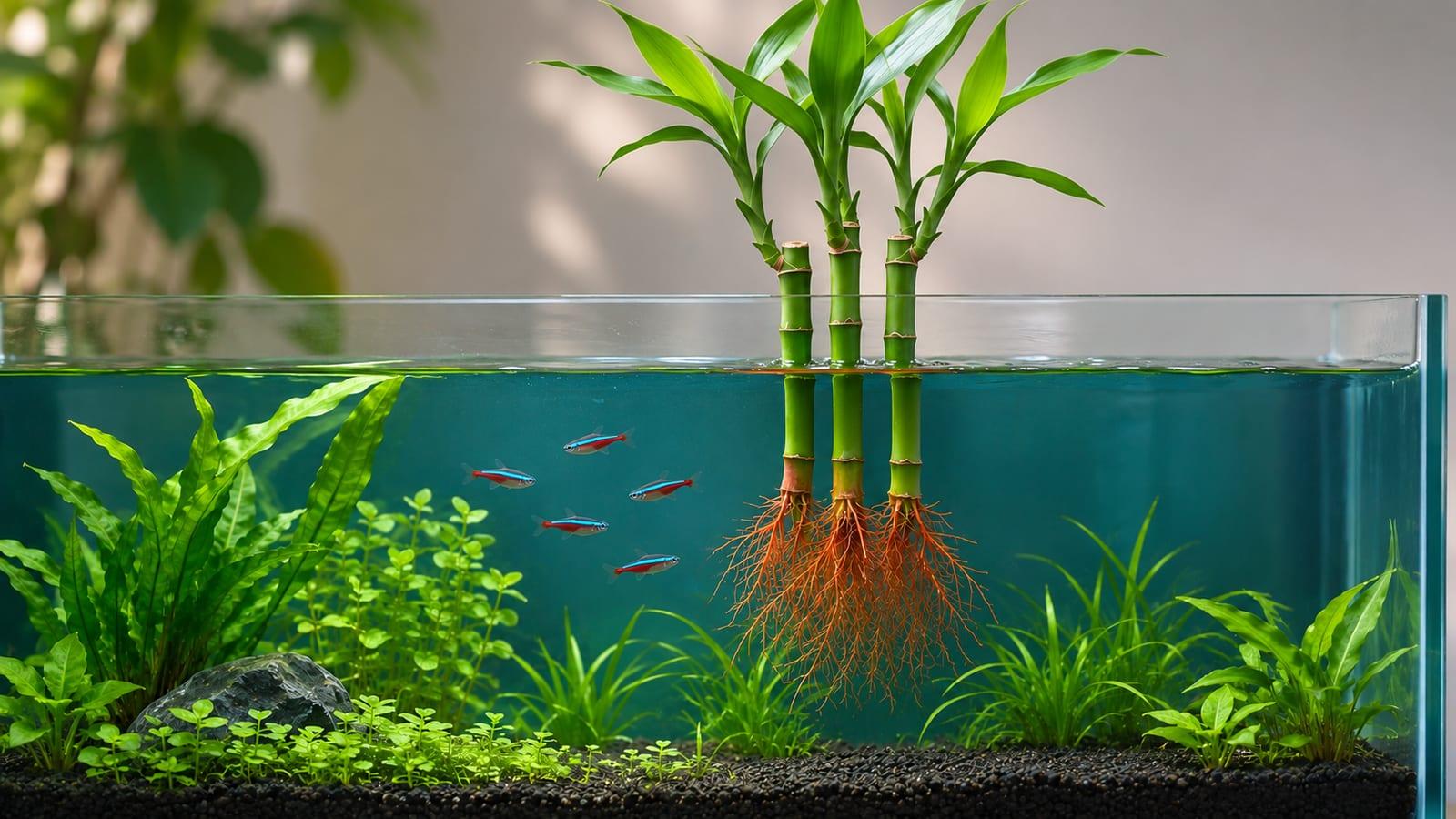
Lucky Bamboo in an Aquarium: Keep the Leaves Above Water
Lucky bamboo in an aquarium is safe if only the roots and base sit in water. How to set it up, why leaves rot underwater, and what it does for nitrate.