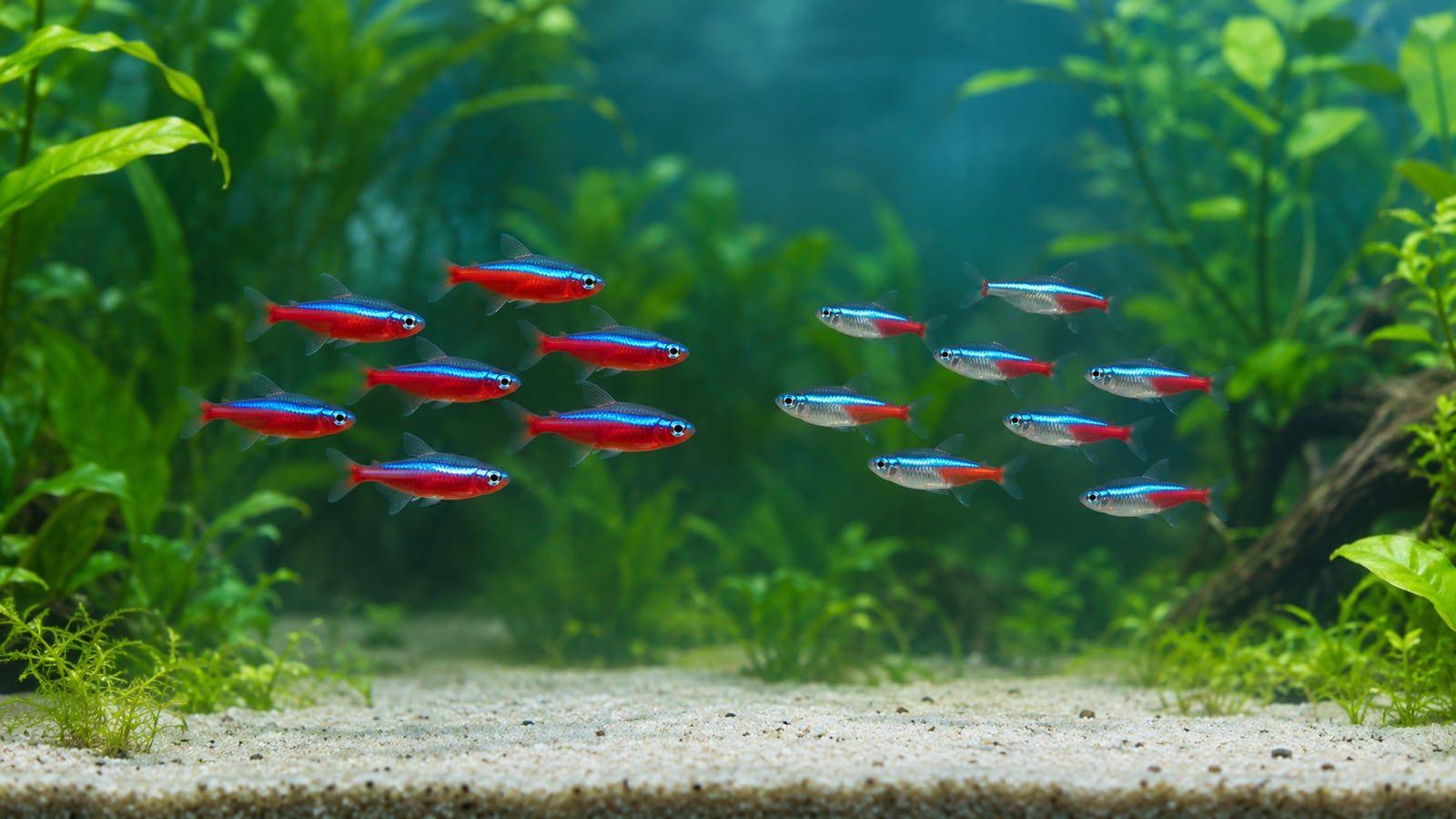
Tell them apart by the red stripe: full length on a cardinal, rear half on a neon. Cardinals are about 5 mm longer, more often wild-caught and cost a dollar or two more each. Both need the same tank and a school of eight. Built from species databases, a lab study, care guides and keeper reports, not from our own tanks.
The numbers
| Neon tetra | Cardinal tetra | |
|---|---|---|
| Species | Paracheirodon innesi | Paracheirodon axelrodi |
| How to tell | Red on the rear half only; pale belly in front of it | Red runs the full length, head to tail |
| Adult size | About 30 mm (1.2 in) without the tail | About 35 mm (1.4 in) without the tail |
| Temperature | 70–77°F (21–25°C); keep at 74–76°F | 73–84°F (23–29°C) |
| pH / hardness | pH 4.0–7.5, 1–12 dGH | pH 3.5–7.5, 1–12 dGH |
| Recommended tank | 24 × 12 in base (about 14 US gal) | The same |
| School | At least 8–10; six is the floor | The same |
| Where shop fish come from | Almost all farmed | Many still wild-caught |
| Price (US, Nov 2026) | About $1–3 each | About $3–4 each |
| Best for | A first school in a tank at 74–76°F | A tank at 78°F or warmer |
Buy neon tetras for a tank kept at 74–76°F, and cardinal tetras for one at 78°F or warmer. Tell them apart by the red stripe: a cardinal's runs head to tail, a neon's covers only the rear half. Cardinals grow slightly larger and cost more.
At 76–77°F either works, and that is the setting for a tank with both. Cardinal tetra vs neon tetra is a choice between two species of one genus, Paracheirodon innesi (the neon) and Paracheirodon axelrodi (the cardinal), not two colour forms of one fish. This page is built from the Seriously Fish and FishBase species profiles, a Brazilian lab study on cardinals, care guides and keeper reports. We have not kept or tested either fish. The ranges in the table above are from Seriously Fish, and the prices were checked at US chains in November 2026.
How to tell a cardinal from a neon
Look at where the red starts. On a cardinal the red runs the whole length of the lower body, from the eye to the tail; on a neon it starts about halfway along and runs to the tail (Aquarium Co-Op), leaving the belly in front of it pale. Seriously Fish puts the same thing in database terms: the cardinal has "relatively more red pigment on the body" than the neon, and a broader blue stripe above it.
Size is not a reliable tell in a shop tank. The gap is small (next section), and young cardinals and grown neons overlap.
There is a third look-alike. The green neon, Paracheirodon simulans, has a greener stripe where the cardinal's is bluer, according to Seriously Fish. If the stripe looks green rather than electric blue, it is neither of the fish on this page.
Cardinal tetra size: closer to the neon than most pages say
Neon tetra vs cardinal tetra size is the claim most pages get wrong. "Two inches against one" turns up again and again. The species databases put the gap at about 5 mm:
- Neon: about 30 mm (1.2 in) without the tail, according to Seriously Fish; FishBase lists 2.5 cm. With the tail, roughly an inch and a half.
- Cardinal: about 35 mm (1.4 in) without the tail, according to Seriously Fish; FishBase lists 3.0 cm. Aquarium Co-Op says a cardinal "grows up to 1.75 inches (4 cm) long in captivity", which only fits the database figure as a length with the tail.
So a cardinal is about a fifth longer, not twice the size. Part of the confusion may be that cardinals appear to grow larger in captivity than they do in the wild (Walker, 2004, as summarised on Wikipedia), so a well-fed adult can look bigger than its database figure.
The gap does not change the tank, the school or the tank mates. The differences that do are temperature, hardiness and price.
Neon and cardinal tetra temperature: the difference that decides
This is the real buying difference. Seriously Fish lists:
- Neon: 70–77°F (21–25°C).
- Cardinal: 73–84°F (23–29°C).
FishBase agrees on the direction, with neons at 68–79°F and cardinals at 73–81°F. On the Seriously Fish ranges, the two overlap at 73–77°F. Here is how that turns into a choice:
- Tank at 74–76°F: neons sit in the middle of their range and cardinals near the bottom of theirs. This is the setting our neon tetra stocking guide recommends. Buy neons.
- Tank at 76–77°F: both fit. This is the setting for a tank with both.
- Tank at 78°F or warmer: above the neon's listed range, and in the middle of the cardinal's. That covers the warm end of the 76–78°F community setting in our fish tank temperature guide, and tanks kept warm for other fish. Buy cardinals.
Cold matters more for cardinals. In a Brazilian lab study on wild-caught cardinals, the authors concluded that temperatures below about 19.6°C (67°F) "may compromise fish survival", and at 15°C (59°F) every fish died within the four-day test (Oliveira et al., 2008). That 19.6°C is the point where half the fish died within four days, not a safe floor; the listed range starts at 73°F. A heater that fails in a cool room is a bigger risk for them, which is a good reason to buy a heater you can trust and check it with a thermometer.
For cardinals, at least, a short heat spike is a smaller worry. In the same study, every cardinal survived 31°C (88°F) for four days, above its listed range. We could not check a comparable figure for neons. The listed ranges are where a fish lives well over months, not the point where it dies on a hot afternoon.
Which is hardier, cardinal or neon tetras?
Nobody has compared them directly. The honest answer depends less on the species than on where the fish in your shop came from.
Neons in shops are almost all farmed. Seriously Fish says farmed fish "are more adaptable than wild specimens", but also that "years of commercial breeding have somewhat affected the genetic vigour of the ornamental strain". The neon guide covers how to pick healthy neons and the signs of neon tetra disease.
Cardinals are now bred commercially too, but Seriously Fish says "a significant proportion" in the trade are still wild-caught, and that "wild fish are less tolerant of deteriorating water conditions than commercially-produced ones".
The lab study shows where wild cardinals' limits lie. Wild cardinals from the middle Rio Negro, held for at least four weeks and then tested for four days at a time, all survived from pH 4.0 to 8.5. Nitrite was a different story: about 1.1 mg/L killed half the fish within four days. That is a lethal level, not a safe one; University of Florida guidance says nitrite is toxic to fish from as low as 0.10 mg/L. The lesson is simple: cardinals go only into a fully cycled tank, and any nitrite reading needs fixing at once.
The same study is why "cardinals need very acidic water" is overstated for shop fish. Seriously Fish lists pH 3.5–7.5, with more acidic water for wild fish. Stable tap water in the normal range suits captive-bred cardinals and neons alike. If you have wild-caught cardinals or want to breed them, softening the water is the place to start, rather than chasing a pH number.
Keepers split on which fish is tougher. In two old forum threads on exactly this question, most replies called cardinals the hardier fish, while others said wild cardinals do poorly and well-bred neons hold up better. Several put it down to where the fish came from rather than the species. Whichever is right, the advice is the same for either fish:
- Ask how long the shop has had the batch, and prefer fish that have settled there for a while.
- Skip any tank with dead fish in it.
- Acclimate them slowly once home.
- If several die in the first weeks, work through why fish keep dying before buying more.
Tank size and school size are the same for both
Several pages say neons need 10 gallons and cardinals 20. Neither database says so. Seriously Fish gives both species the same tank, with a base of 24 × 12 inches (about 14 US gallons) or larger, and the same mixed-sex group of at least 8–10. FishBase gives both a 60 cm (24 in) minimum tank and groups of five or more.
So the numbers on this site are the same for both fish. In a cycled 10 gallon, keep eight neons, with six the floor and ten the ceiling, or six to eight cardinals, with eight the target. How many neon tetras fit in a 10 gallon shows the working.
A 10 gallon is about 20 inches long, shorter than both databases recommend. If you have a 10 gallon and want a tetra that fits it without that caveat, ember tetras are the better choice. If you have not bought the tank yet, a 20 gallon long is the better tank for either species.
Why cardinal tetras cost more than neons
In November 2026, PetSmart's US site listed neon tetras at $2.99 each, and Aquarium Co-Op gives $1–2 for a neon and $3–4 for a cardinal. So a cardinal costs a dollar or two more per fish, which on Aquarium Co-Op's figures is double or more. Prices change; check your shop.
The gap comes from the supply. Neons are farmed in huge numbers. Many cardinals are caught in the forest streams of Brazil's Rio Negro, a blackwater river, and shipped abroad: in 2003 they made up about two-thirds of the ornamental fish Amazonas state exported abroad (Anjos et al., 2009).
Can neon and cardinal tetras live together?
Yes, they can share a tank. Both are small, peaceful schooling fish that need the same tank. Keep it at 76–77°F, inside both temperature ranges.
Whether they form one school is less clear. No study has tested it. Keepers report that they mix when there are only a few of each, and keep to their own kind when each has a full group. One 2006 forum thread gave all three answers: they school together, they school together only in small numbers, and they school separately when there are plenty of each.
The practical answer: buy one species. Three neons and three cardinals are not a school of six; they are two small groups, both below the floor of six. A full group of each, eight and eight, is sixteen fish, which belongs in a 20 gallon long or larger, not a 10 gallon.
Cardinal vs neon tetra: which should you buy?
- A first school of tetras, tank at 74–76°F, budget matters: neon tetras, eight of them.
- A tank that runs at 78°F or warmer: cardinal tetras, eight, from a batch the shop has held for a while.
- A tank at 76–77°F: either. Pick on looks and price.
- A 10 gallon: either at eight works, but ember tetras fit it better.
- A betta tank: on temperature, cardinals fit and neons do not, since a betta's 78–80°F target sits inside the cardinal's range. The betta's temperament still decides, and our betta tank mates page explains why ember tetras and a backup plan are the safer route. This page does not recommend the pairing.
- An angelfish tank: cardinals suit its warm water, but a grown angelfish can eat small tetras; see angelfish tank mates.
- A 5 gallon or smaller: neither. A school of six or more needs more room than that; see best fish for a 5 gallon tank.
The short version
Neons for a tank at 74–76°F, cardinals for 78°F and up, either at 76–77°F. Same tank, same school of eight, and a red stripe that runs halfway or all the way. Whichever you buy, add them only to a cycled, heated tank.
Sources
- Seriously Fish. Paracheirodon axelrodi (cardinal tetra).
- Seriously Fish. Paracheirodon innesi (neon tetra).
- FishBase. Paracheirodon axelrodi summary.
- FishBase. Paracheirodon innesi summary.
- Oliveira, Souza, Nunes, Carvalho, Menezes, Marcon, Roubach, Ono and Affonso (2008). Tolerance to temperature, pH, ammonia and nitrite in cardinal tetra, Paracheirodon axelrodi, an Amazonian ornamental fish. Acta Amazonica 38(4): 773–779.
- Aquarium Co-Op. Care Guide for Cardinal Tetras and Neon Tetras and Cardinal Tetras. A retailer's guides.
- Walker (2004), Acta Amazonica 34(1): 69–73, as summarised in Wikipedia, Cardinal tetra.
- Anjos, Amorim, Siqueira and Anjos (2009). Exportação de peixes ornamentais do estado do Amazonas, Bacia Amazônica, Brasil. Boletim do Instituto de Pesca 35(2): 259–274. In Portuguese.
- Francis-Floyd, Watson, Petty and Pouder. Ammonia in Aquatic Systems. University of Florida IFAS Extension, FA16 (revised 2022).
- Zayas, M. (2026). Tetra Fish Care Sheet. PetMD.
- Prices, checked November 2026: PetSmart, Neon Tetra.
- Keeper reports: FishProfiles, "Neons and Cardinals schooling" (2006); FishProfiles, "neons over cardinals"; AquariaCentral, "Harder, Cardinal or neons?" (2005).
Questions people ask
Mentioned in this guide
Related guides
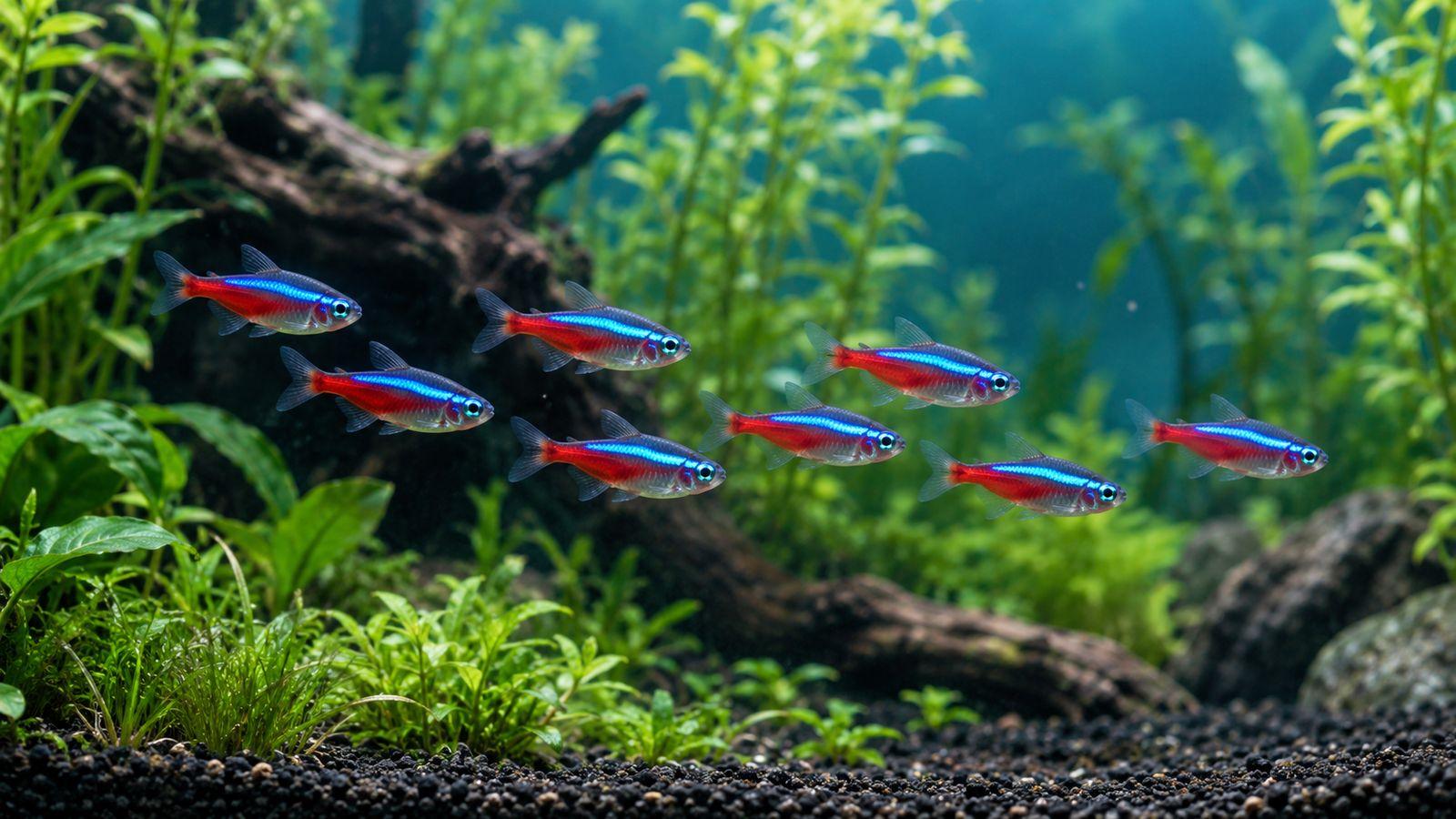
How Many Neon Tetras in a 10 Gallon Tank? Eight, and Why
How many neon tetras in a 10 gallon tank? Eight, kept on their own. Six is the floor and ten the ceiling. The math, plus how to add them without losses.
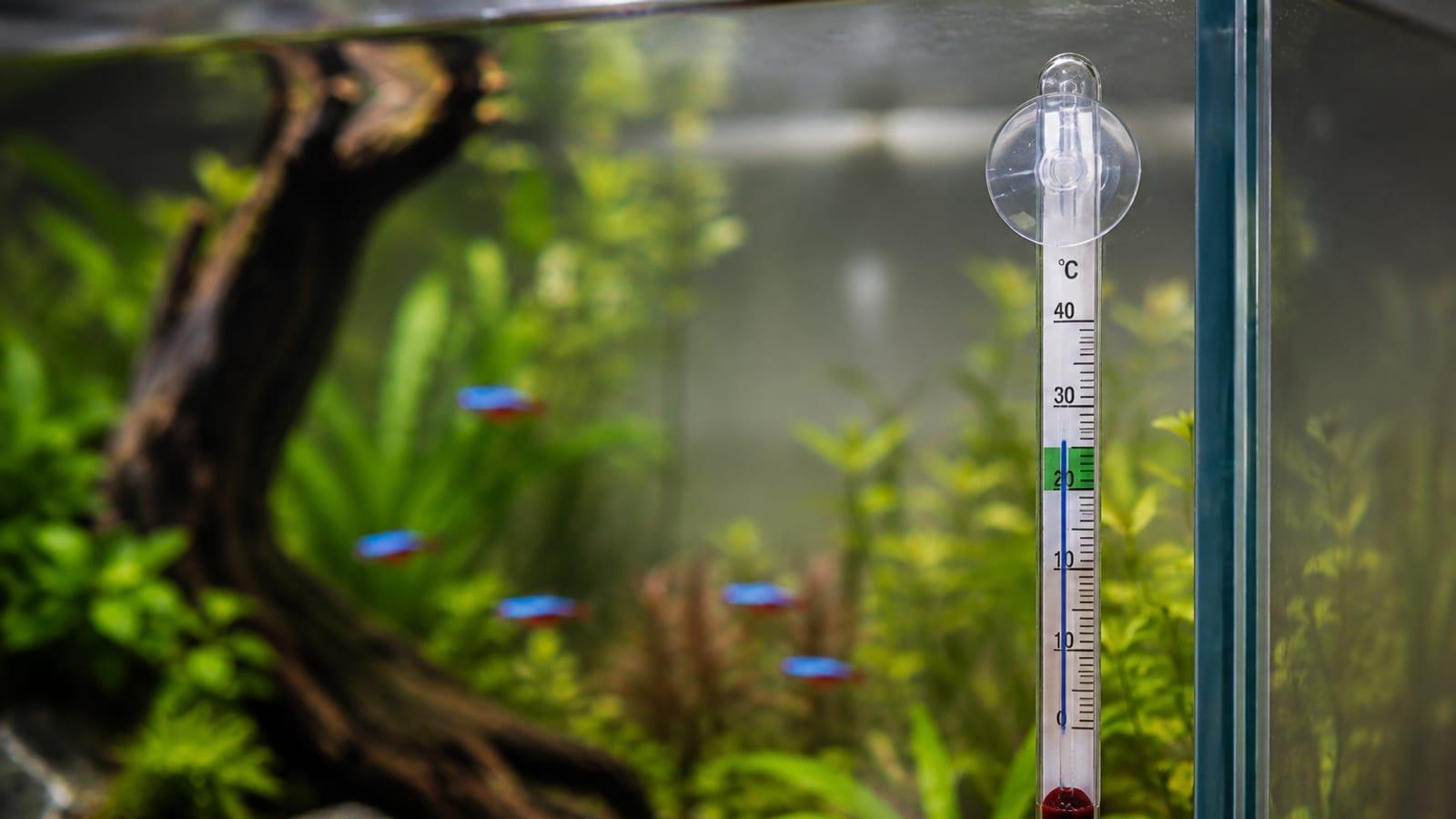
What Temperature Should a Fish Tank Be? By Species
What temperature should a fish tank be? 76-78°F suits most tropical community tanks. Bettas want it warmer, goldfish cooler. Species chart inside.
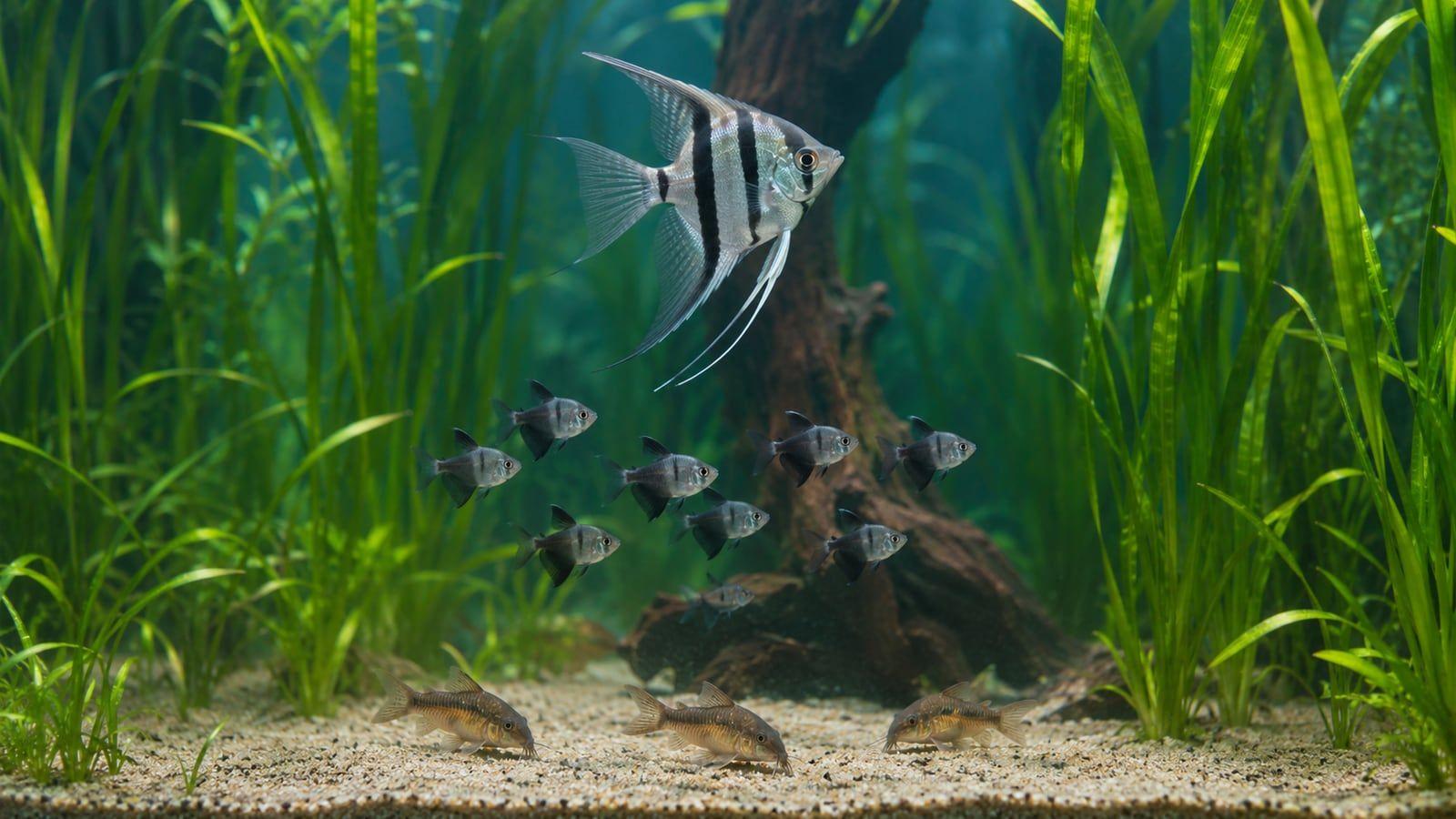
Angelfish Tank Mates: Good, Risky and No, With Reasons
Angelfish tank mates that work, the risky ones and the ones to avoid, with adult sizes and temperatures. Why neon tetras get eaten and barbs nip fins.