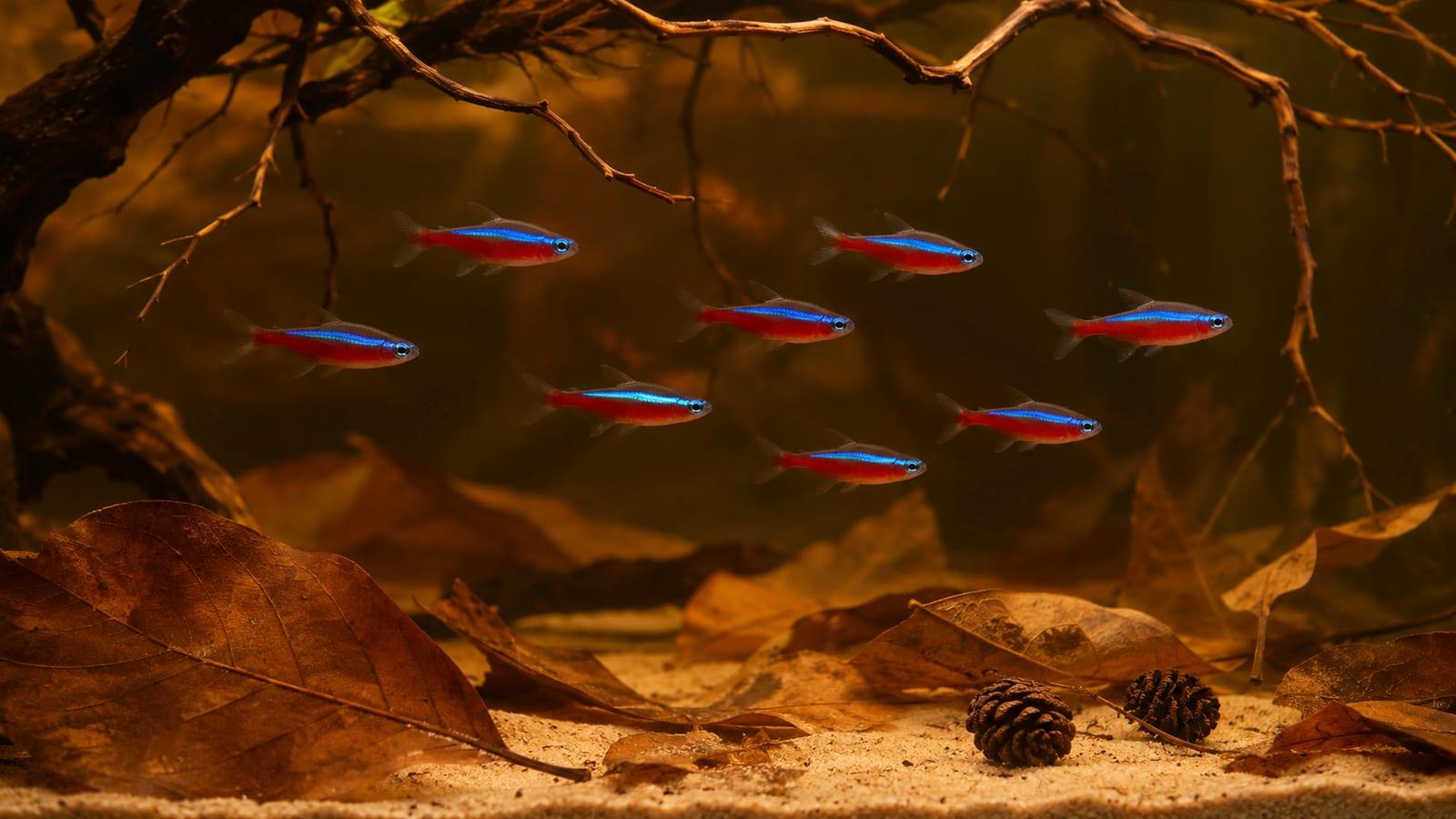
The colour is easy; soft, acidic water is not, because hard tap water absorbs the acid. Cardinals, neons and rasboras do well in tinted water at a stable pH with KH at 3 dKH or above. The health benefits are studied in labs and fish farms, not in home aquariums. Based on species profiles, fish-physiology research and keeper reports, not our own tanks.
The numbers
| Material | Colour | Lowers pH? | The catch |
|---|---|---|---|
| Driftwood | Slow, steady tea tint | Slightly, in low-KH water | White fuzz on new wood for the first weeks |
| Indian almond (catappa) leaves | Tea tint; strength varies by leaf | Mainly in water that is already soft | Turn to mush; take them out every few weeks |
| Oak or beech leaves | Tea tint; strength varies by leaf | Slightly, in soft water | Collect away from roads and sprayed fields; dry first |
| Alder cones | Tea tint; no source measures it | Slightly, in soft water | No published dose; start with one or two |
| Peat | Stains the water brown | Yes, until it is used up | Unsustainable to collect; no reliable dose |
| Bottled blackwater extract | Instant, or none in 'clear' versions | Varies by product | Commercial humic acids differ from river humic matter |
| RO or distilled water, mixed with tap | None | Yes, by lowering KH | Needs testing; never on its own |
A blackwater aquarium is stained tea-brown by tannins and humic substances from leaves, cones and driftwood, like the forest streams of the Amazon and Southeast Asia. The colour is easy. Soft, acidic water is not: in hard tap water the pH barely moves.
The good news is that the fish usually sold for these tanks, cardinals, neons, rummy-noses and rasboras, are mostly farmed or tolerant, and do well in tinted water at a stable pH. Pick a cardinal or neon on temperature, not on water colour. There is real research on blackwater and fish gills, but none on home aquariums. This page is built from species profiles, fish-physiology research, an extension fact sheet, hobby magazines and keeper reports. We have not kept a blackwater tank.
What is a blackwater aquarium?
Blackwater rivers, the Rio Negro in the Amazon being the best known, run brown with organic matter washed out of forest soils and leaf litter. A 2021 review of fish physiology in these waters says "about 8% of all freshwater fish species" live in the Rio Negro's blackwaters (Morris et al.). The pH is "typically 4.0–6.0 but can be as low as 3.0" in forest streams, and calcium and sodium are almost absent. Peat-swamp streams in Malaysia and Indonesia are another home of blackwater aquarium fish.
The colour and the softness have different causes. Most of the colour and acidity comes from humic and fulvic acids; tannins from leaves and wood add to it (Morris et al.; Practical Fishkeeping). The water is soft because the sandy soils lost their minerals long ago, not because of the leaves. Practical Fishkeeping says of blackwater as a whole that "it's the geology of a landscape that plays the focal role".
In a tank, wood, leaves and cones release the same kind of compounds, so the water turns the colour of weak tea. That gives two kinds of black water fish tank:
- A tinted tank: the look, in whatever water comes out of your tap. This page is mostly about this one.
- A biotope: soft, acidic water built from RO or distilled water, for wild-caught fish or breeding.
Either way, tea-coloured water is not algae, and it is harmless.
Do tannins lower pH? Tea-coloured is not soft and acidic
Test your tap water for pH, KH and GH before anything else. KH, the carbonate hardness, is the buffer. If it is moderate or high, leaves and wood will colour the water and move the pH very little: the carbonate absorbs most of the acid before the pH shifts, as the softening guide explains. Chewy's guide How To Lower pH in a Fish Tank Safely says the same of wood: "In highly buffered water, however, driftwood may have little noticeable effect on pH." A Tropical Fish Hobbyist article says leaves and peat lower pH "slightly and gradually, not drastically and quickly", and that with high alkalinity "the effect of any pH-lowering material will be quite fleeting."
Keepers report the same in practice. On Monster Fish Keepers, about half a dozen almond leaves in a large tank at pH 8 left it at pH 8; another keeper added eight to a similar tank and "never noticed a difference". In water with very little KH the opposite happens: on the Aquarium Co-Op forum, a keeper with low-KH tap water reports one leaf pushing the pH too low.
Peat does more, because it swaps calcium for acid, but it runs out, nobody has published a dose, and Seriously Fish says there is "no need to use natural peat, the collection of which is both unsustainable and environmentally-destructive."
If you want truly soft, acidic water, the only reliable way is to mix RO or distilled water with tap. The ratio and the steps are in how to soften aquarium water; RO is never used on its own.
Do not aim low. Blackwater guides print targets anywhere from pH 5.5 to 7.0. This site gives none below 6.5, for one reason: the filter bacteria slow dramatically below about 6.5 and largely stop below 6.0. They also use up carbonate as they work; University of Florida's ammonia fact sheet says that "At a total alkalinity less than 20 milligrams per liter (mg/L), common species of nitrifying bacteria do not function effectively." Keep KH at 3 dKH or above, and let the pH sit where that leaves it.
Tannins in an aquarium: what they do for fish, and what they don't
Almost every page on the subject says blackwater helps fish heal and resist disease. Some of that is studied. Most of it was studied somewhere other than a fish tank.
| Claim | What was actually tested | What it means for a home tank |
|---|---|---|
| Blackwater protects fish gills | Natural Rio Negro organic matter gave zebrafish "almost perfect protection" against ion loss at pH 4.0 in ion-poor water (Duarte et al. 2016) | Real, but measured in very soft water at pH 4, not in neutral tap water |
| Any humic product does it | Commercial humic acids "usually derived from coal or peat" are "fundamentally different", and one made low-pH ion loss worse in Amazonian stingrays (Morris et al. 2021) | Bottles are not river water |
| It helps sick fish recover | A fish-health review: humic substances help stressed or injured fish recover, but "are not real alternatives to strong traditional therapeutics", and reports are "diverse, if not inconsistent" (Meinelt et al. 2008) | Not a treatment |
| It stops fungus | Humic substances slowed a fish water mould on agar plates; "fungistatic, rather than fungicidal" (Meinelt et al. 2007) | A dish, not a fish |
| It boosts immunity | One aquaculture trial: juvenile rainbow trout in 50 mg of carbon per litre of a fulvic-acid product for 28 days grew better and showed stronger immune markers (Lieke et al. 2021) | One product, one species, a high dose |
| Almond leaves cure disease | Leaf extract slowed bacteria taken from bettas in lab tests (Purivirojkul 2012) | Nobody has measured what a few leaves release into a tank |
Wild blackwater fish are built for this water. When neon tetras were moved from pH 6.5 to pH 3.25, their sodium uptake "did not show even a slight inhibition", and cardinals share the trait (Gonzalez et al. 2024). That shows tolerance, not need.
There is a downside too. The same research group that reviewed the benefits found humic substances "exert a mild chemical stress" on aquatic animals and can have hormone-like effects on fish (Steinberg et al. 2008). A Tropical Fish Hobbyist writer warns that "too high a concentration of tannins" coagulates the fish's mucus, and that the remedy is "an immediate, large water change". Leaves that rot into mush add waste like uneaten food.
On almond leaves and fin rot: a small study in bettas found the extract improved resistance to Aeromonas bacteria, but no study has tested it as a fin rot treatment.
The verdict: a good reason to like the look, not a treatment. None of it has been tested in a home aquarium.
Best blackwater fish for beginners
| Fish | Where wild fish live (Seriously Fish) | In the shop | Keep at |
|---|---|---|---|
| Cardinal tetra | Rio Negro, water "stained brownish" | "A significant proportion" still wild-caught | 73–84°F, buy for 78°F or warmer; school of eight |
| Neon tetra | Blackwater and clearwater streams | Almost all farmed | 70–77°F; school of eight |
| Rummy-nose tetra | Water "stained brown with tannins"; colours fade in alkaline water | — | 73–79°F; 10 or more, 36 in or more of swimming length |
| Harlequin rasbora | Peat-swamp streams, "stained faintly brown to yellowish" | Farmed | 70–82°F; group of 8–10 |
| Chili rasbora | "Black water streams and pools associated with ancient forest peat swamps" | — | 68–82°F; ten to twelve in a 10 gallon |
| Betta | Not blackwater: "rice paddies, swamps, roadside ditches, streams and ponds" | Farmed | 76–81°F; leaf litter for cover is fine |
Seriously Fish's ranges for the five schooling fish start as low as pH 3.5 to 5.5, but every one runs up to pH 7.0 or 7.5, and it notes that wild cardinals "are less tolerant of deteriorating water conditions than commercially-produced ones." The rummy-nose is the one to watch in hard, alkaline water, since its red fades there. For counts, see how many neons and chili rasboras in a 10 gallon.
The betta correction. Many blackwater fish lists include the betta. Seriously Fish places wild Betta splendens in paddies, ditches and swamps, often shaded by plants, with no mention of blackwater; it is the wider genus that includes peat-swamp species. Bettas still take well to a leaf or two and soft light.
Who does not belong in a soft, acidic biotope: livebearers such as guppies, which Seriously Fish lists at 8–30 dGH, and snails and shrimp, which need minerals for shells and moults. A tinted tank at near-neutral pH is fine for a shrimp tank; a soft, acidic one is not. Discus, apistogramma and wild-caught fish are the advanced end, and the RO route.
How to set up a blackwater aquarium
- Test the tap water for pH, KH and GH, and write the numbers down. They decide whether you are making a tinted tank or an RO project.
- Wood first. Driftwood gives the slow, steady tint. Soaking new wood for a week or two removes most of its tannins, so skip the long soak if you want the colour, and expect white fuzz on new wood. It is harmless and fades.
- Leaves. Dried Indian almond (catappa), oak or beech, all named in Seriously Fish profiles. If you collect your own, pick them away from roads and sprayed fields and dry them first (Practical Fishkeeping, Tropical Fish Hobbyist).
- Go slowly. No source gives a measured dose; retailer and hobby-site counts all differ. Start with one or two leaves per 10 gallons, add more over weeks, and watch the fish rather than the colour. Seriously Fish replaces leaf litter "every few weeks".
- Alder cones, which Seriously Fish suggests for cardinals and neons, are another source of tint. No source gives a dose either; start with one or two.
- No peat. It is unsustainable to collect, and the tint is easy to get without it.
- Take the carbon out, or it strips the colour. If you ever run it, it is replaced monthly, as the filter guide covers. If the water gets too dark, Practical Fishkeeping suggests running carbon "for a week or so each month as a compromise".
- Dim the light. Seriously Fish says cardinals and harlequins do best under fairly dim lighting. For plants, java fern and anubias tied to the wood are the usual choice. Aquasoil also lowers pH, as the substrate guide explains.
- Skip the bottle, or treat it as optional. One bottled humic conditioner's listing says it will "slightly acidify the water, make it softer, and encourage fish spawning". Researchers warn that commercial humic acids behave differently from the humic matter in rivers (Morris et al.).
- Cycle the tank first, as with any tank. Add fish only when ammonia and nitrite read zero.
Keeping a blackwater fish tank stable
Change water the same way as in any tank: 25% weekly, with new water close to tank temperature. If you run a softened mix, make every change at the same ratio. Chewy's pH guide says to "Avoid making abrupt changes to aquarium pH", and one big change with harder tap water is exactly that.
Low pH hides ammonia
In acidic water most ammonia sits as ammonium, the far less toxic form. The University of Florida fact sheet says un-ionized ammonia is "approximately 100 times more toxic" and that there is more of it at high pH. It follows that in a low-pH tank where the bacteria have slowed, a large water change that lifts the pH can turn stored ammonium into toxic ammonia. Test ammonia before a big change, and change water in steps. Amazonian fish are also "more sensitive to ammonia toxicity" than fish from neutral waters when compared at pH 7 (Morris et al.).
Lift out leaves that have turned to mush, and siphon the debris off the sand; cleaning aquarium sand covers the method. The colour fades as wood ages and water changes dilute it; top it up with a leaf, not a bottle. Shop water and a tinted tank can differ in pH, so acclimate new fish as usual.
The short version
Wood and a few leaves will make any tank tea-coloured. Only RO or distilled water mixed with tap makes it soft and acidic. For captive-bred cardinals, neons and rasboras the colour is enough: keep KH at 3 dKH or above and the pH steady.
Sources
- Morris, Val, Brauner and Wood (2021). The physiology of fish in acidic waters rich in dissolved organic carbon, with specific reference to the Amazon basin. Journal of Experimental Zoology Part A 335(9–10): 843–863, doi:10.1002/jez.2468. Author's copy.
- Duarte, Smith, Val and Wood (2016). Dissolved organic carbon from the upper Rio Negro protects zebrafish (Danio rerio) against ionoregulatory disturbances caused by low pH exposure. Scientific Reports 6: 20377. Abstract read via Europe PMC.
- Gonzalez, Patrick and Val (2024). Ion uptake in naturally acidic water. Journal of Comparative Physiology B 194(5): 685–696.
- Meinelt, Schreckenbach, Pietrock, Heidrich and Steinberg (2008). Humic substances. Part 1: Dissolved humic substances (HS) in aquaculture and ornamental fish breeding. Environmental Science and Pollution Research 15: 17–22. Abstract read via Europe PMC.
- Steinberg, Meinelt, Timofeyev, Bittner and Menzel (2008). Humic substances. Part 2: Interactions with organisms. Environmental Science and Pollution Research 15: 128–135. Abstract read via Europe PMC.
- Meinelt, Paul, Phan, Zwirnmann, Krüger, Wienke and Steinberg (2007). Reduction in vegetative growth of the water mold Saprolegnia parasitica (Coker) by humic substance of different qualities. Aquatic Toxicology 83(2): 93–103. Abstract record only.
- Lieke, Steinberg, Pan, Perminova, Meinelt, Knopf and Kloas (2021). Phenol-rich fulvic acid as a water additive enhances growth, reduces stress, and stimulates the immune system of fish in aquaculture. Scientific Reports 11: 174. Abstract read via Europe PMC.
- Purivirojkul (2012). Potential application of extracts from Indian almond (Terminalia catappa Linn.) leaves in Siamese fighting fish (Betta splendens Regan) culture. Communications in Agricultural and Applied Biological Sciences 77(4): 439–448. Abstract read via Europe PMC.
- Watson, Francis-Floyd, Petty and Pouder. Ammonia in Aquatic Systems. University of Florida IFAS Extension, FA16 (first published 1990; current revised EDIS version).
- Seriously Fish. Species profiles: Paracheirodon axelrodi, Paracheirodon innesi, Hemigrammus bleheri, Trigonostigma heteromorpha, Boraras brigittae, Betta splendens.
- Sergeant. A blackwater breakdown. Practical Fishkeeping, undated.
- Bednarczuk. Leaf Litter & More: How to Naturally Lower Aquarium pH. Tropical Fish Hobbyist, September/October 2018.
- Chewy (2026). How To Lower pH in a Fish Tank Safely. Hilary Jaffe, reviewed by Joseph Hiduke (not a vet); updated 1 September 2026. A retailer's guide, cited by title.
- Brightwell Aquatics. BlackWater Clear product description (a version sold without the brown tint), read on a retailer listing, 24 November 2026. Manufacturer claim.
- Keeper reports: Monster Fish Keepers, Experiment w Almond Leaves (2021); Aquarium Co-Op forum, "Indian almond leaves and pH" and "pH too low after Indian almond leaf added" (the second from May 2022; titles and search excerpts only).
Questions people ask
Mentioned in this guide
Related guides
How to Soften Aquarium Water: Lower GH Without Crashing pH
How to soften aquarium water: mix RO or distilled with tap at a measured ratio to lower GH. Get the formula, and why softeners and almond leaves fail.
Can You Use Distilled Water in a Fish Tank? Not on Its Own
Can you use distilled water in a fish tank? Not by itself — it has no minerals and cannot hold a stable pH. Use it for top-offs and to soften hard tap water.
Angelfish Tank Mates: Good, Risky and No, With Reasons
Angelfish tank mates that work, the risky ones and the ones to avoid, with adult sizes and temperatures. Why neon tetras get eaten and barbs nip fins.