Goldfish beyond one young fancy fish, common plecos and angelfish do not fit. Built from species databases and vet sheets, not our own tanks.
The numbers
| Plan | Fish and how many | Temperature | The catch |
|---|---|---|---|
| Community | 10 harlequin rasboras or neon tetras, 6 panda corydoras, 2 honey gouramis, 2 nerite snails | 76°F | Pandas want 77°F or cooler |
| Dwarf cichlid | 1 pair cockatoo dwarf cichlids, 10 ember tetras | 78°F | The pair guards the floor when it breeds |
| Betta | 1 male betta, 8–10 harlequin rasboras, 5–6 kuhli loaches | 78°F | Depends on the betta. No long-finned fish |
| Shrimp | A cherry shrimp colony, 10–12 chili rasboras, 2 nerite snails | 75°F | Fish eat baby shrimp. Add them last |
| Goldfish | 1 young fancy goldfish, alone | 65–75°F | Needs 30–40 gallons as an adult |
| Common pleco | 0 | — | Grows to between about 11 inches and nearly two feet |
| Angelfish | 0 | 75–86°F | Database asks for a tank 20 in tall. May eat tetras |
| Zebra danios | 0 | — | Need a tank 36 in long |
The best fish for a 20 gallon tank are a shoal of ten small fish, six corydoras and a centrepiece such as two honey gouramis. Or plan the tank around a dwarf cichlid pair, a betta or a shrimp colony.
Goldfish (beyond one young fancy fish), common plecos and angelfish outgrow it. We have not kept or tested these fish ourselves. Every size and group below comes from a species database (Seriously Fish, FishBase), a vet-written or vet-reviewed care sheet (PetMD, WebMD), two papers on fish growth and metabolism, and keeper reports. The plans and counts are our judgement inside the group sizes the databases give, and we say so where it matters.
Every plan is written for the 30 inch 20 long. How stocking counts are worked out in general is in how many fish fit in a 10 gallon tank.
How to tell if a fish fits a 20 gallon tank
Two tanks share the name. The 20 high is 24¼ by 12½ inches and 16¾ tall; the 20 long is 30¼ by 12½ inches and 12¾ tall, all measured on the outside of the glass. They hold the same water and weigh about 225 lb filled. Most fish swim along the length, so every plan below is for the long.
Seriously Fish gives a minimum tank base for most species it profiles. Set against a 20 long's floor of about 378 square inches, that gives a simple rule for what fish can live in a 20 gallon tank:
- Listed at 60 × 30 cm (24 × 12 inches) or smaller: it fits.
- Listed at 80 × 30 cm (31½ × 12 inches): that is a little more than the 20 long's whole floor, and over an inch longer than the tank. Borderline, and on this page only with a reason.
- Listed at 90 × 30 cm (36 × 12 inches) or more, or asking for a tall or deep tank: it does not fit.
The match is on floor area and length. The inside of the glass is a little smaller than the outside, so a fish at the borderline has no margin.
Length matters more than the count, because waste does not scale with length. FishBase's Rainer Froese pooled 3,929 published weight–length relationships for 1,773 species and confirmed that weight rises with roughly the cube of length (Froese, 2006). Across 69 species, a fish's resting oxygen use rises with its weight to the power of about 0.79 (Clarke and Johnston, 1999). Put the two together, which is our arithmetic, not theirs, and a fish twice as long weighs about eight times as much and works the tank roughly five times as hard. Ammonia is a by-product of that metabolism, which is why it is the filter's load. So a 20 gallon holds a shoal of ten 1.5 inch fish and one or two bigger ones, not ten 3 inch fish. Snails and shrimp barely count.
Within the fish that fit, the plans are ordered by how forgiving they are for a beginner. That order is our call.
Four stocking plans for a 20 gallon long
Each plan is a complete tank with one temperature that every animal in it tolerates. Pick one. Sizes are standard length, measured without the tail, as Seriously Fish gives them.
1. The community tank: ten small fish, six corydoras, two honey gouramis
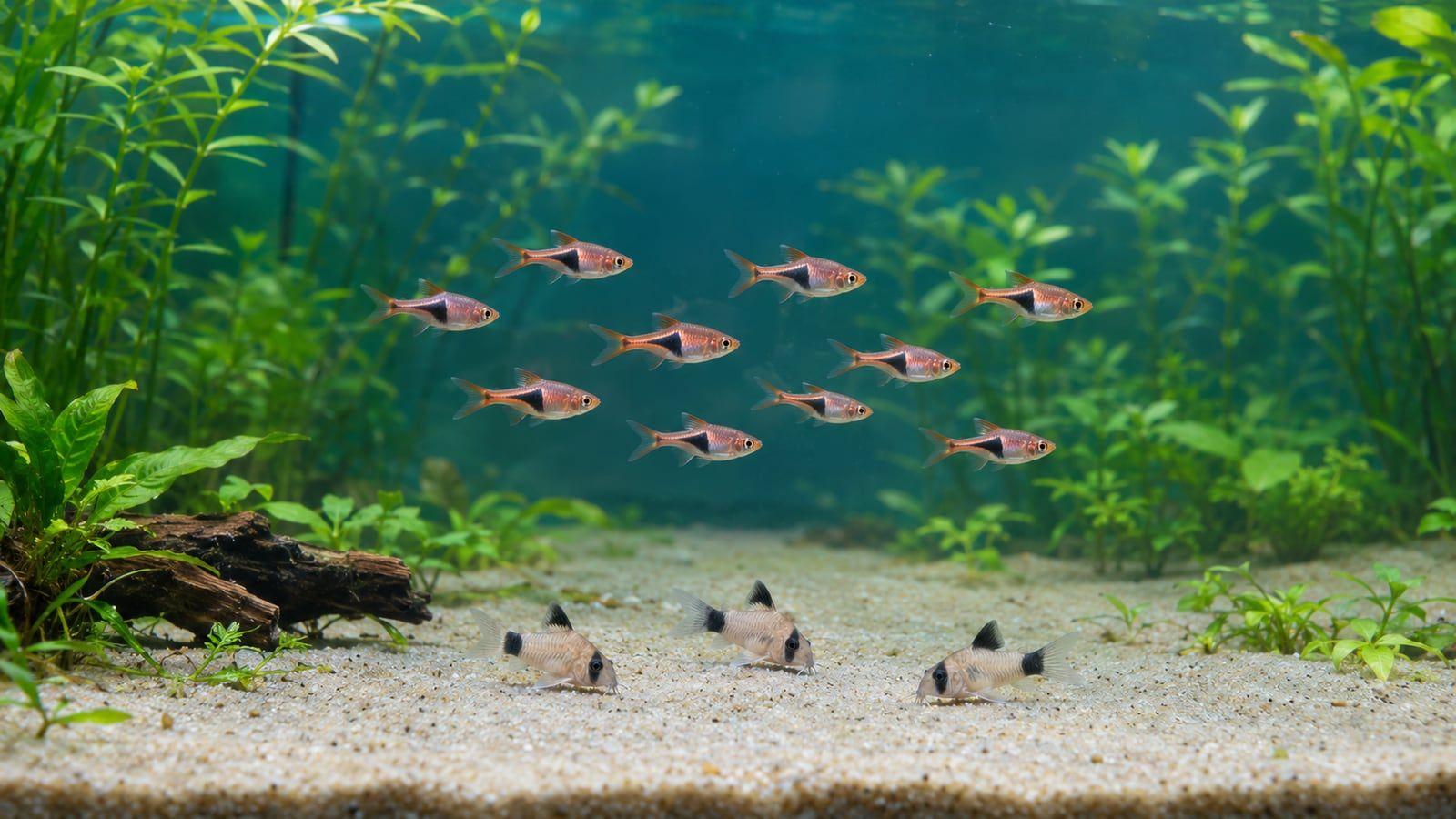
10 harlequin rasboras (or 10 neon tetras), 6 panda corydoras, 2 honey gouramis and 2 nerite snails. Set the heater to 76°F.
Harlequin rasboras reach about 1.8 inches and take 70 to 82°F. Seriously Fish lists them at a 60 × 30 cm base, says they should be "kept in a group of at least 8-10 specimens", and gives them "an unreserved recommendation for those new to fishkeeping". Neon tetras are the swap: 1.2 inches, 70 to 77°F, the same base and group. Seriously Fish warns that years of commercial breeding "have somewhat affected the genetic vigour" of farmed neons. Cardinal tetras look similar and like it warmer, 73 to 84°F; cardinals or neons covers that choice.
Panda corydoras reach 2 inches. Seriously Fish says tank-bred fish are "happy over the range 72 to 77°F" and that "A group of at least six is best". They need sinking food of their own, not what drifts down from the shoal above; the feeding table for a 20 gallon community has a row for this tank.
Honey gouramis are the centrepiece: 2.2 inches, 72 to 81°F, slow and peaceful. Seriously Fish says a 60 × 30 cm base is enough "to house a pair or small group". The same profile says the species "does best in a group of four to six", while its summary lists it as best in a pair. It is slow and "easily outcompeted". With a shoal and six corydoras already in the tank, we take the pair; that is our call, not the database's.
Why 76°F: the four species overlap at 72 to 77°F, and the pandas set the ceiling. That sits inside the community range in the temperature guide.
This is the tank the site already describes for a 20 long: a shoal of ten small fish, a centrepiece and a cleanup crew. The fish cost is in what a 20 gallon costs.
The catch: the pandas want 77°F or cooler, so no warm-water fish join this plan. If your tank runs warmer, swap them for six sterbai corydoras, which Seriously Fish lists at 75 to 82°F.
2. The dwarf cichlid tank: a cockatoo pair over ten tetras
1 pair of captive-bred cockatoo dwarf cichlids (Apistogramma cacatuoides) and 10 ember tetras (or 10 cardinal tetras). 78°F.
The male reaches about 3 inches and the female about 2. Seriously Fish lists the species at 72 to 84°F and says a base of "60 ∗ 30 cm … or more are acceptable for a single pair", with a group needing more room. It calls captive-raised fish "the recommended choice for the general community aquarium".
Ember tetras reach 0.8 inches, take 68 to 82°F and should be bought as "a minimum of 8-10". Seriously Fish says the species "does not normally hunt fry", which matters in a tank where the cichlids will breed. The overlap with the cichlids is 72 to 82°F. Cardinals overlap at 73 to 84°F; Seriously Fish notes that a significant share of trade cardinals are still wild-caught, and wild fish are less tolerant of poor water.
There is no bottom shoal in this plan on purpose. The pair claims the floor and its caves, and Seriously Fish warns that when breeding "in smaller aquaria" the female can become "hyper-aggressive" and the male may need to be removed.
The swap readers ask about: the German blue ram fits the floor, and Aquarium Co-Op, a fish retailer, puts it in its seven fish for a 20 gallon. Seriously Fish lists it at 81 to 86°F, says it "is not recommended for the general community aquarium", and says ornamental strains such as gold and balloon rams "tend to be genetically weak and short-lived". We would not start with it.
The catch: a pair with fry will chase the tetras. Give them plants and cover across the whole tank.
3. The betta tank: one betta, harlequins and kuhli loaches
1 male betta, 8–10 harlequin rasboras and 5–6 kuhli loaches on sand. 78°F.
This is the company the site already gives a betta in a bigger tank: harlequin rasboras "in a group of eight to ten" and kuhli loaches, which need "a 20-gallon long or larger". The wider list is in what a betta can live with.
Kuhli loaches reach nearly 4 inches. Seriously Fish lists them at 70 to 79°F, says "a group of at least 5-6 specimens should be the minimum purchased", and says to "Use a soft, sandy substrate". With the betta's 76 to 81°F from PetMD's care sheet, the overlap is 76 to 79°F.
Keep the flow gentle. A sponge filter is the betta option for a 20 gallon.
The catch: it depends on the individual betta, which you cannot know before you try. Seriously Fish calls the betta "not recommended for the standard community aquarium" and says it is best kept alone: some individuals tolerate other species, "but this is the exception not the expected norm." It allows that some small cyprinids and loaches are suitable, which is why this plan uses harlequins and kuhlis, and says to avoid fish with trailing fins. No guppies, no long fins, and no fin-nippers such as tiger barbs. Have a spare tank ready in case the betta does not accept company.
4. The shrimp tank: a cherry shrimp colony with chili rasboras
A cherry shrimp colony (start with about ten), 10–12 chili rasboras added once the shrimp are breeding, and 2 nerite snails. 75°F.
The shrimp count is our judgement: no source we found gives shrimp per gallon. Cherry shrimp take 72 to 82°F and chili rasboras 68 to 82°F, both inside a 75°F tank.
Nathan Hill, writing in Practical Fishkeeping, calls the dwarf rasboras that include the chili "small enough to live with shrimp in nano tanks" and says "Any mortalities will be of the youngest baby shrimp." For fish that will eat the young, he advises "giving your shrimp colony time to build up before you add the fish", which is why the chilis go in last. Aquarium Co-Op says some nano fish, the chili among them, "pose little threat to full-grown cherry shrimp" and recommends lots of cover. Seriously Fish says chilis can live with Neocaridina shrimp in a planted tank, and that they are too timid to make an ideal community fish, which suits a tank with no other fish.
Later, a group of six otocinclus can join once the tank is mature and planted. The same Practical Fishkeeping article captions them "100% safe" with shrimp, and the brown algae guide explains why they can starve in a young tank.
Feeding is in what cherry shrimp eat. Setting the tank up is in shrimp tank setup.
The catch: every fish eats baby shrimp. Dense plants and moss decide how many survive.
Other good fish for a 20 gallon tank
These are all listed at a 60 × 30 cm base or smaller. Mix them only inside one plan's temperature.
- Neon or cardinal tetras, 10 or more, as the shoal in plans 1 or 2.
- Cherry barbs, 6 to 10. 2 inches, 68 to 81°F, "Generally very peaceful."
- Pygmy corydoras, 10 or more. Seriously Fish says at least 6, preferably 10 or more, with other tiny fish only. Unlike most corydoras they swim in midwater.
- Sterbai corydoras, 6. 2.6 inches, 75 to 82°F: the warm-water cory.
- One bristlenose pleco. About 5 inches, 70 to 79°F. Seriously Fish lists a 60 × 30 cm base for "a single specimen or breeding pair" and calls it territorial with its own kind. It is the community's algae grazer and close to the biggest fish a 20 gallon holds. It still needs an algae wafer of its own.
- Male platies, or eight male guppies. No females; why only males explains it.
- Sparkling gouramis or celestial pearl danios, for something less common.
- For an unheated tank: White Cloud Mountain minnows, 10 or more. Seriously Fish lists a 60 × 30 cm base and says they are "most comfortable" at 57 to 72°F.
Popular fish that do not fit a 20 gallon tank
Eight fish are regularly sold or recommended for a 20 gallon and outgrow it.
Goldfish
PetMD's care sheet, by Melissa Witherell, DVM, says "a single juvenile goldfish needs a 20-gallon habitat or larger" and asks for about 5 gallons for every inch of body. By that rule, a 6 to 8 inch adult fancy goldfish wants 30 to 40 gallons; common goldfish need a pond or a very large tank. So a 20 gallon suits one young fancy goldfish, not a group, and has no room for tank mates.
Some lists put goldfish in a 20 gallon community. Aqueon's "3-4" fancy goldfish are for a 29 gallon, not a 20. See how big goldfish get and what can live with a goldfish.
Common pleco
Two species are sold under the name. FishBase gives Hypostomus plecostomus a common length of 28 cm (11 inches) and Pterygoplichthys pardalis a maximum of 57.8 cm (nearly 23 inches). So the fish grows to between about 11 inches and nearly two feet, depending on which species the shop is selling. A 20 long is 30¼ inches. The bristlenose is the pleco that fits.
Angelfish
Sources disagree here, so here is the whole of it.
- WebMD, medically reviewed, says "An angelfish aquarium should be at least 20 gallons." Aquarium Co-Op says angelfish fit "if you have upwards of 20 or 25 gallons (especially a vertically tall tank)".
- Seriously Fish says adults "reach 15 cm in body length and 20 cm or more in height" and asks for a tank of 100 × 40 × 50 cm: 39 inches long, 16 deep and 20 tall.
- A 20 long is 12¾ inches tall and a 20 high 16¾, both on the outside. Neither reaches the 20 inches the database asks for a fish about 8 inches tall.
- Seriously Fish says angelfish "may eat small fish such as tetras", and PetMD says to avoid smaller fish "your angelfish might see as food". That rules out every plan above.
We side with the database, because it sizes the tank to the adult fish, not to the juveniles sold in shops. A breeding pair is a bigger project still: Seriously Fish's route to a pair is to grow on a group of six juveniles and let them choose. For the tank an angelfish does need and what can live with one, see angelfish tank mates.
Five more sold for 20 gallons
- Zebra and leopard danios. 2 inches, but Seriously Fish asks for a 90 × 30 cm base, 36 inches long. Aquarium Co-Op suggests 12 to 15 danios for an unheated 20 and a group of six leopard danios in another list. The database disagrees, and we side with it. White Cloud Mountain minnows are the unheated fish that fit.
- Tiger barbs. Base 80 × 30 cm, the 20 long's limit, and Seriously Fish calls them "notoriously aggressive" fin-nippers, mostly "when insufficient numbers are purchased or space is limited". In a 20 they are both.
- Kribensis. Seriously Fish lists 24 by 15 inches for a pair. A 20 long is 12½ inches front to back.
- Swordtails. Seriously Fish asks for a 120 × 30 cm base, 48 inches long. Shop fish are often smaller than the species' maximum; the tank figure is the point.
- Pearl gourami. About 5 inches, base 90 × 30 cm. Aqueon lists it for 20 to 50 gallon tanks; the database puts it in the bigger half of that range.
Also too big: mollies (base 90 × 30 cm, and hard water), rummy-nose tetras (a tank at least 36 inches long), and oscars, discus and African cichlids. The dwarf gourami fits the floor, but we leave it off for the same reason as on the 10 gallon page: Seriously Fish reports a dwarf gourami iridovirus that "thus far has proved untreatable".
Check the adult size before the price
Shop tanks hold juveniles, and the label gives today's size. Look up the adult size and the tank base the database lists. A 20 long is 30 inches; a fish that needs 36 does not fit, however small it is on the day you buy it.
Pick one plan, then set the tank up for it
- Cycle the tank first. Three to six weeks, before any fish.
- Price the whole setup in what a 20 gallon costs. Fish are the last and smallest line.
- Choose the filter for your plan: a hang-on-back rated above 20 gallons for the community and cichlid plans, a sponge filter for the betta and shrimp plans.
- Set the heater to the plan's temperature. A 20 gallon takes a 75 to 100 W heater.
- Use sand for the kuhli loaches in plan 3, and plant plan 4 densely.
- Add about a third of the fish, wait two weeks, test ammonia and nitrite, then add the next third. Acclimate each batch.
If your tank is smaller, see the best fish for a 10 gallon tank or a 5 gallon. For rainbowfish, kribensis or bigger shoals, see a 55 gallon.
The short version
Four plans, one per tank: ten harlequins or neons with six panda corydoras and two honey gouramis; a cockatoo dwarf cichlid pair with ten ember tetras; a betta with harlequins and kuhli loaches; a cherry shrimp colony with chili rasboras. No goldfish beyond one young fancy, no common pleco, no angelfish.
Sources
- Aqueon. Aquarium sizes and dimensions chart (PDF), via our dimensions chart.
- Froese, R. (2006). Cube law, condition factor and weight–length relationships: history, meta-analysis and recommendations. Journal of Applied Ichthyology 22(4): 241–253.
- Clarke, A. and Johnston, N.M. (1999). Scaling of metabolic rate with body mass and temperature in teleost fish. Journal of Animal Ecology 68(5): 893–905.
- Seriously Fish, community plan: Trigonostigma heteromorpha, harlequin rasbora; Paracheirodon innesi, neon tetra; Paracheirodon axelrodi, cardinal tetra; Corydoras panda; Corydoras sterbai; Trichogaster chuna, honey gourami.
- Seriously Fish, cichlid plan: Apistogramma cacatuoides; Hyphessobrycon amandae, ember tetra; Mikrogeophagus ramirezi, German blue ram.
- Seriously Fish, betta plan: Betta splendens; Pangio semicincta, kuhli loach.
- Zayas, M. (2026). Betta Fish Care Sheet. PetMD.
- Seriously Fish, shrimp plan and other fish that fit: Boraras brigittae, chili rasbora; Puntius titteya, cherry barb; Corydoras pygmaeus; Ancistrus cf. cirrhosus, bristlenose; Trichopsis pumila, sparkling gourami; Danio margaritatus, celestial pearl danio; Xiphophorus maculatus, platy; Tanichthys albonubes, White Cloud Mountain minnow.
- Hill, N. What can I keep with shrimp? Practical Fishkeeping.
- Aquarium Co-Op. Top 12 Tank Mates to Keep With Cherry Shrimp in Freshwater Tanks. A retailer's guide.
- Seriously Fish, fish that do not fit: Danio rerio, zebra danio; Puntigrus tetrazona, tiger barb; Pelvicachromis pulcher, kribensis; Xiphophorus hellerii, swordtail; Trichopodus leerii, pearl gourami; Poecilia sphenops, molly; Hemigrammus bleheri, rummy-nose tetra; Trichogaster lalius, dwarf gourami.
- Seriously Fish. Pterophyllum scalare, angelfish.
- Felton, A., medically reviewed by Begum, J. (2024). What to Know About Owning a Pet Angelfish. WebMD.
- Childree, A., reviewed by Witherell, M. (2025). 10 Angelfish Fun Facts That Will Make You Love Them Even More. PetMD.
- Witherell, M. (2024). Goldfish Care Sheet. PetMD.
- FishBase. Hypostomus plecostomus and Pterygoplichthys pardalis.
- Aquarium Co-Op. 5 Best Fish Tank Ideas for a 20-Gallon Aquarium, 7 Popular Fish You Should Try in a 20-Gallon Aquarium and Top 5 Centerpiece Fish. A retailer's guides, used for what the shop advice says.
- Aqueon. Best Beginner Fish by Tank Size.
- Zayas, M. (2026). Guppy Fish Care Sheet. PetMD.
Questions people ask
Mentioned in this guide
Related guides
Best Fish for a 10 Gallon Tank: 6 That Fit, 3 That Don't
The best fish for 10 gallon tank setups, ranked: one betta, 8 ember tetras, 10 chili rasboras or 5 male guppies. Plus why goldfish and plecos do not fit.
How Many Fish in a 10 Gallon Tank? A Straight Answer
How many fish in a 10 gallon tank? Six to eight small schooling fish, or one betta plus a clean-up crew — and why inch-per-gallon keeps killing tanks.
Cardinal Tetra vs Neon Tetra: How to Tell and Which to Buy
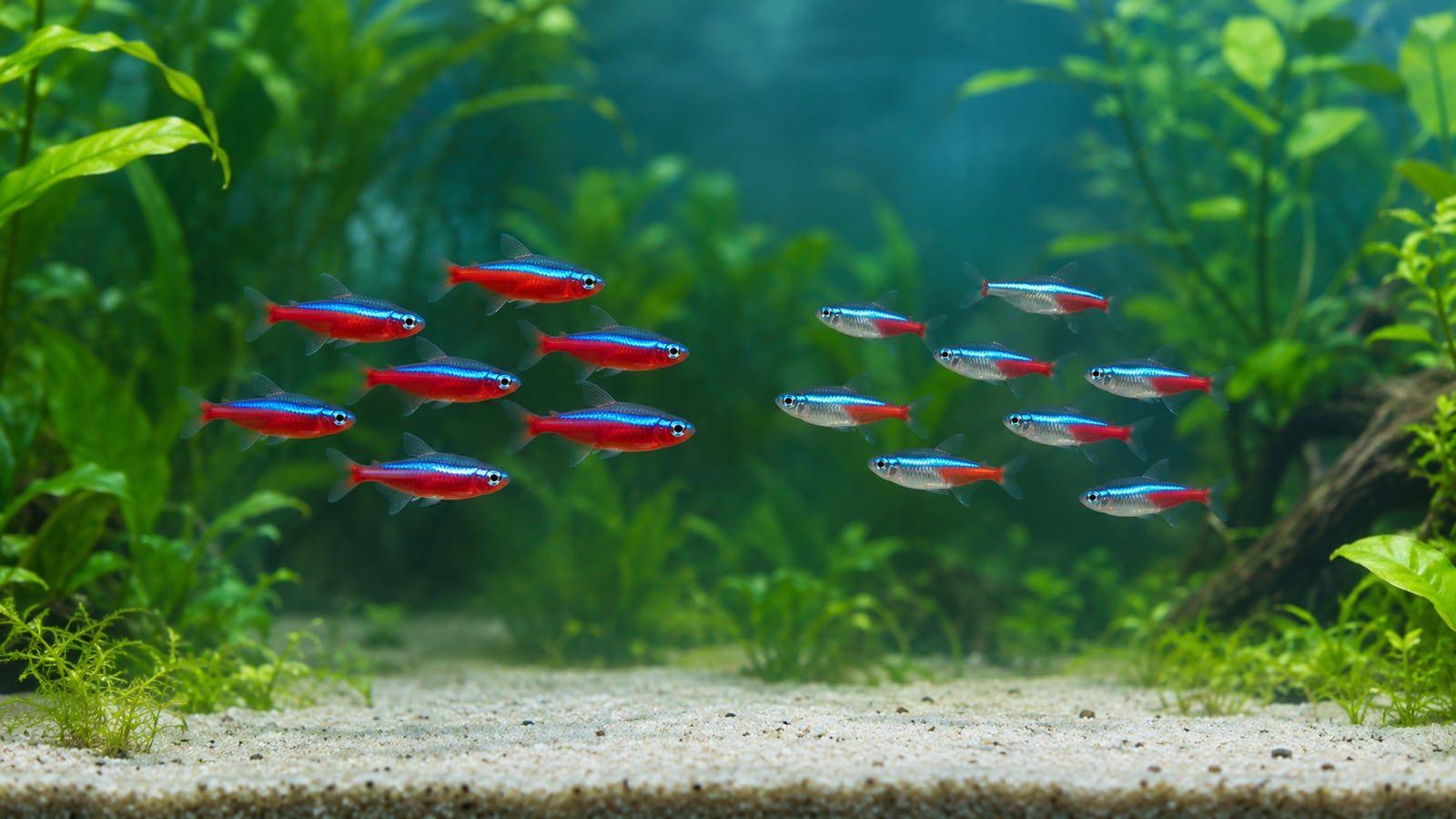
Cardinal tetra vs neon tetra: buy neons for a tank at 74–76°F, cardinals for 78°F or warmer. A cardinal's red stripe runs head to tail, a neon's only halfway.