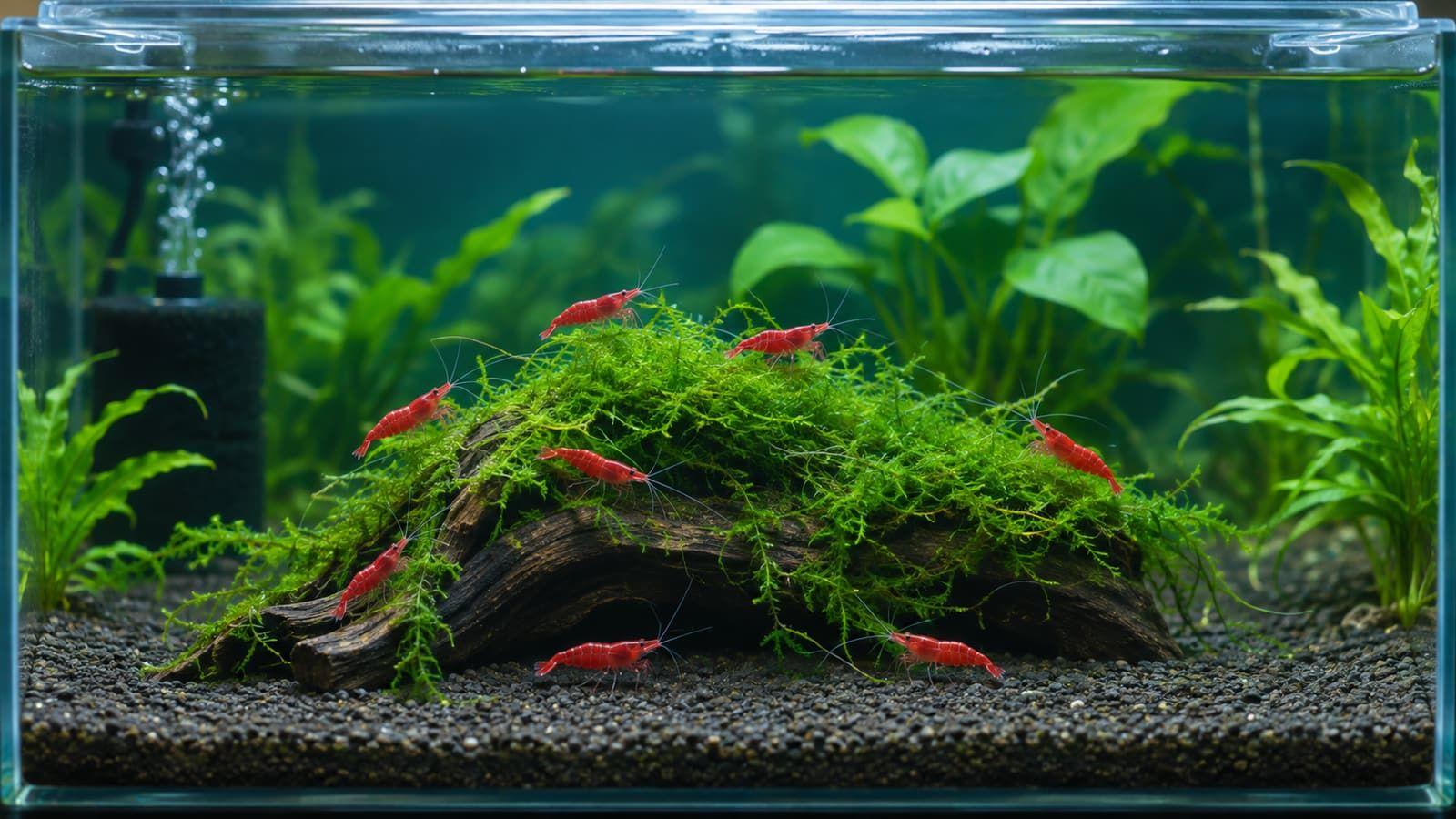
Cycle it without animals until 2 ppm ammonia clears in a day, then add about ten cherry shrimp, drip acclimated over an hour or more. 0 and copper out. Based on peer-reviewed studies, vet-reviewed care sheets and keeper reports, not on our own testing.
The numbers
| Step | What to use | Why |
|---|---|---|
| Tank | 5–10 gallons, with a lid | More water changes more slowly; shrimp climb out |
| Filter | Sponge filter on an air pump | Gentle, and no intake to pull in 1–2 mm babies |
| Substrate | Fine gravel or sand; aquasoil optional | Cherry shrimp do well on plain substrate |
| Cover | Java moss, a piece of wood, easy plants | Moss is where they shelter and graze |
| Heater | Set about 75°F (range 72–82°F) | Steady temperature; optional only in a warm, stable room |
| Water | pH 6.5–8.0, ordinary tap water, dechlorinated | Very soft water needs minerals added |
| Cycle | Fishless, until 2 ppm ammonia clears in 24 hours | Even a trace of ammonia can kill shrimp, and nitrite harms them |
| Shrimp | About ten, from one batch | Both sexes, so the group can replace itself |
| Acclimation | Drip, an hour or more | Shrimp react badly to sudden changes in hardness |
| Copper | No copper medication; shrimp-safe fertiliser only | Copper medication kills shrimp |
Set up a shrimp tank with a 5 to 10 gallon tank, a sponge filter, plain gravel and plenty of moss, then cycle it fully before any shrimp go in. Add about ten cherry shrimp, drip acclimated over an hour, and keep copper out.
This shrimp tank setup is for cherry shrimp (Neocaridina davidi), the shrimp most beginners start with. Soft-water shrimp such as Caridina, the crystal and bee shrimp, need water built from RO and are not covered here. The page is built from peer-reviewed studies of the shrimp, vet-reviewed care sheets, makers' instructions and keeper reports. We have not set up or kept a shrimp tank ourselves; the 75°F setting and the count of ten in the table above are our picks within those sources.
What you need for a shrimp tank
The shopping list, by type:
- A 5 to 10 gallon tank and a lid.
- A sponge filter, an air pump, airline tubing and a check valve.
- Fine gravel or sand.
- Java moss, a few easy plants and a piece of wood.
- A small heater and a thermometer.
- Water conditioner.
- A liquid test kit for ammonia, nitrite, nitrate and pH, plus a GH and KH test.
- Bottled ammonia for the cycle.
For what a small tank costs in total, see the 10 gallon setup guide.
How to set up a shrimp tank, step by step
Shrimp tank setup takes ten steps, in this order. Most of the work is waiting at step 6, and that wait decides whether the shrimp live.
1. Choose a 5 to 10 gallon tank
A 10 gallon is the easiest first shrimp tank, and a 5 gallon works. Chewy's vet-reviewed care sheet calls 2 to 10 gallons ideal and adds: "Consider a 10- or 20-gallon tank if you're breeding cherry shrimp." Aquarium Co-Op, which sells shrimp, prefers "a 10-gallon tank or larger" for a breeding colony.
Our reasoning: more water changes more slowly, and cherry shrimp need steady water. Smaller still, a 3 gallon holds five or six. Still choosing between shrimp and fish? See what else a 5 gallon suits.
2. Fit a sponge filter
Do cherry shrimp need a filter? Yes, but a gentle one. Newborn shrimp, which keepers call shrimplets, are only 1 to 2 mm long (University of Florida), and a strong filter intake can pull them in. A 2014 paper on the same aquarium shrimp, under the older name Neocaridina denticulata, says: "Low-powered filtration systems are recommended to aid the survival of juvenile shrimp, and a sponge filter is adequate" (Kenny et al., 2014).
A sponge filter runs on an air pump, with airline tubing and a check valve. A hang-on-back filter works with a sponge over the intake, but Aquarium Co-Op says tiny shrimp "can still get through the foam in some cases". An air stone alone does not filter.
Rinse the sponge in water taken from the tank, never under the tap; see how to clean the filter.
3. Add substrate, wood and moss
Plain fine gravel or sand is enough. Chewy's care sheet says "Cherry shrimp thrive in a variety of substrates", and Buce Plant, a shrimp shop, advises inert sand or gravel for Neocaridina.
Aquasoil suits shrimp too, but cherry shrimp do not need it. It lowers pH a little, and Fluval says adding it "has the potential to slightly increase ammonia levels". If you use it, put it in now, before the cycle.
Then add cover, moss first. In a shelter study, 82% of the shrimp were sheltering at any one check. Java moss was the most used shelter, holding about 41% of all the shrimp, wood came next, and rock held about 2.5% (Carvalho-Batista et al., 2023). Kenny et al. also recommend java moss for hiding.
Shop plants can carry pesticides that kill shrimp, so quarantine them first, as with pesticide-treated plants. Hydra and planaria also ride in on plants and moss, and both eat baby shrimp.
4. Fit a heater and a lid
Cherry shrimp do well at 72–82°F (22–28°C), the range on the temperature chart. Set the heater at about 75°F. That is our pick: it sits inside the 72–76°F that Chewy and Aquarium Co-Op call ideal, and next to the 22–24°C (about 72–75°F) optimum in Kenny et al. The same paper says "temperatures should not be allowed to change rapidly or markedly."
Do cherry shrimp need a heater? Only if the room stays in range day and night. Chewy's care sheet says "Many cherry shrimp can live in a stable, unheated aquarium". A room that cools at night needs a small one; see heater size. In a lab study they bred best at about 82°F, and at 90°F females lost their eggs (Tropea et al., 2015).
Fit a lid: Chewy calls one "always a good idea", and a Tropical Fish Hobbyist article advises keeping the water a little below the top so shrimp do not crawl out.
5. Fill it and test your tap water
Fill with tap water treated with water conditioner. Then test the tap water's pH, GH and KH before you buy any shrimp, and compare the readings with the parameters table below. If your tap is very soft, or you planned to use distilled or softened water, read the hardness notes first; what GH is explains the term.
6. Cycle the tank without shrimp
This step decides whether they live. Practical Fishkeeping says of these shrimp: "Even a tiny trace of ammonia is fatal and these creatures are also intolerant of nitrite." Chewy's care sheet puts it in one line: "To keep cherry shrimp safe, cycle all tanks."
Run a fishless cycle with bottled ammonia. It usually takes three to six weeks. The tank is ready when a dose of 2 ppm ammonia reads 0 ammonia and 0 nitrite within 24 hours, not before. Then change some water to bring nitrate down: Chewy and WebMD both give under 20 ppm.
Some guides cycle a shrimp tank with "starter" fish. This site does not, because it exposes those fish to ammonia and nitrite for weeks.
7. Give it a few extra weeks if you can
Keepers disagree about how long to wait, not about whether to cycle. Aquarium Co-Op says "Ideally, put them in a mature tank that has been running for many months." Keepers on its forum suggest anything from six to eight weeks to three months; Shrimp Science, a hobby site, six to eight weeks for the cycle and a layer of biofilm, the film young shrimp graze.
No study measures how long biofilm takes to build in a home tank. Our suggestion: the shrimp can go in once the cycle test passes, and two to four more weeks with the light on and plants growing gives them more to eat. If they go in straight away, follow Chewy's advice for an immature tank: "offer very small portions and remove leftovers."
8. Buy about ten shrimp
Buy ten, from one shop and one batch; why ten is explained below. Chewy's care sheet says to quarantine new shrimp, "even to an established tank". In a new tank with no other animals, our reading is that the tank itself is the quarantine.
9. Drip acclimate them over an hour or more
Shrimp react badly to changes in mineral content and hardness, so drip acclimate them over an hour or more, not the 20-minute mix used for fish. Chewy's care sheet lists poor acclimation among the causes of death.
- Float the closed bag in the tank for about 15 minutes so the temperature matches.
- Pour the shrimp and their bag water into a clean container.
- Run airline tubing from the tank into the container as a slow siphon. A loose knot or a small valve on the tubing slows it to one to three drops a second, the rate shrimp shops' guides give.
- When the water in the container has roughly tripled, over an hour or more, move the shrimp into the tank with a net or a cup.
- Throw the bag water away.
No study sets a time. Keepers run anything from an hour to overnight.
10. The first month
Feed very little, as in step 7. Once the tank matures it grows most of their food; what cherry shrimp eat has the routine.
Test ammonia and nitrite twice a week for the first two weeks (our suggestion), and change some water if either reads above zero. After that, change about a quarter of the water each week, dechlorinated and within 2°F of the tank, as in the water-change guide. Chewy gives 10–25% weekly: small and steady, not large and rare.
Do not worry if you barely see them at first. In the shelter study, 89% of the shrimp were hidden during the day.
Cherry shrimp water parameters: pH, temperature and hardness
| What | Aim for | Source |
|---|---|---|
| Temperature | 72–82°F (22–28°C); about 75°F is a good setting | Site chart; Kenny et al. optimum 22–24°C; Chewy and Aquarium Co-Op 72–76°F ideal |
| pH | 6.5–8.0 | Kenny et al. 2014 (peer-reviewed); the same range in WebMD's vet-reviewed sheet and Practical Fishkeeping |
| GH (calcium and magnesium) | Moderate. Aquarium Co-Op suggests at least 6 dGH | No study sets a target. A lab colony bred at about 4.5 dGH (Tropea et al.) |
| KH (carbonate hardness) | Aquarium Co-Op suggests at least 2 dKH | A retailer's figure; no study. KH steadies pH |
| Ammonia and nitrite | 0 | Chewy and WebMD (vet-reviewed); the cycle test |
| Nitrate | Under 20 ppm | Chewy and WebMD |
Steady matters more than the exact number. A 2013 paper quoted by the US Fish and Wildlife Service names "its tolerance of varying water qualities" as one reason this became one of the most popular ornamental shrimp. Kenny et al. describe its native water as "medium-soft and slightly alkaline (pH 7–7.5)" and give a survivable range of pH 6.5–8.0. Chewy and Aquarium Co-Op print up to 8.5; 6.5–8.0 is the range every source we read shares, so we use it.
Hardness, honestly. Aquarium Co-Op suggests a GH "of at least 6°" and a KH "of at least 2°". A university lab bred cherry shrimp in pH 7.5 tap water at 80 mg/L hardness (Tropea et al., 2015): about 4.5 dGH by our conversion, a little softer than Co-Op's minimum. Our reading: tap water that is not very soft is usually fine.
Very soft water is the exception: distilled, RO and house-softened water need minerals added. WebMD, Aquarium Co-Op and Practical Fishkeeping all link soft water to moulting trouble and suggest added minerals. That is care-sheet advice; we found no study measuring it in cherry shrimp. Shrimp shops also give a TDS figure, which we found no study behind, so we print none.
How many cherry shrimp to start with
Start with ten in a 5 or 10 gallon shrimp-only tank. WebMD's vet-reviewed sheet and Aquarium Co-Op both say at least ten if you want them to breed, and Co-Op gives the reason: ten "should guarantee you have both males and females." Practical Fishkeeping says groups of at least six.
Breeding matters because cherry shrimp do not live long. A field study of a wild population in Japan put their lifespan at about 10 to 15 months (Mitsugi and Suzuki, 2018). A group that does not breed is gone within a year or two.
| Tank | Start with | Basis |
|---|---|---|
| 2.5–3 gallons | 5 or 6 | Our judgement, in the 3 gallon guide |
| 5 gallons, shrimp only | 10 | WebMD and Aquarium Co-Op minimum; the tank size is our pick |
| 10 gallons, shrimp only | 10 | Same; the colony grows into the space |
| 10 gallons with a betta | 6 | Can cherry shrimp live with a betta |
How many cherry shrimp per gallon? We found no vet or university source that gives a figure, so we print none. In a lab study, survival stayed high at 2.5 to 10 shrimp per litre (Vazquez et al., 2017): water quality limits them, not crowding. WebMD says you can keep "dozens of them in a 10-gallon tank", which is where a healthy colony ends up.
Keep copper and pesticides out of the shrimp tank
Copper kills shrimp
Seachem's label for its copper treatment says "Remove all invertebrates - these are extremely sensitive to copper". Never treat a sick fish in a shrimp tank.
Where copper comes from:
- Fish medicines. Copper-based medicines kill snails and shrimp at normal doses. Treat fish in a separate tank, such as a hospital tank.
- Shop plants. Practical Fishkeeping says to soak and rinse new plants to remove copper-based snail treatments.
- Plant fertilisers. Here the sources disagree. WebMD says to avoid fertilisers with copper; Practical Fishkeeping says the traces in fertilisers are usually harmless. Our advice: use one sold as shrimp-safe, or none in a low-light tank.
Kenny et al. note the shrimp is sensitive "to heavy metals and the use of insecticides", which is why step 3 says quarantine plants. We found no study giving a copper level that kills this shrimp, so we print none.
Feeding and tank mates
A mature tank grows most of their food, and a small pinch of sinking food every other day covers the rest; what cherry shrimp eat has the routine.
Aquarium Co-Op says "Almost all fish will eat baby shrimp", so a shrimp-only tank is the only sure way to a growing colony. For the most common pairing, see can cherry shrimp live with a betta; for larger shrimp, Amano and ghost shrimp.
The short version
A 5 to 10 gallon tank, a sponge filter, gravel, moss and a heater at about 75°F. Cycle it until the test passes, wait a little longer if you can, then add ten cherry shrimp, drip acclimated over an hour or more. Feed little, change water steadily, and keep copper out.
Sources
- Kenny, Sin, Shen, Qu, Wang, Chan, Tobe, Shimeld, Chu and Hui (2014). Genomic Sequence and Experimental Tractability of a New Decapod Shrimp Model, Neocaridina denticulata. Marine Drugs 12(3): 1419–1437. The paper uses an older name for the aquarium cherry shrimp.
- Tropea, Stumpf and López Greco (2015). Effect of temperature on biochemical composition, growth and reproduction of the ornamental red cherry shrimp Neocaridina heteropoda heteropoda. PLoS ONE 10(3): e0119468.
- US Fish and Wildlife Service (2025). Cherry Shrimp (Neocaridina davidi) Ecological Risk Screening Summary. Quotes Klotz et al. (2013).
- Suen and Gillett-Kaufman (2020). Cherry Shrimp. UF/IFAS Extension, EENY-751 / IN1301.
- Carvalho-Batista, Nogueira, Costa and Pantaleão (2023). Shelter preference and variation in the daily activity pattern of the ornamental shrimp Neocaridina davidi. Nauplius 31: e2023018.
- Mitsugi and Suzuki (2018). Life history of an invasive freshwater shrimp Neocaridina davidi. Crustacean Research 47: 9–16.
- Vazquez, Delevati-Colpo, Sganga and López Greco (2017). Density and gender segregation effects in the culture of the caridean ornamental red cherry shrimp Neocaridina davidi. Journal of Crustacean Biology 37(4): 367–373.
- Chewy (2026). Cherry Shrimp Care Guide: Tank Size, Diet, and More. Hilary Jaffe, reviewed by Ivan Alfonso, DVM; updated 18 November 2026, re-read 24 November 2026. A retailer's guide, cited by title.
- Wendt and Racelis, reviewed by Amy Flowers, DVM (2025). What Are Red Cherry Shrimp? WebMD.
- Aquarium Co-Op. Care Guide for Cherry Shrimp. A retailer's guide, used for tank size, group size, hardness, tank maturity and fish eating baby shrimp. The line on shrimp getting through intake foam is from its Pre-filter sponge product page, as cited in the 10 gallon filter guide.
- Dunn (2009). Frequently asked questions on Neocaridina shrimps. Practical Fishkeeping.
- Seachem. Cupramine product page.
- Fluval. Plant and Shrimp Stratum, as cited in the substrate guide.
- Maddocks. Your First Planted Shrimp Tank. Tropical Fish Hobbyist.
- Shrimp shop and hobby pages: Buce Plant, A Guide for Keeping Freshwater Shrimp; Shrimp Science, The Beginner's Guide to Freshwater Shrimp Tanks.
- Keeper reports: Aquarium Co-Op forum threads on setting up and cycling a first shrimp tank, acclimation threads on the SKF Aquatics forum and MonsterFishKeepers, and shrimp shops' drip-acclimation guides. Read through search results, not in full.
Questions people ask
Mentioned in this guide
Related guides
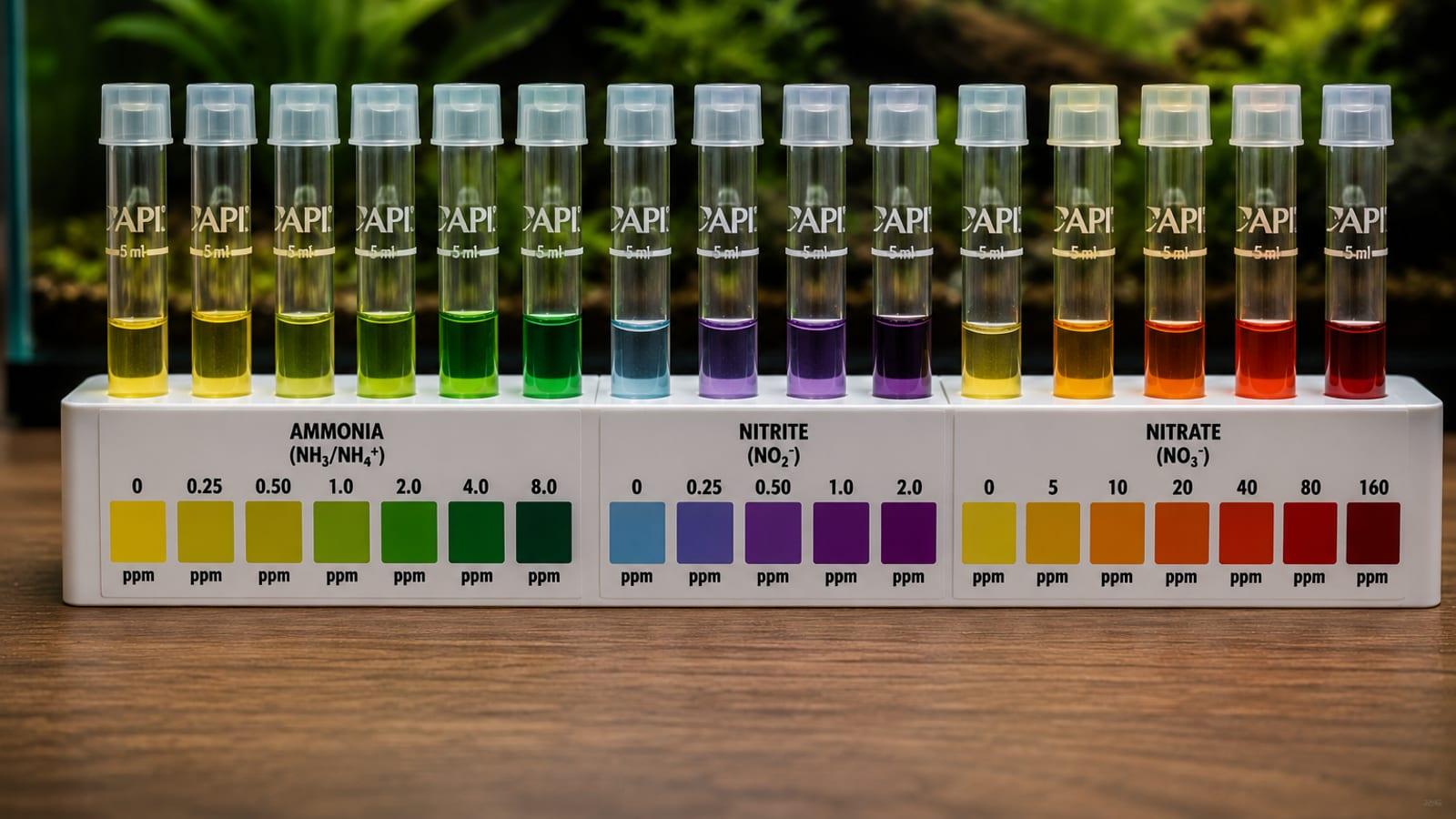
Nitrogen Cycle for Beginners: Why You Wait Weeks for Fish
Ammonia, nitrite and nitrate in plain English — how to run a fishless cycle step by step, and the one test that tells you the tank is ready for fish.
Best Fish for a 5 Gallon Tank: 4 That Fit, 12 That Don't
Best fish for a 5 gallon tank: one betta, or one pea puffer, least killifish or licorice gouramis kept alone. Why neons and guppies need more room.
Fish for a 3 Gallon Tank: One Betta at Most, Often None
Fish for a 3 gallon tank: one betta at most, and no fish in a 1 gallon. See what vets and two studies say about 1, 2.5 and 3 gallon tanks, and what fits.