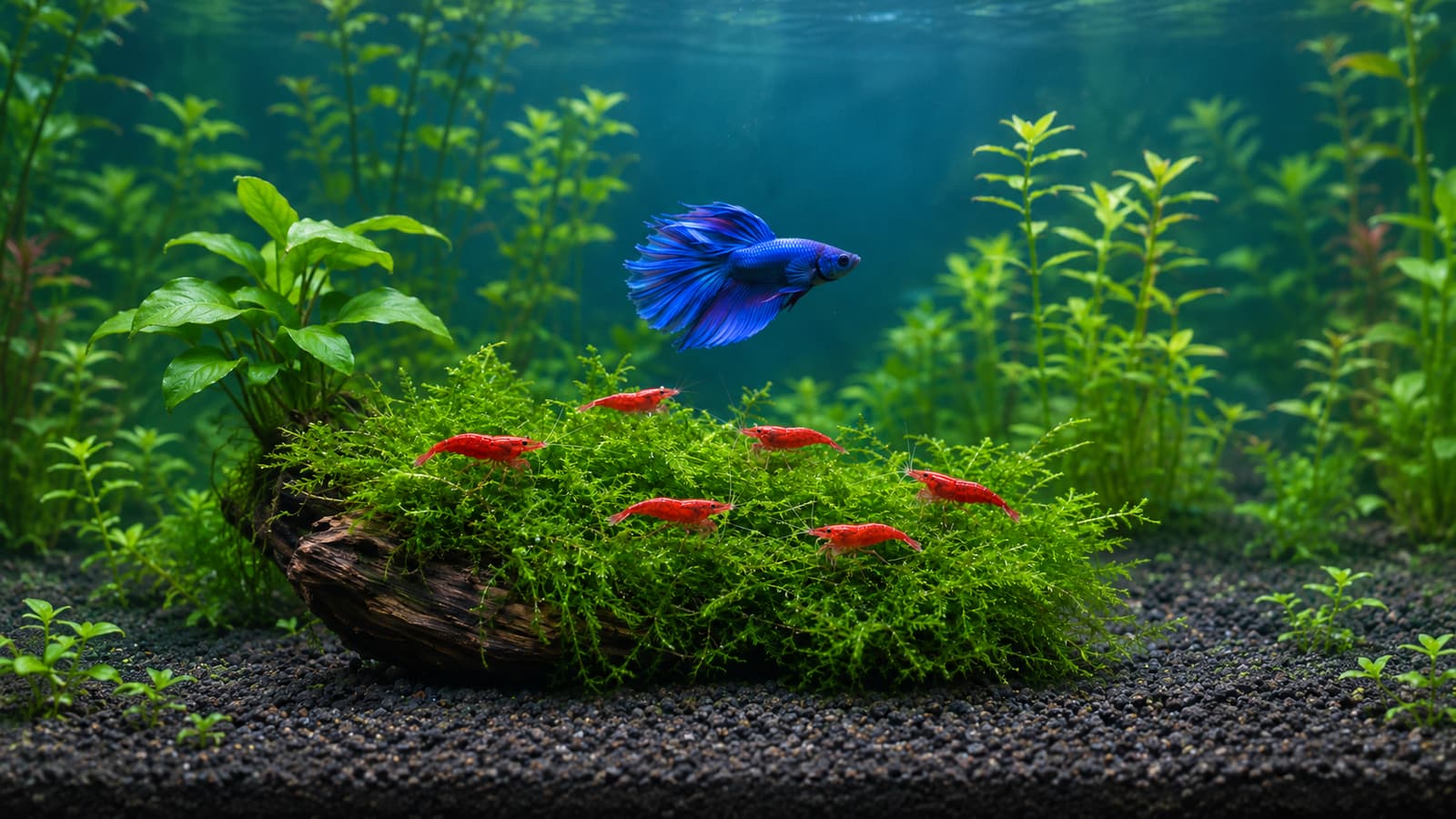
It depends on the individual betta, which you cannot know before you try. Newborn shrimp are betta food, so expect few to survive. If the betta hunts the adults, separate them. Based on vet care sheets and keeper reports, not on our own testing.
The numbers
| Setup | Adult shrimp | Shrimplets | Verdict |
|---|---|---|---|
| 10 gallon, thick moss and plants, shrimp added first | Usually left alone | Most eaten; some survive in the moss | The version worth trying |
| 10 gallon, sparse decor | At risk: nowhere to get out of sight | Eaten | Add cover before the shrimp |
| 5 gallon, heavily planted | Depends on the betta; less room to avoid it | Eaten | Tried, but the riskier version |
| 3 gallon or smaller | Not recommended | Not recommended | Too small for the pair |
| Betta that strikes at adults, any tank | Eaten, or hiding constantly | Eaten | Separate them |
| Shrimp-only tank | Safe | Survive | The only sure way to a growing colony |
Yes, usually, but it depends on the individual betta. Keepers report adult cherry shrimp sharing a planted 10 gallon tank with a calm betta, while most newborn shrimp get eaten. Add the shrimp first, pack in moss, and keep a backup container ready.
So can cherry shrimp live with a betta in your tank? You cannot tell which kind of betta you have until you try. PetMD's vet-written care sheet says the same about any betta tank mate: "personality varies". It names ghost shrimp, not cherry shrimp, and so does the University of Illinois vet school. The cherry shrimp pairing rests on what keepers report. No study has measured it, and we have not tested it. The table above is that keeper consensus, not a set of measured rates.
Will a betta eat cherry shrimp?
The babies, yes, almost always. The adults, sometimes. Aquarium Co-Op, which sells shrimp, puts the first half plainly in its care guide: "Almost all fish will eat baby shrimp."
Bettas are carnivores. FishBase lists the wild diet as "zooplankton, mosquito and other insect larvae", and Seriously Fish says the species is "likely to prey on aquatic and terrestrial invertebrates in nature". A small crustacean walking across the moss is the kind of thing a betta is built to eat. The only question is whether it fits.
| Betta | Adult cherry shrimp | Newborn cherry shrimp | |
|---|---|---|---|
| Size | 2.5–3 in (6–7.5 cm) body | Males about 1 in (2.5 cm); females 1.2–1.5 in (3–4 cm) | Head-and-body section 1.3 mm |
| Diet | Carnivore: zooplankton, insect larvae | Grazer | Grazer |
| To a betta | n/a | Large prey; keepers report some bettas attack anyway | Prey-sized |
The betta size is from PetMD. The newborn figure is from a lab study that measured newly hatched cherry shrimp at a cephalothorax length of 1.26 mm (Tropea et al., 2015). For the adults, a field study of 1,235 wild cherry shrimp in Japan found the largest male at 25.5 mm body length and the largest female at 30.0 mm (Mitsugi and Suzuki, 2018). Aquarium Co-Op's care guide says tank-kept females can reach 1.5 inches (4 cm). The table covers both.
No source we found measures a betta's mouth against a shrimp. The size comparison is our own reading: an adult is large prey for a fish under 3 inches, and a newborn is a millimetre-scale animal, in the range of the zooplankton and insect larvae on that wild menu.
Cherry shrimp have almost no larval stage. A lab study of their development found it "almost suppressed" (Pantaleão et al., 2017). They hatch looking like small shrimp, so the newborns, which keepers call shrimplets, are on the moss and the gravel from the first day, within the betta's reach.
Why it depends on the betta
Good sources do not agree on whether a betta should have company at all. PetMD says bettas "can have tank mates in the right setup, but personality varies". The University of Illinois College of Veterinary Medicine lists "snails, ghost shrimp, certain species of fish, and African dwarf frogs" as tank mates that can be added safely. Seriously Fish goes the other way and calls the betta "not recommended for the standard community aquarium".
Keepers report both outcomes, sometimes in the same forum thread. One, whose tank is "full of plants": "He's way too lazy to go after them, and even if he did, he'd never catch them." Another: "the last time I tried it was a disaster."
A quiet first week is a good sign. It is not a guarantee.
Keepers in that thread also expect a long-finned male to be a worse hunter than a short-finned plakat. That is hobby opinion. No study has compared them.
So the position this site already takes on bettas with other fish applies here too: it depends on the individual betta, which you cannot know before you try. That makes this a cheap test with a backup plan, not a promise.
Keeping cherry shrimp with a betta: what tilts it in the shrimp's favour
A 10 gallon tank, not a 5
PetMD says bettas "do best in at least 2.5 gallons, and 10 gallons or larger is ideal". The Illinois vet school adds that with tank mates "the size of the tank and filtration system must increase". No study compares a 5 gallon with a 10 for this pairing. Hobby pages split between "5 works" and "nothing under 10".
We say 10. Betta and cherry shrimp in a 5 gallon is tried often, and we treat it as the riskier version: there is less cover and less room for a shrimp to get out of sight. That is our reasoning, not a measured failure rate. If 5 gallons is what you have, read the 5 gallon version first, and see why a 3 gallon is too small for anything but the betta.
Moss before anything else
"Lots of plants" is the usual advice. There is data on which cover cherry shrimp actually use. In a 2023 lab study, 82% of the shrimp were sheltering at any one moment. Java moss was the most used shelter, holding about 41% of them, followed by wood. A piece of rock held about 2.5% (Carvalho-Batista et al., 2023).
The study describes tanks holding only shrimp, so it shows where cherry shrimp choose to hide, not how many survive a betta. It is still the best reason available to buy a large clump of java moss and a piece of wood before a cave ornament. The betta gains too: Seriously Fish recommends a well-planted, shaded tank with surface cover for the species.
Shrimp first, betta second
Keepers report that the pairing goes better when the shrimp are in the tank first. No study has tested it. The practical reasons hold up regardless: the shrimp find the cover before anything is hunting them, and the tank has time to mature.
Cycle the tank first, then drip acclimate the shrimp over an hour or more. If the betta is already living there, the order for how to introduce shrimp to a betta tank is cover first, shrimp second.
Start with six cheap adults
Six is the number we already use for a 10 gallon: one betta, six shrimp and two snails. Shrimp add very little to the waste load, so the limit is the betta, not the water.
- Buy full-grown shrimp, not juveniles. Size is their first protection.
- Buy inexpensive ones. Do not pay for high-grade shrimp until the betta has shown how it behaves.
- Feed the betta properly, with a pellet staple. Keepers say a fed betta hunts less. Nobody has measured it, so do not rely on it.
Will cherry shrimp still breed with a betta?
Yes. In the lab, female cherry shrimp carried their eggs for 12 days at 90°F and about 21 days at 75°F, and released about 24 young per brood (Tropea et al., 2015). Nobody measured 78°F. It falls between those two, nearer the long end.
With a betta in the tank, most of those young are eaten. How many survive in thick moss has not been measured by anyone. Keepers report both ends: shrimp left alone in tanks full of plants, and every shrimp lost, adults included. Shrimplets graze on the biofilm that coats moss and wood, a staple of what cherry shrimp eat, so a mature, mossy tank helps them twice.
No competing page spells out what this means for the group. Cherry shrimp do not live long. A field study of a wild population in Japan put the lifespan at about 10 to 15 months (Mitsugi and Suzuki, 2018), close to the year a ghost shrimp gets, and hobby pages commonly say one to two years, a figure we could not trace to a study. If no babies survive, the group cannot replace itself. Six adults become four, then two, and within a year or two you are buying shrimp again.
So decide which one you want:
- A few shrimp alongside a betta. That works with the right fish. Expect to top the group up.
- A colony that grows. That needs a tank with no fish in it. It is what we mean elsewhere on this site by a 5 gallon holding "one betta, or a shrimp colony".
Water and equipment both can live with
- Temperature: 78°F. PetMD and the Illinois vet school both give bettas 76 to 81°F. In the lab, cherry shrimp survived and grew at 75, 82 and 90°F, and the authors put the best temperature for growing and breeding at about 82°F. At 90°F the young females lost their eggs (Tropea et al., 2015). 78°F sits inside both.
- Filter: a sponge filter. PetMD lists air-driven sponge filters among the ideal choices for bettas, Seriously Fish says strong water movement should be avoided, and a sponge filter has no intake to pull shrimplets in.
- pH: PetMD gives 6.5 to 7.8 for the betta. For cherry shrimp, a peer-reviewed paper gives a survivable range of 6.5 to 8.0 (Kenny et al., 2014), so the betta's range sits inside it. We found no study that sets a hardness target for cherry shrimp, so we are not printing one.
- Medication: copper kills shrimp. Seachem's label for its copper treatment says "Remove all invertebrates - these are extremely sensitive to copper". Treat a sick betta in a hospital tank, never in the shrimp tank.
If your betta is attacking the cherry shrimp
Already seeing attacks?
Separate them today. Do not wait to see whether the betta settles down. Step 2 below is all you need tonight.
- Tell hunting from looking. A betta that watches or follows a new shrimp has not attacked it. Strikes, or a shrimp in its mouth, are hunting.
- Separate them. Move whichever is easier to catch. The shrimp can go into any clean container with water from the tank and a clump of the moss. The keeper in one forum thread held them in a bag floating in the tank, and was told to change the water in it regularly. Either is a short stopgap, not a home. No source we found says how long it is safe.
- Do not expect the betta to change. Keepers who answer this question are blunt: "this betta sees shrimp as food. You should separate them." Some hobby pages suggest rearranging the decor and trying again. None offers evidence that it works.
- Choose the permanent answer. Return or rehome the shrimp. Or give them their own tank, started with filter media from the main one so it cycles faster. Or keep the betta alone, which is a complete setup for that fish.
- If a shrimp is missing but nobody saw an attack, count again. Most cherry shrimp are hidden at any moment: 89% in the daytime and 75% at night in the shelter study. Count after dark with a dim light before blaming the betta.
We found no source that reports harm to a betta from eating a shrimp. Invertebrates are its natural food.
Other shrimp with a betta
Ghost shrimp are the ones vet sources actually name. PetMD and the Illinois vet school both list them, and neither mentions cherry shrimp. Keepers consider amano shrimp safer because they are larger than cherry shrimp, though we found no source that measures it. The same rule holds for all of them: it depends on the betta, and the babies of any shrimp can end up as food. For fish and snails, see betta tank mates for a 5 gallon and what else suits a 10 gallon.
The short version
Adults usually, by keeper report. Babies rarely. Use a 10 gallon tank at 78°F with a sponge filter, a large clump of moss, the shrimp added first, six cheap adults, and a container ready. If the betta hunts them, separate them and stop trying with that fish.
Sources
- Zayas, M. (2026). Betta Fish Care Sheet. PetMD.
- Mueller, quoting Dr. Krista Keller (2019). Bettas Need More Than Bowls. University of Illinois College of Veterinary Medicine.
- FishBase. Betta splendens.
- Seriously Fish. Betta splendens.
- Tropea, Stumpf and López Greco (2015). Effect of temperature on biochemical composition, growth and reproduction of the ornamental red cherry shrimp Neocaridina heteropoda heteropoda. PLoS ONE 10(3): e0119468.
- Mitsugi and Suzuki (2018). Life history of an invasive freshwater shrimp Neocaridina davidi. Crustacean Research 47: 9–16.
- Carvalho-Batista, Nogueira, Costa and Pantaleão (2023). Shelter use by the cherry shrimp Neocaridina davidi. Nauplius 31: e2023018.
- Pantaleão, Gregati, da Costa, López-Greco and Negreiros-Fransozo (2017). Post-hatching development of the ornamental 'Red Cherry Shrimp' Neocaridina davidi under laboratorial conditions. Aquaculture Research 48(2): 553–569.
- Seachem. Cupramine product page.
- Aquarium Co-Op. Care Guide for Cherry Shrimp. A retailer's guide, used for adult size and baby shrimp.
- Kenny, Sin, Shen, Qu, Wang, Chan, Tobe, Shimeld, Chu and Hui (2014). Genomic Sequence and Experimental Tractability of a New Decapod Shrimp Model, Neocaridina denticulata. Marine Drugs 12(3): 1419–1437. The paper uses an older name for the aquarium cherry shrimp; used for the pH range.
- Keeper reports: fishforums.net, "Betta with Cherry Shrimp" (2025–2026); fishforums.net, "Betta attacking cherry shrimp, what can i do?" (2018).
Questions people ask
Mentioned in this guide
Related guides
Betta Tank Mates for a 5 Gallon: Snails Yes, Fish No
Betta tank mates for a 5 gallon tank: a nerite snail or two, shrimp if your betta allows it, and no fish. Why schools do not fit and what 10 gallons adds.
What Do Cherry Shrimp Eat? Mostly What Your Tank Grows
What do cherry shrimp eat? Mostly what the tank grows. What to add, how often to feed, what babies eat, and how long they can go without food.
Can a Betta Live With a Goldfish? No, and Here's Why
Can a betta live with a goldfish? No. Goldfish need 20 gallons and strong filtration, bettas need calm water, and their temperatures barely overlap.