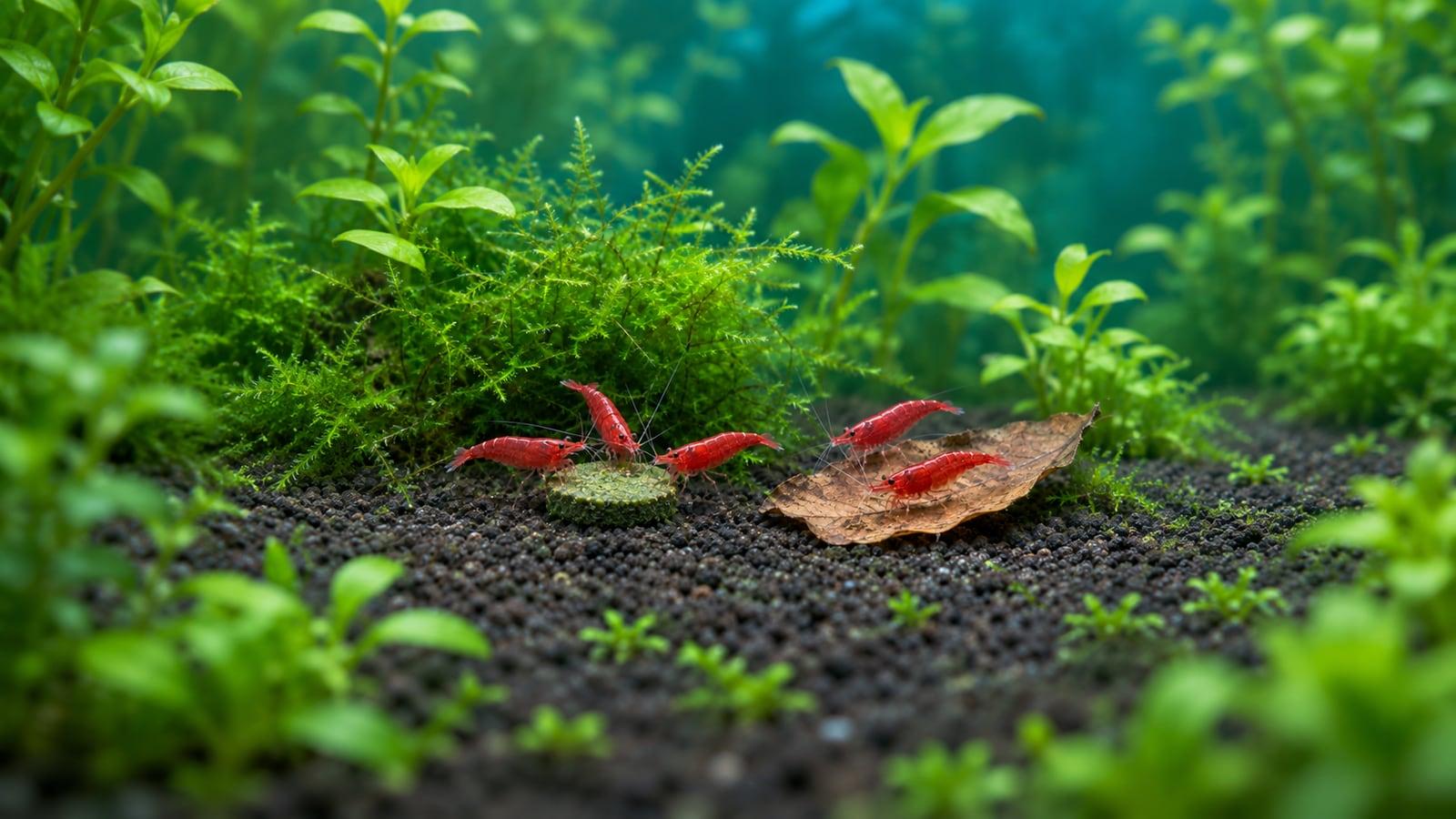
Top that up with a small pinch of sinking shrimp or fish food every other day, blanched vegetables once or twice a week, and remove what is left after a few hours. Leave moults in, keep copper out. Based on a university extension sheet, vet-reviewed care sheets, lab studies and keeper reports, not on our own testing.
The numbers
| Food | How often | Notes |
|---|---|---|
| Biofilm, algae, detritus | Constantly; the tank grows it | Most of their diet. Detritus and algae top their stomach contents |
| Sinking shrimp food, wafer or community fish food | Every other day in a mature tank | Any decent food works; five commercial diets all supported growth in a 90-day trial |
| Blanched vegetables (courgette, spinach, cucumber) | Once or twice a week | Wash or peel first; remove after a few hours |
| Dried leaves | A leaf or two, replace when gone | Food and a surface for biofilm |
| Frozen bloodworm or brine shrimp, thawed | Occasionally | A little protein; small amounts |
| Powdered food | A pinch, when babies are present | Newborns get outcompeted for food |
| Their own moult | Leave it in the tank | They eat it to recover nutrients |
| Copper medication | Never | Kills shrimp; treat fish elsewhere |
Cherry shrimp eat mostly what grows in the tank: biofilm, algae, decaying plants and tiny animals in the gravel. In a mature, planted tank that is most of their diet. Add a small pinch of sinking food every other day.
So what do cherry shrimp eat when nobody feeds them? When researchers looked inside their stomachs, detritus came first and algae second. In an aquaculture trial, a surface film of algae and microbes was their only food, and the shrimp still grew, carried eggs and bred. Food from you is a top-up. This page is built from a University of Florida extension sheet, vet-reviewed care sheets, lab studies and keeper reports. We have not kept or fed these shrimp ourselves, and the table above is that evidence put into a routine, not a feeding trial of our own.
Cherry shrimp diet: what they eat in a tank
Cherry shrimp (Neocaridina davidi) are omnivores that live mostly off the tank itself. The University of Florida's extension sheet calls them "detritivores and opportunistic feeders" and says they spend most of their time "grazing on biofilms that form on leaf litter". Ranked by the evidence:
- Detritus. Rotting plant matter and the brown mulm that settles in the gravel. A 2016 study in small model ecosystems reports that it was "the most common food item in the stomach of N. davidi, followed by algae", in line with earlier studies (Weber and Traunspurger, quoted by the US Fish and Wildlife Service).
- Algae and biofilm. Second in the same stomachs, and what they spend their days picking at.
- Tiny animals in the gravel. The same study found "a high degree of omnivory": the shrimp ate enough nematodes, small worms and tiny crustaceans in the sediment to cut their numbers. Cherry shrimp are not vegetarians.
- Dead leaves. In a feeding study, cherry shrimp ate about half their own dry body weight in leaf litter a day (Schoolmann and Arndt, 2017). That is why keepers drop dried leaves into shrimp tanks: they are food, not decoration.
- Their own moults. Cherry shrimp grow by shedding their shell, and the Florida sheet says they eat the old one "to reabsorb valuable nutrients". Leave it in the tank.
- Whatever sinks. Fish food, dead plants, dead animals. Chewy's vet-reviewed care sheet puts it simply: they eat "a variety of plant-based and meaty foods."
The strongest evidence that a tank can feed them comes from a 2020 aquaculture study. Biofilm made of microalgae, diatoms, cyanobacteria and tiny single-celled animals was "used as the sole diet", and the shrimp matured, carried eggs and completed the life cycle (Viau et al., 2020). That was an aquaculture set-up with no water changes and plastic netting added for the film to grow on, not a home tank. It still shows that the useful question is less "what do I feed them?" than "how mature is my tank?"
What to feed cherry shrimp
When the tank needs topping up, the bar for cherry shrimp food is low. A 90-day study tested five commercial diets made for ornamental animals and found all five "adequate for satisfactory growth", with survival above 80% on every one (Tomas et al., 2020). The best food for cherry shrimp is one that sinks and gets eaten. The table above has the routine; here is what goes into it.
- Staple. A shrimp pellet, an algae wafer or the fish food you already have. Chewy's care sheet lists sinking pellets and wafers. Keepers crumble flake so it sinks before the shrimp lose it.
- Vegetables. Courgette (zucchini), spinach or cucumber, blanched first, once or twice a week. One shrimp shop suggests boiling "2-3 minutes for leafy vegetables and longer for carrots and zucchini". Wash and peel shop-bought vegetables, or use organic ones. Pesticides kill shrimp, as they do on pesticide-treated plants; for vegetables, that caution is keeper practice rather than a tested result.
- Protein. Thawed frozen bloodworm or brine shrimp, a few pieces now and then. Chewy says only "meaty foods"; the two items are keeper practice. Aquarium Co-Op says to include enough protein because "the juveniles need it for growing".
- Variety. Practical Fishkeeping's comparison of 28 shrimp foods across 27 tanks concluded that "a varied, balanced diet is the key to success". It was one hobbyist scoring how keenly shrimp went for each food, not a nutrition study, so it settles variety, not brands.
How often and how much to feed cherry shrimp
Start with the amount, because the sources mostly agree on it: give what they clear in two to three hours, then take out the rest. Chewy's care sheet says "1–3 hours"; a shrimp shop says two to three. Some keepers lift leftovers out much sooner. Food left longer turns into ammonia and later nitrate. Shrimp feel that before fish do. Some keepers feed from a small dish or tray so leftovers are easy to lift out.
How often is where the advice splits, from twice a day to twice a week. Chewy's vet-reviewed sheet ties it to the tank: "The exact feeding schedule for cherry shrimp depends on how many shrimp and fish are in the tank."
| Your tank | How often | Why |
|---|---|---|
| Mature, planted, shrimp only | A small pinch every other day | The tank grows most of their food |
| Crowded shrimp-only tank or breeding colony | Every other day, or a little daily | More mouths than biofilm. Chewy says every other day for lots of shrimp; Josh's Frogs and keepers feed daily |
| New tank, little biofilm yet | Very small portions; remove leftovers | Chewy's advice for an immature tank |
| Community tank, fish fed daily | Two or three times a week | Chewy's figure. Our reading: fish leftovers already reach the shrimp, and snails like a mystery snail take a share of anything that sinks |
WebMD's "Your shrimp will eat every day" is true, but it means they graze all day, not that you must feed them daily. The same page adds: "They only eat a little."
Signs you are feeding too much, by keeper practice: food still there after a few hours, cloudy water, or a rotten smell. One keeper noticed his shrimp barely ate at 68°F (20°C) and went after food more in his other tank at 75°F (24°C). That is one keeper, not a rule.
Do cherry shrimp eat algae?
Yes, the soft kinds. Do cherry shrimp eat hair algae or black beard algae? Do not count on it. No study has tested either. One shrimp shop says they will not eat hair algae, a shrimp hobby site says only the softer kinds get eaten, and we found no first-hand keeper report of cherry shrimp clearing it.
What they do eat is the thin film on glass, wood and leaves. In a mesocosm experiment, a set of large tanks modelling a shallow lake, Neocaridina denticulata sinensis, a name the US Fish and Wildlife Service lists as a synonym of N. davidi, cut the film of algae and microbes on Vallisneria leaves and the plants grew faster (Ye et al., 2019). That was a lake model, not an aquarium. They also graze brown diatoms and the white fuzz on new wood.
For black beard algae, even Amano shrimp may only graze young tufts and do not clear an established patch, and nothing we found suggests cherry shrimp do better. If algae control is the job, keepers pick Amano shrimp; Amano shrimp vs ghost shrimp covers that choice. When there is algae to graze, feed a little less, but keep feeding.
What do baby cherry shrimp eat?
The same as the adults. Newborn shrimp, which keepers call shrimplets, hatch as miniature adults only 1 to 2 mm long, according to the Florida sheet, and graze the same biofilm from their first day. A 2007 hobby-magazine care article puts it simply: "the shrimplets will eat the same diet as the adults."
Their problem is competition, not diet. Aquarium Co-Op, which sells shrimp, says newborns "do not move as much and can easily get outcompeted for food" and suggests "a variety of powdered foods". Surfaces help too: Aquarium Co-Op notes that dense mosses grow algae and biofilm, and in the biofilm culture study, juveniles survived and grew better when plastic netting or a sheet of agricultural fleece was added for the film to grow on.
Newborns can also go a long time without food (see the next section), so a day or two without powder is not a crisis. A bare, new tank is the real risk; the shrimp tank setup guide covers cycling and planting the tank before the shrimp go in. And almost any fish will eat them; with a betta in the tank, most will not survive.
How long can cherry shrimp go without food?
Keepers expect a mature, planted tank to carry them through a week or two away. In the forum thread we read, about a two-week trip, nobody reported back on how the shrimp did. Nobody has measured adults.
The one measurement is for juveniles. In a 2015 lab study, newborn shrimp and shrimp at the third juvenile stage went without food for one to four days and were then fed; a control group was never fed. From those results the authors estimated the point of no return, the fast after which half of them could no longer recover even when fed: about 16 days for newborns and about 9 days for the older juveniles (Pantaleão et al., 2015). Those two figures are curve estimates, not fasts anyone watched. In the never-fed groups, 65% of the newborns and all of the older juveniles had died by day 20. The authors found these early stages more tolerant of starvation than other decapods, the shrimp and crab group, studied before. Each juvenile sat alone in a 250 ml plastic cup of water, with no plants or leaves, so a planted tank likely gives more slack. It is still not a figure for adults.
Before a trip, keepers advise adding no extra food: what is not eaten rots, and the water goes bad while you are away. One keeper did several partial water changes in the week before leaving. A dried leaf or two is fine. If fish share the tank, the fish side is in how long fish can go without food.
Can food make cherry shrimp redder?
Partly. Shrimp "cannot synthesize carotenoids endogenously", the pigments behind their red, so they have to eat them (Hou et al., 2024). In the 90-day trial of five commercial diets, the shrimp fed the diet richest in carotenoids had the brightest colour (Tomas et al., 2020). In a 56-day trial, adding astaxanthin, a red carotenoid, to the feed improved the colour of young males, and their colour held steady through nine hours of low oxygen (Hou et al., 2024).
Shrimp pages often say colour comes from breeding, not food, and both halves are true. Breeding sets which colour a line can show; diet and stress affect how strong it looks. If you want stronger red, astaxanthin and other carotenoids are what the studies tested. We name no food for it.
What to keep out of a cherry shrimp tank
Copper and pesticides kill shrimp
Seachem's label for its copper treatment says "Remove all invertebrates - these are extremely sensitive to copper". Treat a sick fish in a separate tank, never in the shrimp tank.
- Copper medication. See above. Chewy's care sheet says to keep the water free of copper-containing medications and products.
- Copper on a food label. A different question. Some shrimp pages warn against any food that lists copper, without a source. We found no study testing ordinary fish food on cherry shrimp, either way.
- Pesticides. On shop plants and unwashed vegetables. Quarantine new plants as in the pothos guide.
- Overfeeding. UF's fish nutrition sheet calls overfeeding "the most common mistake made by pet owners", and the leftovers go straight into the water the shrimp live in.
The short version
A mature, planted tank feeds them. Add a pinch of sinking food every other day, vegetables now and then, leave the moults in, take out what is left after a few hours, and keep copper out.
Sources
- Suen and Gillett-Kaufman (2020; issued in EDIS 2021). Cherry Shrimp. UF/IFAS Extension, EENY-751 / IN1301.
- Weber and Traunspurger (2016). Influence of the ornamental red cherry shrimp Neocaridina davidi on freshwater meiofaunal assemblages. Limnologica 59: 155–161. The stomach-content ranking is quoted from: US Fish and Wildlife Service (2025). Cherry Shrimp (Neocaridina davidi) Ecological Risk Screening Summary.
- Viau et al. (2020). Breeding and life cycle of the ornamental freshwater shrimp Neocaridina davidi in a biofilm-based culture system. Aquaculture Research 51(9): 3847–3864.
- Schoolmann and Arndt (2017). Leaf-litter preferences of the introduced freshwater shrimps Atyaephyra desmarestii and Neocaridina davidi. Crustaceana 90(14): 1715–1730.
- Tomas, Sganga, Marciano and López Greco (2020). Effect of diets on carotenoid content, body coloration, biochemical composition and spermatophore quality in the "red cherry" shrimp Neocaridina davidi. Aquaculture Nutrition 26(4): 1198–1210.
- Pantaleão et al. (2015). Nutritional vulnerability in early stages of the freshwater ornamental 'red cherry shrimp' Neocaridina davidi. Journal of Crustacean Biology 35(5): 676–681.
- Hou, Chang, Yang, Gong, Pan, Hsu and Huang (2024). Enhancing the color and stress tolerance of cherry shrimp (Neocaridina davidi var. red) using astaxanthin and Bidens pilosa. PLoS ONE 19(12): e0315585.
- Ye et al. (2019). Omnivorous shrimp Neocaridina denticulata sinensis enhances the growth of submerged macrophyte Vallisneria denseserrulata. Knowledge and Management of Aquatic Ecosystems 420: 32.
- Chewy (2026). Cherry Shrimp Care Guide: Tank Size, Diet, and More. Hilary Jaffe, reviewed by Ivan Alfonso, DVM; updated 18 November 2026, re-read 19 November 2026. A retailer's guide, cited by title.
- Wendt and Racelis, reviewed by Amy Flowers, DVM (2025). What Are Red Cherry Shrimp? WebMD.
- Seachem. Cupramine product page.
- Aquarium Co-Op. Care Guide for Cherry Shrimp. A retailer's guide, used for baby shrimp, protein and powdered food.
- Demas (2007). Red Cherry Shrimp. Tropical Fish Hobbyist.
- Gabor Horvath. The BIG shrimp food test. Practical Fishkeeping.
- Francis-Floyd. Fish Nutrition. UF/IFAS VM114, as cited in the tropical fish food guide.
- Shrimp shops: The Shrimp Farm, cherry shrimp feeding; Josh's Frogs, keeping and breeding cherry shrimp. Shrimp hobby site: Shrimp Science, freshwater shrimp diet.
- Keeper reports: fishforums.net, "How much to feed cherry shrimp?" (2018); fishforums.net, "Can cherry shrimp be left for 2 weeks?" (2008).
Questions people ask
Mentioned in this guide
Related guides
Can Cherry Shrimp Live With a Betta? Yes, With Losses
Can cherry shrimp live with a betta? Usually, in a planted 10 gallon, but expect the babies to be eaten. How to set it up, and what to do if it goes wrong.
Amano Shrimp vs Ghost Shrimp: Algae Eater or Cheap Cleaner
Amano shrimp vs ghost shrimp: Amanos eat hair algae but can't breed in fresh water. Ghost shrimp cost under $1, live a year and may eat fry. Which to buy
Shrimp Tank Setup: A Cherry Shrimp Tank, Step by Step
Shrimp tank setup for cherry shrimp: the tank, sponge filter, substrate and heater, the water numbers, when the cycle is done, and how many to add.