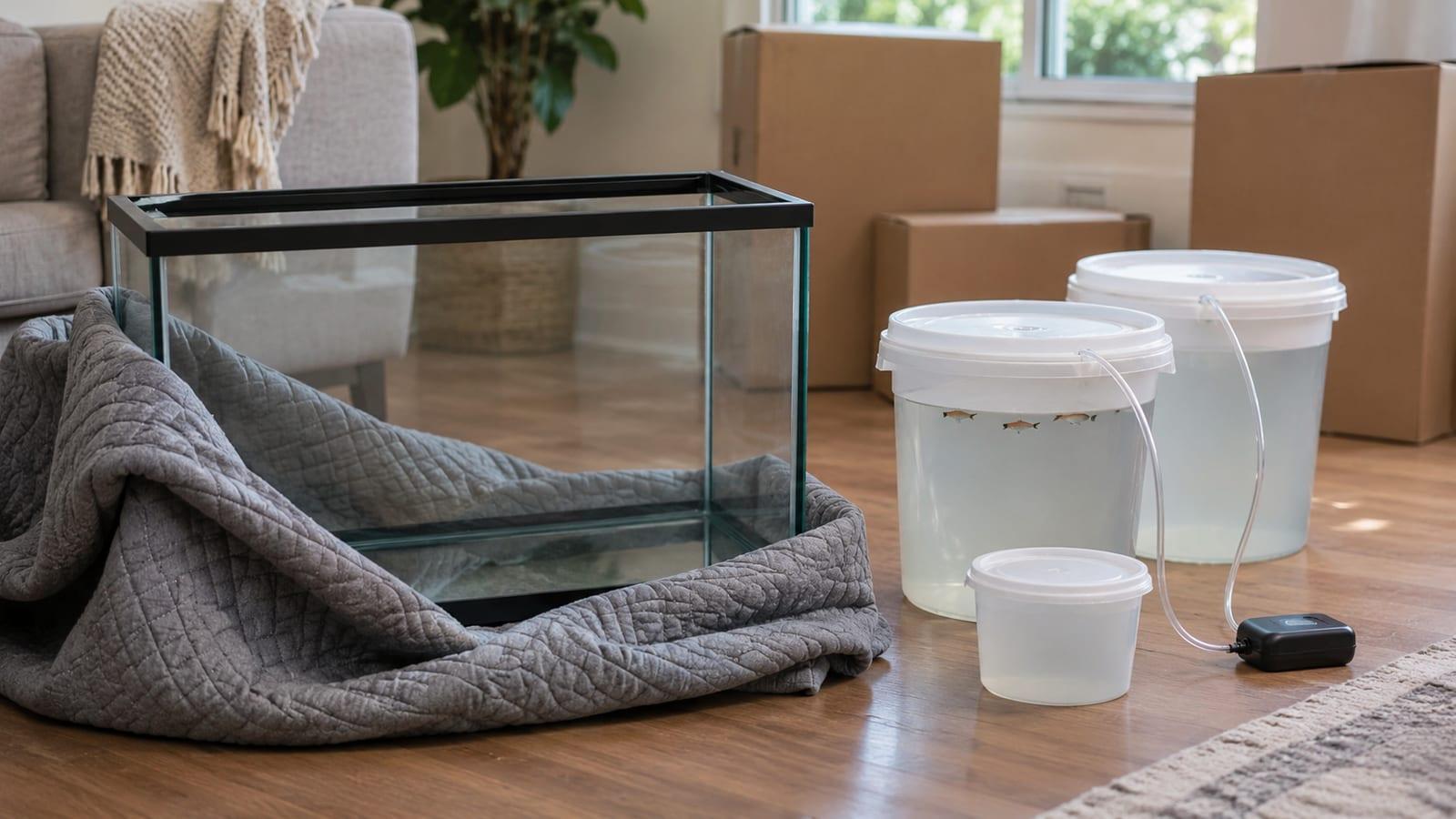
Skip a day's food, save about three-quarters of the water, move the fish in an aerated bucket of tank water, keep the filter media and gravel wet in tank water, and have it running again the same day. Then test ammonia and nitrite daily for a week. Based on tank and filter makers' instructions, extension sheets on transporting fish and keeper reports, not our own moves.
The numbers
| Step | Across the room | To a new house |
|---|---|---|
| Water in the tank | None. Siphon it all out, gravel too | None. Never lift, slide or carry it with water or gravel in |
| Fish | Bucket of tank water with an airstone | Lidded bucket with a battery air pump; oxygen bags from a fish shop for long drives |
| Filter media | In a container of tank water | Submerged in tank water, lid loose, out of the sun |
| Water to save | Enough to refill most of the tank | About three-quarters, in lidded buckets |
| Food | Skip that day's feed | Skip the last day's feed |
| Time budget | An hour or two | Same day. Overnight only with air, heat and a water change |
| Afterwards | Test ammonia and nitrite daily for a week | Test daily for a week; watch the fish for three weeks |
To move a fish tank, empty it first: never lift or slide it with water or gravel in. Fish ride in an aerated bucket of tank water, the filter media stays wet, and everything runs again that day.
The water alone in a 20 gallon weighs 167 lb, and in a 55, 459 lb (how much a fish tank weighs). A filled tank that is lifted or slid twists its glass seams. The part that decides whether the fish are fine a week later is the filter: the bacteria that keep them alive live in the filter media and gravel, not the water. This page is built from tank and filter makers' instructions, university and extension sheets on transporting fish, retailers' and hobby guides, a vet-reviewed care page, a lab study and keeper reports. We have not moved these tanks ourselves.
Can you move a fish tank with water in it?
No, not even across the room, and not even a few inches. Aqueon, a tank maker, puts it in capitals: "Regardless of size, NEVER lift or transport an aquarium with water or gravel in it." Aquael's tank manual says the same: "Tank filled with water must not be lifted nor moved (risk of breaking!)". It also says to empty a tank "only by pumping the water out", never by tipping it.
The weight explains why. From this site's weight table:
| Tank | Glass, empty | The water alone |
|---|---|---|
| 10 gallon | 11 lb | 83 lb |
| 20 gallon (high) | 25 lb | 167 lb |
| 55 gallon | 78 lb | 459 lb |
Gravel adds more: each inch of it in a 55 gallon is about 37 lb. Even an inch of water left over the gravel in a 55 is roughly another 20 lb (our arithmetic, approximate), and it sloshes.
As the weight guide puts it, trying to move a filled tank "puts twisting force on the glass seams", and seams "do not sag as a warning. They let go." Aqueon adds that the weight and the sloshing water can damage the tank and its seals.
Some keepers carry a small tank a short way with an inch of water over the gravel and report no trouble, and a couple of guides, LiveAquaria's and a vet-reviewed transport page, say a little water is fine. The makers say no, and Aquael's warranty does not cover cracked or chipped glass, damaged silicone seams, or use against its conditions. We side with the makers.
Empty, two people can carry even a 55. Carry it with hands underneath: Aquael says an empty tank "must not be lifted by the edge".
Moving a fish tank across the room
- Skip that day's feed. Healthy adult fish go a day or two without food without harm.
- Unplug the heater and let it cool for 30 minutes before it comes out of the water (Aqueon; the same rule as in the heater guide).
- Siphon most of the water into clean buckets that have never held soap. Net the fish into one of them, with an airstone and a lid.
- Unplug the filter and lights, and put the filter media straight into a container of tank water. Do not clean it now.
- Scoop the gravel or sand out wet into its own bucket, and put decorations and plants into tank water.
- Siphon out the rest, then carry the empty tank with two people, hands underneath.
- Move the stand and check it with a spirit level. Aquael's manual says the stand and tank must be "properly levelled", with no rocking. The weight guide covers which floor and wall can take it.
- Set it up again as in the section below.
Done this way, the fish spend an hour or two in the bucket, and the filter is back on before anything has had time to go wrong.
Moving a fish tank to a new house
The same job with a car journey in the middle. Most of the risk is in the timing, so plan it in three stages.
Two weeks before. Do a normal 25% water change and light gravel clean, as Aqueon suggests. Aqueon also lightly cleans the filter at this point without disturbing the biological media; if yours is due, rinse it in tank water now, then leave it alone until the move. No deep clean before a move. Look at where the tank will stand in the new house: a level spot near an outlet, on a floor that can take the filled weight (the weight guide has the floor advice). For a big tank, measure doorways and stairs against its dimensions. Collect lidded buckets, a battery air pump with airline, a siphon, and towels or a cooler box. That Pet Place, a retailer, suggests adding extra media to the filter weeks ahead, so a spare piece is already colonised.
The day before. No food. Aqueon says 24 hours; a fish-hauling sheet from the Southern Regional Aquaculture Center says at least one to two days in warm months. If it is hot or cold outside, plan to keep the buckets in the car's cabin wrapped in towels or in a cooler. Aqueon also suggests setting up conditioned water at the new house a day or two ahead.
Moving day. The tank is the last thing packed and the first thing unpacked; moving guides agree on that much. In order:
- Save about three-quarters of the water in lidded buckets. Aqueon says 75 to 80%; Jeremy Gay, a former Practical Fishkeeping editor writing for Swell UK, says 75%.
- Fish go into a bucket of tank water with a battery air pump running.
- Plants go into tank water. Plants tied to wood or rock, such as java fern and anubias, travel attached.
- Filter media goes into tank water (see the filter section below). Gravel goes into its own bucket, wet.
- The last, dirtiest water goes down the drain. Wrap the empty tank, keep it upright, and stack nothing on it.
In the car. Wedge the buckets so they cannot tip, lids on, air running, out of the sun. The fish ride with you, not in the moving truck. Practical Fishkeeping says to "Avoid the boot of the car where you can."
Long moves. If the trip takes more than a day, the fish may be better off staying behind. For a move across the country, Aqueon suggests rehoming them, or asking a local fish store to hold them and ship them on.
How long can fish stay in a bucket or a bag?
What runs out first is oxygen, and then the water fouls. A University of Florida extension sheet on shipping aquarium fish says oxygen falls and carbon dioxide rises as fish breathe, and that ammonia and CO2 build up in the bag. The Southern Regional Aquaculture Center's hauling sheet, written for food fish in trucks, names the same limits: dissolved oxygen, and the build-up of ammonia and carbon dioxide, both affected by temperature, crowding and the length of the trip.
Sealed bags of air are for short trips. The Florida sheet is blunt: "If the sealed bag contains only ambient air, the fish quickly consume all of the available oxygen." Commercial shippers fill bags with pure oxygen to keep fish for up to 36 hours. LiveAquaria's guide uses bags for trips under an hour, and oxygen-filled bags from a fish shop, kept in a cooler, for one to six hours. Treat those as one retailer's guide, not a measured limit.
If you do use bags, fill them a third with water and two-thirds with air, as Aqueon, JBL and Practical Fishkeeping all say. Practical Fishkeeping: "NEVER fill a bag to the top with water and no air — your fish will suffocate en route." A vet-reviewed transport page says the opposite, 80 to 90% water, and up to 48 hours in a bag; that is longer than the 36 hours the Florida sheet gives for commercial bags filled with pure oxygen, so we do not follow it.
For a moving day, use a bucket with air. A lidded bucket of tank water with a battery air pump, kept near tank temperature, gives the fish far more water and oxygen than a bag. Plan for them to be back in the running tank the same day.
Overnight is possible, with work. A bucket has no filter, so it builds up ammonia within a day and needs its own water changes, heater and air. Keepers report holding fish overnight this way at the new house.
What does not exist is a sourced hour limit. Figures online run from a couple of hours to the vet-reviewed page's 48, and none of them is measured for a bucket. Practical Fishkeeping warns that fish stuck in transit for "12 hours or more" face a water chemistry and water quality problem. Same day is the plan.
Keeping the filter bacteria alive during the move
The cycle travels in the filter media and the gravel, not the water. The bacteria live on the media, the gravel and the glass. Saved water is there to keep temperature and chemistry familiar. Lose the media, by letting it dry out or throwing it away, and the tank goes through the nitrogen cycle again, this time with fish in it.
Don't clean the filter before the move. Jeremy Gay: "Don't clean the filter at this stage as you want as much beneficial bacteria to be intact as possible." Leave the filter clean for a few weeks after.
Keep it wet, in tank water, with air. Aqueon and LiveAquaria keep media in aquarium water. That Pet Place says to keep it wet and aerated, in a container that is not airtight. INJAF, a fishkeeping welfare site, suggests a battery airstone in the bucket. Jeremy Gay notes that a mature filter uses oxygen itself. So: media submerged in tank water, lid loose, an airstone if it will be hours, out of the sun. Never dry, and never under the tap. JBL, a filter maker, keeps sponges damp in the air rather than submerged; both approaches are about oxygen.
How long can it wait? No reliable source gives an hour figure, so we give none. INJAF: "filter bacteria won't die the second the filter is switched off!" In lab cultures of two nitrifying species (not the main ones in aquarium filters), bacteria starved for days to weeks regained much of their activity once fed again, more slowly and less fully the longer they had gone without (Tappe et al., 1999). The risks the moving guides warn about are drying out and running out of oxygen in a sealed container. Get the filter running again the same day.
Gravel counts too. Keep it wet and put it back; don't swap it for new.
Setting the tank up again
- Level the stand, then the tank on it, before any water goes in.
- Put the wet gravel back, then rock and wood.
- Pour in the saved water first, onto a plate set on the gravel so it does not stir it up (INJAF; Aqueon says the same).
- Plant, then add the rest of the saved water.
- Put the media back in its filter and switch it on. The heater goes in the water 30 minutes before it is plugged in.
- Top up with tap water treated with a conditioner that covers chloramine, within 2°F of the tank, as in the water change guide. The new house's tap water may be treated differently from the old: dechlorinate the new tap water the same way, and check the label. Aqueon also suggests comparing its pH and alkalinity with the old water.
- Fish go in last. Match the temperature first, then net them in and pour the trip water away, as in the acclimation guide.
- Lights off for the rest of the day, and no food until tomorrow.
The first week after the move
Test ammonia and nitrite daily for a week. Aqueon says to test three to five days after the move and warns of "New Tank Syndrome" because "the biological balance has been disrupted". A week of daily tests covers that and more.
A small ammonia rise is common. Keepers report it even after a short drive, with the fish hiding and off their food two days later. If ammonia or nitrite reads above zero, change water and feed lightly; how to lower nitrites has the full routine. Do not clean the filter that week.
Watch the fish for three weeks. The hauling sheet says fish can develop disease "a few days to 3 weeks after delivery if they were significantly stressed during transport." Hiding and a skipped meal for a day or two are normal. Lying on the bottom or gasping at the surface is not.
The short version
Empty it, every time. Fish in an aerated bucket of their own water, media wet in tank water, gravel wet in a bucket, everything running again the same day. Then a week of tests.
Sources
- Aqueon. How to Move an Aquarium. A tank maker's guide, undated.
- Aquael. Tanks instruction manual (English section).
- Crosby, Hill, Martinez, Watson, Pouder and Yanong. Preparation of Ornamental Fish for Shipping. UF/IFAS Extension, FA-120, revised September 2024.
- Wynne and Wurts. Transportation of Warmwater Fish: Equipment and Guidelines. Southern Regional Aquaculture Center, Publication No. 390, January 2011 revision. Written for hauling food fish.
- Hill. Travels with your fish. Practical Fishkeeping, undated.
- Gay. How to move a fish tank. Swell UK, a retailer's blog, undated.
- LiveAquaria. How to Move Your Aquarium. A retailer's guide, undated.
- That Pet Place. How to Move Your Aquarium. A retailer's guide, undated (site © 2023).
- Wiesensee. Moving With Your Aquarium – The Checklist. JBL blog, 2019.
- INJAF. Moving your aquarium when moving house. Undated.
- Psaradelis, reviewed by Javed, DVM. How to Transport Fish. TheVetDesk, updated 29 October 2025.
- Tappe, Laverman, Bohland, Braster, Rittershaus, Groeneweg and van Verseveld (1999). Maintenance energy demand and starvation recovery dynamics of Nitrosomonas europaea and Nitrobacter winogradskyi cultivated in a retentostat with complete biomass retention. Applied and Environmental Microbiology 65(6): 2471–2477. Lab cultures of Nitrosomonas europaea and Nitrobacter winogradskyi.
- Keeper reports: Monster Fish Keepers, Tank going into a re-cycle after moving (2008); Reef Central, "Ammonia spike after tank move" (2015); FishLore, "Moving tank with fish" and "Tips and tricks for moving an aquarium, fish in?"; Aquarium Co-Op forum, threads on moving and on holding fish in a bucket.
Questions people ask
Mentioned in this guide
Related guides
How Much Does a 55 Gallon Fish Tank Weigh? Every Size, Filled
A 55 gallon fish tank weighs about 78 lb empty and around 625 lb filled. Weights for every common size, empty and full, and what your floor can take.
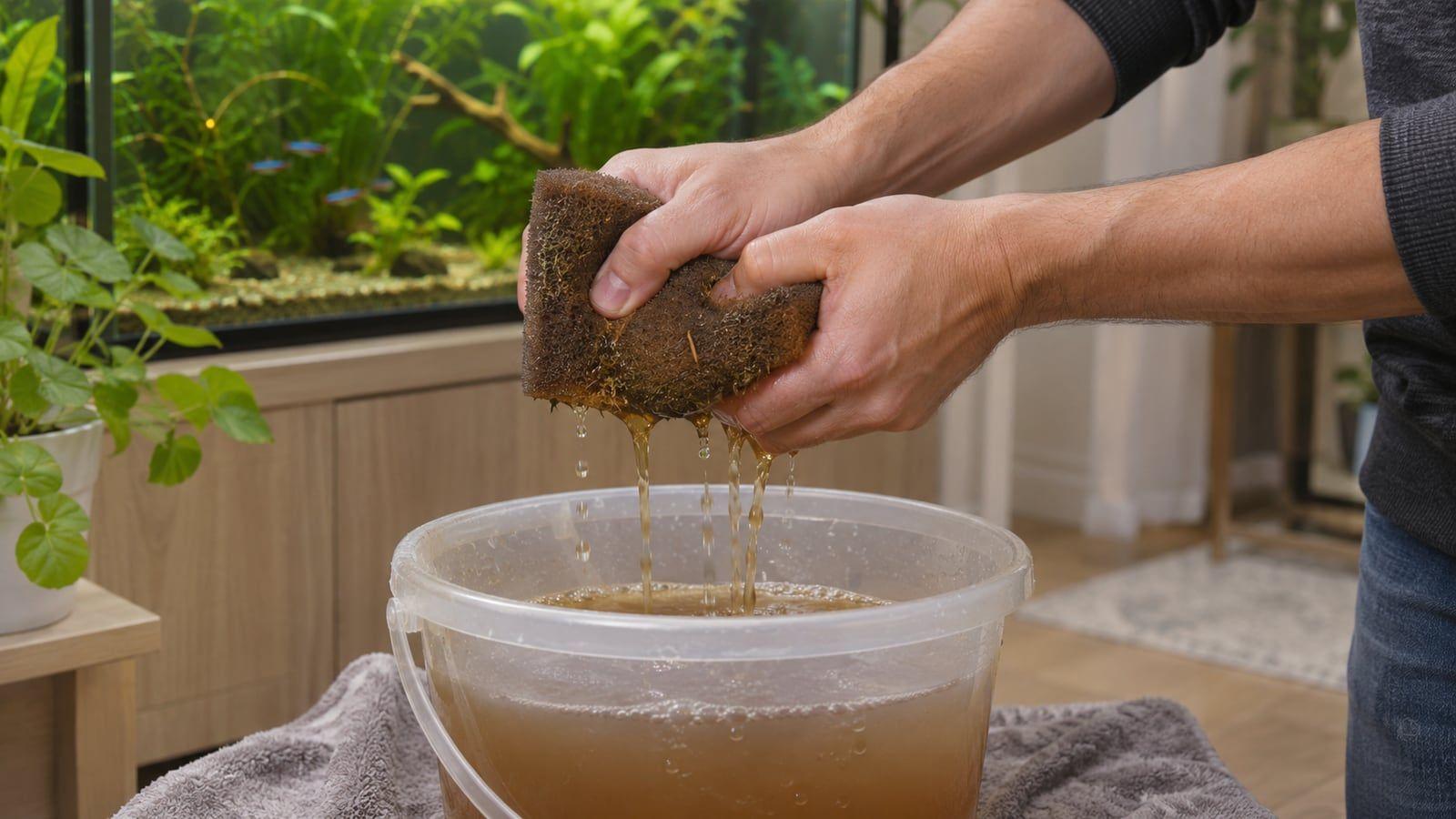
How to Clean a Fish Tank Filter Without Crashing the Cycle
How to clean a fish tank filter: old tank water, never the tap, about monthly. Steps for sponge, hang-on-back and canister filters, and the cartridge trap.
Shrimp Tank Setup: A Cherry Shrimp Tank, Step by Step
Shrimp tank setup for cherry shrimp: the tank, sponge filter, substrate and heater, the water numbers, when the cycle is done, and how many to add.