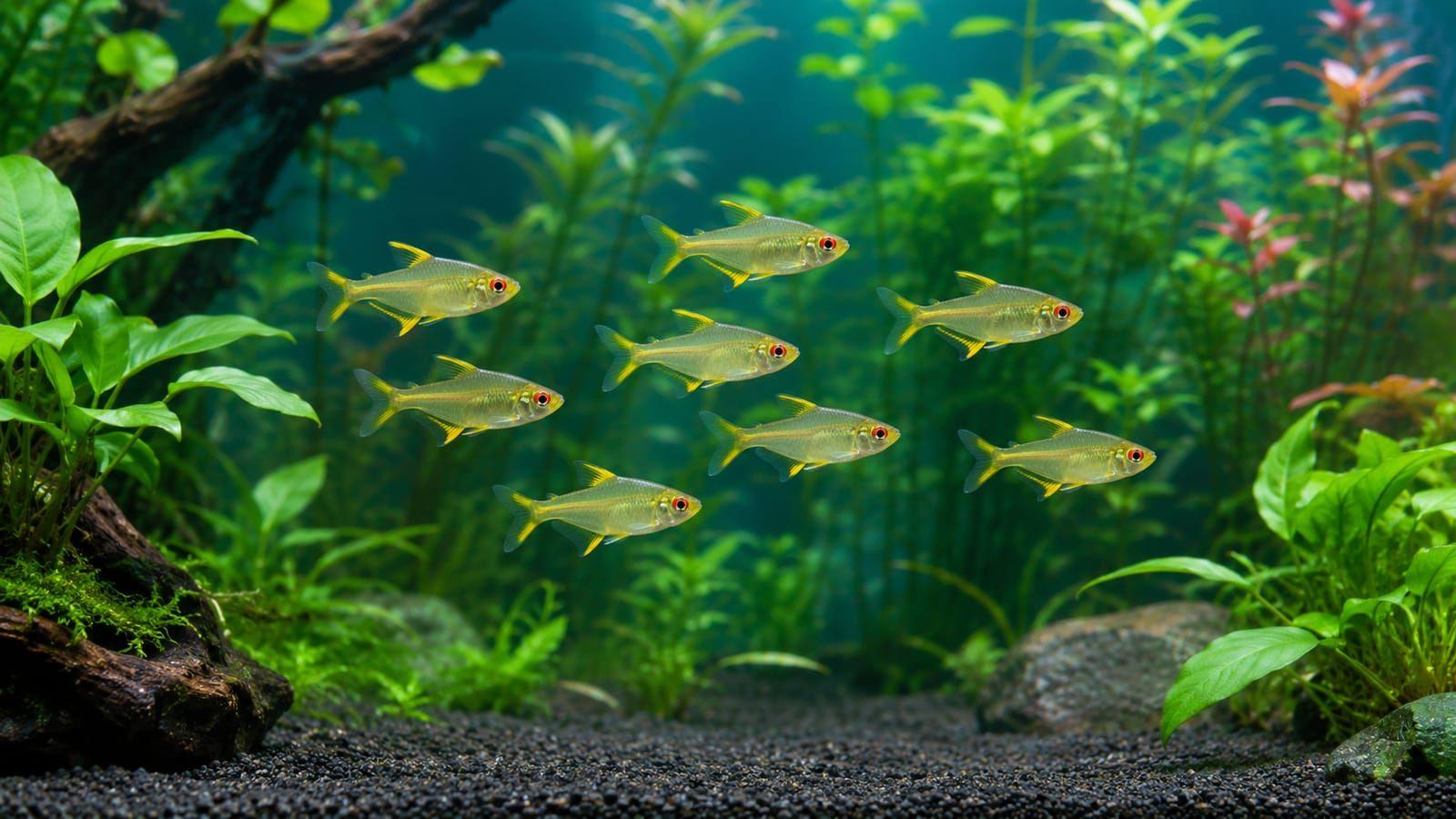
Bettas and goldfish manage a week with no harm and survive about two, weakened. Fry need food every day, and young or sick fish no more than two or three days. Before a trip, change some water, feed normally the day before and leave nothing in the tank; past a week, use a tested feeder or a sitter. Skip feeder blocks. Based on vet-reviewed care sheets, a veterinary manual, university guidance, lab studies and keeper reports, not on our own testing.
The numbers
| Fish | Healthy adult without food | Notes |
|---|---|---|
| Betta | Up to a week with no lasting harm; survives about two, weakened | Young, sick or old: no more than two or three days |
| Goldfish in a tank | A week with no harm; usually survives about two | Young (under about three inches): two or three days at most |
| Pond goldfish in cold water | All winter below about 50°F | They stop eating; do not feed them in the cold |
| Small tropical fish (tetras, rasboras, guppies, platies, mollies, danios) | About a week in a clean, cycled tank | Small and warm, so less in reserve. Vet range, not a measured figure |
| Corydoras and other bottom-feeders | About a week | Do not count on leftovers; they need food that reaches the bottom |
| Algae grazers (otocinclus, bristlenose plecos) | About a week in a mature tank with algae (keepers' expectation) | Less in a new, clean tank. Newly bought otos often arrive underfed |
| Angelfish and larger community fish | About a week | More reserves than small fish |
| Cherry shrimp | A week or two in a mature, planted tank (keepers' expectation) | Adults have not been measured |
| Fry | Not safe to skip | Several small meals a day; a feeder or sitter for any trip |
Most healthy adult aquarium fish can go three days to a week without food, and a weekend away needs no plan at all. Bettas and goldfish manage about a week with no harm. Fry cannot: they need feeding every day.
Surviving is not the same as unharmed. In a lab study, young adult zebrafish went three weeks without food and none died, but they stopped growing and stayed smaller than fed fish even after they were fed again. So a week is safe for healthy adults; it is not free for anything still growing. And what goes wrong on most trips is too much food (a dumped feeder, a block, a generous sitter), not too little. This page is built from vet-reviewed care sheets, a veterinary manual, a university extension sheet, lab studies and keeper reports. We have not fasted, fed or travelled with any of these fish ourselves.
How many days each kind of fish can go without food
The table above has a row for each kind of fish a beginner usually keeps. The sources do not agree on one number, so here is where ours comes from.
Chewy's vet-reviewed care sheet gives three ranges on one page: most healthy adults go "3–5 days" without lasting effect, "three to seven days" in ideal conditions, and "technically" 10–14 days, which it does not recommend. A fish vet quoted on a second Chewy page, Dr Benjamin Rosenbloom, says most adult fish "can be fine without eating for a full week, or two weeks at most". Aquarium Co-Op says healthy fish can go "a week or even more, depending on the species". The University of Florida says fish "should probably be fed at least 5 days per week", so a weekend needs nothing.
Our position: a week is the line to plan around. It sits at the top of the vet range and matches what the vets and care guides say about a full week. Past a week, arrange food.
- Bettas and goldfish have their own guides. A healthy adult betta goes up to a week with no lasting harm and survives about two, weakened: see how long a betta can go without food. A healthy adult goldfish goes a week with no harm and usually survives about two; pond goldfish in cold water go all winter. See how long goldfish can go without food.
- Small tropical fish (tetras, rasboras, guppies, platies, mollies, danios). Small fish and warm water both mean a faster metabolism, so they have less in reserve than a bigger, cooler fish. A healthy adult still handles a week in a clean, cycled tank. No study has measured any of these species; the row is the vet range applied to the group, plus keeper reports.
- Corydoras and other bottom-feeders. The same week, but do not count on leftovers to carry them. The Merck Veterinary Manual says that leaving bottom-dwellers to live on leftovers is "not an acceptable practice" and that they "should receive targeted feeding".
- Algae grazers (otocinclus, bristlenose plecos). In a mature tank with algae and biofilm, keepers expect them to keep grazing while you are away, though Chewy's vet-reviewed sheet says grazers may need more frequent meals than predators. In a new, clean tank there is almost nothing to graze. Practical Fishkeeping notes that otocinclus "often don't have access to food before transport" and "feed almost constantly", so a newly bought oto may already be underfed. Do not leave one in its first weeks.
- Angelfish and larger community fish. Bigger fish have more in reserve. Keepers report a week without trouble. Merck allows feeding "once or twice a week" only for "carnivorous fish that ingest large meals", which is not a typical angelfish, so do not read that as a licence for a fortnight.
- Shrimp and snails. Keepers expect a mature, planted tank to carry cherry shrimp through a week or two; nobody has measured adults. The detail is in what cherry shrimp eat. Snails graze the same way; what mystery snails eat covers their food.
Why fish can survive so long without food
Fish are cold-blooded, so they spend no energy keeping warm, and that is a large part of why a week is survivable. "Being cold-blooded, fish do not normally need to eat with the same frequency mammals and birds do," Dr Rosenbloom tells Chewy. Water temperature sets their pace instead. Across 69 fish species living at different temperatures, resting metabolism was about 1.8 times higher per 10 °C warmer, and about 2.4 times when one species was kept warmer (Clarke and Johnston, 1999). In plain terms, it roughly doubles with every 10 °C (18 °F). A tropical tank at 78°F runs a fish's engine faster than a cool goldfish tank, which is part of why tropical fish get less slack. The right tank temperature matters more on a trip, not less.
The best evidence for what a fast costs comes from a lab study. Researchers raised zebrafish, a small tropical fish, to about two months old, which the authors call early adulthood, then gave half of them "no food for the following 21 days". None died. But the fasted fish were "significantly smaller than fed fish by 7 days", and after feeding resumed they grew again yet "remained significantly smaller than fed fish" to the end of the experiment (Jawahar et al., 2022). The authors note that a zebrafish's fat stores take about a week to empty in young fish and up to three weeks in adults.
Those fish lived in lab tanks on a recirculating system that kept the water clean throughout, which a home tank with nobody around is not. The study does not mean fish can go three weeks. It means survival is the wrong target. Those still-growing fish were already smaller after a week; a full-grown, healthy adult has less to lose, but past a week it is spending itself.
Fry and young fish are the exception
Newly hatched fish, which keepers call fry, cannot fast. They need several small meals a day. Dr Rosenbloom, quoted by Chewy, says newly hatched fish "may need to be fed 3-8 times per day". Merck allows fry and fingerlings up to 5% of their body weight in food a day, against 3% for adults. The University of Florida says young stock need "small meals fed more frequently". Even Aqueon, which sells vacation feeders, says virtually all fish can go a weekend unfed "short of newly hatched fry".
Lab studies give the only measured numbers. Labs usually give zebrafish larvae their first food at 5 days old. Delaying the first meal to day 8 did no harm, but at day 9 survival fell from over 90% to 66% (Hernandez et al., 2018). In larvae that were never fed, two-thirds were dead by day 15 (Voskarides et al., 2022). For fry, the margin is days, not weeks.
Young fish past the fry stage get a little more room, as the betta and goldfish guides say: young bettas under about four months and young goldfish under about three inches should not go more than two or three days without food. Sick fish and fish recovering from illness follow the same rule; Aquarium Co-Op says they "need regular feedings to help with the recovery process". For how often growing fish eat, see how often to feed goldfish.
If fry turn up in a community tank before a trip, which happens with a pregnant guppy, they need a tested feeder or a sitter every day.
Going on vacation: what to do for each length of trip
These are the same four bands as the betta and goldfish guides, applied to healthy adult fish in a clean, cycled tank.
| Time away | Healthy adult fish | What to do |
|---|---|---|
| 1–3 days | No effect | Nothing. Feed normally the day before |
| 4–7 days | Fine; hungry when you return | Water change 1–2 days before; leave no food in the tank |
| 8–14 days | Most survive, but lose condition | A tested automatic feeder, or a sitter with set portions |
| Over 2 weeks | Risk of starvation and water problems | Someone must feed the fish and check the tank |
| Any trip, with fry | Cannot go without | Daily feeding by feeder or sitter |
For small tropical fish, the 4–7 day band sits at the top of the vet range. Before a trip of any length:
- Do a 25–30% water change one or two days before you leave, so the water is clean and you have time to notice if something went wrong.
- Check the heater is working. A heater that fails while you are away is a bigger risk than hunger.
- Feed the normal amount the day before. Do not feed extra: fish cannot store it, and the leftovers rot into ammonia.
- Put the light on a timer, or leave it off. A week with the light on all day grows algae.
- Remove any uneaten food before you go.
- Do not deep-clean the filter right before leaving. If the sponge is clogged, rinse it in a bucket of old tank water, never tap water. The method is in how to clean a fish tank filter.
Leftover food matters most in a small tank, where there is less water to dilute what it turns into. If you keep a 5 gallon tank, the "leave nothing in" rule matters even more.
Why vacation feeder blocks are a risk
A vacation feeder block is food set in a block that slowly dissolves in the water; Chewy describes the food as embedded in "gel or a calcium block". The calcium kind is the hard, plaster-like one. The trouble is not hunger. It is the water.
Aquarium Co-Op says feeder blocks "have the tendency to cause ammonia spikes and algae blooms when used during vacations". Dr Jessie Sanders, quoted on Chewy's vacation page, says they "tend to be low in nutrition and can severely foul your water". Many fish do not recognise a block as food, so it dissolves uneaten and everything in it ends up in the water. Keepers report the same pattern: one on Monster Fish Keepers remembers a block leaving the tank cloudy, with dead fish. Gel blocks are a different design, and we found no test of them either way, but they still add food you cannot take back out.
Our position, as in the betta and goldfish guides: skip them. An empty tank is safer than one with a block in it.
Automatic feeders and sitters
Automatic feeders suit trips of 8 to 14 days, if you test them. Set the smallest portion and run the feeder for a week while you are still home. They fail both ways. A feeder that jams leaves fish hungry, which a healthy adult can handle for a week; keepers report one feeder clogging with condensation, with the fish fine at the end. One that keeps dispensing, or dumps its hopper, fouls the tank. Chewy's vacation page points out that a feeder keeps dispensing even if the fish stop eating, and Dr Rosenbloom advises setting it to "the minimum amount of food you think your fish needs to get by". Dr Veronica Pardini, quoted on Chewy's main care sheet, says overfeeding is a bigger danger than underfeeding.
Sitters work if you control the portions. Aquarium Co-Op says sitters overfeed because "the fish looked hungry", and tells them not to make up a missed day with extra food. Put each day's portion in a pill organiser, one compartment per day, and ask them to give only that. A sitter who only checks the tank is still useful: a failed heater or filter does more harm than hunger. Dr Jessie Sanders, quoted by Chewy, suggests visits "every other day, every few days, or if they can, every day".
When you come back
Look before you feed. Count the fish, and check for cloudy water or a smell. If anything looks off, do a water change before anything else. Then feed a normal or slightly smaller meal. Do not try to make up for the missed days with a big one: the fish cannot finish it, and the leftovers foul the water, the same reason Co-Op gives for telling sitters not to double up. Return to normal feeding the next day.
A fish that will not eat after you return is a different problem from one that was not fed. Start with the water, then see a fish lying on the bottom of the tank.
The short version
A weekend needs nothing. A week is fine for healthy adults in a clean tank: change some water, feed normally the day before, leave nothing in. Past a week, a tested feeder or a sitter. Fry, every day. Skip the blocks.
Sources
- Chewy (2025). How Long Can Fish Go Without Food? 5 Ways to Keep Your Underwater Friend Safe on Vacation. Kate Barrington, reviewed by Ivan Alfonso, DVM; quotes Veronica Pardini, DVM, and Robert Martinez, DVM; updated 3 November 2025, read 24 November 2026. A retailer's guide, cited by title.
- Chewy (2025). All The Different Ways to Feed Fish While On Vacation. Samantha Schwab; quotes Jessie Sanders, DVM, CertAqV, and Benjamin Rosenbloom, DVM; updated 30 April 2025, read 24 November 2026. A retailer's guide, cited by title.
- Petty, Francis-Floyd and Yanong. Nutritional Diseases of Fish. Merck Veterinary Manual (professional version).
- Francis-Floyd (revised 2022, reviewed 2025). Fish Nutrition. UF/IFAS Extension VM114 (FA096).
- Aquarium Co-Op. How to Care for Your Aquarium Fish When You Are Going Out of Town. A retailer's guide.
- Aqueon. Traveling? Here's How to Prep Your Aquarium Before You Go. A manufacturer of feeders and feeder blocks; used only for its fry line.
- Jawahar, McCumber, Lickwar et al. (2022). Starvation causes changes in the intestinal transcriptome and microbiome that are reversed upon refeeding. BMC Genomics 23: 225.
- Hernandez, Galitan, Cameron, Goodwin and Ramakrishnan (2018). Delay of Initial Feeding of Zebrafish Larvae Until 8 Days Postfertilization Has No Impact on Survival or Growth Through the Juvenile Stage. Zebrafish 15(5): 515–518.
- Voskarides, Koutsofti and Pozova (2022). TP53 Mutant Versus Wild-Type Zebrafish Larvae Under Starvation Stress: Larvae Can Live Up to 17 Days Post-Fertilization Without Food. Zebrafish 19(2): 49–55.
- Clarke and Johnston (1999). Scaling of metabolic rate with body mass and temperature in teleost fish. Journal of Animal Ecology 68(5): 893–905.
- Bob Mehen. Should I fatten these Otocinclus catfish up? Practical Fishkeeping.
- Alison Page (2023). How long can fish go without food? Aquariadise. A hobby blog, used only for fish ignoring feeder blocks.
- Keeper reports: Monster Fish Keepers, "How long with no food" (2008); Monster Fish Keepers, "Vacation for about a week" (2007); fishforums.net, "Back from holiday" (2005).
Questions people ask
Mentioned in this guide
Related guides
How Long Can a Betta Go Without Food? A Week Is Fine, Two Is Not
A healthy adult betta can go about a week without food, and survives up to two. How to plan a trip, which feeders to avoid, and why a betta stops eating.
How Long Can Goldfish Go Without Food? Up to Two Weeks
A healthy adult goldfish can go a week without food easily and survives about two. How to prepare for a trip, why feeder blocks backfire, and ponds in winter.
Best Food for Betta Fish: Picks by Size, With Label Data
The best food for betta fish is a betta pellet sized to its mouth. Six picks compared on label protein and pellet size, plus how many to feed a day.