Rinse new sand in small batches until milky water turns cloudy, and pour it into an empty tank. Keep plain sand 1 to 2 inches deep and never wash the whole bed. Based on makers' instructions, a fish vet's care page and keeper reports, not our own testing.
The numbers
| Job | How | How often | Watch out for |
|---|---|---|---|
| Rinse new sand | A few pounds in a bucket under the tap; stir, pour off, repeat | Once, before it goes in | Stop at cloudy, not milky; skip live sand and products the maker says not to rinse |
| Add it to the tank | Wet sand into the empty tank, water poured onto a saucer | Once | A haze for 24–48 hours is normal |
| Stir the top layer | Chopstick or fingers through the top inch | Weekly, before vacuuming | Reach the corners and the sand behind rocks |
| Vacuum the surface | Tube about an inch above the sand; lower until waste lifts and sand falls back | A third of the floor at each weekly water change | Lift the tube or pinch the hose if sand reaches it |
| Spot clean | Turkey baster on dropped food or waste | As needed | Keep the baster for the tank only |
| Corydoras, trumpet snails | Sift and burrow on their own | Every day | They help; they never replace the vacuum |
| Replace or top up | Swap 5–10% a week, or mix in a cup a day | Rarely | Never wash the whole bed or layer new sand on top |
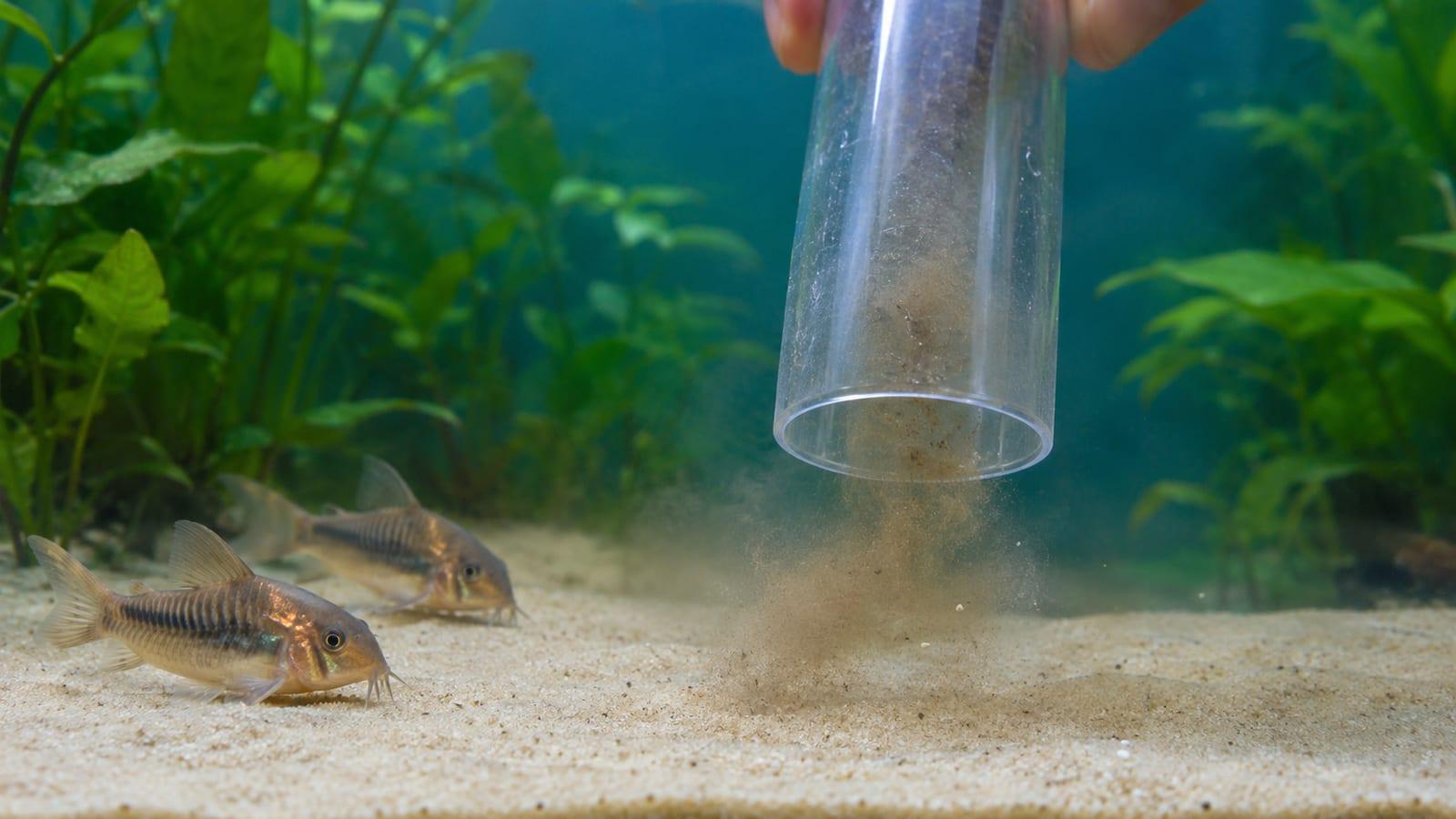
To clean aquarium sand, hover the gravel vacuum just above the surface instead of pushing it in, so the waste lifts and the sand falls back. Stir the top inch first. Rinse new sand in a bucket until milky water turns cloudy.
The gravel method, pushing the tube into the substrate and letting the stones drop back, fails on sand because the grains are light enough to ride up the tube into the bucket. Waste also sits on top of sand instead of sinking into it, so there is nothing to dig for. Do it at the weekly water change, over about a third of the floor; the rest of the routine is in how to clean a fish tank. This page is built from sand and siphon makers' instructions, a fish vet's care page, a species database, hobby-magazine practice, water-quality data and keeper reports. We have not tested these methods, and the table above is that evidence turned into a routine.
Why sand needs a different method from gravel
Geologists call grains under 2 mm sand; gravel starts at 2 mm (USGS, on the Wentworth scale). A gravel vacuum works on gravel because the stones are too heavy to ride up the tube: they tumble, shed their dirt and drop back. Sand does not drop back. Practical Fishkeeping's Nathan Hill puts it plainly: "A gravel cleaner and syphon will just lift the sand out of the tank."
Sand also packs tight. In groundwater tables published by the Minnesota Pollution Control Agency, water moves through fine sand hundreds of times more slowly than through gravel (typical values of 5×10⁻⁶ m/s against 3×10⁻³ m/s). Those figures are for natural ground, not a fish tank, but two consequences carry over:
- Waste stays on the surface, where the tube can reach it without digging.
- Little fresh water reaches the lower layer, so a deep, fine bed that nothing stirs can lose its oxygen.
That is the whole method: lift the waste off the top, and stir so the bed below does not go airless.
Before use: how to rinse new aquarium sand
Bagged sand carries fine dust that turns the water milky. Wash it out in a bucket, not in the tank.
- Check the bag first. CaribSea, a sand maker, names three of its products (Aragalive, Eco-Planted, Eco-Complete Cichlid) that are not rinsed, and Bulk Reef Supply, a reef retailer, says live sand never is. Everything else gets rinsed, including sand labelled pre-washed: "Even if it says it was pre-washed, it will still carry some dirt" (Bulk Reef Supply). For plant soils, follow the bag; the substrate guide covers them.
- Use a clean bucket that has never held soap or cleaning products. Put in a few pounds at a time, as CaribSea says. Practical Fishkeeping uses 5–8 cm (2–3 in) of sand per bucket and Bulk Reef Supply fills it a third full; small batches rinse faster than a whole bag.
- Run cold tap water in and stir hard with your hand. Practical Fishkeeping: "stir continuously and vigorously while flushing with cold water." Pour off the dirty water, keep the sand, and repeat.
- Stop when the water is cloudy rather than milky. That is CaribSea's standard: rinse "until it turns from milky to cloudy."
- Tap water is fine for rinsing. New sand has no bacteria to protect yet. The conditioner goes in with the water you fill the tank with; see how to dechlorinate tap water.
- Put the wet sand into the empty tank and level it, then pour the water in onto a saucer or your hand. CaribSea: "Pouring sand through the water column can cause unnecessary cloudiness."
- Start the filter and wait. CaribSea says that, depending on the product, a tank should "begin to clear within hours and be completely clear in 24 to 48 hours".
Where the sources disagree. Bulk Reef Supply says "It may take 10 or more rinses before the sand is clean and the water remains clear." CaribSea, which makes the sand, says to stop at cloudy because once the tank is running, "any remaining haziness will be removed" by the filter. We follow the maker. Rinsing until the bucket runs perfectly clear costs a lot of time and water for a haze the filter clears in a day or two.
Adding sand to a tank that already has some? Mix it in, do not lay it on top. CaribSea suggests "about a cup of sand per day into the existing bed" and warns: "Do not cap off an old bed with new sand as it can cause another cycle."
How to clean aquarium sand in a running tank
Do it during the weekly water change, 25% each week, over about a third of the floor, so the whole bed is covered every three weeks. Starting the siphon, the bucket and the refill are in the water change guide. Its checklist pushes the tube into gravel; on sand, swap that one step for the steps below.
- Stir first. Run a chopstick or your fingers through the top inch of the third you are about to clean. Waste and brown film lift into the water. Practical Fishkeeping's Hill rakes his fingers through his sand weekly; Swell UK's Jeremy Gay says to rake the bed, "turning it over and dislodging dirt and debris."
- Hold the mouth of the tube about an inch (2.5 cm) above the sand. Lower it slowly until the waste lifts and the sand swirls up and drops back. Swell UK describes the aim: the sand is "lifted, cleaned and dropped back down."
- If grains reach the hose, lift the tube. Keepers also slow the flow by pinching or kinking the hose, or with a finger over the end of the tube.
- Move a tube's width at a time across that third. Next week, do the next third.
- Keep the tube off plant roots. Anubias and java fern rhizomes should sit on top of the sand, never under it; if sand has drifted over one, fan it off (java fern, anubias).
- In a shrimp tank, check the bucket for baby shrimp before you tip it out.
How high to hold the tube is not agreed, and no source measures it. Keepers on the Aquarium Co-Op forum say to work over the sand, not in it; Swell UK and Pond Planet say "slightly higher" than for gravel; Practical Fishkeeping's Hill says "I skim just above the surface of the sand." An inch is our starting point, not a figure any of them gives. The real test is the sand: if it falls back, the height is right. Some keepers cut the tip of the tube at an angle, which they report picks up more surface waste and less sand.
Between water changes, keepers lift a dropped wafer or a dead snail with a turkey baster kept only for the tank.
Cleaning fish tank sand without a vacuum
Stir the top inch so the waste rises, let the filter catch what floats, and take the water out with a jug at the water change. Keepers on FishLore describe turning the sand over by hand at each water change.
It is not a full replacement. Jessie Sanders, a fish vet writing for PetMD, says "A gravel siphon removes waste buildup from substrate, which is essential for keeping your tank clean," and "Simply stirring substrate is not enough." Waste you stir up is still in the tank until it leaves with the water. Stirring without a siphon only works alongside regular water changes.
Bubbles, black patches and gas pockets in the sand
Where no oxygen reaches, bacteria make hydrogen sulphide, the gas that smells of rotten eggs. A report filed with the US EPA describes it as forming "where biological and/or chemical oxygen demand exceeds the available dissolved oxygen". It is toxic at tiny concentrations: the EPA's long-standing water-quality criterion is 2 micrograms per litre of undissociated hydrogen sulphide. That is a limit for wild waters, not a measurement from any aquarium.
In a tank, the place it forms is deep, fine, compacted sand that nothing stirs. Swell UK's Gay: "Fine sand can compact and turn black if not cleaned regularly," the black coming from anaerobic bacteria "producing a rotten smell". Practical Fishkeeping says fine silver sand "Cannot be used for deep substrates as it can turn anaerobic."
How deep, then? Gay says beds over 2.5 cm (1 in) are "more prone to compacting and turning anaerobic", but gives no source for the figure, and the site's planted substrate guide slopes deeper for planted gravel. For plain sand we say about 1 to 2 inches (2.5–5 cm), stirred weekly: shallow enough that the weekly chopstick reaches most of it. For planted tanks, follow the substrate guide instead. How much a fish tank weighs shows what an inch of substrate weighs.
How worried to be. A few small bubbles when you stir release too little to matter, and the smell is the only effect. Stir that spot more often. One hobby site, aquariumscience.org, goes further: it says aquariums never produce poisonous quantities, and that its own year-long bucket tests of deep sand beds made no hydrogen sulphide. Those are one hobbyist's tests, described on the site but not peer reviewed or repeated, so this page does not rely on them. Nobody has measured how much gas stirring an aquarium sand bed releases.
A bed that stinks across the whole tank, or has turned black right through, needs more than stirring; see why a fish tank smells. A dark, slimy sheet lying on top of the sand is something else, usually cyanobacteria.
Do corydoras and trumpet snails keep sand clean?
Corydoras sift the top of the sand for food, but they are a reason to keep it clean, not a cleaning crew. Seriously Fish says to "ensure the substrate is kept scrupulously clean," because "These cats are sensitive to poorly-maintained or dirty substrates and can lose their barbels if kept in poor conditions." They also need food of their own: Pond Planet says to "make sure you still regularly feed them sinking food designed for the species."
Malaysian trumpet snails burrow through the bed. The Freshwater Gastropods of North America project: "The snails tend to burrow into the substrate by day and emerge to graze by night." Aqueon says that foraging keeps the substrate "aerated". That is a maker's claim; nobody has measured how much air snails work into sand. The same Aqueon page calls them "the primary culprit for overpopulating an aquarium", and most populations reproduce without males, so one snail can start a colony. If you already have them, let them work. Do not add them for this unless you are happy with a lot of them; trumpet snails are hard to thin out.
Neither replaces the weekly stir and hover.
Mistakes that make sand worse
- Pushing the tube in like gravel. It is the right move for gravel and the reason sand ends up in the bucket. Aquarium Co-Op's general siphon guide says "Push the siphon into the gravel or sand"; on sand, hover instead.
- Taking all the sand out to wash it. As the detritus worm guide says, "Removing and washing the substrate destroys a large part of your bacterial colony and starts your nitrogen cycle over." If sand has to go, CaribSea replaces "only about 5 to 10% of the substrate per week" and warns "the biological filtration will be impacted somewhat for the next 4 to 6 weeks". Practical Fishkeeping, which siphons sand out to rinse and return it, limits that to 25% of the sand at once. We follow CaribSea's slower pace.
- Pouring new sand on top of old. Mix it in a cup at a time (CaribSea).
- A deep bed nobody stirs. See the gas section above.
- Letting sand into the filter. Keepers report sand drawn into a hang-on-back intake reaching the impeller and stopping the filter. Keep the intake well above the sand and fit an intake sponge.
- Everything on one day. Vacuuming all the sand, rinsing the filter and scrubbing the decorations in one session removes a large share of the bacteria at once. A third of the sand each week, the filter once a month; how to clean a fish tank spreads out the rest.
The short version
Rinse new sand until milky turns cloudy and put it into an empty tank. After that, stir the top inch and hover the vacuum over a third of the floor each week. Keep plain sand shallow, and never wash the whole bed.
Sources
- CaribSea. FAQ. Sand manufacturer.
- Bulk Reef Supply. How to Clean Sand or Gravel for the Aquarium. A reef retailer's guide, updated 22 April 2022.
- Hill. How clean is your bottom? Practical Fishkeeping, undated.
- Gay. How to clean aquarium sand. Swell UK, a retailer's blog, undated.
- Pond Planet. How to Clean Aquarium Sand. A retailer's blog, 15 December 2021.
- Sanders, DVM. How To Clean a Fish Tank. PetMD, 7 May 2026.
- Seriously Fish. Corydoras sterbai. Species profile.
- Freshwater Gastropods of North America. Melanoides tuberculata. Species account.
- Aqueon. Types of Aquarium Snails. Manufacturer's article.
- Minnesota Pollution Control Agency. Aquifer hydraulic properties. Minnesota Stormwater Manual. Groundwater figures for natural sediments.
- US Geological Survey. Sediment nomenclature. Open-File Report 2006-1046.
- Weston Solutions (2006). Site-Specific Sulfide Criterion for Produced-Water Discharges at Five California OCS Platforms. Technical report submitted to US EPA Region IX on behalf of an offshore oil producer.
- aquariumscience.org. Anaerobic myth and Anaerobic science. One hobbyist's own tests, not peer reviewed.
- Aquarium Co-Op. How to Use a Gravel Vacuum to Clean Aquariums. A retailer's guide, undated.
- Keeper reports: Aquarium Co-Op forum, Do you guys vacuum your sand? How often? Why?, What's the most efficient way to clean light sand substrates? and Sand in my AquaClear 50; FishLore, How do I clean the sand in tank?; Monster Fish Keepers, Turkey baster to spot clean sand and threads on sand in filters.
Questions people ask
Mentioned in this guide
Related guides
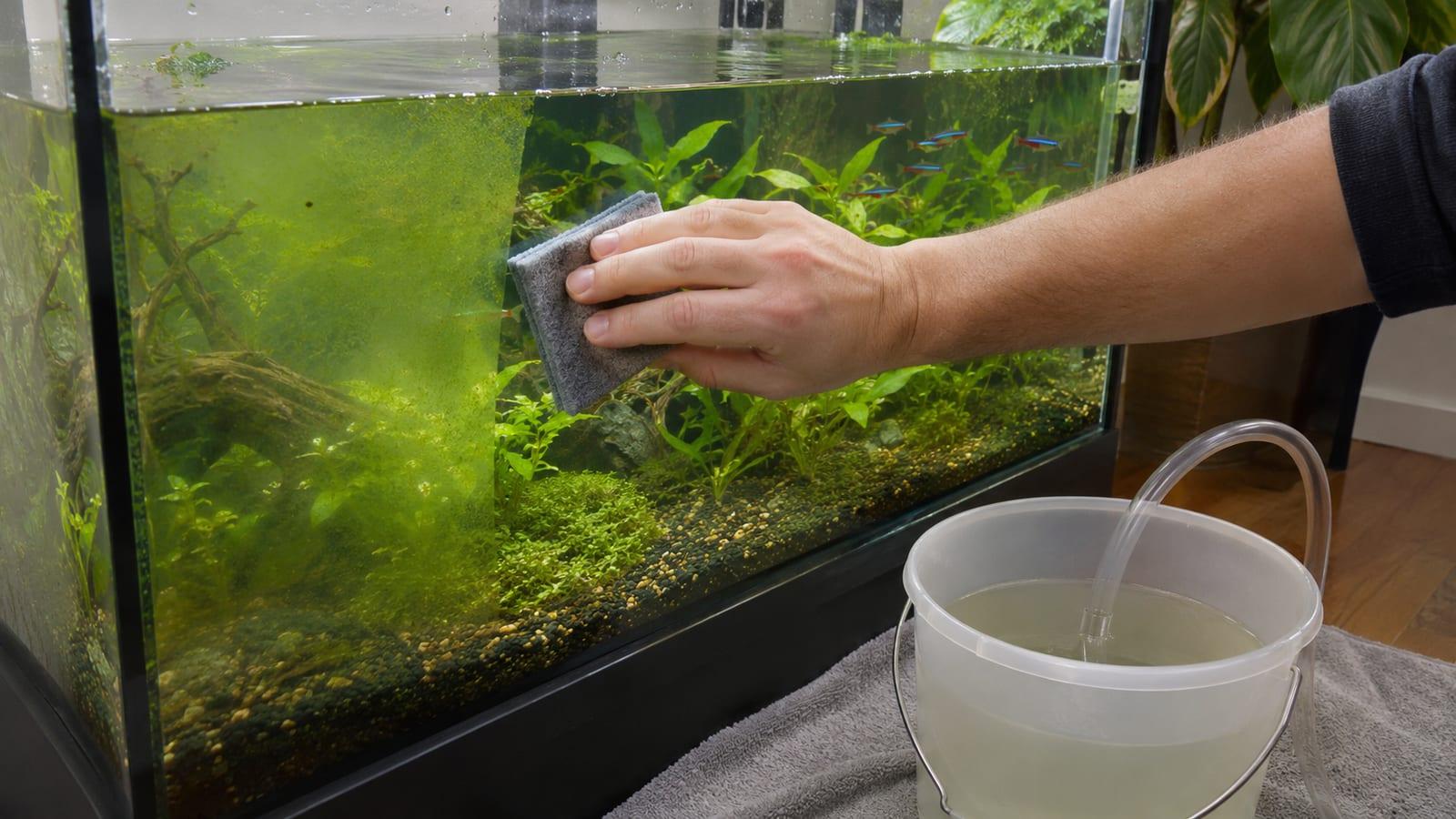
How to Clean a Fish Tank, and How Often to Clean Each Part
How often to clean a fish tank, job by job: water and front glass weekly, the filter monthly, decorations when dirty, and the full clean you should skip.
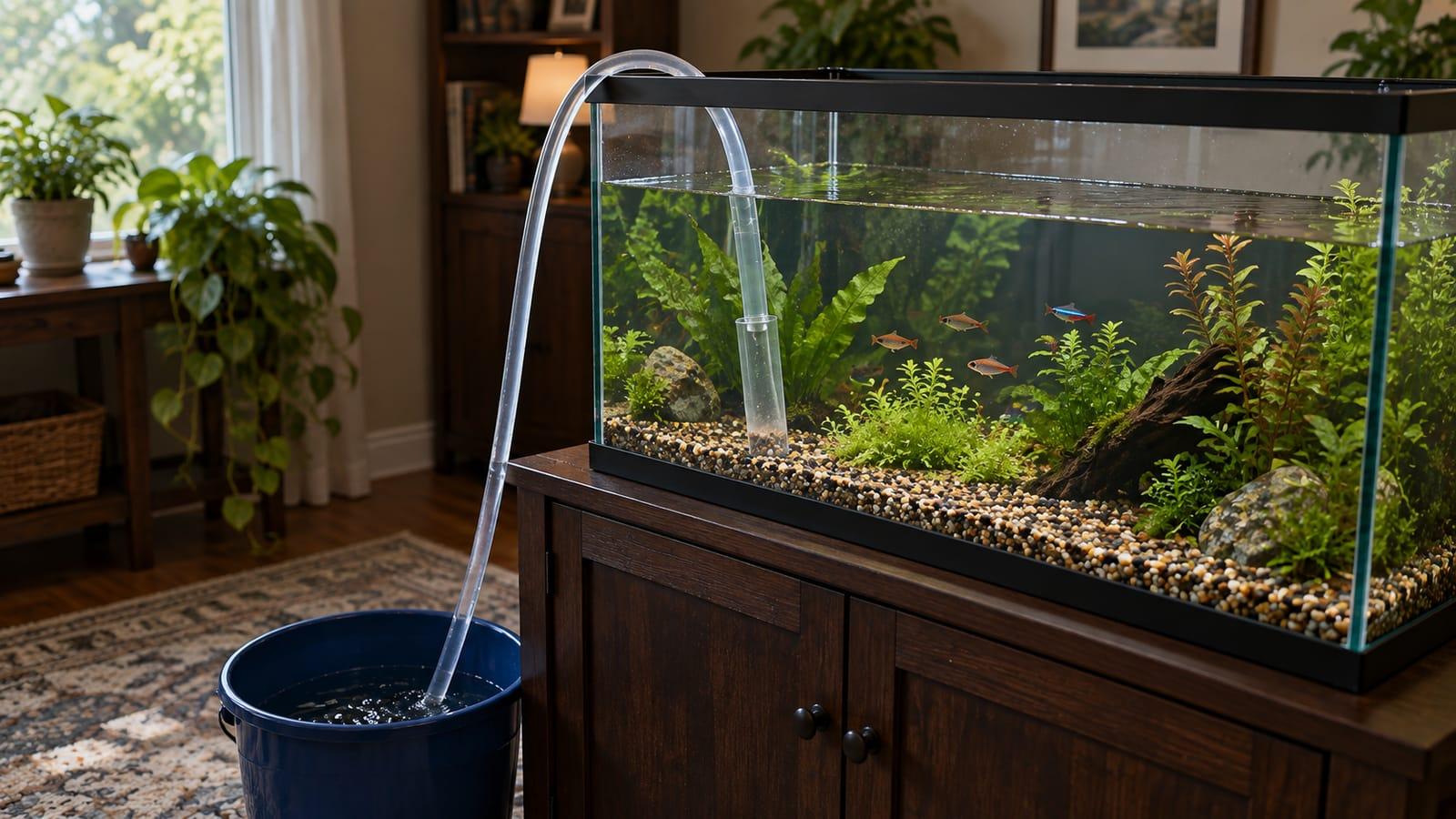
How to Change Fish Tank Water, and How Often to Do It
How to change fish tank water: replace 25% once a week, with new water dechlorinated and matched to within 2°F. The steps, and how to set your own schedule.
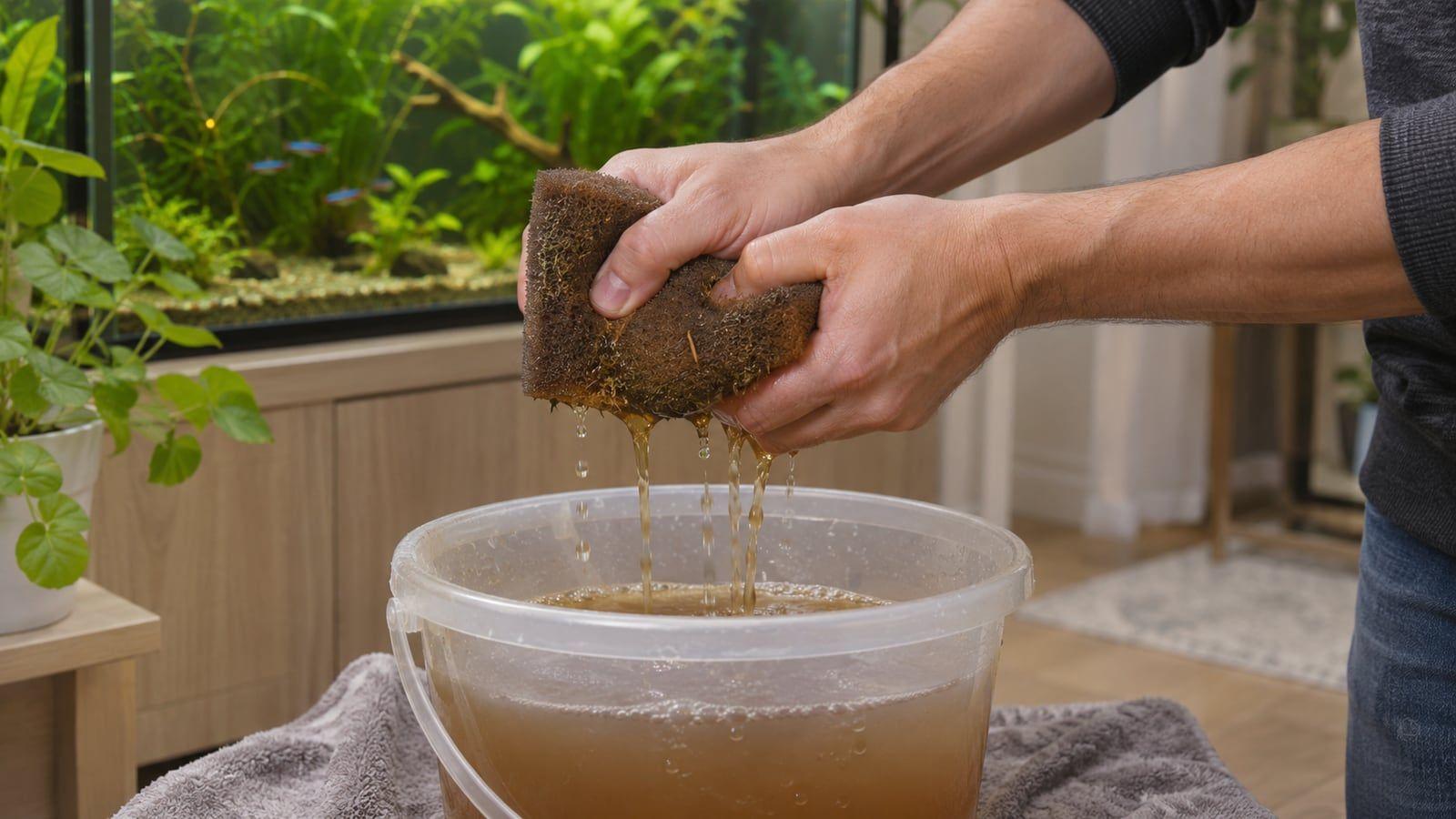
How to Clean a Fish Tank Filter Without Crashing the Cycle
How to clean a fish tank filter: old tank water, never the tap, about monthly. Steps for sponge, hang-on-back and canister filters, and the cartridge trap.